Technical Knowledge
What is the working principle of concrete laser leveling machine?
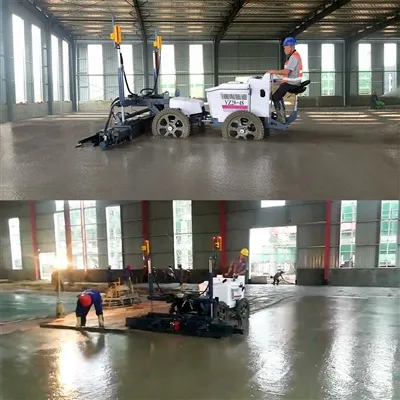
The concrete laser leveling machine is an advanced equipment that uses laser technology for ground leveling. Its working principle mainly includes the following aspects:
1. Laser transmitting and receiving:
The leveling machine is equipped with a laser transmitter, which emits a precise laser beam. At the same time, a laser receiver is installed on the leveling head of the leveling machine to receive and process these laser signals.
2. Real-time adjustment and control:
The laser receiver will process the received laser signals in real time and perform precise adjustment and control based on these signals. The leveling head will automatically adjust its height and position according to the guidance of the laser signal to ensure the accuracy of the leveling process.
3. Movement and leveling work of the leveling head:
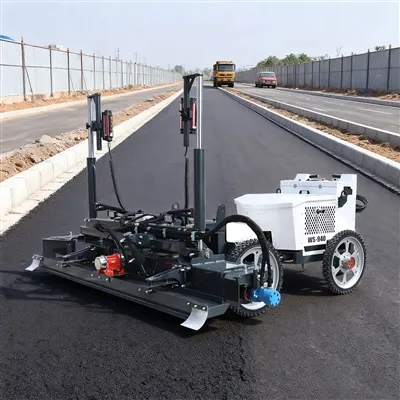
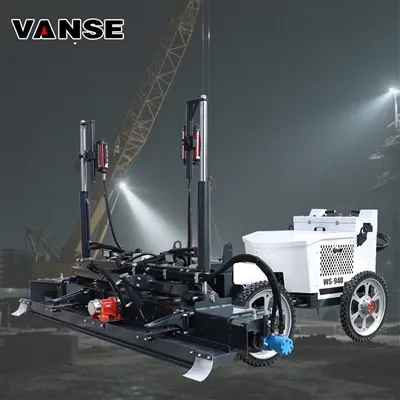
The leveling head moves under the drive of the leveling machine. It is equipped with scrapers, spirals, vibrating plates and other components. During the leveling process, these components work together to complete the initial leveling, vibrating and leveling of the concrete.
4. Computer control system:
The leveling machine is equipped with a computer control system for monitoring and controlling the entire leveling process. This system can adjust leveling parameters such as leveling speed, vibration frequency, etc. as needed to ensure the optimization of the leveling effect.
5. Control of floor elevation:
A significant feature of the laser leveling is that it can break away from the traditional mode of controlling the floor elevation by construction templates. Through the laser control system, the leveling machine can accurately control the elevation of the floor, greatly reducing manual errors and improving construction speed and accuracy.
To sum up, the working principle of the concrete laser leveling machine is mainly to achieve precise leveling of the ground through laser technology. It uses laser transmitters and receivers for precise measurement and control. Through the movement and leveling work of the leveling head, combined with the monitoring and adjustment of the computer control system, it achieves efficient and precise leveling of the concrete floor. This technology has greatly improved construction efficiency and quality, and has become one of the important equipment in modern floor construction.
Thanks to All the Friends Who Support and Trust Shandong Vanse Machinery Technology Co., Ltd.
If you want to know more about Shandong Vanse Machinery Technology Co., Ltd. or have any questions, please feel free to contact us:
Our Factory
Shandong Vanse Machinery Technology Co., Ltd.








Share this article

About the Author: Shandong Vanse Machinery Technology Co., Ltd.
Shandong Vanse Machinery Technology Co., Ltd. is a high-tech manufacturer specializing in concrete construction machinery, including laser screeds and related equipment. The company integrates R&D, production, and global sales, with products exported to over 60 countries and widely used in infrastructure projects worldwide.
Previous Post
Next Post
Related Articles
You Might Also Like
How to consider its practicality and ease of use when purchasing a laser receiver?
When purchasing a laser receiver, it is important to consider its practicality and ease of use. This is not only related to the performance of the equipment in daily work, but also affects the operator's experience and efficiency. Here are some specific considerations and suggestions regarding practicality and ease of use when purchasing a laser receiver: ◇◇◇ Practical considerations ◇◇◇ Application scene matching: First of all, it is necessary to clarify what scene the laser receiver will be used in. Different scenarios may require different performance parameters and features. For example. 1. Laser receivers in industrial environments may require stronger anti-interference capabilities and higher stability. 2. Performance requirements: According to the application scenario, determine the required performance parameters, such as receiving sensitivity, dynamic range, wavelength compatibility, etc. These parameters directly affect the practicality and working effect of the laser receiver. 3. Durability and reliability: Consider the durability and reliability of the equipment to ensure that it can operate stably for a long time in harsh working environments. Understand the materials, workmanship, and protection levels of your equipment to ensure it meets the needs of the actual application. 4. Compatibility and scalability: Consider the compatibility of the laser receiver with existing systems and possible future scalability. This helps ensure that the device integrates smoothly into existing systems and accommodates possible future technology upgrades and expansion needs. 5. Technical support and after-sales service: Understand the supplier's technical support and after-sales service policies. A good technical support and after-sales service team can help solve problems during use and ensure the continued stable operation of the equipment. ◇◇◇ Ease of use considerations ◇◇◇ 1. Operation interface and instructions: Ensure that the operation interface of the laser receiver is concise and clear, and the instructions are clear and easy to understand. This helps operators quickly become familiar with the equipment and reduce operational difficulty and error rates. 2. Installation and maintenance: Considering the difficulty of installation and maintenance of the equipment, the installation process of the equipment should be simple and clear, and the maintenance should also be convenient and fast, which will help reduce downtime caused by installation and maintenance problems. 3. User manual and training materials: Suppliers should provide detailed user manuals and training materials to help operators better understand and use the equipment. These materials should include basic operation of the equipment, performance parameters, FAQs, etc. 4. Training and technical support: Suppliers should provide necessary training and technical support to help operators better master the use skills and maintenance methods of the equipment. This ensures that the device will perform optimally in real-world applications. ◇◇◇ Comprehensive suggestions ◇◇◇ 1. Trial and evaluation: Before purchasing, strive for trial opportunities as much as possible to conduct a practical evaluation of the performance and ease of use of the laser receiver. This helps provide a more accurate picture of how the equipment will perform in actual work. 2. Refer to user feedback and reviews: Check the feedback and reviews of other users to understand the actual use of the device. This helps identify potential issues and deficiencies, allowing for more informed purchasing decisions. 3. Communicate with suppliers: Establish good communication channels with suppliers to understand the performance characteristics, usage skills and maintenance methods of the equipment. Maintaining close contact with suppliers can ensure timely technical support and assistance during use. To sum up, when purchasing a laser receiver, it is very important to consider practicality and ease of use. By clarifying application scenarios, understanding performance requirements, evaluating durability and reliability, considering compatibility and scalability, paying attention to technical support and after-sales service, and paying attention to operating interfaces and instructions, you can ensure that you purchase a laser that is both practical and easy to use. receiver. This will help improve the overall performance and user experience of the device, bringing convenience and efficiency to actual work.What are the main differences in operation processes among different types of concrete laser leveling?
The four types of concrete laser leveling machines you mentioned represent typical models with different levels of automation and functionality. The main differences in their operation processes lie in several core links such as equipment positioning, elevation control, travel mode and construction scope. Now let's break down the unique operation process of each model one by one. To understand more intuitively, we can compare their differences in key operation links through the following table: Operation link Walk-behind type Four-wheel drive Four-wheel telescopic arm type Remote-controlled four-wheel telescopic arm type 1. Equipment positioning and movement Manual traction consumes a lot of physical effort from the operator and the movement is not precise. Cab operation, like driving a car, requires moving on a leveled or solid ground. The cab operates the movement, but the flat head is precisely positioned at a distance through the telescopic boom. The remote control operates the movement, allowing the operator to stand at the best observation point. 2. Control of a flat hairstyle The flat head is integrated with the main unit and moves along with it. The flat head is usually fixed at the front or bottom of the fuselage and moves along with the body. The flat head is separated from the main unit and controlled independently by a multi-section telescopic arm. The flat head is separated from the main unit and controlled independently by a multi-section telescopic arm. 3. Elevation and slope control It relies on manual adjustment by the operator and requires extremely high levels of experience and a sense of touch. The laser system automatically controls the elevation of the leveling head and can preset single or double slopes. The laser system automatically controls the elevation and slope of the leveling head, unaffected by the posture of the fuselage. The laser system automatically controls the elevation and slope of the leveling head, unaffected by the posture of the fuselage. 4. Construction scope and flexibility Small-scale construction, low flexibility, prone to leaving footprints that need to be repaired. Large-scale construction is carried out, but there are blind spots near walls and columns, and manual material replenishment is required. It has a wide coverage range, with an arm span of up to 6 to 12 meters, and can handle some blind spots. It has the highest flexibility and can be installed closely against walls and column bases with almost no blind spots. 5. Requirements for operators High skills and high physical strength Driving skills and system operation Driving skills, spatial sense and boom operation techniques Advanced remote control skills and spatial sense, with the lowest physical requirements. Core features: Human-machine integration, with humans serving as the power source and main control system. Typical operation process Installation reference: Set up a rotating laser emitter outside the construction area. Positioning and startup: Place the machine at the starting point of the concrete, install the laser receiver, and turn on the vibration motor. Manual traction and leveling The operator holds the handle with both hands and pulls the machine backward relying on physical strength. Keep your eyes fixed on the laser receiver signal light installed on the mast (or listen to the buzzer), and manually rotate the adjustment rod to adjust the height of the scraper in real time to reach the laser plane. Repetition and shifting: After completing one row, turn off the vibration, lift or drag the equipment to the next row with great effort, overlap with the previous row, and repeat the process. Blind spot handling: Corners and edges that machines cannot handle, which need to be repaired manually with traditional tools. Core features: Operator driving, the leveling system and the walking system are closely integrated. Typical operation process Installation benchmark: The same as above. Driving into position: The operator drives the equipment from a solid ground into the starting point of the construction area. System Settings: Set the slope mode (horizontal, single slope, etc.) on the control panel of the cab. Driving and Automatic Leveling Let go of the crew cut. The operator controls the steering wheel and the accelerator to move the machine forward, backward and turn. The elevation and slope of the flat head are automatically maintained by the laser system and do not require human intervention for leveling. Monitoring and Steering: The operator monitors the instruments and the concrete condition ahead in the cab and turns at the end of each row. The fuselage must be moved to allow the entire flat head to cover the new area. Core features: The flat head is separated from the main unit, and the working range is expanded through the telescopic arm. Typical operation process Installation benchmark: The same as above. Driving and strategic positioning: The operator drives the equipment to a strategic fixed position (usually in the middle or on one side of the area to be poured), after which the machine body no longer needs to be moved frequently. Boom operation and automatic leveling The operator operates the multi-way valve handle or rocker in the cab to control the extension, contraction, lifting, lowering and left and right swinging of the telescopic arm. The laser system automatically controls the elevation and slope of the flattening head. The operator only needs to control the boom to move the leveling head to the position that needs to be leveled. Covering construction: Through the flexible movement of the boom, the flat head can cover a large area in a "fan-shaped" or "net-like" path, while the machine body remains stationary. Core feature: Based on the telescopic arm type, it has achieved remote control with "human-machine separation". Typical operation process Installation benchmark: The same as above. Remote control positioning: The operator holds the remote control to remotely control the movement of the equipment and park it at the optimal fixed position, which can easily avoid ground obstacles and steel mesh. Remote precision operation The operator leaves the cab and stands in a position where the overall situation can be overseen. All the movements of the telescopic arm and the flat head can be precisely controlled through the joystick and buttons on the remote control. Panoramic Monitoring and Construction Due to the excellent field of vision, the operator can simultaneously observe the material condition of the concrete, the leveling effect, and the distance between the boom and the surrounding obstacles. The leveling head can be directed to closely adhere to the formwork, wall base and column base for construction, minimizing blind spots and achieving the most efficient and precise leveling operation. Walk-behind type: Suitable for extremely small, irregular or areas where large equipment such as equipment foundations cannot enter. It has a low cost, but it is the most dependent on people and technology. Four-wheel drive type: Suitable for large, open and barrier-free warehouse and factory floors, its efficiency is much higher than that of the Walk-behind type. It is the main force in traditional large-scale construction. Four-wheel telescopic boom type: Suitable for construction sites of medium complexity, such as those with partial columns or equipment foundations. It reduces the number of movements of the fuselage and improves the coverage efficiency. Remote-controlled four-wheel telescopic boom type: It is the top-of-the-line choice, suitable for the highest standards and most complex construction sites (such as super factories, precision workshops, and projects with a large number of columns and obstacles). It offers unparalleled flexibility, vision and construction quality, minimizing manual repair work to the greatest extent. Which model to choose depends on the scale of your project, the complexity of your layout, your budget, and your requirements for construction efficiency and precision. Note: The parameters provided in this document are for reference only and are not mandatory. Due to differences in technical characteristics between different brands and models of laser levelers, please consult the manufacturer for a suitable solution before actual operation. This reference document assumes no responsibility for any issues arising from failure to follow the manufacturer's instructions.How environmental factors affect the performance of concrete laser leveling machines
Environmental factors affect the performance of concrete laser levelings across multiple dimensions, including equipment operation, construction accuracy, efficiency, and service life. Different environmental conditions can indirectly or directly cause performance fluctuations by affecting the equipment's mechanical system, laser positioning system, and concrete working conditions. The following details the specific impact mechanisms and countermeasures based on three core categories: climate, geology, and site conditions, and electromagnetic and light environments: Climatic factors (temperature, humidity, precipitation, wind) not only affect the stability of the mechanical components of the laser leveling machine, but also change the initial setting speed and fluidity of the concrete, thereby indirectly affecting the leveling accuracy and efficiency. Climate Type Specific impact Performance differences High temperature environment (≥30℃) 1. Equipment hydraulic system: Hydraulic oil viscosity decreases, seals age faster, and leaks and pressure shortages are more likely to occur. – Increased probability of mechanical failure (e.g., decreased hydraulic pump efficiency, motor overload); 2. Engine/motor: Heat dissipation efficiency decreases, potentially triggering overheat protection and causing shutdown. – Shrinkage cracks are more likely to form on the concrete surface, increasing flatness deviation after leveling; 3. Concrete: Moisture evaporation accelerates, shortening initial setting time and narrowing the leveling window (necessitating faster vibration and leveling). – Work efficiency is forced to increase, which can lead to decreased accuracy due to hasty operation. Low temperature environment (≤5℃) 1. Hydraulic System: Increased hydraulic oil viscosity increases flow resistance in pipelines, slowing equipment response (e.g., delayed raising and lowering of the leveling blade); – Decreased equipment operational sensitivity (laser signal feedback and mechanical movement become out of sync); 2. Batteries/Circuits: Reduced lead-acid battery capacity makes circuit connectors susceptible to oxidation due to condensation, leading to poor contact; – Concrete density after leveling is insufficient, resulting in a lower surface flatness compliance rate; 3. Concrete: Prolonged initial setting time, reduced fluidity, increased difficulty in vibrating, and the tendency to develop honeycombs and rough surfaces. – Equipment startup is difficult, requiring warm-up time, and overall construction efficiency decreases by 30%-50%. High humidity/rainfall environment 1. Laser System: Condensation or water ingress on the laser transmitter/receiver lens can cause laser signal attenuation or scattering, resulting in positioning accuracy drift. – Laser positioning error increases (from ±2mm to over ±5mm), failing to meet high-precision floor requirements; 2. Electrical System: Moisture in the control panel and motor junction box can lead to short circuits or leakage. – The risk of electrical failures (such as motor failure) increases dramatically, potentially causing "faults" on the concrete surface; 3. Concrete: Excessive moisture content can lead to slow strength development and sanding and powdering of the surface after leveling. – Additional rain protection measures (such as temporary sheds) are required, increasing construction costs. Strong wind environment (≥ level 5) 1. Laser Signal: Strong winds can move the laser transmitter bracket (if not securely fixed), causing the laser reference line to shift. – Laser reference line deviation (a single operation can vary by 5-10mm), resulting in a "wavy" surface; 2. Equipment Stability: Small laser levelers (such as hand-push models) can easily tilt due to wind, affecting the leveling trajectory. – Equipment operation becomes more difficult, requiring additional manual stabilization, and accuracy fluctuations due to human intervention; 3. Concrete Surface: Wind erosion can cause rapid moisture loss from the surface, resulting in cracks. – Concrete surface quality deteriorates, requiring secondary repairs later. The geological conditions of the site (hardness, flatness), obstacle distribution and ground bearing capacity directly affect the load of the laser leveling machine's travel system and vibration system, which in turn leads to performance deviation or mechanical damage. Soft soil (e.g., uncompacted soil): The equipment is prone to "sinking" during travel, causing the leveling blade to lose its level position (although the laser positioning is correct, the machine's posture is tilted), resulting in local depressions on the leveling surface. Furthermore, the vibration force of the vibrating system may cause further subsidence, exacerbating flatness errors. Hard soil (e.g., old concrete, rock formations): Wheels/tracks wear faster, increasing the vibration amplitude of the equipment, making precise control difficult for the operator. If the foundation surface has protrusions (e.g., stones, rebar heads), these can get stuck in the leveling blade, causing "skipping" and resulting in scratches or uneven surfaces. Narrow spaces (such as indoor rooms and elevator shafts): Large laser levelings (such as ride-on models) are difficult to steer and require frequent adjustments, causing the laser receiver to frequently deviate from the baseline and reduce accuracy. Furthermore, insufficient heat dissipation space can easily lead to motor overheating. Dense obstacles (such as pre-buried pipelines and pillars): Operation requires frequent starts and stops, as well as detours. This prevents continuous leveling during the initial setting period of the concrete, leading to the appearance of "joints." Accidental collisions with obstacles can cause the laser transmitter to shift, requiring recalibration and delaying the project. If the ground's bearing capacity is lower than the equipment's own weight (e.g., temporary formwork or uncured concrete), the ground will deform as the equipment moves, causing the entire surface to deform accordingly, resulting in "wavy" patterns. In severe cases, this can cause the formwork to collapse and damage the equipment. The core accuracy of the laser leveling machine depends on the signal matching between the laser transmitter and the receiver. Electromagnetic interference, strong light or dust will directly block or distort the signal, resulting in positioning failure. Sources of interference: Strong electromagnetic equipment at the construction site, such as welding machines, tower cranes, high-voltage cables, and walkie-talkies. Mechanism of Impact: Electromagnetic signals can interfere with the laser receiver's circuitry, causing it to misinterpret the laser reference line (e.g., misinterpreting a "horizontal signal" as a "tilt signal"), leading to incorrect control of the leveling blade. Performance: Irregular height differences appear on the leveling surface, with accuracy plummeting from ±2mm to over ±10mm, or even completely disrupting normal operation. High-light environments (such as midday sun or strong spotlights): When direct sunlight shines on the laser receiver lens, the strong light can drown out the laser signal (laser is red or green visible light, and strong light reduces signal contrast). The receiver cannot accurately capture the baseline, resulting in "signal loss," causing the device to automatically shut down or enter "manual mode" (significantly reducing accuracy). High-dust environments (such as dry-mix mortar mixing and earthmoving operations): Dust adhering to the surface of the laser transmitter/receiver lens can scatter or block the laser signal, causing signal attenuation. If dust enters the lens, it can damage the optical components, permanently reducing positioning accuracy over time. In response to the above environmental factors, performance loss can be reduced through "device adaptation + environment optimization + operation adjustment": High Temperature: Use high-temperature resistant hydraulic fluid, install a cooling fan on the engine, and shorten the concrete pouring interval (to prevent initial setting). Low Temperature: Preheat the hydraulic system (e.g., with electric heating), use early-strength concrete, and cover with insulation film after work. Rainfall/High Humidity: Install a rain cover on the laser system, ensure waterproof sealing of electrical components, and clean condensation from the lens after rain. Soft soil foundation: Use a roller to compact the foundation first, or lay steel plates to distribute the load on the equipment. Hard soil foundation: Clean any surface protrusions in advance and replace wear-resistant wheels/tracks. Narrow spaces: Use a small, hand-push laser leveling, or employ a "segmented leveling + secondary finishing" process. Electromagnetic Interference: Keep the laser transmitter away from strong electromagnetic equipment (distance ≥ 10m) and use a shielded cable to connect to the receiver. Strong Light/Dust: Install a polarizing filter (to mitigate strong light) on the lens. Dedicated personnel should be assigned to clean dust from the lens during operation. Set up a dustproof booth if necessary. In summary, environmental factors impact concrete laser levelings in a multi-dimensional and interlinked manner-from the core laser positioning system to the mechanical execution system to the concrete workpiece-all of which can experience performance degradation due to environmental fluctuations. In actual construction, it's crucial to assess environmental conditions in advance and adjust equipment parameters and operating procedures accordingly to maximize the equipment's precision advantages. ARMOUR JOINT CONCRETE LASER LEVELING MACHINE POWER TROWEL SLIPFORM MACHINE STEEL FIBER TOPPING SPREADER