Technical Knowledge
Three common misunderstandings about maintenance of concrete laser levelers. Have you fallen into any of these misunderstandings?

Concrete laser leveling machines can meet the construction requirements of large areas with high requirements for flatness and levelness. They play a very important role in the construction process. After the equipment is used, I believe everyone knows the maintenance of the leveling machine, but it is very likely that wrong operations will occur during the maintenance process, which will only have a counterproductive effect. In this article, our staff will explain the three major maintenance misunderstandings of concrete laser leveling machines.
1. Bolts are tightened too tight
There are many fasteners of bolts and nuts in the concrete laser leveling machine. In order to make the connection reliable, it should be ensured that there is sufficient preload. However, it is not wrong to think that the tighter the bolts are tightened, the better. Blindly increasing the torque of the bolts will not only cause the fasteners to be permanently deformed by excessive external force, but also the screw will cause thread stripping or screw breakage due to excessive tension.
2. The tire pressure is too high
The tire inflation pressure of the concrete laser leveling machine is the main factor that determines its service life and work quality. When the air pressure is too low, the deformation of the tire body increases, which will cause the internal stress to increase, and accelerate the aging of rubber and the fatigue of the cord; at the same time, the rolling resistance increases, so the tire shoulder wear is aggravated. However, when the inflation pressure is too high, the tire cord will produce a lot of tension, the resistance to impact will be weakened, and the rock edges will easily damage the tire; at the same time, the tire tread will be aggravated, causing the tire to slip, which will reduce the operating efficiency of the concrete laser leveler.
3. When replacing the hydraulic oil, only drain the oil in the tank
The concrete laser leveler has many hydraulic components and requires sufficient hydraulic oil. Whenever the hydraulic oil deteriorates due to long-term use and needs to be replaced, there will always be people who mistakenly think that they only need to drain the oil in the hydraulic oil tank and fill it with new hydraulic oil. In fact, the correct oil change procedure should first drain the hydraulic oil in the hydraulic oil tank, then clean the tank and add new hydraulic oil; then remove the circuit main pipe, start the engine and run it at a low speed, which will cause the oil pump truck operator to operate manually. If each mechanism is operated separately, the old oil in the circuit will be discharged one by one by relying on hydraulic oil until new oil flows out of the return oil main pipe; then connect the return oil main pipe to the oil tank, and then add new hydraulic oil to the concrete laser leveler tank to the specified position.
If you make the mistakes mentioned in the above article when maintaining the concrete laser leveler, we hope you can correct them in time and use the correct maintenance method to avoid machine failure due to improper maintenance. We will continue to organize and publish relevant information about the leveler, and you are welcome to follow our website.
Thanks to All the Friends Who Support and Trust Shandong Vanse Machinery Technology Co., Ltd.
If you want to know more about Shandong Vanse Machinery Technology Co., Ltd. or have any questions, please feel free to contact us:
Our Factory
Shandong Vanse Machinery Technology Co., Ltd.








Share this article

About the Author: Shandong Vanse Machinery Technology Co., Ltd.
Shandong Vanse Machinery Technology Co., Ltd. is a high-tech manufacturer specializing in concrete construction machinery, including laser screeds and related equipment. The company integrates R&D, production, and global sales, with products exported to over 60 countries and widely used in infrastructure projects worldwide.
Previous Post
Next Post
Related Articles
You Might Also Like
Four requirements that must be met in concrete mix design
Concrete mix design is a key link to ensure the quality of the project. It must meet the following four core requirements to ensure that the concrete reaches the expected goals in terms of strength, construction performance, durability and cost: The strength of concrete (such as compressive strength, tensile strength, etc.) must strictly comply with the engineering design standards (such as C30, C50 and other strength grades), which is the basis of structural safety. During the design, it is necessary to accurately calculate the water-cement ratio, select the cement strength grade and aggregate grading to ensure that the concrete reaches the design strength under standard curing conditions. For example, for high-rise buildings or large-span structures, it is necessary to appropriately increase the amount of cement or add high-efficiency water reducer to improve the early strength and later strength reserve of concrete. Concrete must have good workability (including fluidity, cohesion and water retention) to adapt to the construction links such as mixing, transportation, pouring, and vibration. 🌸Flowability: By adjusting the water-cement ratio, sand ratio or adding water reducing agent, the slump or expansion of concrete can meet the requirements of construction equipment (such as the slump of pumped concrete is usually controlled at 120~200mm). 🌸Cohesion and water retention: Avoid segregation or bleeding of concrete during transportation or pouring, which affects the uniformity of the structure. For example, the cohesion of concrete can be improved and stratification can be prevented by increasing the sand ratio or adding mineral admixtures such as fly ash and silica fume. Concrete needs to adapt to the erosion of the long-term use environment and have anti-freeze, anti-seepage, anti-corrosion, anti-carbonization and other properties. 🌸Anti-freeze: In severe cold areas, it is necessary to control the air content of concrete (usually 3%~5%) and add air entraining agent to prevent freeze-thaw cycles from causing structural damage. 🌸Impermeability: By reducing the water-cement ratio, optimizing aggregate grading or adding expansion agents, the density of concrete can be improved to resist the intrusion of moisture and harmful media (for example, underground projects must meet the P6~P12 impermeability grade). 🌸Corrosion resistance: For corrosive environments such as salt spray, acid and alkali, corrosion-resistant cement (such as slag silicate cement) can be used or the thickness of the concrete protective layer can be increased. On the premise of ensuring performance, it is necessary to optimize the material composition, reduce production costs and comply with environmental protection principles: 🌸Reasonable use of admixtures: Add fly ash, slag powder, silica fume and other industrial waste slag to replace part of the cement, reduce the amount of cementitious materials, reduce hydration heat and carbon emissions (for example, the amount of fly ash in large-volume concrete can reach 20%~40%). 🌸Optimize aggregate grading: Use coarse and fine aggregates with continuous grading to reduce the amount of cement paste and reduce the risk of shrinkage cracking. 🌸Control the amount of admixture: Select suitable water reducers, early strength agents, etc., and reduce the cost of admixtures while meeting the performance requirements. Concrete mix design should focus on strength, workabilityas the construction basis, durabilityas the long-term guarantee, and economic efficiencyas the optimization goal. By scientifically adjusting the material composition and proportion, the balance between engineering performance and cost can be achieved. In actual design, it is also necessary to combine specific construction processes (such as whether to use equipment such as concrete laser leveling machines) and material properties for trial adjustment to ensure that the quality of the entire process from mixing to molding of concrete is controllable. Click the below to jump immediately!!! ARMOUR JOINT LASER LEVELING MACHINE LIGHT TOWER POWER TROWEL SLIPFORM MACHINE STEEL FIBER TOPPING SPREADER TRACKED MINI DUMPERSelection and Installation Key Points of Formwork Systems in Super Flat Floor Construction
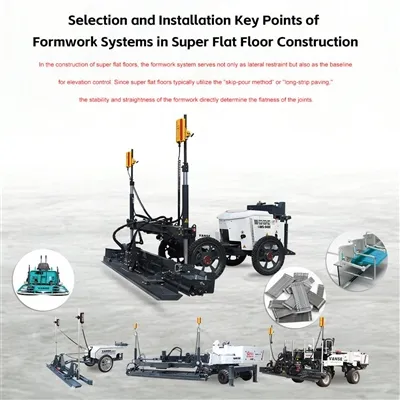
In the construction of super flat floors, the formwork system serves not only as lateral restraint but also as the baseline for elevation control. Since super flat floors typically utilize the "skip-pour method" or "long-strip paving," the stability and straightness of the formwork directly determine the flatness of the joints. The following are key points regarding the selection and installation of formwork systems for super flat floors: Traditional wooden formwork has been phased out in super-flat floor construction due to its susceptibility to deformation and low strength. The current mainstream solutions are as follows: Composition: Consists of two cold-drawn steel corner guards, load transfer bars, breakable bolts, and a lower steel plate. Advantages: No need to remove after construction; it remains in the floor as a permanent joint; effectively protects the concrete edges from impact damage by forklift wheels (prevents chipping). Applicable to: Longitudinal construction joints in very narrow aisle (VNA) areas. Requirements: Must possess sufficient rigidity, and the top surface must be machined and leveled. Advantages: When used with a laser leveling machine, it can serve as a physical reference for the leveling head. The accuracy of template installation directly affects the FL (Levelness) value, and the following steps must be followed: Precise elevation control: Use a high-precision leveling instrument (accuracy requirement within ± 0.5 mm ) for surveying. Denser measurement points: Set a fixed control point every 2 ~ 3 m along the template support trajectory to ensure straightness over long distances. Reinforcement design: The template must be firmly anchored to the base layer using steel reinforcement bars. In ultra-flat floor construction, the power trowel is heavy and vibrates strongly; even a 1 mm settlement of the template will result in unacceptable flatness in that area. Gap sealing: The gap between the bottom of the template and the base layer should be sealed with mortar to prevent leakage and the resulting "root rot" phenomenon, otherwise it will lead to honeycomb and pockmarked surfaces at the edges. Perpendicularity requirement: Dowel bars must be strictly parallel to the floor surface and perpendicular to the template surface. Displacement control: The use of dowel bar sleeves or supports is recommended. If the dowel bars tilt during pouring, it will cause irregular cracks in the concrete during shrinkage, rather than cracking at the predetermined joints. Key processes Technical Requirements Equipment coordination Top surface cleaning No old concrete or foreign objects shall remain on the top surface of the formwork. Manual inspection with a trowel is performed before pouring. Joint connection The connection between two formwork sections must have a "zero height difference" transition. A tongue-and-groove joint structure or reinforcing steel plates on the back are used. Demolding time The side formwork (non-armored joint) must be removed after the concrete strength reaches 2 to 3 MPa. Avoid using a sledgehammer to pry, to prevent damage to the edges of the newly poured concrete. When installing armored joints, it is important to pay attention to their three-dimensional adjustability. Adjustable height bolt supports are typically used, allowing for fine-tuning before concrete pouring to ensure the top surface of the angle steel is precisely at the design elevation. Misconception 1: Relying on laser Leveling without paying attention to formwork. Truth: When working near the edges of the formwork, laser Leveling are limited by the width of the Leveling blade and edge interference, often requiring the formwork as a physical reference. If the formwork is uneven, the flatness of the edges will inevitably be compromised. Misconception 2: Dowel bars are inserted directly through wooden formwork. Truth: This makes it very easy to dislodge the dowel bars during formwork removal, damaging the bond between the dowel bars and the initial setting concrete. It is recommended to use armored joints or steel formwork with professional sleeves. Note: The parameters provided in this document are for reference only and are not mandatory. Due to differences in technical characteristics between different brands and models of laser levelers, please consult the manufacturer for a suitable solution before actual operation. This reference document assumes no responsibility for any issues arising from failure to follow the manufacturer's instructions.How can the concrete laser leveling machine components (such as laser emitters) be maintained to extend their service life
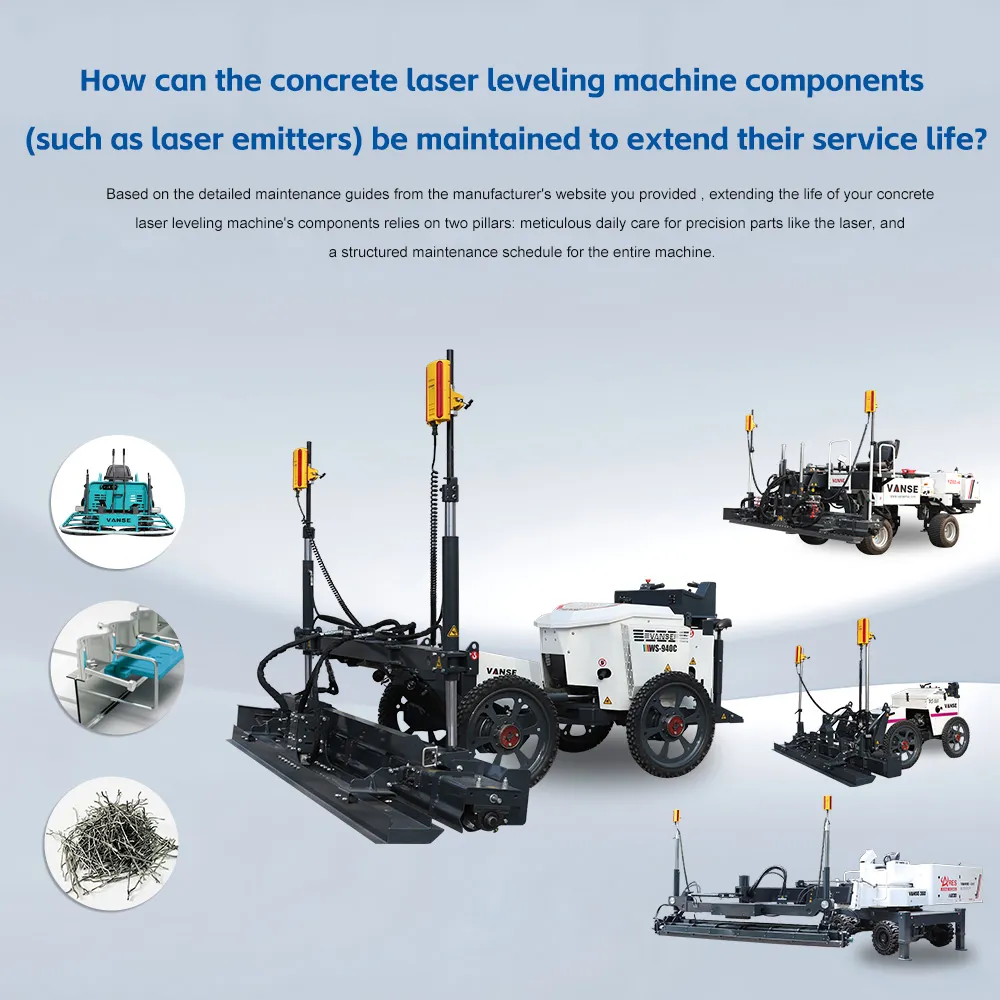
Based on the detailed maintenance guides from the manufacturer's website you provided , extending the life of your concrete laser leveling machine's components relies on two pillars: meticulous daily care for precision parts like the laser, and a structured maintenance schedule for the entire machine. Here is a practical guide focused on the key components you asked about. The laser emitter and receiver are the most sensitive parts. Their maintenance revolves around cleanliness, careful handling, and regular accuracy checks . Component Daily Care Essentials Calibration & Advanced Care Laser Emitter Clean the lens gently after each use with special lens paper or a blower ever use rough materials . Perform a self-check before key projects: Set it up, allow it to self-level, then verify accuracy by checking beam height at two distances (e.g., 5m and 15m). The height difference should be near zero . Check laser tube brightness every 300-500 hours. Replace if the beam is weak or range shortens . Wipe the body with a dry cloth . Always store in its dedicated, foam-padded box to prevent shock . Use and store in a cool, dry place . Manage battery: Avoid deep discharge; charge every 1-2 months during long storage . Laser Receiver & Sensors Keep the sensor lens clean and free of mud . Perform linkage calibration: After the emitter is set, calibrate the receiver with the control panel. Slowly raise/lower the receiver rod and record the "high" and "low" points so the machine responds correctly . Adjust sensitivity based on site conditions (e.g., higher in bright sunlight) for optimal signal capture . Secure the mounting to prevent loosening from vibration . Handle the receiver rod carefully to avoid bending . Inspect cables daily for damage or loose connections, as these cause signal issues . To keep the laser system and the rest of the machine in top condition, follow a maintenance plan based on operating hours. The table below integrates recommendations from your provided sources . Frequency Key Actions for Longevity Daily (After Each Use) Thoroughly clean all concrete residue from the Leveling head, vibrator, frame, and especially the laser components . Inspect for leaks, loose bolts, and any visible damage . Grease all pivot points and bearings to prevent wear . Weekly (~50 Hours) Check and clean/replace the engine air filter . Inspect hydraulic oil level and condition; check for leaks in hoses and connections . Check tire pressure/wear or track tension and condition . Tighten all exposed bolts and nuts, especially on vibrating parts . Monthly (~250 Hours) Clean or replace the hydraulic tank's breather filter . Inspect the electrical system: battery terminals, wiring for wear . Calibrate the laser system to ensure construction accuracy . Inspect structural components like the frame and Leveling for cracks or deformation . Quarterly/Semi-Annually (~500-1000 Hours) Replace hydraulic oil and all filters (suction, return, pressure) . Perform full engine maintenance: change oil, oil filter, fuel filter . Conduct an in-depth inspection of hydraulic pumps, motors, and cylinders for wear . Clean Before Hardening: The most important rule is to wash off concrete slurry before it hardens. Cured concrete is extremely difficult to remove and will quickly damage moving parts and affect machine balance . Keep Records: Maintain a logbook of all maintenance, calibrations, and part replacements. This helps track the equipment's health and plan future servicing . Treat with Care: Always handle the laser components as you would a precision camera lens. Their accuracy depends on it . For Long-Term Storage: If the machine won't be used for over a month, clean it thoroughly, apply rust protection to exposed metal, disconnect the battery, and store it in a dry place . By integrating this laser-specific care into a comprehensive maintenance routine, you ensure the entire machine works harmoniously for years to come. If you are using a specific model from the Vanse series (like the DZ25-2 or WS550 you saw earlier) and need model-specific advice, feel free to ask. Contact us NOW Note: The parameters provided in this document are for reference only and are not mandatory. Due to differences in technical characteristics between different brands and models of laser levelers, please consult the manufacturer for a suitable solution before actual operation. This reference document assumes no responsibility for any issues arising from failure to follow the manufacturer's instructions.