Technical Knowledge
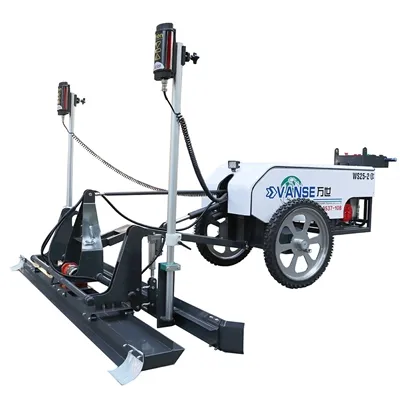
The laser leveling machine parts frequently fail. How much do you know about the correct avoidance methods?

If the laser leveling machine is used for too long or the method of use is incorrect, the various components will frequently fail. To prevent such a phenomenon from happening, it is necessary to check the wear of the equipment accessories in time. If the wear phenomenon is serious, the seriously worn accessories should be replaced in time to avoid affecting the normal use of the equipment. Let's take a detailed look at the methods to prevent frequent failures of laser leveling machine parts.
1. Check the connection and fastening of the various parts of the laser leveling machine, whether the connecting bolts are loose or broken, tighten or replace them if necessary, check whether there are leaks, and eliminate leaks in various parts in time. Pay attention to the amount of engine oil, fuel, coolant and hydraulic oil, and add new oil to the oil mark as required. Check whether the grease in the centralized lubrication device is appropriate.
2. Be careful not to work under a larger load than the machine can bear. Use the machine to the best of your ability. As a laser leveling machine manager, when designating an operator, you should give the laser leveling machine random information and operation manual to the operator so that he can master the mechanical performance and operating procedures normally, and should not arbitrarily withhold the relevant information.
3. Try to ensure the uniform addition and subtraction of mechanical load, so that the machine is in a relatively gentle load change. Specifically, it is necessary to add and subtract the throttle more evenly to prevent the engine and working device from fluctuating greatly. After the construction, there will be a lot of dust and mud on the equipment. First, wipe the dust on the laser leveler clean, and wipe the dirt and oil stains with thin paper or cotton cloth.
4. If the laser signal is lost during the construction of the laser leveler, the machine needs to be restarted. The interval time is more than ten seconds. If there are too many stains, you can soak it in water diluted with neutral detergent with a soft cloth, wring it out and wash it. Remember not to use volatile oil, thinner, gasoline and other chemicals to clean and wipe. The laser leveler uses several automatic control components to monitor the elevation of the leveling head in real time, and the monitoring frequency is relatively high, which can reach about 10 times per second.
The above is a method to prevent the failure of laser leveler components. You can learn about it in detail. If you have any ideas and need to understand the intention of the product during the reading process, you can contact us in time, and we will have professional technicians to help you solve the problem.
Thanks to All the Friends Who Support and Trust Shandong Vanse Machinery Technology Co., Ltd.
If you want to know more about Shandong Vanse Machinery Technology Co., Ltd. or have any questions, please feel free to contact us:
Our Factory
Shandong Vanse Machinery Technology Co., Ltd.








Share this article

About the Author: Shandong Vanse Machinery Technology Co., Ltd.
Shandong Vanse Machinery Technology Co., Ltd. is a high-tech manufacturer specializing in concrete construction machinery, including laser screeds and related equipment. The company integrates R&D, production, and global sales, with products exported to over 60 countries and widely used in infrastructure projects worldwide.
Previous Post
Next Post
Related Articles
You Might Also Like
How does the material and design of the trowel blades affect the power trowel effect?
– The wear resistance of the trowel directly affects its service life and the sustainability of the trowel effect. For example, the trowel made of high-hardness alloy steel has a slow wear rate during long-term friction with the ground due to its high hardness. When dealing with large areas of concrete or stone floors, the size and shape of the trowel can be maintained to ensure that the contact area and pressure of each trowel are uniform, so that the gloss and flatness of the ground remain consistent throughout the construction process. In contrast, trowels with softer materials, such as some ordinary plastic trowels, are easy to wear. After a period of use, the edges of the trowels may be worn and deformed, resulting in uneven contact with the ground during troweling, causing local unevenness or inconsistent gloss on the ground. – Trowels with certain elasticity and flexibility have unique advantages in the troweling process. For example, when a rubber trowel encounters an uneven ground or tiny particles, it can produce a certain deformation to adapt to the ground conditions. When smoothing delicate floors such as wooden floors, rubber trowels will not scratch the floor as easily as hard materials. At the same time, this elasticity can also make the trowel fit the floor better, enhance the pressure transmission to the floor, and improve the smoothing effect. If the trowel material is too rigid, such as some ceramic trowels, it may not fit the floor effectively when the floor is uneven, resulting in a significant reduction in the smoothing effect. – Different floor materials require trowels of different materials to achieve the best effect. For concrete floors, metal trowels (such as stainless steel and alloy steel) can rub well with the floor, remove the slurry and bubbles on the concrete surface, and make the floor more dense and smooth. For more sensitive floor materials such as epoxy floors, it is more appropriate to use softer polyurethane trowels, because this material will not react chemically with epoxy materials, and can be finely smoothed without damaging the epoxy floor coating, so that the epoxy floor can achieve a bright mirror effect. – The shape and size of the trowel affect its coverage area and work efficiency. Round trowels are the most common type, and their diameter determines the coverage area of each trowel. For example, round trowels with a larger diameter (such as about 1 meter) are efficient when troweling large areas of the floor, and can quickly cover the floor, but are not convenient to operate in corners. Round trowels with a smaller diameter (such as 0.3-0.5 meters) are more suitable for troweling in narrow spaces and corners. In addition, there are square trowels, which can better fit the shape of the corners in right-angle areas such as corners, achieving more thorough troweling. – The surface texture of the trowel has a significant impact on the trowel effect. Smooth-surface trowels are mainly used for the final fine troweling of the floor, which can produce a higher gloss on the floor. For example, when polishing indoor marble floors, using smooth metal trowels can make the marble surface shiny. Trowels with a certain degree of roughness, such as those with fine bumps or frosted textures on the surface, are suitable for removing large unevenness and impurities on the ground in the early stage of troweling, and for preliminary compaction and leveling of the ground. In concrete floor construction, this kind of rough trowel can smooth the coarse particles on the concrete surface, laying the foundation for subsequent fine troweling. – The installation method of the trowel affects its stability and the convenience of replacement. If the trowel is designed to be easy to disassemble and install, such as through a slot or bolt connection, it will be convenient to operate when the trowel is worn or needs to be replaced with a trowel of different material and texture. In addition, trowels with adjustable angles can better adapt to different construction requirements. For example, when troweling a sloped ground (such as a parking lot slope), by adjusting the angle of the trowel, the trowel effect can be made more uniform, ensuring that the ground slope meets the design requirements, while achieving a good trowel effect.How to calibrate a concrete laser leveling correctly to ensure ±3mm flatness tolerance for super flat floors
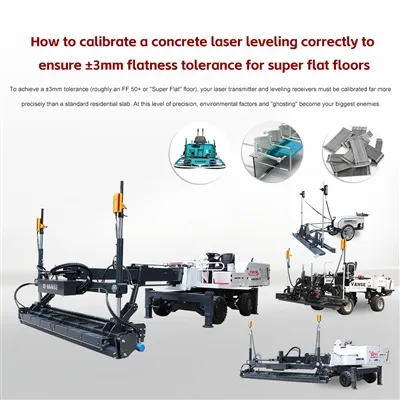
To achieve a ±3mm tolerance (roughly an FF 50+ or "Super Flat" floor), your laser transmitter and leveling receivers must be calibrated far more precisely than a standard residential slab. At this level of precision, environmental factors and "ghosting" become your biggest enemies. Here is the professional procedure for calibrating a laser leveling system for super flat requirements. Before the pour, you must verify the laser transmitter itself. Even a high-end unit can drift. The Set-up: Place the laser exactly halfway between two walls (or stakes) approximately 30m (100ft) apart. Step A: Turn the laser to Face 1 (X-axis). Mark the beam height on Wall A and Wall B. Step B: Rotate the laser 180° to Face 2. Re-mark Wall A and Wall B. The Math: If the difference between the two marks on either wall exceeds 1.5mm, the internal pendulum or diode is out of spec. The "Super Flat" Rule: For ±3mm floors, your transmitter should ideally be accurate to ±1.5mm per 30m to allow for cumulative errors in the receiver and leveling hydraulics. If you are using a laser leveling (e.g., Vanse), you must calibrate the relationship between the laser receivers and the leveling head. Hydraulic Warm-up: Run the machine for 15–20 minutes. Cold hydraulic fluid moves slower, causing a "lag" in the auto-leveling that will blow your FF numbers. Auto-Cal Sequence: Set the transmitter 20–30m away. Place the leveling boom at 100% extension. Enter the machine's "Tuning" or "Service" menu and select Auto-Cal. The machine will move the cylinders through their full range to "learn" the exact voltage needed to move the head 1mm. Vibration Check: Ensure the vibrator is ON during the final stages of calibration. The vibration causes "settling" in the head that must be accounted for. Once the machine is calibrated, you must sync it with the physical site datum. Establish a Master Benchmark (usually a brass plug or a column mark) away from the pour area. Set your hand-held laser receiver (grade rod) to this benchmark. Place the grade rod on the leveling's finish blade (not the plow). Adjust the leveling's offset until the machine's "On Grade" light matches the grade rod's "On Grade" signal. Factor Requirement Why? Wind/Heat Use a "dead" zone Wind can vibrate the laser transmitter tripod, causing "beam bounce" (a 1mm shake at the source becomes 5mm at the leveling). Receiver Height Keep it low The higher the receivers are on the masts, the more they amplify any "sway" or vibration from the machine. Tripod Stability Concrete/Solid Earth Never set the transmitter on a wood deck or loose fill. Use a heavy-duty fiberglass tripod. Overlap 10–20% On super flat pours, each pass must overlap the previous one significantly to "erase" the transition line. If your numbers are off despite calibration, check for Refraction. On hot days, the laser beam can "bend" as it passes through heat shimmering off the ground. Solution: Raise the transmitter tripod to 2 meters (6.5 ft) high. This keeps the beam above the hottest air layer near the ground, providing a more stable reference line. Would you like me to explain how to conduct a "Dipstick" or Floor Profiler test to verify these numbers once the concrete has cured? Contact us NOW Note: The parameters provided in this document are for reference only and are not mandatory. Due to differences in technical characteristics between different brands and models of laser levelers, please consult the manufacturer for a suitable solution before actual operation. This reference document assumes no responsibility for any issues arising from failure to follow the manufacturer's instructions.How to improve the construction quality of concrete laser leveling machine?
Improving the construction quality of concrete laser leveling machines is one of the key factors to ensure the overall quality of construction projects. Concrete laser leveling machines use laser technology to control the flatness and precision of the ground, but to achieve high-quality construction results, multiple factors need to be considered comprehensively. The following is a detailed analysis of how to improve the construction quality of concrete laser leveling machines. Introduction In the field of construction, concrete laser leveling machines are widely used in ground leveling operations due to their high efficiency and high precision. However, the improvement of construction quality depends not only on the equipment itself, but also requires strict construction management and operation procedures. 1. Preparation before construction Sufficient pre-construction preparation is the basis for improving construction quality: – **Equipment inspection: Ensure that the laser leveling machine is in the best working condition, including the laser system, control system and mechanical components. – **Construction plan formulation: Develop a detailed construction plan according to the project requirements, including concrete mix ratio, pouring thickness and leveling process. – **Operator training: Ensure that the operator is familiar with the equipment operation and construction process, and understands the key points of quality control. 2. Quality control of construction materials The quality of construction materials directly affects the final construction quality: – **Concrete ratio: strictly control the ratio of concrete to ensure that it meets the design requirements. – **Raw material quality: select high-quality cement, aggregates and additives to avoid material problems affecting the construction quality. 3. Quality monitoring during construction Quality monitoring during construction is the key to ensuring construction quality: – **Laser system monitoring: real-time monitoring of the stability of the laser system to ensure the accuracy of the laser plane. – **Flatness detection: regularly use professional equipment to detect the flatness of the concrete surface and adjust the working parameters of the leveling machine in time. 4. Accurate operation of construction equipment Accurate operation is a direct means to improve construction quality: – **Equipment adjustment: adjust the height and speed of the leveling machine in time according to the actual situation of the concrete and the construction environment. – **Operation continuity: maintain the continuity of operation to avoid inconsistent flatness due to interruptions in operation. 5. Control of construction environment A good construction environment is an external condition to ensure construction quality: – **Environmental factor control: Control the temperature, humidity and light conditions of the construction site to avoid adverse factors affecting the coagulation and hardening of concrete. – **Construction site management: Reasonably arrange the layout of the construction site to ensure the smooth construction process. 6. Maintenance management after construction Reasonable maintenance management is crucial to ensure construction quality: – **Timely covering: Cover the concrete surface in time after construction to prevent moisture from evaporating too quickly. – **Curing time: Ensure sufficient curing time to fully harden the concrete. 7. Recording and analysis of construction data Detailed recording and analysis of construction data will help to continuously improve construction quality: – **Data recording: Record various parameters during the construction process, such as concrete temperature, pouring speed, leveling speed, etc. – **Data analysis: Analyze data, find out factors that affect construction quality, and continuously optimize construction plans. 8. Acceptance standards for construction quality Establish strict acceptance standards for construction quality: – **Acceptance process: Establish a standardized acceptance process to ensure that each construction link meets quality requirements. – **Acceptance tools: Use professional tools for quality acceptance, such as flatness measuring instruments, strength testers, etc. 9. Problem solving during construction Quickly identify and solve problems during construction: – **Problem identification: Quickly identify problems that occur during construction, such as concrete segregation, surface bubbles, etc. – **Problem handling: Take appropriate measures to deal with the problem according to the nature of the problem, such as re-leveling, repairing, etc. 10. Technological innovation and application Technological innovation is an important way to improve construction quality: – **New process exploration: Continuously explore and experiment with new construction processes to improve construction efficiency and quality. – **Technology integration: Integrate the latest technologies, such as intelligent control systems, to improve the level of construction intelligence. 11. Conclusion Improving the construction quality of concrete laser leveling machines is a systematic project, which requires comprehensive consideration and management from multiple aspects such as pre-construction preparation, quality control of construction materials, quality monitoring during construction, precise operation of construction equipment, control of construction environment, maintenance management after construction, recording and analysis of construction data, acceptance standards for construction quality, problem solving during construction, and technological innovation and application. Through the implementation of these measures, the construction quality of concrete floors can be effectively improved to meet the construction quality and use requirements.