Technical Knowledge
The Concrete Laser Leveling Equipment Maintenance: Failure Rate Analysis and Maintenance Frequency Determination
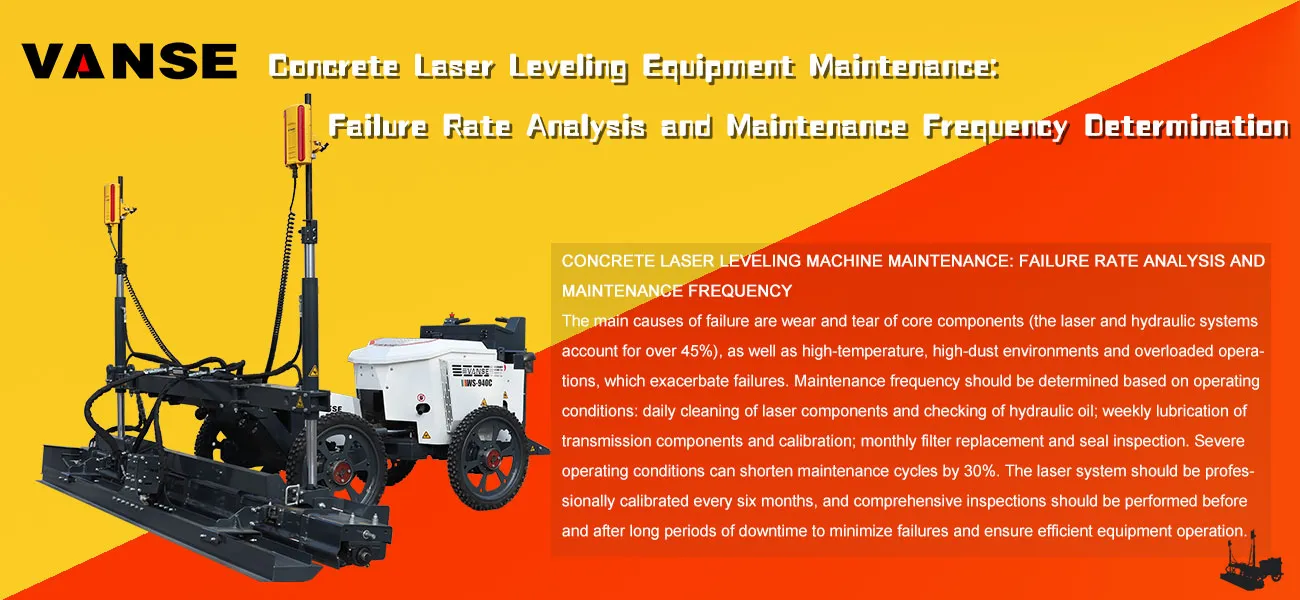
Concrete Laser Leveling Equipment Maintenance: Failure Rate Analysis and Maintenance Frequency Determination
1. Analysis of Key Factors Influencing Failure Rate
(1) Percentage of Core Component Failures
Laser System (25%-30%): Construction dust and vibration can easily cause laser transmitter calibration deviation, or prolonged high temperature environments can cause poor circuit contact, resulting in leveling accuracy deviation and frequent alarms.
Hydraulic System (20%-25%): Hydraulic oil contamination (impurities/water) and seal aging can lead to cylinder leakage and lag. Prolonged oil shortages can cause hydraulic pump wear, a major cause of downtime and maintenance.
Travel and Transmission Components (15%-20%): Tire/Track wear (from friction on gravel roads), chain slack (from long-term load operation), and drive motor carbon brush wear can easily lead to equipment deviation and power loss.
Electrical System (10%-15%): Oxidation of wiring terminals (from humid environments), wear of control switch contacts, and impact damage to sensors (such as elevation sensors) can easily cause equipment start/stop failures and false data reports.
Structural parts and wearing parts (10%-15%): wear of the leveling scraper (concrete friction), damage to the vibrator bearing (high-frequency vibration), loose connection bolts (equipment vibration transmission). Although the cost of a single repair is low, it can easily affect construction efficiency.
(2) Impact of External Environment and Usage Habits
Environmental Factors: High temperatures (>35°C) accelerate hydraulic oil deterioration and circuit aging; humid/rainy environments increase the risk of electrical short circuits; dusty construction sites (such as those near gravel pits) shorten the lifespan of laser systems and heat dissipation components, increasing the failure rate by 20%-30%.
Usage Habits: Overloading (e.g., exceeding the rated leveling thickness of the equipment), running at full load immediately after startup (without preheating), and failing to clean the machine promptly after shutdown (due to residual concrete buildup) can increase the failure rate by over 30%.
2. Scientific Methods for Determining Maintenance Frequency
(1) Basic Maintenance: Setting the Frequency Based on the Dual Dimensions of "Operation Duration + Cycle"
| Maintenance Level | Maintenance Details | Maintenance frequency (normal operating conditions) | Adjustments for harsh operating conditions (high temperature, high dust, and humidity) |
| Daily Maintenance | 1. Clean dust from the laser transmitter and receiver; | Daily before and after work | Add one laser system cleaning during operation |
| 2. Check the hydraulic oil level and quality; | |||
| 3. Tighten the machine body connecting bolts; | |||
| 4. Clean any remaining concrete from the leveling blades; | |||
| Weekly Maintenance | 1. Lubricate the travel chain and bearings (add grease); | Every 50-80 work hours (or once a week) | Reduced to every 30-50 operating hours |
| 2. Check tire/track wear and tire pressure; | |||
| 3. Test the laser system accuracy (check with a calibration ruler); | |||
| 4. Check for loose electrical terminals; | |||
| Monthly Maintenance | 1. Replace the hydraulic oil filter; | Every 200-300 work hours (or once a month) | Reduced to every 150-200 operating hours |
| 2. Check the hydraulic seals for leaks; | |||
| 3. Calibrate the elevation sensor and travel deviation correction; | |||
| 4. Check the drive motor operating temperature and noise |
(2) In-depth Maintenance: Set based on component lifespan and failure patterns.
Laser System: Professionally calibrate every 6 months (or 800 operating hours) and replace the laser transmitter dust cover (if worn). If accuracy deviation exceeds 0.5mm/2m, immediately shut down the machine for calibration.
Hydraulic System: Replace hydraulic oil (and oil tank filter) every 12 months (or 2000 operating hours). Completely inspect and replace seals every 18 months (or 3000 operating hours).
Electrical System: Replace control switch contacts and motor carbon brushes (if worn more than 1/2) every 8 months (or 1500 operating hours). Waterproof and seal the electrical cabinet before the rainy season.
Consumable Parts: Leveling scraper (wear exceeds 5mm), vibrator bearings (noise during operation), tires (tread depth <3mm). Replace as needed (generally every 1000-1500 operating hours).
(3) Supplementary Rules for Special Scenarios
Long-term shutdown (>15 days): Before shutdown, bleed residual hydraulic system pressure, clean the equipment inside and out, and store in a dry, ventilated area. Before restarting, perform a comprehensive inspection (hydraulic oil, electrical circuits, and precision calibration). Do not restart operations immediately.
High-intensity operation (average daily operation time >8 hours): Reduce all maintenance frequency by 30%, and increase daily hydraulic system and motor temperature monitoring (if the temperature exceeds 60°C, shut down the machine for cooling).
Note:
The parameters provided in this document are for reference only and are not mandatory. Due to differences in technical characteristics between different brands and models of laser levelers, please consult the manufacturer for a suitable solution before actual operation. This reference document assumes no responsibility for any issues arising from failure to follow the manufacturer's instructions.
Thanks to All the Friends Who Support and Trust Shandong Vanse Machinery Technology Co., Ltd.
If you want to know more about Shandong Vanse Machinery Technology Co., Ltd. or have any questions, please feel free to contact us:
Our Factory
Shandong Vanse Machinery Technology Co., Ltd.








Share this article

About the Author: Shandong Vanse Machinery Technology Co., Ltd.
Shandong Vanse Machinery Technology Co., Ltd. is a high-tech manufacturer specializing in concrete construction machinery, including laser screeds and related equipment. The company integrates R&D, production, and global sales, with products exported to over 60 countries and widely used in infrastructure projects worldwide.
Previous Post
Next Post
Related Articles
You Might Also Like
Technical measures to ensure the quality of power trowel operation under extreme weather conditions such as high and low temperatures
For the technical measures to ensure the construction quality of the power trowel machine under extreme weather conditions such as high and low temperatures, we also need to systematically respond from four dimensions: environmental analysis, material adjustment, process optimization and finished product protection. The following is the specific technical measure plan: Prevention first: The core of all measures lies in "early prediction and preparation" rather than remedial measures after the fact. Systematic response: Concrete construction is a closely interlinked process that requires full-process control from the concrete mix ratio to the final curing. Flexible adjustment: Dynamically adjust the construction process based on specific conditions such as on-site temperature, humidity, and wind speed. High temperatures can cause rapid evaporation of water in concrete, significant loss of slump, and shortened setting time, thereby increasing the difficulty and risk of operating the power trowel, and easily leading to problems such as surface powdering, plastic shrinkage cracks, and surface cracking. (1) Preparations before construction Concrete mix proportion adjustment Communicate with the commercial concrete mixing station to use retarding water-reducing agents, delay the initial and final setting times, and strive for a longer operation window for plastering. When necessary, air-entraining agents can be appropriately added to enhance the crack resistance of concrete. Under the premise of ensuring the design strength, the amount of cement should be reduced as much as possible to minimize the heat of hydration. Pouring plan adjustment Avoid high-temperature periods: Try to schedule concrete pouring in the evening, at night or in the early morning. Ensure the coherence of the construction organization and shorten the entire timeline from the concrete leaving the tank to the completion of the plastering. On-site preparation Water the base layer and formwork to cool them down, but there must be no standing water. Prepare sunshades, sunshade nets, windbreak sheds, etc., to reduce the area of concrete exposed to sunlight and wind. Ensure that the power trowel is in good condition and prepare a spare machine to prevent delays caused by equipment failure. (2) Key control Points for the operation of the power trowel machine Precisely control the timing of polishing The initial setting judgment is crucial: Use the "footprint method" (when the footprint depth is approximately 3-5mm) for judgment, and at this point, the first round of smoothing can be carried out. Concrete reaches a workable state very quickly at high temperatures and must be closely monitored by a dedicated person. Better late than early: In high temperatures, it is especially important to avoid operating the machine when there is still floating slurry and bleeding on the concrete surface, otherwise the surface structure will be damaged, leading to sanding and cracking. Optimize the polishing process First coat (rough power troweling/slurry lifting) : Use a power trowel to install the disc and quickly carry out slurry lifting and initial leveling. Act quickly and avoid staying in the same position for too long. The second coat (fine power troweling/calendering) : When the surface moisture has evaporated and the footprints left by people stepping on it are very shallow, replace the power trowel (power trowel) of the power trowel machine and perform cross-operation. This round is the key to eliminating marks and enhancing density. If necessary, increase the number of passes: If the surface loses water too quickly, a manual wooden power trowel can be used to assist in roughening between two passes to seal fine cracks and create conditions for the next machine smoothing. Prevent surface water loss During the intervals of the power trowel operation, if you notice that the surface starts to turn white and dry, you should immediately use a sprayer to apply a small amount of spray to moisten the surface. It is strictly forbidden to sprinkle a large amount of water. Beside the operation area of the power trowel machine, arrange workers to be ready to spray the curing agent at any time. (3) Post-construction maintenance Immediate maintenance: After the last coat of polishing is completed, the surface moisture and luster disappear, and there is no trace left when pressed hard with a finger, maintenance should be carried out immediately. Maintenance method Prioritize the use of curing agents: Immediately spray a layer of film-forming curing agent on the concrete surface to lock in moisture. This is the most effective way. Covering for moisture retention: Immediately after the smoothing is completed, cover with plastic film, wet felt cloth or geotextile, and ensure that the covering remains moist at all times. The coverings should overlap tightly. Low temperatures can significantly delay the hydration reaction of cement, resulting in a slow increase in the strength of concrete. In the early stage, it is prone to frost damage, causing the surface to peel and become loose, and permanent loss of strength. The operation window period of the power trowel machine will be abnormally extended, but power troweling and curing must be completed before the freshly poured concrete freezes. (1) Preparations before construction Concrete mix proportion adjustment Communicate with the commercial concrete mixing station to use early-strength water-reducing agents or antifreeze to accelerate the development of early strength and lower the freezing point. High-strength grade cement or Portland cement can be considered for use, as they have a higher early hydration heat. Environmental temperature guarantee Build an insulated shed: Set up a sealed insulated shed in the construction area, and use warm air fans, steam pipes, etc. for heating inside to ensure that the temperature inside the shed does not fall below +5℃. Foundation preheating: Preheat the base layer and steel bars to prevent concrete from coming into contact with the frozen base layer. Hot air blowers can be used for blowing or insulation materials can be laid. Material and equipment preparation The temperature of concrete leaving the machine should not be lower than 10℃, and the temperature of concrete entering the formwork should not be lower than 5℃. Place the power trowel machine in a warm shed in advance for preheating to prevent the cold machine from touching the concrete surface, causing "rapid cooling" and adhesion. (2) Key control Points for the operation of the power trowel machine Precisely control the timing of polishing Concrete sets very slowly at low temperatures. It is strictly forbidden to operate the machine before the concrete reaches a certain hardness. One must wait patiently and use the "footprint method" for judgment, but the waiting time will be much longer than at normal temperature. It may take several hours or even longer to wait. Better late than early: Waiting for a long time is better than boarding the computer too early. Using the machine too early will damage the concrete structure, causing excessive bleeding and peeling on the surface, forming "spring-like soil" that cannot be polished. Optimize the polishing process Due to the slow increase in intensity, the operation of the power trowel can be more relaxed, but the interval time between each pass will be very long. The operation number of the power trowel is similar to that at normal temperature, but it is necessary to pay attention to observing the surface. If ice crystals or signs of freezing are found, the operation must be stopped immediately and insulation and heating measures should be strengthened. Prevent surface freezing Ensure that the construction environment temperature is always above the safety line. Keep a close eye on the weather forecast to prevent the "quick-freezing" weather from hitting. (3) Post-construction maintenance Heat storage and insulation maintenance After the smoothing is completed, immediately cover it with a layer of plastic film (to prevent water loss), and then cover it with insulation materials such as insulation blankets, straw curtains, and rock wool quilts. The number of covering layers should be determined based on the temperature measurement results to ensure that the concrete does not freeze before reaching the "critical strength for frost resistance" (usually 30% of the designed strength or 5MPa). Continuous heating curing If heat storage alone cannot ensure the temperature, continuous heating should be provided in the insulated shed to keep the concrete in a positive temperature environment. Steam curing is more effective and can provide both temperature and humidity simultaneously. Extend the curing time: At low temperatures, the strength growth of concrete is slow. The curing time should be at least twice as long as the time required by the specification. Moreover, before the strength of the test blocks cured under the same conditions reaches the design requirements, they should not be frozen or subjected to loads. Precise temperature measurement: Set up temperature measurement points at key structural parts to monitor the internal temperature of the concrete at regular intervals and guide the curing work. Control dimension High-temperature environment Low-temperature environment Core contradiction Water evaporates quickly, condenses rapidly and is prone to cracking Slow hydration, slow strength growth, and prone to freezing Material adjustment Retarder, air-entraining agent, reducing cement dosage Early strength agent/antifreeze, high-strength cement Construction timing Avoid midday and choose early morning, late evening or late night It should be carried out during the daytime when the temperature is relatively high Polish the timing The waiting time is short. Be sure not to miss the window. It's better to wait late than early The waiting time is long. Be sure not to go up too early. It's better to be late than early Polishing process It acts quickly and can be sprayed in small amounts to prevent water loss Operate calmly and strictly prevent surface freezing Maintenance measures Spray the curing agent immediately or cover it to retain water Cover and keep warm immediately, and heat if necessary Key tools Sprayers, sunshade nets, maintenance agents Insulation shed, heating equipment, insulation materials, thermometer Through the above systematic technical measures, the negative impact of extreme weather on the construction quality of the power trowel can be offset to the greatest extent, ensuring that the strength, flatness, wear resistance and appearance quality of the final floor meet the standard requirements. Note: The parameters provided in this document are for reference only and are not mandatory. Due to differences in technical characteristics between different brands and models of laser levelers, please consult the manufacturer for a suitable solution before actual operation. This reference document assumes no responsibility for any issues arising from failure to follow the manufacturer's instructions.Laser leveling machine helps speed up and improve the quality of cast-in-place floor construction in industrial plants!
With the increasing number of warehouse and large production workshop construction projects, the existing conventional construction technology can no longer meet their needs for the flatness and quality of concrete floors. In this situation, laser leveling technology has been successfully introduced. The use of laser leveling machines for construction can not only effectively reduce the occurrence of ground cracking, damage, sanding, etc., but also has a high level of construction automation, fast construction speed, and low construction cost. The economic benefits brought by the cast-in-place floor construction of industrial plants are very considerable. The following is a brief introduction to the specific application of laser leveling machines in the construction of cast-in-place floor slabs of industrial plants. —- Working principle of laser leveling machine Laser leveling consists of four parts: laser transmitter, data processing system, laser receiver, and leveling power system. The laser transmitter rotates continuously at a speed of 600r/min to form a horizontal laser plane in space. After receiving the laser signal, the laser receiver on the laser leveler transmits the data to the data processing system, and the data processing system then sends a signal to the electric push rod on the laser leveler. The electric push rod executes the command at a speed of 10 times/s, so that the fabric spiral, scraper, and vibrator on the laser leveler can adjust the elevation in real time to ensure the levelness of the floor. —-Technical features of laser leveler ❶ High flatness quality: The flatness of the floor can reach a deviation of less than 2mm within a range of 2m. The floor elevation is automatically controlled by the laser and data processing system, and the leveling system is adjusted in real time through the bidirectional electric push rod to ensure accurate leveling. ❷ Good integrity of the floor: Due to t he independent arrangement of the laser transmitter, large-area casting can be achieved during the construction of the main frame cast-in-place floor slab. Compared with the traditional method, the construction joints are greatly reduced, making the cast-in-place floor structure more integrated. ❸ Good concrete density: Since the laser leveling machine itself has a vibration system with a vibration frequency of 3000 times/min, compared with the traditional inserted vibrator, the density of the floor structure plate can be increased by more than 20%, thereby avoiding the risk of floor cracking caused by uneven vibration. ❹ Significantly improved work efficiency: The laser leveling head scraper, fabric spiral, vibrator and leveling beam of the laser leveling machine integrate the leveling, leveling and vibration work in one go. Compared with traditional construction methods, about 300m of leveling work can be completed per hour, and an average of 3000m can be completed per day, reducing labor by more than 30%, and the work efficiency can be increased by about 3 times. —-Cast-in-place floor laser leveling construction technology ❶ Construction preparation: First divide the construction section, and after the template support and steel bars of the pouring construction section are installed and accepted, install and debug the laser leveling machine equipment. The laser transmitter is set up on a special tripod to ensure that the laser emission is not blocked so that the construction area can receive the laser smoothly. The laser transmitter can be set up independently of the main body of the frame to be cast to avoid accidental collision during construction. According to the original leveling point, the fixed reference leveling point on the floor is measured and imported into the laser leveling machine to make the laser transmitter, leveling point, and laser leveling machine correspond. ❷ Casting concrete: Use pumped commercial concrete, and the slump is controlled between 160~180mm. According to the workshop area of each floor of the factory building, it is divided into 8 construction sections for segmented construction. According to the divided construction sections, the columns, beams, and slabs are cast in order from one end to the other. After the column and beam concrete are put into the mold, they are vibrated with an inserted vibrator. The concrete of the casting slab needs to be about 2cm higher than the template to facilitate the laser leveling machine to scrape it flat, and the material reduction or supplementation work can be carried out as needed. To prevent cold joints, the concrete transportation should be as continuous and uniform as possible, and the pauses and intervals in the middle should be minimized. During pouring, the piles of concrete need to be roughly flattened manually, and then the laser leveling machine controls the electric push rod according to the signal of the laser transmitter, and adjusts the horizontal height of the leveling head in real time to ensure that its height is always consistent with the set level point. At the same time, two workers are equipped to level and fill materials at the leveling head to ensure the flatness of the floor, and complete the vibration and compaction work while leveling. ❸ Slurry lifting and finishing: After laser leveling, when the concrete is about 3mm deep when people stand on the concrete surface before and after the initial setting, a disc trowel is used to lift the slurry. The speed of the mechanical trowel should be adjusted appropriately according to the hardening degree of the concrete, and the operation should be carried out in a criss-cross manner. Switch to a blade trowel for polishing, and use manual troweling for corners, column corners and other detailed parts that cannot be polished by the trowel. ❹ Maintenance and finished product protection: After the concrete is finished, water is sprinkled and covered with plastic film to prevent water evaporation and maintain a moist maintenance state. The curing time shall not be less than 7 days, and people are prohibited from stepping on the concrete before the concrete strength reaches 1.2MPa. The above is a brief discussion of the working principle and technical characteristics of the laser leveling machine, as well as a systematic summary of the specific process flow of the lightweight leveling machine used in the construction of cast-in-place floor slabs in industrial plants. By comparing multiple engineering practices, it is found that the effect and economic benefits of using a laser leveling machine for construction are more significant than those of manual construction.When there are bubbles on the concrete surface, how should the operating parameters of the trowel be adjusted?
Appropriately increase the number of trowel passes of the trowel machine, so that the blade squeezes and presses the concrete surface multiple times, which helps to further squeeze out the bubbles inside the concrete and make the concrete surface more compact and smooth. However, attention should be paid to the time interval between each trowel. It is not advisable to perform the next trowel before the concrete reaches a certain strength, so as not to damage the concrete structure. Generally speaking, it is more appropriate to perform 2-3 trowels after the initial setting of the concrete and before the final setting. The pressure of the trowel machine on the concrete surface can be appropriately reduced. If the pressure of the trowel machine is too high, a harder "shell" will form on the concrete surface, which is not conducive to the discharge of bubbles, but may seal the bubbles inside the concrete. By adjusting the counterweight or hydraulic system of the trowel machine, the trowel machine can apply a more appropriate pressure to the concrete surface during operation, so that bubbles can escape the surface more easily. The specific pressure adjustment value needs to be tested and explored according to the state of the concrete and the situation of bubbles. In the process of adjusting the operating parameters of the trowel machine, it is necessary to closely observe the changes on the concrete surface and make fine adjustments to the parameters in time according to the actual effect to achieve the best trowel effect and eliminate bubbles on the concrete surface. At the same time, it is also possible to combine measures such as optimizing the concrete mix ratio and improving the pouring process to fundamentally reduce the generation of bubbles on the concrete surface.