Technical Knowledge
Six functions of engine oil on laser leveling machine
As soon as the laser leveling machine came out, it has attracted the attention of consumers and has a lot to do with its own function. The oil has the unique functions of lubricating and reducing wear, cooling and cooling, sealing and leak-proof, shock absorption and buffering on the equipment. It is precisely because of these human nature The effect of chemicalization makes the equipment popular among consumers. During use, engine oil can effectively reduce the phenomenon of equipment wear and tear. The following laser leveling machine manufacturers will take you to learn more about the six functions of engine oil on laser leveling machines.
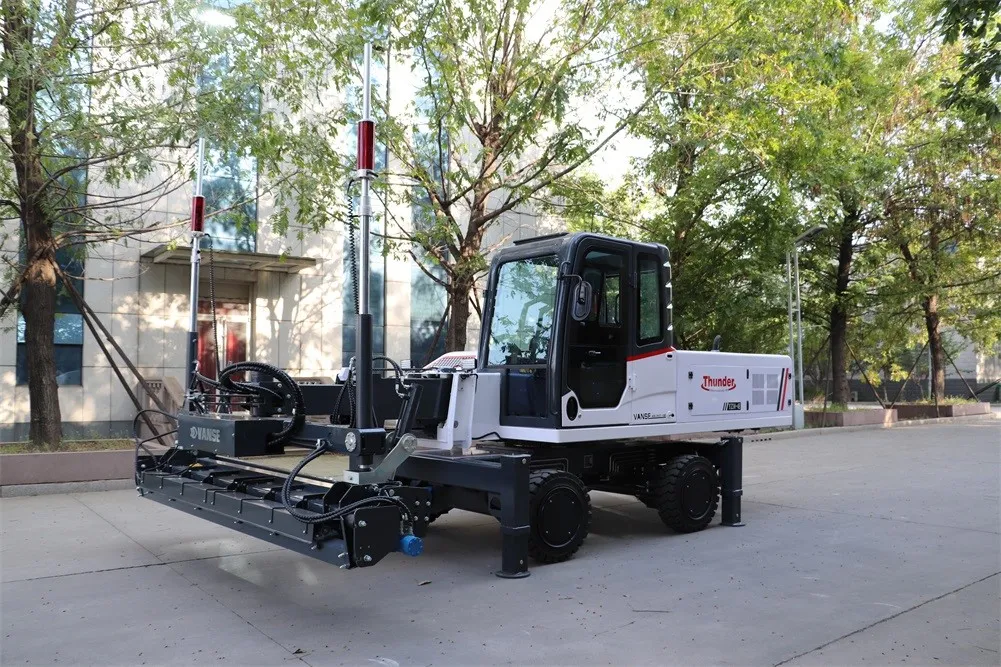
★ Lubrication and wear reduction: In recent years, in order to pursue a more flat and perfect ground, more and more people use laser leveling machines for construction. Using equipment construction can ensure that the entire ground is dense and uniform, which has been well received by the construction industry. Laser leveling The leveling machine needs to be maintained for a period of time. During the maintenance, the oil has a great effect on the laser leveling machine. There is a very fast relative sliding between the piston and the cylinder, between the main shaft and the bearing bush, so it is necessary to prevent If parts wear too quickly, an oil film will build up between the two sliding surfaces. As long as there is an oil film of sufficient thickness, the surfaces of the relatively sliding parts will be separated, so as to achieve the purpose of reducing wear.
★ Cooling and cooling: The oil can bring heat back to the oil tank, and then dissipate it into the air to help the water tank cool the engine. Cleaning: Good engine oil can remove carbides, sludge, worn metal particles, etc. on engine parts through the circulation belt Return to the oil tank, and through the flow of lubricating oil, wash away the dirt generated on the working surface of the parts.
★ Sealing and anti-leakage: The engine oil can form a sealing ring between the piston ring and the piston to reduce gas leakage and prevent external pollutants from entering the engine. Anti-rust and anti-corrosion: Lubricating oil can be absorbed on the surface of parts To prevent water, air, acidic substances and harmful gases from contacting parts.
★ Shock absorption and buffering: When the pressure of the cylinder port of the laser leveling machine engine rises sharply, the load suddenly added to the piston, piston bits, connecting rod and crankshaft bearing will be very large. The impact load acts as a buffer.
The relevant knowledge points shared for you are basically explained here. If you have good suggestions or opinions, you can contact us in time. We will have professional technicians to help you solve the problem. Thank you for your attention and support all the time. .
Thanks to All the Friends Who Support and Trust Shandong Vanse Machinery Technology Co., Ltd.
If you want to know more about Shandong Vanse Machinery Technology Co., Ltd. or have any questions, please feel free to contact us:
Our Factory
Shandong Vanse Machinery Technology Co., Ltd.








Share this article

About the Author: Shandong Vanse Machinery Technology Co., Ltd.
Shandong Vanse Machinery Technology Co., Ltd. is a high-tech manufacturer specializing in concrete construction machinery, including laser screeds and related equipment. The company integrates R&D, production, and global sales, with products exported to over 60 countries and widely used in infrastructure projects worldwide.
Previous Post
Next Post
Related Articles
You Might Also Like
Are concrete laser leveling machines worth it
Excellent question. This is a common dilemma for contractors, serious DIYers, and farmers. The short answer is: Yes, they are absolutely worth it for professionals and for specific large-scale DIY projects. Let's break down the value proposition, the costs, and who should (and shouldn't) buy one. Also called a laser grader or concrete leveling screed, it's a machine that uses a rotating laser level and a sensor-equipped drag blade or screed to automatically grade soil or strike off concrete to a perfectly level or sloped plane. The operator sets the laser, and the machine does the work, moving material to achieve the specified grade. Unparalleled precision and consistency: This is the biggest selling point. You will achieve an extremely high level of flatness that is very difficult to achieve by hand, especially in large areas. This is crucial for warehouse floors, large courtyards, and any drainage or subsequent floor installation projects. Massive Time and Labor Savings: For large slabs (e.g., 1,000+ sq. ft.), a laser grader can do in 1-2 hours what would take a skilled 4-5 person crew using manual screeds and bull floats all day. It reduces the need for a large, highly experienced finishing crew. Reduced Physical Strain & Skill Dependency: It takes much of the "art" and back-breaking labor out of achieving a flat slab. The operator needs to understand the machine and concrete basics, but doesn't need the same level of finishing intuition as a master concrete finisher. Material Efficiency: By precisely cutting to grade, you can often use less concrete because you're not over-pouring to compensate for low spots. Precise subgrade preparation also saves on base material. Versatility: Most machines can handle both fine grading of compacted sub-base (dirt/gravel) and striking off/pouring concrete. This one-tool-does-both capability is a huge efficiency gain on a job site. Professional Credibility and Competitive Edge: Offering laser-graded flatwork is a major marketing point and allows you to bid on larger commercial or high-end residential projects that demand superior flatness. High initial investment: A new professional-grade machine may cost more than 40,000 US dollars. Even smaller riding models start at tens of thousands of dollars. Although the price of second-hand machines is reasonable, there is a risk of maintenance. Not for Small Jobs: The setup time (tripod, laser, calibration) means it's inefficient for tiny pours like a single sidewalk slab or a small porch. It shines on open areas. Learning Curve and Maintenance: You need to learn to set up the laser plane, operate the machine, and perform basic maintenance. It's a piece of mechanical/electronic equipment that can break down. Transportation: These machines are heavy and require a trailer and a capable vehicle to move them. Doesn't Replace All Skill: You still need a crew to place concrete, run vibrators, edge, and finish (broom, trowel) behind the machine. It doesn't automate the entire process. Professional Concrete Contractors: If you pour slabs for garages, warehouses, basements, or large driveways regularly, it's a no-brainer. The ROI in labor savings and competitive advantage is rapid. Site Preparation & Grading Contractors: For precise grading of building pads, sports fields, or arena floors before concrete. Large-Scale Agricultural Operations: For leveling barn floors, silage pads, or large equipment pads. The Extremely Serious DIYer/Homeowner: Only if you have a massive project (e.g., grading and pouring a 2,000+ sq. ft. shop yourself) and value perfection over cost. For 99% of homeowners, renting is the answer. This is often the perfect solution. Rental yards commonly carry laser screeds. You can typically rent one for: $300 – $800 per day $1,000 – $2,000 per week For a one-off large project (e.g., pouring your own backyard shop), renting for a day is extremely cost-effective and gives you all the benefits without the capital outlay and storage/maintenance headaches. Scenario Recommendation Professional Contractor YES. A business investment with clear ROI. Start by renting to try it, then buy when your volume justifies it. Regular Large DIY Projects POTENTIALLY. If you're building multiple outbuildings over years, buying used could pay off. One Big DIY Project RENT. This is the smartest financial move. Small Projects/Patios NO. Stick to traditional screeding methods. Final Thought: For anyone whose business or major project involves creating flat surfaces, a concrete laser leveling machine isn't just a tool-it's a force multiplier. It elevates quality, saves money on labor, and reduces physical wear on crews. For them, it's not just worth it; it's essential. For everyone else, the rental market makes the technology accessible without the long-term commitment. Note: The parameters provided in this document are for reference only and are not mandatory. Due to differences in technical characteristics between different brands and models of laser levelers, please consult the manufacturer for a suitable solution before actual operation. This reference document assumes no responsibility for any issues arising from failure to follow the manufacturer's instructions.Economic analysis of ride-on power trowels and walk-behind power trowels in Projects of different scales
The economic choice between ride-on and walk-behind power trowels is far more than just about the unit price of the equipment; it is a systematic decision based on the scale of the project, overall cost and efficiency. The following is the economic analysis of the two in projects of different scales. Walk-behind power trowel: Low initial investment, strong flexibility, but high labor cost per unit area and low efficiency. Its economy is reflected in small-scale, complex-shaped or projects that require a large amount of edge work. Ride-on power trowel: High initial investment, but extremely low construction cost per unit area and high efficiency. Its economy has an overwhelming advantage in large-scale and large-scale projects. Comparison dimension Walk-behind power trowel Ride-on power trowel Economic analysis Initial purchase cost Low (unit price only tens of thousands of yuan) High (Unit price of hundreds of thousands of yuan, more than 5 to 10 times that of the hand-held type) The hand-holding style wins. This is the primary consideration for contractors with tight budgets and unstable sources of work. 2. Labor costs High (Requires 1 experienced operator +1 assistant worker, with extremely high labor intensity) Extremely low (only one operator is needed, with low labor intensity) The riding style wins. In the long term, the savings in labor costs are the greatest economic advantage of ride-on vehicles, especially against the backdrop of rising labor costs. 3. Work efficiency Low (about 100-200 square meters per hour, relying on the physical strength of the workers) Extremely high (reaching over 1,000 to 2,000 square meters per hour) The riding style wins. The efficiency gap can reach 5 to 10 times, directly affecting the construction period. 4. Construction quality and consistency Relying on the skills and experience of the operators, it is difficult to ensure complete flatness during large-scale construction. Guaranteed by machines, the flatness and smoothness are extremely high and uniform. The riding style wins. High quality reduces the risks and costs of subsequent repairs, which is particularly crucial for high-standard floors such as warehouses and logistics centers. 5. Applicability and flexibility High (capable of handling complex areas such as corners, column bases, and small rooms) Low (Unable to handle edges and narrow areas, usually needs to be used in conjunction with a hand-held type) The hand-holding style wins. The vehicle-mounted type cannot completely replace the walk-behind type in edge processing. 6. Operator requirements and fatigue levels Workers with high skills and abundant physical strength are prone to fatigue and their efficiency will decline over time. It has low physical requirements. Ordinary people can operate it after training and can maintain high efficiency for a long time. The riding style wins. The reliance on workers with special skills has been reduced, and the personnel are more stable. 7. Maintenance and operation costs Low (simple structure, low maintenance cost) Higher (Complex structure, higher maintenance costs for hydraulic systems, etc.) The hand-holding style wins. However, compared with the labor costs it saves, this increase is usually acceptable. Recommended equipment: walk-behind power trowel Economic analysis Sufficient efficiency: For small areas, the hand-held type can be completed within a reasonable time. Flexibility is essential: Such projects usually have many partitions and corners, making it impossible to carry them out in a ride-on style. Optimal cost: The high initial investment in a car cannot be diluted through this small project, and renting a car may not be cost-effective either. Using the hand-held type is the solution with the lowest total cost. Economic analysis Combination strategy: Use the ride-on type to handle the rapid slurry lifting, compaction and finishing of large areas, and use 1-2 walk-behind types to handle areas such as edges and column roots that machines cannot reach. The way of balance: This combination can not only take advantage of the high efficiency of the ride-on type in large areas, but also make up for the lack of flexibility of the hand-held type. It is the golden combination for achieving the best economic benefits and construction progress. At this point, the return on investment in the form of a vehicle begins to become very significant. Recommended equipment: Multiple ride-on power trowels and walk-behind power trowels working in formation Economic analysis Only efficiency can meet the construction period: Only vehicle-like high efficiency can complete the work within the required construction period of such projects. Economies of scale are reflected in the fact that the initial investment in a ride-on vehicle is diluted by the vast area, and the depreciation cost per unit area of equipment becomes very low. Meanwhile, the labor cost savings and the construction period advantage it brings are extremely significant. Quality Assurance: For the extremely demanding flatness of the floor, only the ride-on type can ensure the uniformity of quality and avoid huge repair costs caused by quality issues. Project scale Recommended plan Core economic logic Small and complex shapes Walk-behind type Control the initial investment and leverage the advantage of flexibility. Medium-sized, regular large-area 1 Ride-on power trowel + walk-behind type Reduce equipment investment through efficiency improvement to achieve the optimal total cost. Large and extra-large ride-on power trowel team + walk-behind type Efficiency is the only option, maximizing economies of scale and achieving the highest return on investment. The final decision should also take into account: Business model: If you have been undertaking large-scale floor projects for many years, investing in ride-on flooring is an inevitable choice. If the projects are scattered and mainly small in scale, walk-behind or rental vehicle types are more economical choices. Schedule pressure: Tight schedules often force you to choose more efficient equipment, even if the initial investment is higher. Trend of labor costs: In the long run, labor costs will only keep rising. Investing in mechanized and automated equipment is an inevitable trend for cost reduction and efficiency improvement. Therefore, choosing which equipment to use is essentially a precise financial calculation of your business type, project scale and long-term development strategy. Note: The parameters provided in this document are for reference only and are not mandatory. Due to differences in technical characteristics between different brands and models of laser levelers, please consult the manufacturer for a suitable solution before actual operation. This reference document assumes no responsibility for any issues arising from failure to follow the manufacturer's instructions.How to maximize the efficiency of the concrete laser leveling machine while ensuring construction safety?
In concrete construction, ensuring safety and improving efficiency requires coordinated efforts in equipment operation, personnel management, and construction process. The following is a detailed implementation plan that combines document safety specifications with construction points: Equipment hardware inspection (15 minutes before each operation): Confirm that the safety signs are complete (such as the "danger" signs on the telescopic arm and vibration beam are not detached), and the protective covers (hydraulic system, rotating parts) are installed in place. Check tire pressure (solid tires are not punctured), brake system (parking brake lock is reliable), and the hydraulic oil level is not lower than 1/2 of the oil gauge window (YZ40-4E hydraulic oil tank is 200L, if it is lower than the lower limit, add oil immediately). Test the signal connectivity between the laser receiver and the transmitter: The transmitter is placed at the reference point (height 3.2 meters), the receiver indicator light is centered, and the deviation exceeds ±1.5mm and needs to be recalibrated. Electrical system verification: Before starting, check the power cut-off switch (press to cut off, lift to turn on), there is no fault code on the instrument panel (such as water temperature > 112℃ warning light is not on), and all control handles are returned to zero position. Requirements for certification: Operators must pass manufacturer training (such as Shandong Wanshi Machinery's practical assessment), and are strictly prohibited from working under the influence of alcohol or while fatigued (continuous operation for more than 4 hours requires rotation). Emergency response drills: Simulate "abnormal equipment shutdown" and "laser signal interruption" scenarios every month, requiring operators to complete the following within 10 seconds: ① Lock the safety lever → ② Turn off the engine → ③ Take out the key. Multi-machine collaboration signal unification: A dedicated person is assigned to command with standard gestures at the construction site (such as "horizontal arm swing" to indicate shutdown), and all personnel must remember the "three-point contact on and off the machine" principle in the "Safety Rules" (maintain three-point support between the body, handrails, and pedals, and jumping is prohibited). Foundation pretreatment: The foundation needs to be compacted to 95% density, and the elevation deviation is controlled within ±20mm (laser elevation technology measurement) to avoid accumulation of leveling errors due to uneven foundation. Dividing construction zones: According to the 4-meter leveling width of YZ40-4E, each zone overlaps 0.5 meters to reduce joints (such as a 1000㎡ site can be divided into 25 40㎡ units). Concrete parameter matching: Use C20-C30 commercial concrete, the slump is controlled above 120mm (insufficient fluidity can easily lead to blockage of the screw conveyor), and the supply speed is matched with the construction efficiency of 24㎡/min to avoid material interruption and shutdown. Telescopic arm and steering coordination: During straight-line construction, the telescopic arm maintains 60% extension length (about 3.6 meters), and the crab steering mode (four wheels turn at the same time) is used for right-angle turns to minimize the time of moving the machine. When working on a slope (≤15°), adjust the automatic leveling system of the outriggers to ensure the level of the machine body, and adjust the excitation force to 3000N (maximum value) to enhance the density of the concrete. Dynamic calibration of the laser system: Use a handheld receiver to randomly check 3 points (such as the four corners and center of the site) every 2 hours of construction. If the FF value deviates by > 5 (such as from FF50 to FF45), immediately reset the laser reference point. Distance control for high-voltage line operation: ≥2 meters from 10kV cables, ≥11 meters from 500kV cables (see document safety distance table), set up warning lines during operation, and signalmen monitor the distance between equipment and cables in real time. If it is necessary to get close to the cable, the operator must wear insulating rubber shoes, lay rubber mats in the cab, and single-person operation is prohibited (2 people are required to cooperate, and 1 person is ready to stop the machine at any time). Operation specifications in high-temperature environments: Wait 30 minutes after the engine is shut down (the oil temperature drops below 60℃) before opening the cover for inspection. When removing the fuel tank cap, slowly unscrew it to release the pressure to avoid hot oil splashing and burns. Daily completion of "15-minute golden maintenance": High-pressure washing (150Bar pressure) of concrete residues on the leveling mechanism and tires to prevent wear of parts after solidification. Apply Mobil XHP222 high-temperature grease to the telescopic arm joints and screw conveyor bearings (deep lubrication once a month). Check that there is no leakage in the oil pipe joints (such as the fuel pipe, replace it every 250 hours), and there is no corrosion on the battery terminals (if the electrolyte splashes on the skin, rinse with water immediately) Maintenance items Cycle Efficiency impact point Replace engine oil 500 hours Power attenuation rate reduced by 15% Clean air filter 100 hours Avoid engine stalling due to insufficient air intake Replace hydraulic oil filter 250 hours Prevent valve core from getting stuck and causing malfunction Safety failures (must be shut down): If a hydraulic oil pipe bursts (risk of high-pressure oil injection), immediately press the power cut-off switch, cover the leak with a wooden board (do not touch it with bare hands), and contact the manufacturer to replace the oil pipe (do not use non-original accessories). When the laser receiver signal is interrupted, switch to manual mode (M gear) and manually calibrate the elevation with a ruler to prevent large-scale leveling deviations. Efficiency failures (temporary handling): When the screw conveyor is stuck, turn off the engine and use a special tool (non-metallic crowbar) to remove the concrete to avoid forced start and damage to the hydraulic motor (downtime is controlled within 10 minutes). If the downtime exceeds 30 minutes due to delayed concrete supply, you need to: ① lower the leveling mechanism to the ground → ② run the engine at idle speed (start every 15 minutes to prevent battery depletion) → ③ use a high-pressure water gun to rinse the working head to prevent the initial setting of the concrete. Record items Safety indicators Efficiency index Daily data Number of illegal operations (≤0 times) Actual construction area (≥2000㎡) Weekly summary Safety inspection pass rate (100%) Equipment utilization rate (≥85%) Monthly analysis Accident hazard rectification rate (100%) Fuel consumption (≤1.2L/100㎡) By converting the safety distance, maintenance cycle, and operating specifications in the documents into executable checklists and process nodes, we can ensure that the operation meets safety standards and improve equipment efficiency through parameter optimization and time management. For example, strict implementation of the "15-minute pre-job inspection" can reduce the equipment failure downtime rate by 20%, and zoning construction planning can maximize the efficiency of a 4-meter leveling width.