Technical Knowledge
Requirements & treatment for laser leveling of concrete base layers before grinding of special floors (such as epoxy floors and curing agent floors)
The quality of the concrete base directly determines the final effect and service life of special floors (such as epoxy and curing agent floors). Laser leveling, as a high-standard process in modern floor construction, lays a solid foundation for subsequent grinding and surface layer construction.
The following is a detailed description of the requirements and treatment for laser leveling of concrete base before grinding of special floors:
Ⅰ. Core Objective: To provide an ideal "canvas" for grinding and surface layer construction
The concrete base layer after laser leveling and treatment should achieve the following core goals to meet the requirements of special floors
Extremely high flatness: Eliminate large areas of waves and local height differences, ensure uniform thickness of the floor surface layer, and avoid problems such as uneven coating wear and dust accumulation caused by uneven base surfaces.
Excellent levelness: Ensures that the ground meets the designed elevation, especially for large factories, warehouses and other places with strict requirements for ground slope.
Solid surface strength: The base concrete must have sufficient compressive strength and surface hardness to prevent sanding, hollowing, and be able to withstand grinding by a grinding machine.
Dense and uniform surface: Reduce pores, prevent excessive penetration of floor materials (such as epoxy primer), and provide uniform adhesion for the surface layer at the same time.
Controllable cracks: Through reasonable cutting techniques, irregular cracks are guided to the preset shrinkage joints to ensure that no random cracks occur on the surface layer.
Ⅱ. Specific Requirements for the Laser Leveling Stage
Laser leveling is the crucial first step to achieving the above goals.
1. Base (subgrade) treatment
Compaction degree: The soil base must be fully compacted, with a density of no less than 90%, to prevent concrete cracking caused by future settlement.
Cushion layer: Usually, graded crushed stone is used as the cushion layer, with a thickness of no less than 150mm. It needs to be evenly spread and compacted. The cushion layer serves as the foundation for stress dispersion and drainage.
Waterproof and moisture-proof: For floors with a high groundwater level or the first floor, a moisture-proof layer (such as PE film) must be set up to prevent the rise of underground water vapor from causing the epoxy floor to bubble and peel off.
2. Requirements for concrete materials
Strength: The grade should not be lower than C25. For areas with heavy load requirements, it is recommended to use C30 or higher. The compressive strength should ultimately reach above 25MPa.
Mix ratio: The water-cement ratio is crucial and should be strictly controlled below 0.5. A low water-cement ratio is the prerequisite for ensuring the high strength and wear resistance of concrete.
Aggregate: Medium and coarse sand and continuously graded crushed stone should be used, with the maximum particle size not exceeding 25mm, to ensure the compactness of the concrete.
Additives: Water-reducing agents (ensuring workability while reducing the water-cement ratio), fibers (anti-cracking), etc. can be added as needed.
3. Requirements for laser leveling construction technology
Set control points: Based on the designed elevation, establish an accurate horizontal control network through a laser emitter.
Concrete paving: The height of the loose paving should be 2-3cm higher than the designed elevation to prepare for the compaction and leveling by the leveling head.
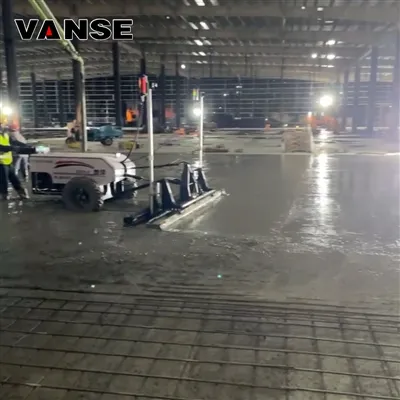
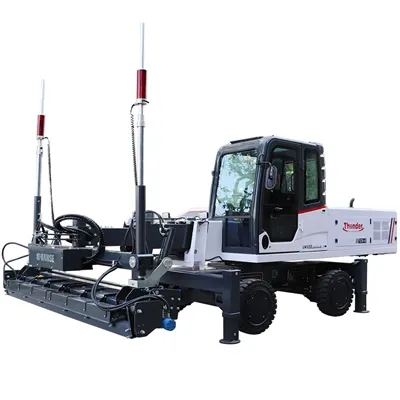
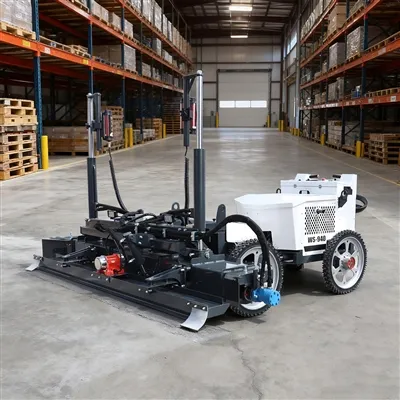
Concrete laser leveling machine operation
The concrete laser leveling relies on laser signals to automatically control the height of the scraper, precisely spreading and initially compacting the concrete.
Advantages: Compared with traditional techniques, it can achieve extremely high flatness (the height difference within a 2-meter straightedge is ≤3mm) and levelness, with extremely high efficiency and reduced reliance on workers.
Synchronous processing: After laser leveling, a large trowel with a diameter of more than 1 meter should be used immediately to lift the slurry and finish the surface, flattening the surface floating slurry and aggregates to prepare for subsequent processing.
Ⅲ. Key Processing Procedures after Leveling (Before Grinding)
Laser leveling merely creates a "rough blank". To meet the standard of a base layer that can be ground, a series of fine treatments are still required.
1. Finishing and smoothing
Timing control: The mechanical trowel operation should be carried out after the initial setting of the concrete and before the final setting (when the depth of the footprints left by a person standing on it is approximately 2-3mm).
The process is usually carried out in 2 to 3 rounds. For the first coat, use a disc to lift the slurry and smooth it out. Subsequently, switch to different trowelers for cross-operation to smooth and polish the surface. High-quality polishing is the core for achieving a hard, dense and uniform surface.
2. Maintenance
Objective: To ensure the full hydration of cement, enhance its strength and prevent cracking.
Method
Recommendation: Spray the special concrete curing agent to form a sealing film.
Traditionally effective: Cover with plastic film or lay non-woven fabric and sprinkle water to keep it moist.
Time: At least 7 days. During this period, no load is allowed.
3. Cutting (shrinking)
Objective: To guide the release of concrete shrinkage stress at the preset position, form neat straight cracks, and avoid irregular cracking.
Timing: Usually within 6 to 24 hours after pouring (when the strength reaches 5 to 10MPa), it should be able to cut through the concrete without carrying the aggregates.
Requirement
Spacing: Generally 20 to 30 times the thickness of the concrete slab, usually 4 to 6 meters.
Depth: 1/4 to 1/3 of the plate thickness.
Position: Align with the center line of the column and the edge line of the equipment foundation to maintain aesthetics.
4. Base inspection (must be carried out before grinding)
Before planning the grinding construction, a comprehensive assessment of the concrete base must be conducted:
Strength: The compressive strength should be ≥25MPa when tested using a rebound tester or core sampling. Insufficient strength and direct grinding will cause the aggregates to peel off.
Flatness: Use a 2-meter straightedge for inspection. The drop at any point should be ≤3mm. Laser-leveled floors can usually be easily achieved.
Moisture content: Tested using a CM type moisture content tester. For epoxy flooring, the moisture content of the base layer should be ≤4%. For the curing agent floor, the requirements can be appropriately relaxed, but there must be no standing water.
Surface quality: Check for no hollowing (by tapping with a small hammer), no sanding, no cracks (except shrinkage joints), no oil stains or other contaminants.
Ⅳ. Pretreatment of the base layer before grinding
Even after the above processes, some pretreatment may still be required before formal grinding:
Cleaning: Thoroughly remove any residual maintenance agent, dust and debris from the ground.
Repair: To repair minor defects, cracks or hollows in a local area. Use high-strength epoxy resin or special cement-based repair mortar.
Preliminary grinding: If there is a slight amount of floating slurry or hardener residue on the surface, it may be necessary to use a metal grinding disc for a preliminary and light grinding to open up the surface pores and prepare for the subsequent penetration of the curing agent or the adhesion of the epoxy primer.
Summary
For special floors, the saying "seven parts base layer and three parts surface layer" is no exaggeration. Laser leveling technology makes it possible to achieve high-quality concrete base layers, but it must be combined with strict material control, precise timing of construction, perfect curing and scientific joint treatment.
A qualified laser-leveled concrete base layer suitable for grinding should possess:
Level: Check with a 2-meter straightedge. The drop should be no more than 3mm.
Strong: Compressive strength ≥25MPa, with a hard surface and no sanding.
Dry: Moisture content meets the standard (epoxy ≤4%).
Clean: The surface is clean, free from contamination and hollowing.
Uniform: The surface is dense and uniform with small color differences.
Only in this way can the subsequent grinding process be carried out efficiently, and the epoxy or curing agent floor can fully demonstrate its best wear resistance, pressure resistance, aesthetic appeal and long service life.
Note: The parameters provided in this document are for reference only and are not mandatory. Due to differences in technical characteristics between different brands and models of laser levelers, please consult the manufacturer for a suitable solution before actual operation. This reference document assumes no responsibility for any issues arising from failure to follow the manufacturer's instructions.
Thanks to All the Friends Who Support and Trust Shandong Vanse Machinery Technology Co., Ltd.
If you want to know more about Shandong Vanse Machinery Technology Co., Ltd. or have any questions, please feel free to contact us:
Our Factory
Shandong Vanse Machinery Technology Co., Ltd.








Share this article

About the Author: Shandong Vanse Machinery Technology Co., Ltd.
Shandong Vanse Machinery Technology Co., Ltd. is a high-tech manufacturer specializing in concrete construction machinery, including laser screeds and related equipment. The company integrates R&D, production, and global sales, with products exported to over 60 countries and widely used in infrastructure projects worldwide.
Previous Post
Next Post
Related Articles
You Might Also Like
How is the construction process of concrete pavement with double-layer steel mesh different from that of single-layer steel mesh?
The construction process of concrete pavement with double-layer steel mesh differs from that of single-layer steel mesh in the following aspects: – Single-layer steel mesh: – Steel bar processing mainly involves straightening, cutting, bending, etc. according to design requirements. After the processed steel bars are transported to the construction site, they are laid directly on the base. – Usually, the steel mesh is placed in the designated position by manual or small machinery, and fixed with iron wire or steel bar horse stool to ensure that there is a certain protective layer thickness between the steel mesh and the base, generally 3-5cm. – Double-layer steel mesh: – In addition to basic steel bar processing, for double-layer steel mesh, supporting steel bars or horse stool bars need to be set between the upper and lower steel meshes to ensure that the spacing between the two layers of steel mesh meets the design requirements, generally about 15-30cm. – First lay the lower steel mesh, and then install the upper steel mesh after fixing it. During the process, the position and spacing of the two layers of steel mesh must be strictly controlled to ensure that they do not shift during the concrete pouring process. – Single-layer steel mesh: – The installation of the formwork is mainly to ensure that its position is accurate and firm, and it can withstand the lateral pressure during concrete pouring. The height of the formwork is generally consistent with the design thickness of the concrete pavement. – Double-layer steel mesh: – Due to the existence of double-layer steel mesh, the installation of the formwork requires higher precision. When installing the formwork, it is necessary to consider the position of the steel mesh and the thickness of the protective layer to ensure that the spacing between the formwork and the steel mesh is uniform, and to prevent the formwork from squeezing the steel mesh and causing its position deviation. – Single-layer steel mesh: – When pouring concrete, the concrete can be directly poured into the formwork, and the inserted vibrator and the flat vibrator can be used to vibrate to make the concrete dense. During the vibration process, be careful to avoid the vibrator rod directly touching the steel mesh to avoid displacement of the steel mesh. – Double-layer steel mesh: – When pouring concrete, in order to avoid the upper steel mesh displacement caused by the impact of concrete falling, a more reasonable pouring method needs to be adopted, such as evenly spreading the concrete along one side of the formwork, allowing the concrete to slowly flow to the other side, or using a layered pouring method. – When vibrating, in addition to using an insert vibrator and a flat vibrator, for the concrete between the double-layer steel mesh, it may be necessary to use a small vibrating rod or vibrating sheet for auxiliary vibration to ensure that the concrete can be fully compacted between the two layers of steel mesh. At the same time, pay more attention to the operation of the vibrating rod to avoid touching the steel mesh and causing it to deform. – Single-layer steel mesh: – After the concrete is vibrated, use a scraper to flatten the surface, and then perform surface treatment procedures such as smoothing, and finally cover with a curing film or sprinkle water for maintenance to keep the concrete surface moist and prevent the surface from losing water and cracking. – Double-layer steel mesh: – During surface treatment, due to the restraining effect of the double-layer steel mesh on the concrete surface, more care should be taken during operations such as polishing to avoid uneven surfaces caused by the influence of the steel mesh. – During the curing process, it is necessary to ensure that the curing measures can fully cure both the interior and surface of the concrete, because the double-layer steel mesh will affect the migration and heat dissipation of the moisture inside the concrete to a certain extent, so the curing time may need to be appropriately extended, generally not less than 7 days. CONCRETE LASER LEVELING MACHINE POWER TROWEL TRACKED MINI DUMPER AMOUR JOINT LIGHT TOWER STEEL FIBERWhat are the components of high-performance laser leveling machine?
The laser leveling machine can bring us many advantages when using it. I believe that all friends who have used it should have realized it. Although everyone is very handy when operating the leveling machine, many friends are not clear about the components of the laser leveling machine. The components of the laser leveling machine: Through some understanding of the above content, I believe that you should now have a clearer understanding of the components of the laser leveling machine. If you are interested in this product and want to know more about it, please contact our online customer service directly, and our staff will provide you with sincere service and detailed answers.What are the specific implementation methods for the multifunctional integrated design of concrete laser leveling machines?
The multifunctional, integrated design of concrete laser leveling is a key approach to further expanding their application scenarios, improving their cost-effectiveness, and enhancing their market competitiveness, building on their intelligent foundation. The core of this design concept is to leverage the leveling platform and utilize modular, switchable functional accessories to achieve "multiple uses in one machine." The following is a detailed explanation of this implementation, which can be understood from several perspectives: This is the most popular integrated approach, designed to allow a single machine to complete multiple closely related floor construction processes. Implementation: A hydraulic or electric vibrator is integrated in front of or within the leveling head. While the leveling blade levels the concrete, the vibrator provides high-frequency vibration to eliminate air bubbles and ensure a dense, compacted concrete. Advantages: Combining two key processes into one reduces the need for separate vibrating equipment and personnel, improving construction efficiency and achieving uniform compaction. Implementation: An adjustable slurry lifter is integrated behind the leveling head. Typically made of metal or composite, this plate kneads the surface immediately after leveling, lifting the cement and fine aggregate slurry to the surface, providing an ideal foundation for subsequent finishing. Advantages: More uniform leveling application, better surface quality, and reduced preparation time for subsequent troweling. Implementation: This is a more advanced integration method, integrating a floating trowel plate or a small-diameter trowel disc behind the leveling head or as a switchable attachment. Preliminary troweling and finishing can be performed immediately after leveling and applying the leveling. Advantages: This further consolidates process steps, making it particularly suitable for floors requiring a high surface finish and effectively reducing the workload of dedicated trowels later on. This is the technical foundation for achieving "multiple uses with one machine," encompassing both the mechanical interface and the control system. Implementation: The mainframe is equipped with hydraulic quick-change connectors. Different working heads (such as leveling heads of varying widths, dedicated vibrating beams, and scrapers) are each designed with corresponding interfaces. Advantages: Operators can change attachments in minutes, without tools, significantly improving equipment flexibility and utilization. Implementation: The main machine provides modular hydraulic power and electrical control interfaces for various attachments. When different attachments are connected, the main control system automatically identifies the attachment type and displays the corresponding operation interface and control program. Advantages: Plug-and-play operation simplifies operation, prevents misoperation, and ensures each accessory operates within its optimal parameters. These designs are designed to meet the needs of specific flooring applications. Implementation: A steel mesh support and unwinding system is installed in front of the leveling. As the machine moves, it automatically raises the pre-placed steel mesh to the designed concrete cover height, where concrete is then laid and leveled. Advantages: Ensures accurate rebar placement and uniform cover thickness. It's particularly suitable for reinforced floors, significantly improving the efficiency and accuracy of rebar placement. Implementation: For floor systems requiring an insulation layer (such as XPS board), a composite machine is designed that first installs the fixed insulation board, then performs concrete paving and leveling on top of the insulation board. Benefits: Combining the two processes reduces equipment entry and exit times and improves composite floor construction quality. Implementation: By replacing the machine with a powerful power system and specialized forming molds, the machine can not only level large floors but also perform continuous slipform construction of linear structures such as curbs and gutters. Advantages: This greatly expands the machine's application range from flat floors to linear structures, making it a multifunctional construction center. These functions don't directly affect leveling, but they can significantly improve construction quality, efficiency, and safety. Implementation: A fluid reservoir and spray boom are integrated into the rear of the machine. After leveling is complete, curing agent is automatically and evenly sprayed according to a pre-programmed schedule. Benefits: This allows for immediate, automated curing, ensuring concrete curing quality. Implementation: As mentioned in the previous question, a total station, GNSS receiver, and other equipment are integrated into the machine as standard equipment, enabling fully automated, high-precision control. Advantages: This represents the highest level of functional integration, integrating the core decision-making function of "measurement" to achieve truly intelligent construction. In summary, the multifunctional integrated design of the concrete laser leveling machine is a systematic project, primarily reflected in the following aspects: Mechanical: Utilizes quick-change interfaces and modular accessories. Hydraulically/electrically: Provides standardized power and control interfaces. Functionally: Vertically integrates process steps (vibration, slurry preparation, and troweling), while horizontally expanding applications (reinforcement mesh, insulation board, and slipforms). Intelligently: Integrated measurement and decision-making systems, supplemented by automated auxiliary functions. This design trend has transformed a single device from a simple "leveling tool" into a highly flexible "concrete surface treatment automation platform," meeting the comprehensive efficiency, quality, and cost control requirements of modern construction. Note: The parameters provided in this document are for reference only and are not mandatory. Due to differences in technical characteristics between different brands and models of laser levelers, please consult the manufacturer for a suitable solution before actual operation. This reference document assumes no responsibility for any issues arising from failure to follow the manufacturer's instructions.