Technical Knowledge
Is a concrete laser leveling practical? Any highlights?

Must be practical! Let me tell you about it~ Let’s talk about the advantages first: it is simply the favorite of all major "contractors".
First, compare with humans.
1. Save more labor costs.
Anyone who has done construction knows that if the concrete leveling work is done manually, at least 15 people will be needed. If calculated according to the current manual labor cost, the daily labor cost will be more than 3,000 yuan. If the latter is used, the labor required is doubled, and 8 people can complete the job, which greatly saves labor costs.
2. Save more construction time.
If manual construction is used, the amount that 15 people can complete per day is relatively limited, less than 800 square meters. If time is limited, this cannot meet the completion progress requirements at all. But if you use the latter, its construction speed is faster, several times that of manual construction. In this way, its construction period is shortened a lot, and you don't need to worry about asking for help from everywhere if it can't be completed within the construction period.
3. Better guarantee the construction quality.
If manual labor is used, the construction is mostly based on one's own experience. If there is insufficient experience, there will often be some cracking and other substandard quality. If a laser leveling machine is used, its construction procedures have been input into the program before the machine is completed. It is constructed according to free procedures, and the quality can be said to be relatively standard, which greatly saves the need for rework. cost. And the flatness is very good, the error is within 3 mm.
Then there are the advantages of construction.
First:
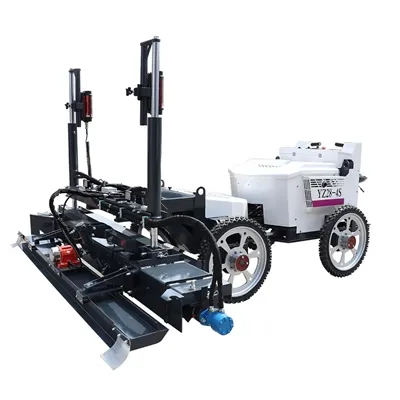
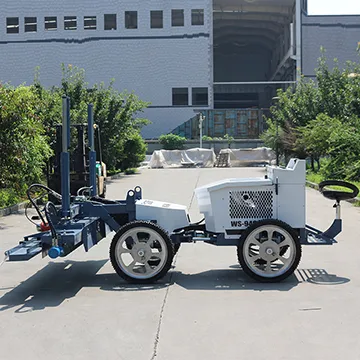
The working principle of the laser leveling machine is mainly through its own various equipment, such as more advanced laser technology, which enables it to perform hundreds of data calculations and feedback within a minute, and also uses Complex closed-loop control technology accurately reflects various construction conditions to the brain of the equipment through the closed-loop system, and then responds quickly through the program set by the equipment personnel. There is also a very excellent hydraulic control system that reflects the equipment. Various electrical signals can be processed very quickly. This process is automatically completed on the computer. This is the biggest construction feature of the laser leveling machine. It is fully automatic and does not require human help. It only requires preliminary work. Set standard parameters.
Second:
The laser leveling machine can automatically control the plane, whether it is horizontal or vertical. This means that after setting the parameters on a plane, you do not need to manually control the machine. It automatically searches and positions within this working range, and then performs leveling and vibration through its own equipment, so that the construction can achieve various desired indicators. The accident personnel only need to perform simple operations and care to complete the project plan. It is a construction machine that can free the hands of construction workers. This is the second construction feature of the laser leveling machine, which can effectively release the labor intensity of construction workers, thereby reducing the construction party’s expenditure on employees to a certain extent.
Third:
When using the laser leveling machine, you only need to let the workers place the equipment and set all the parameters in the equipment. After turning on the machine, the construction staff can perform simple controls to complete a very large area. Construction processing, because it uses modern laser equipment. It is easy to operate and uses an electronically controlled operating system. Only one staff member is required to operate and perform timely maintenance at the construction site. The daily working efficiency is 3000 to 5000 square meters. This is his third characteristic: simplicity and efficiency. To put it simply, it saves time, effort, worry, and is very efficient! ! !
If you want to know more you can follow us! ! !
Thanks to All the Friends Who Support and Trust Shandong Vanse Machinery Technology Co., Ltd.
If you want to know more about Shandong Vanse Machinery Technology Co., Ltd. or have any questions, please feel free to contact us:
Our Factory
Shandong Vanse Machinery Technology Co., Ltd.








Share this article

About the Author: Shandong Vanse Machinery Technology Co., Ltd.
Shandong Vanse Machinery Technology Co., Ltd. is a high-tech manufacturer specializing in concrete construction machinery, including laser screeds and related equipment. The company integrates R&D, production, and global sales, with products exported to over 60 countries and widely used in infrastructure projects worldwide.
Previous Post
Next Post
Related Articles
You Might Also Like
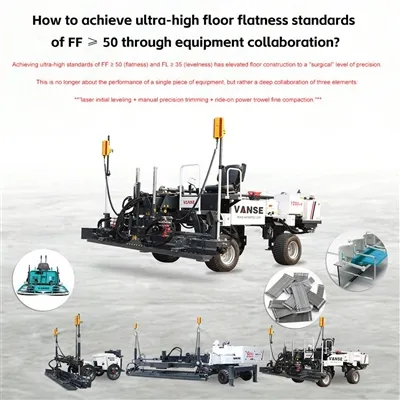
How to achieve ultra-high floor flatness standards of FF ≥ 50 through equipment collaboration?
Achieving ultra-high standards of FF ≥ 50 (flatness) and FL ≥ 35 (levelness) has elevated floor construction to a "surgical" level of precision. This is no longer about the performance of a single piece of equipment, but rather a deep collaboration of three elements: **"laser initial leveling + manual precision trimming + ride-on power trowel fine compaction."** The following is a practical equipment collaboration plan for achieving FF ≥ 50: To achieve FF ≥ 50, the error propagation between equipment must be controlled at the millimeter level. Equipment Selection: A large telescopic arm laser leveling machine must be used, as its leveling head stability is far superior to smaller machines. Coordination Techniques: The laser sensor frequency should be set to the highest level. During the leveling process, the operator needs to reduce the travel speed by 30%, giving the hydraulic system more ample response time to correct the elevation. Role: This is the decisive factor in crossing the threshold from FF30 to FF50. Coordination Techniques: After laser leveling and before the initial setting of the concrete, two experienced technicians use 3m – 4.5m long-handled straightedges to perform a crisscross, back-and-forth leveling in a grid pattern. Accuracy Correction: The straightedge must be perpendicular to the direction of travel of the laser leveling machine, aiming to eliminate the subtle waviness generated by the laser head during gear changes or overlapping paving. In projects where FF ≥ 50, power trowels are used not only for polishing but also to eliminate small bumps through compaction. Equipment: Heavy-duty ride-on power trowel. Coordination: Real-time monitoring with an infrared level is essential. If any localized elevation deviations are detected, use the power trowel's disc to "push and fill" the slurry to correct the level. Angle Control: The tilt angle of the trowel blades must be strictly consistent. Overlapping Coverage: Use the "1/2 overlap method," meaning the path of the second pass must overlap half of the first pass to ensure there are no unpolished areas or steps. In ultra-high standard construction, testing cannot wait until the next day; it must be a process of **"construction, testing, and correction simultaneously."** Equipment: Dipstick automatic flatness tester (or similar F-Number testing instrument). Immediately after the first pass of fine leveling and finishing, the technician conducts spot checks on the floor. If a downward trend in the FF value is detected, the finishing machine operator is immediately instructed via radio to repeatedly compact the high spots or add small amounts of material to the low areas. Thermal Correction: Corrections are completed while the concrete is still plastic; this is the last opportunity to achieve FF50. Stages Equipment coordinated operation Accuracy Objectives Spreading Laser Leveling for uniform spreading + manual assistance for filling material at the edges of the formwork Error: ±3 mm Initial leveling Long-handled Leveling (horizontal + vertical) reciprocating motion for more than 3 passes Eliminate mechanical undulations Grouting Ride-on power trowel (with disc attachment) for overlapping compaction Ensure uniform density Fine leveling Final manual leveling using a 3-meter Leveling Eliminate grout ridges left by the disc Final finishing High-speed trowel blades for finishing + real-time monitoring and feedback Achieve FF ≥ 50 Even the best equipment cannot achieve the desired results if the materials are not compatible: Slump coordination: The slump variation of each batch of concrete must be controlled within ±10 mm. Temperature control coordination: Indoor wind speed should be controlled below 2 m/s to prevent rapid water loss from the surface, which can lead to drying shrinkage and damage the achieved flatness. Note: The parameters provided in this document are for reference only and are not mandatory. Due to differences in technical characteristics between different brands and models of laser levelers, please consult the manufacturer for a suitable solution before actual operation. This reference document assumes no responsibility for any issues arising from failure to follow the manufacturer's instructions.How to avoid scams when buying a laser leveling machine?
Many consumers are still prone to falling into the trap of low prices when buying laser leveling machines, and buying some products of unknown brands. This way of buying is very unwise. We should still believe in the power of brands when buying products. The equipment of big brands has already left other small manufacturers behind by several streets in terms of knowledge and after-sales service. "High degree of automation, low labor intensity, saving templates and channel steel, reducing labor input, and smoother ground"… Based on various advantages, laser leveling machines are now highly sought after by the construction floor industry and have become star products in engineering machinery and equipment. Driven by unlimited business opportunities and market interests, many companies have begun to join in, and Xuancheng itself is a professional brand, a professional manufacturer, and a product expert. This phenomenon makes consumers not know how to choose when buying laser leveling machine products. Here, Shandong VANSE Machinery Editor specially sorted out several precautions for buying laser leveling machines to help users stay away from "being fooled" and find truly professional and focused good brands and good products. For high-tech products such as concrete laser leveling machines, in addition to technological innovation, there is another important factor that affects the quality of concrete laser leveling machines, that is, experience. How to define laser leveling machine products of different models and specifications? How to deal with the flatness of the ground? How to position the laser transmitter and other issues require years of long-term accumulation to accurately grasp. If users hastily buy products from entry-level brands when choosing laser leveling machine products, they are likely to become "guinea pigs" and encounter various troubles. It is very simple to identify whether this brand is just getting started. You only need to check its patent registration time and understand the real cases in the past. For the current phenomenon and confusion in the laser leveling machine industry, industry insiders believe that consumers' trust in a company in the final purchase is a comprehensive consideration. The price factor may account for 25% of it, but in the end, consumers still consider comprehensive factors. Today, when consumption habits are becoming more rational, low prices can only be a gimmick to attract consumers' attention. The real sign of measuring the success or failure of an enterprise is the product quality, after-sales service and the company's own strong strength. At present, the reshuffle trend of the laser leveling machine industry is becoming more and more obvious. For laser leveling machine companies with insufficient terminals, imperfect networks, and less well-known brands, they will face greater pressure. Shandong VANSE Machinery has been committed to the research and development and production of concrete laser leveling machines for many years. Its core components are all produced by large manufacturers in advanced countries such as Germany and the United States. The production process is strictly in accordance with national standards, enterprise standards, and quality control assurance systems to ensure that product quality meets or exceeds the requirements of enterprise standards and relevant national standards. With excellent quality, excellent performance, and superior cost performance, it has won the trust and praise of users. Shandong VANSE Machinery's series of products have been widely used in factories, and customers are all over the country, inside and outside the Great Wall, and have been recognized by partners and customers of many engineering projects such as workshops, underground garages, floors, access bridges, square floors, logistics warehousing, etc. We sincerely invite you to come toHow does concrete laser leveling machine use effect
With the continuous development and progress of science and technology, various mechanical functions are more and more complete, and the demand is increasingly large, leading to a lot of machinery on the market are in short supply, and laser leveling machine is one of them. Then what aspects of the role of leveling machine is played, many people are not very familiar with it, the following Xiaobian from four perspectives to analyze for you, Let you more comprehensive understanding of laser leveling machine equipment. 1, reduce labor costs, double the efficiency. The number of traditional construction, need to support the formwork (channel steel), dot, spread. About 20 people are needed. The daily construction area is 700 square meters. The total number of people using the concrete laser levelling machine is less than half of the traditional process. Can be operated by one person. The daily construction area is 2500 square meters -3500 square meters, greatly reducing the labor cost. 2, laser point, high precision, low error. Traditional technology leveling requires a template to control the elevation of the ground and pull the control line. The elevation error is large. The levelness and flatness of the whole floor cannot be guaranteed. Using laser point emitter, suitable for large area one-time paving. There is a laser measurement and control system to control the elevation in real time, leveling does not need to pull line, the middle does not need to support the side plate to control the ground elevation. In this way, the elevation error caused by the vibration of the formwork (channel steel) in the construction process is avoided, and the elevation error caused by the traditional manual block support die is also reduced. 3. Better flatness and integrity. Traditional technology construction, a day of mold support, a day of watering, can only jump off the construction piece by piece, large limitations, can not be continuous operation, and the integrity is not good, easy to cause the cumulative error of the construction joint. Concrete laser leveling machine for a large area of the floor one-time overall paving, higher efficiency and integrality, the completion of the whole floor makes the ground integrity better, which is completely unable to do traditional construction. 4, the ground is more dense and uniform. High frequency vibrator 4000 times per minute, let the flat head vibrator produce even high frequency vibration, make the concrete floor more compact and uniform.