Technical Knowledge
Laser leveling machine failure is inevitable after long-term use. Early treatment ensures safety
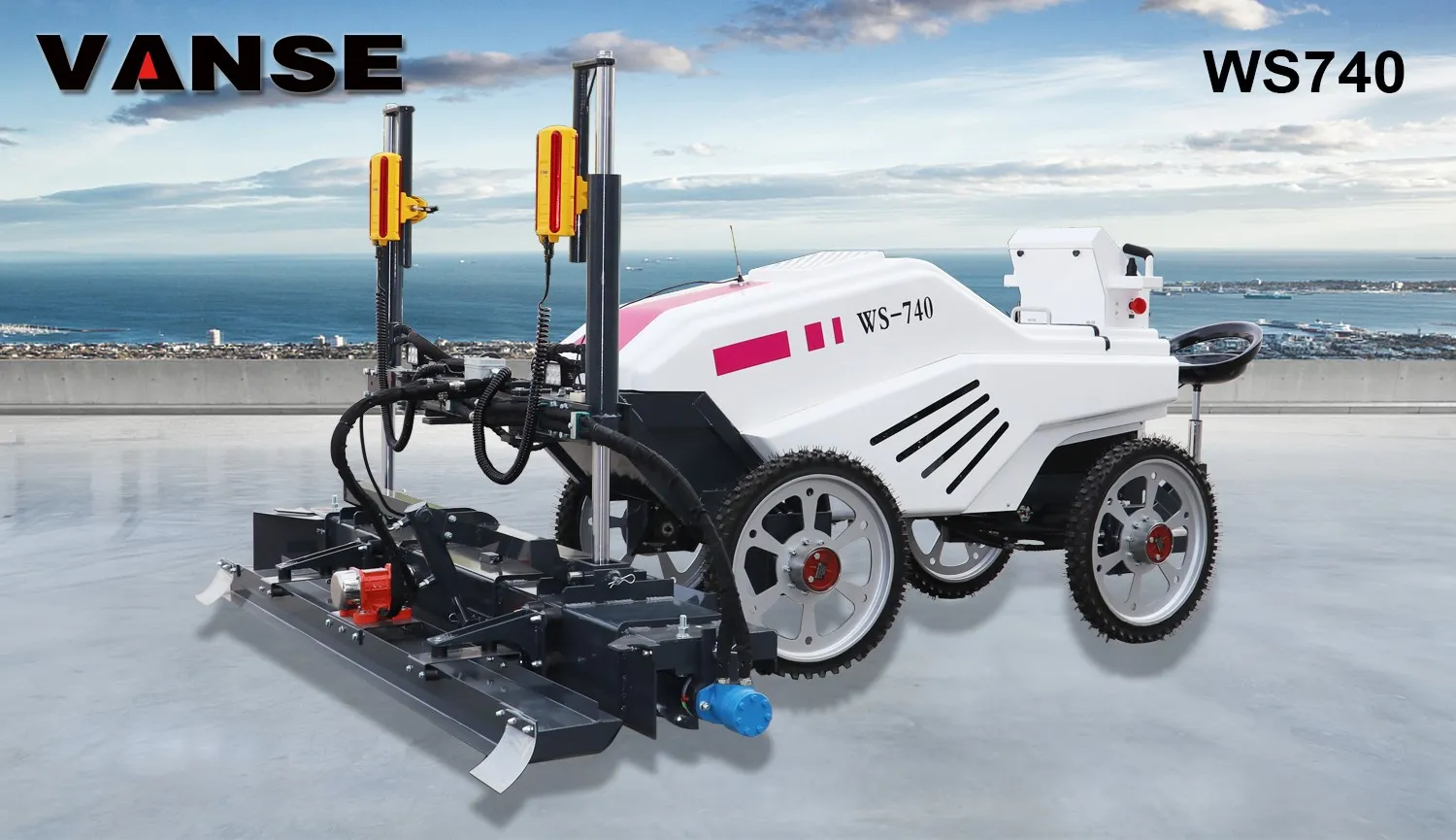
When the laser leveler is working, sanding of the ground is a common fault. The following are the reasons and solutions for sanding of the ground:
I. Reasons
1. Material problems
○ Improper concrete mix ratio, too little cement content or too high mud content in sand will lead to insufficient ground strength and easy sanding.
○ The strength grade of the selected cement is not enough to meet the construction requirements.
2. Construction problems
○ Improper operation of the laser leveler, such as too fast leveling speed, leads to insufficient density of concrete.
○ Poor grasp of the finishing time, too early or too late finishing will affect the quality of the ground.
○ Inadequate maintenance, concrete lacks water during the hardening process, affecting the development of strength.
3. Environmental problems
○ Too high or too low construction environment temperature will affect the coagulation and hardening of concrete and increase the risk of sanding.
○ Low air humidity and too fast evaporation of water on the concrete surface can also easily lead to sanding.
II. Solutions
1. Material aspects
○ Optimize the concrete mix ratio, ensure moderate cement content, and control the mud content of sand.
○ Choose cement with appropriate strength grade to ensure the strength requirements of the ground.
2. Construction
○ Operators should be proficient in the use of laser leveling machines, control the leveling speed, and ensure the density of concrete.
○ Accurately grasp the finishing time, generally finishing after the initial setting of concrete and before the final setting.
○ Strengthen maintenance, such as covering with plastic film and sprinkling water to keep the concrete surface moist, and the curing time is not less than 7 days.
3. Environmental
○ Adjust the construction time and maintenance measures according to the ambient temperature to avoid construction under extreme temperatures.
○ In a dry environment, the number of sprinkling water can be appropriately increased to maintain the humidity of the concrete surface.
Thanks to All the Friends Who Support and Trust Shandong Vanse Machinery Technology Co., Ltd.
If you want to know more about Shandong Vanse Machinery Technology Co., Ltd. or have any questions, please feel free to contact us:
Our Factory
Shandong Vanse Machinery Technology Co., Ltd.








Share this article

About the Author: Shandong Vanse Machinery Technology Co., Ltd.
Shandong Vanse Machinery Technology Co., Ltd. is a high-tech manufacturer specializing in concrete construction machinery, including laser screeds and related equipment. The company integrates R&D, production, and global sales, with products exported to over 60 countries and widely used in infrastructure projects worldwide.
Previous Post
Next Post
Related Articles
You Might Also Like
What long-term impact does a concrete laser leveling have on construction quality?
An automatic concrete floor levelling machine, such as a concrete laser floor leveling machine, utilizes a laser system for highly precise leveling. It can minimize the error in the flatness of the concrete surface. In the long-term use, this high-precision initial flatness ensures that the pressure is evenly distributed when the ground bears various loads. For example, in an industrial plant, the frequent movement of heavy machinery will not cause concentrated stress due to local unevenness of the ground. This effectively prevents problems such as pitting and sanding on the ground, keeping the ground in good condition for a long time and greatly extending the maintenance cycle of the ground. If you are looking for a concrete laser leveling machine for sale, you can find a device that can achieve such long-term flatness effects A concrete laser leveling machine enables more uniform pouring thickness of concrete through accurate leveling. In building structures, uniform concrete thickness helps to ensure the balanced force of the entire structure. Take the floor of a large shopping mall as an example. The floor leveled by a concrete laser leveling machine can better support the upper-level buildings, as well as the loads of people and goods, reducing the risk of structural deformation caused by uneven local thickness. In the long run, this is of great significance for maintaining the overall structural stability of the building, reducing the building structure safety hazards caused by ground problems. The price of a concrete laser leveling machine varies according to different models and functions, but the investment in it can bring long-term structural stability benefits. A well-leveled and evenly-thick concrete surface can effectively reduce water penetration. Water is one of the key factors causing concrete corrosion and steel bar rust. For the floor leveled by a concrete laser leveling machine, due to the reduction of water-accumulation areas, it is difficult for water to penetrate into the concrete interior, thus reducing the carbonation rate of concrete and protecting the internal steel bars from rust. This significantly improves the durability of the concrete structure. Over decades of use, it can still maintain good physical properties, reducing the cost and time of large-scale renovation due to insufficient durability. When considering the purchase of a concrete laser leveling machine for sale, durability improvement should be an important factor to consider. During the leveling process of a concrete laser leveling machine, the compactness of the concrete surface is improved. Under long-term friction from people walking and vehicle driving, the compact surface can better resist wear. For example, in a logistics warehouse, the frequent operation of forklifts causes serious wear to the ground. The ground constructed by a concrete laser leveling machine has obvious wear-resistance advantages, which can keep the surface intact for a long time, reduce dust generated by ground wear, provide a better guarantee for the warehousing environment, and also reduce the frequency of ground maintenance and replacement. Different concrete laser leveling machine prices are related to their performance in aspects such as wear-resistance improvement.Four requirements that must be met in concrete mix design
Concrete mix design is a key link to ensure the quality of the project. It must meet the following four core requirements to ensure that the concrete reaches the expected goals in terms of strength, construction performance, durability and cost: The strength of concrete (such as compressive strength, tensile strength, etc.) must strictly comply with the engineering design standards (such as C30, C50 and other strength grades), which is the basis of structural safety. During the design, it is necessary to accurately calculate the water-cement ratio, select the cement strength grade and aggregate grading to ensure that the concrete reaches the design strength under standard curing conditions. For example, for high-rise buildings or large-span structures, it is necessary to appropriately increase the amount of cement or add high-efficiency water reducer to improve the early strength and later strength reserve of concrete. Concrete must have good workability (including fluidity, cohesion and water retention) to adapt to the construction links such as mixing, transportation, pouring, and vibration. 🌸Flowability: By adjusting the water-cement ratio, sand ratio or adding water reducing agent, the slump or expansion of concrete can meet the requirements of construction equipment (such as the slump of pumped concrete is usually controlled at 120~200mm). 🌸Cohesion and water retention: Avoid segregation or bleeding of concrete during transportation or pouring, which affects the uniformity of the structure. For example, the cohesion of concrete can be improved and stratification can be prevented by increasing the sand ratio or adding mineral admixtures such as fly ash and silica fume. Concrete needs to adapt to the erosion of the long-term use environment and have anti-freeze, anti-seepage, anti-corrosion, anti-carbonization and other properties. 🌸Anti-freeze: In severe cold areas, it is necessary to control the air content of concrete (usually 3%~5%) and add air entraining agent to prevent freeze-thaw cycles from causing structural damage. 🌸Impermeability: By reducing the water-cement ratio, optimizing aggregate grading or adding expansion agents, the density of concrete can be improved to resist the intrusion of moisture and harmful media (for example, underground projects must meet the P6~P12 impermeability grade). 🌸Corrosion resistance: For corrosive environments such as salt spray, acid and alkali, corrosion-resistant cement (such as slag silicate cement) can be used or the thickness of the concrete protective layer can be increased. On the premise of ensuring performance, it is necessary to optimize the material composition, reduce production costs and comply with environmental protection principles: 🌸Reasonable use of admixtures: Add fly ash, slag powder, silica fume and other industrial waste slag to replace part of the cement, reduce the amount of cementitious materials, reduce hydration heat and carbon emissions (for example, the amount of fly ash in large-volume concrete can reach 20%~40%). 🌸Optimize aggregate grading: Use coarse and fine aggregates with continuous grading to reduce the amount of cement paste and reduce the risk of shrinkage cracking. 🌸Control the amount of admixture: Select suitable water reducers, early strength agents, etc., and reduce the cost of admixtures while meeting the performance requirements. Concrete mix design should focus on strength, workabilityas the construction basis, durabilityas the long-term guarantee, and economic efficiencyas the optimization goal. By scientifically adjusting the material composition and proportion, the balance between engineering performance and cost can be achieved. In actual design, it is also necessary to combine specific construction processes (such as whether to use equipment such as concrete laser leveling machines) and material properties for trial adjustment to ensure that the quality of the entire process from mixing to molding of concrete is controllable. Click the below to jump immediately!!! ARMOUR JOINT LASER LEVELING MACHINE LIGHT TOWER POWER TROWEL SLIPFORM MACHINE STEEL FIBER TOPPING SPREADER TRACKED MINI DUMPERIn what scenarios are concrete laser levelings widely used?
Concrete laser levelings are widely used in a variety of scenarios, mainly including the following aspects: 1. Industrial plants and workshops: These places often require large-area, high-precision concrete floors, such as large industrial plants, workshops and automated three-dimensional warehouses. Laser leveling machines can quickly and accurately complete the leveling work of these floors. 2. Electronic appliances and clean workshops: For places such as electronic appliances and clean workshops that require a highly clean environment, laser leveling machines also play an important role because they can provide precise floor flatness and meet cleanliness requirements. 3. Large warehouse supermarkets, logistics centers and exhibition centers: These places also require large areas of concrete floors and high flatness to ensure smooth transportation of goods and safe walking of personnel. 4. Outdoor floors: Outdoor places such as docks, container yards, freight yards, airport runways, aprons, parking lots, squares, residential floors, municipal roads and other outdoor places also require high-quality concrete floors. In these places, laser leveling machines can achieve high-quality leveling of outdoor floors through its high-precision measurement and control technology. In summary, concrete laser leveling machines are widely used in various fields because of their efficient and accurate leveling effects. Places that require high-quality concrete floors.