Technical Knowledge
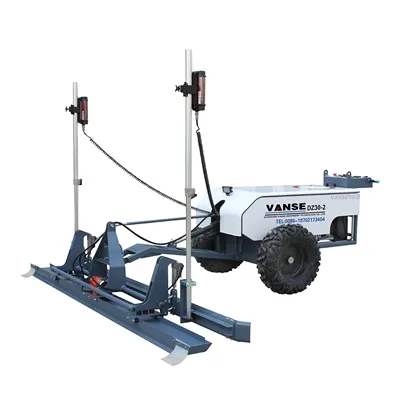
Is the concrete laser leveling machine efficient?

The efficiency of concrete laser leveling machines is relatively high. It uses laser measurement technology to complete large-area leveling operations in a short time and achieve high precision and flatness. Here are some factors that can affect the efficiency of a concrete laser leveling:
✈Smoothing area and working environment
The efficiency of the concrete laser leveling is closely related to the size of the levelinging area and the working environment. When the leveling area is large or the working environment is complex, the work efficiency of the leveling machine may be affected and it will take longer to complete the leveling operation.
✈Operator skills and experience
The skill and experience of the operator also plays a role in the efficiency of the concrete laser leveling. If the operator has rich experience and high skill level, can operate the leveling machine proficiently, and accurately grasps the relevant parameters and routes, then the efficiency of the leveling machine will be relatively high.
✈Automation and control system
The level of automation and control system of a concrete laser leveling also affects its efficiency. The higher the degree of automation and the more advanced the control system, the simpler and faster the leveling machine is to operate, allowing the leveling operation to be completed faster.
✈Maintenance and care
The maintenance and upkeep of a concrete laser leveling is also one of the factors that affects its efficiency. If the leveler is kept in good working condition and the time for breakdowns and repairs is reduced, the efficiency of the leveler will be relatively high.
To sum up, the efficiency of concrete laser leveling machine is relatively high, but it will also be affected by some factors. When choosing to use it, you need to consider the actual situation and choose appropriate machinery and equipment to meet the construction requirements.
Thanks to All the Friends Who Support and Trust Shandong Vanse Machinery Technology Co., Ltd.
If you want to know more about Shandong Vanse Machinery Technology Co., Ltd. or have any questions, please feel free to contact us:
Our Factory
Shandong Vanse Machinery Technology Co., Ltd.








Share this article

About the Author: Shandong Vanse Machinery Technology Co., Ltd.
Shandong Vanse Machinery Technology Co., Ltd. is a high-tech manufacturer specializing in concrete construction machinery, including laser screeds and related equipment. The company integrates R&D, production, and global sales, with products exported to over 60 countries and widely used in infrastructure projects worldwide.
Previous Post
Next Post
Related Articles
You Might Also Like
Compared with traditional leveling machines, how much is the work efficiency improved by laser leveling machines?
Compared with traditional leveling machines, the improvement in work efficiency of laser leveling machines varies depending on the construction scenario, equipment model, construction process and other factors, and can usually be improved by 30%~50% or even higher. The following is a comparative analysis of the efficiency differences between the two from multiple dimensions: Comparison dimensions Traditional leveling machine Laser leveling machine Leveling basis Relies on manual wire drawing and leveling, with fixed elevation as the benchmark Based on the horizontal laser surface emitted by the laser transmitter, the leveling accuracy is automatically controlled in real time Power and operation mode Manually controls the scraper or roller, and adjusts the height based on experience Hydraulic drive + intelligent control system, automatic leveling and vibration compaction Construction coverage The width of a single operation is narrow (usually 1~3 meters), and it needs to be repeated back and forth The single operation width can reach 2~4 meters, or even wider, reducing the number of round trips Shandong Vanse Machinery Technology Co.,Ltd Construction speed: larger coverage area per unit time Traditional leveling machine: Frequent manual measurement of elevation and adjustment of equipment height are required, and the construction area per hour is about 100~200 square meters due to the limitation of manual operation accuracy. For example, when constructing in large areas (such as parking lots and factory floors), it is necessary to work back and forth multiple times, and it is easy to cause rework due to manual errors. Laser leveling machine: The laser system calibrates the height in real time, without frequent shutdown and measurement. The hydraulic system automatically adjusts the height of the leveling beam. It can construct 300~500 square meters per hour, and some large equipment can even reach more than 800 square meters. Taking a 10,000 square meter site as an example, traditional equipment takes about 50~100 hours, while laser equipment only takes 20~30 hours, and the efficiency is improved by 50%~100%. Precision control: reduce time spent on rework Traditional leveling machines: manual control errors are large (usually ±5~10 mm), prone to unevenness, requiring manual repair later, with a rework rate of about 10%~20%, and additional construction time. Laser leveling machines: laser positioning accuracy can reach within ±3 mm, with a high one-time molding pass rate and almost no need for rework. For example, when constructing industrial floors with high flatness requirements (such as warehouses and workshops), traditional equipment may be delayed by 2~3 days due to rework, while laser equipment can directly save this part of time. Labor costs: reduce labor dependence Traditional leveling machines: require multiple workers (such as surveyors, operators, and auxiliary workers), at least 3~5 people to collaborate, and require high worker experience. Laser leveling machines: only 1~2 operators are required (responsible for equipment control and laser system calibration), labor costs are reduced by 50%~70%, and efficiency fluctuations caused by labor fatigue are reduced. Adaptability to complex scenarios: shortening the time spent in special working conditions Traditional leveling machines: When working on slopes, curved surfaces or sites with large elevation differences, manual adjustments are required, which greatly reduces efficiency (may reduce by more than 30%). Laser leveling machines: can be programmed to adapt to a variety of terrains (such as slopes and curved surfaces), and the laser system automatically adjusts the elevation. The efficiency advantage is more obvious in complex scenarios, for example, the efficiency can be increased by 40%~60% when working on slopes. Shandong Vanse Machinery Technology Co.,Ltd Site scale: Small site (such as a few hundred square meters): The equipment debugging time of the laser leveling machine accounts for a high proportion, and the efficiency is improved by about 30%~40%. Large site (tens of thousands of square meters): The "scale effect" of laser equipment is significant, and the efficiency can be improved by more than 50%. Equipment model and configuration: Small laser leveling machine (such as hand-held): suitable for narrow areas, the efficiency is about 1.5~2 times that of traditional equipment. Large driving laser leveling machine: equipped with double vibrating device and wide leveling beam, the efficiency can reach 2~3 times that of traditional equipment. Construction process requirements: Ordinary floor (low flatness requirement): efficiency is improved by about 30%~40%. High-precision floor (such as ultra-flat floor): Laser equipment can meet the standard at one time, avoiding multiple leveling of traditional processes, and the efficiency is improved by more than 50%. Shandong Vanse Machinery Technology Co.,Ltd Case 1: Industrial plant floor construction For a 12,000 square meter plant, a traditional leveling machine was equipped with a team of 4 people and took 12 days to complete; the laser leveling machine was operated by only 2 people and completed in 6 days, with an efficiency increase of 50%, and the flatness error was reduced from ±8 mm to ±2 mm. Case 2: Municipal square construction A 5,000 square meter square contains a sloped terrain. Due to frequent measurement and adjustment, the traditional equipment can only construct 400 square meters per day; the laser leveling machine can only construct 800 square meters per day, with an efficiency increase of 100%, and the flatness of the slope transition meets the standard. Shandong Vanse Machinery Technology Co.,Ltd The laser leveling machine fundamentally reduces manual intervention and rework time through "automatic measurement + precise control + wide-width operation", and its advantages are particularly prominent in large-scale, high-precision construction scenarios. For projects that pursue construction period and quality, its efficiency improvement is not only reflected in time reduction, but also in the optimization of comprehensive costs by reducing manpower and reducing errors. If specific data is required, it can be further calculated based on the project scale and equipment model. Click the below to jump immediately!!! ARMOUR JOINT CONCRETE LEVELING MACHINE LIGHT TOWER POWER TROWEL SLIPFORM MACHINE STEEL FIBER TOPPING SPREADER TRACKED MINI DUMPERHow to Choose the Particle Size & Mix Ratio of Colored Dry-Spread Hardener?
Choosing the particle size and mix ratio of a colored dry-spread hardener (wear-resistant flooring material) essentially involves balancing workability, surface abrasion resistance, and the final color appearance. Because colored flooring requires extremely high visual consistency, the selection of particles is more stringent than for natural-colored flooring. The following is a detailed selection guide: Particle size directly determines the impact resistance and surface smoothness of the floor. Coarse Aggregate (1.5 – 3.5 mm): * Suitable for: Heavy industrial workshops, logistics channels with frequent forklift traffic. Leak inspection: Carefully inspect the entire hydraulic system, including: Features: High impact resistance, but in colored flooring, too many coarse particles can result in a slightly rough surface texture and are prone to "pinholes" during polishing. Fine aggregate (0.1 – 1.5 mm): * Suitable for: Commercial spaces, sidewalks, cleanrooms. Features: Extremely smooth surface, high color fidelity, easy to achieve a mirror finish. Optimal gradation scheme: * Typically uses a continuous gradation, i.e., 30%-40% coarse aggregate + 60%-70% medium-fine aggregate. This combination ensures tight interlocking between aggregates, reducing porosity. Colored dry-spread hardeners are typically pre-mixed from hardening aggregates, high-grade cement, pigment powder, and specialized additives. Aggregate to cementitious material ratio: * Recommended ratio is generally 1:1 to 1.5:1. If the aggregate ratio is too high (e.g., exceeding 2:1), the material's adhesion will decrease, and the colored flooring will be prone to peeling and flaking. Pigment content: * Typically 3% – 8% of total weight. Note: Pigments are fine powders. Excessive content (>10%) will reduce the strength of the surface and increase the risk of cracking; insufficient content will result in unsaturated color, making the underlying concrete color more visible. The amount of paint applied directly affects the depth and wear resistance of the colored flooring. Expected Load Recommended dosage (kg/m2) Construction Methods Light Load (Pedestrian walkways, light storage) 4.0 – 5.0 Manual spreading or light equipment Medium Load (Parking lots, production workshops) 5.0 – 7.0 Automatic spreading machine (spreads material in two stages) Heavy Load (Heavy machinery, unloading areas) 7.0 – 9.0 Specialized equipment must be used to ensure compaction. Colored concrete flooring is most susceptible to color difference, which is directly related to particle size and mixing ratio: Batch Control: Ensure that the hardener used in the same area is from the same batch and has the same mixing ratio. Even slight differences in particle size between different batches can lead to inconsistent light reflection. Two-Coat Application Method: * Apply 2/3 of the amount in the first coat, using the concrete moisture to wet it; Apply 1/3 of the amount in the second coat, specifically to fill in any sparse areas of color left from the first coat. Use Nano Hardener: After construction, it is recommended to use a nano sealing and curing agent. It fills the tiny gaps between the aggregates, "locking in" the colored particles and improving color durability by more than 50%. Note: The parameters provided in this document are for reference only and are not mandatory. Due to differences in technical characteristics between different brands and models of laser levelers, please consult the manufacturer for a suitable solution before actual operation. This reference document assumes no responsibility for any issues arising from failure to follow the manufacturer's instructions.Troubleshooting Multiple Possible Causes of Unexplained Power Trowel Machine Shutdown
Unexplained stalling of a power trowel is a common but headache-inducing problem. To conduct a systematic investigation, one can follow the principle of "from simple to complex and from outside to inside". The following is a detailed investigation of multiple possibilities. You can start checking from the simplest and most likely cause: Possibility: The fuel has expired and deteriorated (gelatinized), water has been mixed in, the fuel grade is incorrect or the fuel quality is too poor. Investigation and resolution: Check the color and smell of the fuel. Fresh gasoline is transparent, while spoiled gasoline will turn yellow or have a pungent smell. Immediately empty the old fuel tank completely and then refill it with clean, fresh unleaded gasoline of grade 92 or above. It is recommended that the fuel tank not be filled with oil for a long time. Possibility: The vent hole of the fuel tank cap is blocked, causing a vacuum to form inside the fuel tank and preventing the fuel from flowing down. Troubleshooting and resolution: When the engine is turned off, immediately open the fuel tank cap to listen for a "sizzling" sound of air intake. Or next time when the engine is turned off, try loosening the fuel tank cap to see if it returns to normal. Clean the vent of the fuel tank cap or replace the fuel tank cap. Possibility: The main fuel gauge hole, idle fuel gauge hole and other parts inside the carburetor are blocked by impurities and gum, resulting in poor fuel supply. Troubleshooting and resolution: Check if the fuel filter (if any) is dirty. Try repeatedly pressing the "oil bubble" on the carburetor (if any). Cleaning the carburetor is the most efficient solution. The carburetor needs to be removed and all oil lines and measuring holes thoroughly rinsed with carburetor cleaner. For old machines, the cost of directly replacing a new carburetor is not high either. Possibility: The air filter was severely clogged with dust and cement powder, causing the engine to "suffocate", resulting in insufficient air intake and stalling. Troubleshooting and resolution: Remove the air filter and observe if it is so dirty that the original color cannot be seen clearly. Clean or replace the air filter. On construction sites with a lot of dust, air filters should be cleaned more frequently (after each shift). When cleaning, use compressed air to blow from the inside out. Possibilities: Severe carbon deposits on the spark plugs, improper electrode gap, cracked porcelain body or mismatched model. Troubleshooting and resolution: Remove the spark plug and check the condition of its top. The normal one should be brown or light gray. If there is black carbon deposit, it indicates incomplete combustion. Clean the carbon deposits, adjust the gap with a feeler gauge to the requirements of the manual (usually 0.6-0.7mm), or directly replace it with a new spark plug of the same model. Possibility: The flameout wire (usually a thin wire) connected to the spark plug has poor contact, short circuit or open circuit, causing the spark plug to accidentally shut off. Troubleshooting and resolution: Check whether the connection of the flameout wire is loose and whether the insulation is damaged. You can try temporarily disconnecting the flameout wire (to keep the switch in operation), and then pull the rope to start it (pay attention to safety and ensure the machine is stable). If it doesn't flameout, the problem lies in the flameout switch or the circuit. Reconnect or replace the flameout wire/switch. Possibility: It is relatively rare, but the ignition coil malfunctions internally after the engine heats up, causing the spark to weaken or disappear. Troubleshooting and resolution: Usually, the machine starts up normally when cold, but suddenly shuts down after working for a period of time due to overheating, and it is difficult to restart immediately. The machine can be started again after it has cooled down. Professional maintenance personnel are required to test the resistance of the ignition coil. After confirmation, it should be replaced. Possibility: The radiator is clogged with cement or oil stains, resulting in poor engine cooling. High temperatures can cause expansion, cylinder seizure or trigger thermal protection, leading to engine stalling. Troubleshooting and resolution: Check whether the heat sinks around the cylinder are clean. Thoroughly clean the blockages on the heat sink. At the same time, check the oil level and quality to ensure normal lubrication. Possibility: After long-term use, the valve clearance changes (usually becomes smaller), causing the valves to not close tightly when the engine is hot, resulting in a decrease in the compression ratio and stalling. Troubleshooting and resolution: The cold start and low-speed operation are normal, but the engine stalls as soon as the accelerator is increased or after working for a period of time. Professional maintenance workers need to use a feeler gauge to check and adjust the intake and exhaust valve clearances to the specified values. Step 1: Check the fuel -> Change to new oil! Step 2: Check the air filter -> Clean or replace! Step 3: Check the spark plugs -> Clean/Adjust/replace! Step 4: Check the fuel tank cap -> Try loosening it! Step 5: Clean the carburetor -> This is the most likely cause! If none of the above steps can solve the problem, then the issue might be more difficult to handle (such as ignition coil or valve problems). It is recommended to contact professional maintenance services. Note: The parameters provided in this document are for reference only and are not mandatory. Due to differences in technical characteristics between different brands and models of laser levelers, please consult the manufacturer for a suitable solution before actual operation. This reference document assumes no responsibility for any issues arising from failure to follow the manufacturer's instructions.