Technical Knowledge
How to change the concrete laser leveling wheels

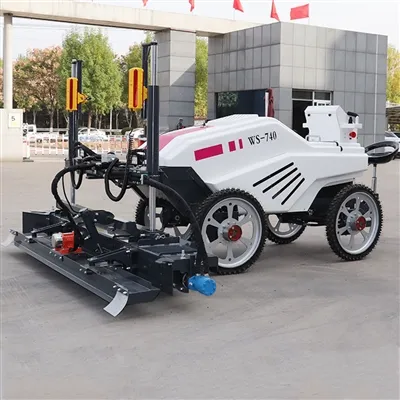
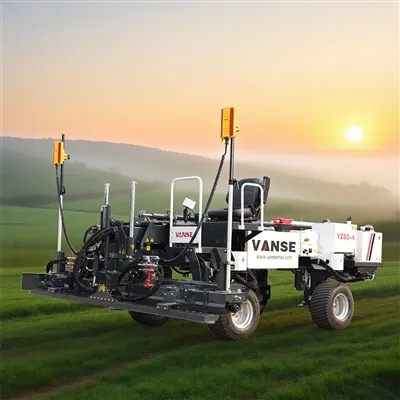
For the concrete laser leveling, the tire is the necessary factor to walk, is an important accessory of the equipment. Once there is a problem with the tire of the laser leveling machine, it will directly cause the equipment to fail to function properly.
The Method Of Quick Tire Replacement
1.Starting the machine, look for a relatively flat open field, press down the boom lift rod, use the boom support to remove the front wheel off the ground, and then support the flash bridge close to the flat tire side, and wedge the rear wheel (must work closely with the driver to avoid personal injury).
2, the use of crowbar and other tools, remove the bezel and lock ring and then check whether the tire liner and the outer surface of the rim is adhesion (the tire use time is longer, the liner and the outer surface of the rim can be adhesion). If the support can be removed, so that the machine in a short distance slow back and forth until the liner is separated from the outer surface of the rim; Then, the front wheels are back up.
3, the internal and outer tire of the relative position of the mark, in order to find, remove foreign objects and repair tires.
4, using the crowbar and other tools, the tire from the rim to remove. Note that the action should be gentle with the tacit understanding, to avoid being hit by tires, and to protect the valve nozzle.
5.After the outer tire is injured by nails and other slender foreign bodies, if the surface does not have a significant opening or the wound is small, then the tire can continue to be used, if the opening is large, must be repaired (because the machine is operated, the tire is crushed and frictiond, a long time will damage the inner tube, even the opening is larger and larger, the inner tube protrudes, resulting in tire scrapping).
6. If the new inner tube, the bolts at the bottom of the valve nozzle must be tightened to prevent leakage, and then remove the foreign body from the inner cavity of the outer tube and sprinkle it with appropriate talcum powder, applied evenly.
In order to make the liner and the inner and outer tire tight, after loading the inner tube should be properly inflated for the inner tube, and then stuffed into the pad.
7, the tire mounted on the rim, installed lock ring, bezel;
8, with the car air compressor to the tire inflatable.
9, press down the boom lift rod, take out the laser leveling machine bracket;
Shandong Vanse Machinery has large, medium, small, various models of laser concrete flatflating machine, suitable for large-scale workshop plant.
When you choose Vanse equipment, you also choose to have peace of mind after-sales protection. We provide quality after-sales service for all customers 365 days a day. If you have any problems with your equipment, please feel free to contact us at any time. Remote telephone after-sales guidance is an efficient after-sales support method. Our after-sales service engineers will get in touch with you as soon as possible and help you to restore the normal operation of the equipment as soon as possible.
Vanse Service, anywhere and anytime!!!
Thanks to All the Friends Who Support and Trust Shandong Vanse Machinery Technology Co., Ltd.
If you want to know more about Shandong Vanse Machinery Technology Co., Ltd. or have any questions, please feel free to contact us:
Our Factory
Shandong Vanse Machinery Technology Co., Ltd.








Share this article

About the Author: Shandong Vanse Machinery Technology Co., Ltd.
Shandong Vanse Machinery Technology Co., Ltd. is a high-tech manufacturer specializing in concrete construction machinery, including laser screeds and related equipment. The company integrates R&D, production, and global sales, with products exported to over 60 countries and widely used in infrastructure projects worldwide.
Previous Post
Next Post
Related Articles
You Might Also Like
How To Perform Regular Inspection And Maintenance Of The Consumables Of The Concrete Laser Leveling Machine?
How to perform regular inspection and maintenance of consumables of concrete laser leveling machine ※1. Overview of consumables Concrete laser leveling machine is an indispensable large-scale equipment in modern construction. Regular inspection and maintenance of its consumables are of great significance to ensure construction quality and efficiency. Consumables mainly include scrapers, cutting blades, crawlers, filters, hydraulic oil, etc. The condition of these components and materials is directly related to the performance and service life of the leveler. ※2.Inspection cycle setting In order to ensure the stable operation of the leveling machine, a reasonable inspection cycle must be set. It is generally recommended that new machines be inspected every half month in the first three months, and then checked once a month. After one year of operation, it is recommended to be inspected every three months. For equipment with harsh working environment or high frequency of use, the inspection cycle should be shortened appropriately. ※3.Inspection of worn parts Check the wear of scrapers, cutting blades and other easily worn parts, especially those in direct contact with concrete. During inspection, attention should be paid to whether there are cracks, breaks, excessive wear, etc. At the same time, check whether the tracks are worn, broken or loose, and whether there are foreign objects embedded in them. ※4. Consumable replacement standards Establish reasonable replacement standards based on component wear and recommendations in the instruction manual. For example, when the scraper wear thickness exceeds 5mm, replacement should be considered; when the scraper blade is severely deformed or wear exceeds 2mm, it needs to be replaced; when the track wear exceeds 1/3 of the original thickness, new parts should be replaced. Properly setting replacement standards can avoid equipment performance degradation. ※5. Detailed explanation of maintenance steps (1) Cleaning equipment: Regularly clean the dust and concrete residue on the surface of the leveler to keep the equipment clean. (2) Check the oil: Check whether the hydraulic oil, gear oil and other oils are sufficient and clean. If they are contaminated or insufficient, they should be replaced and replenished in time. (3) Tighten loose parts: Check whether all parts of the equipment are loose, and if so, tighten them in time. (4) Replacement of consumables: timely replacement of seriously worn parts and consumables in accordance with set replacement standards (5) Lubrication and maintenance: Lubricate and maintain the parts that need lubrication to ensure smooth operation of the equipment. ※6.Safety precautions (1) When performing inspection and maintenance, be sure to ensure that the equipment has completely stopped running and disconnected from the power supply to avoid accidents. (2) Use appropriate tools and equipment for maintenance to avoid equipment damage or personal injury caused by the use of inappropriate tools. (3) During the maintenance process, pay attention to safety measures such as fire prevention and electric shock prevention to avoid safety accidents. ※7.Performance optimization suggestions (1) Regularly conduct overall performance testing of the equipment, including flatness, speed, accuracy and other indicators to ensure stable equipment performance. (2) Based on the test results, adjust the parameters and settings of the equipment in a timely manner to achieve optimal performance. (3) Strengthen the training of operators to improve operation level and equipment usage efficiency, ※8. Records and reports Establish a complete inspection and maintenance record system to record in detail the time, content, problems discovered and measures taken for each inspection. Major problems and maintenance situations should be reported to superiors in a timely manner so that timely measures can be taken to solve the problems. At the same time, inspection and maintenance records are regularly analyzed and summarized to discover the rules and trends of equipment operation and provide data support for equipment preventive maintenance and fault prediction. In short, regular inspection and maintenance of the consumables of the concrete laser leveling are the key to ensuring stable operation of the equipment and extending its service life. Through reasonable inspection cycle settings, worn parts inspection, consumable replacement standards, maintenance procedures, safety precautions, performance optimization recommendations, and the establishment and improvement of records and reports, the leveling machine can always be maintained in good operating condition. , providing a strong guarantee for construction quality and efficiency.What are the benefits of purchasing a laser leveling machine?
The benefits of purchasing a laser leveling machine are centered on achieving superior quality, dramatically increasing efficiency, and gaining a significant competitive and financial advantage in the concrete flatwork industry. Here are the primary benefits of owning this equipment: Achieve High FF/FL Standards: The machine uses laser transmitters to control the leveling elevation in real-time, ensuring the concrete slab meets or exceeds the tightest Floor Flatness (FF) and Floor Levelness (FL) specifications, such as those required for high-traffic industrial buildings (e.g., FF 50+). Reduced Rework: By maintaining elevation with millimeter-level accuracy, the machine minimizes surface variations. This virtually eliminates the need for costly post-pour corrections like grinding high spots or filling low areas after the concrete has cured. Increased Slab Density and Strength: The integrated high-frequency vibrator (often 4,000 vibrations per minute) consolidates the concrete during the leveling process, resulting in a denser, stronger, and more uniform floor, with reported increases in strength and compactness of up to 25% Significant Labor Reduction: A laser leveling can reduce the required labor crew size for leveling and pouring by 50$ to 70$ compared to traditional methods. This is the single biggest operational saving. Avoided Overtime Costs: The speed and efficiency allow for staggering crew start times and completing larger pours faster, which helps reduce or eliminate high-cost overtime pay. Long-Term Financial Savings: For high-volume contractors (those pouring 120,000 sq. ft. per month), the cumulative savings in labor and avoided rework over the equipment's 8–12 year lifespan can total 740,000$ to 920,000$. Asset Ownership: The purchase is a depreciating asset that can provide tax benefits, and it builds equity for your business over time. Faster Placement: The machine can place, strike-off, and consolidate concrete at a rate that is 4 to 5 times faster than manual levelinging. Increased Daily Output: A single machine can level a huge area, often 2,500 to 3,500 m^2 27,000–37,700 sq. ft. per day, significantly shortening overall project schedules. Large-Pour Capability: It enables single-pour, large-area construction without intermediate formwork, which improves the floor's integrity by reducing construction joints and accumulated elevation errors. Win High-Spec Bids: Owning a laser leveling allows you to bid on and win large, highly specialized projects (like tilt-up construction, data centers, and industrial facilities) that mandate extreme FF/FL specifications which manual methods cannot reliably achieve. Schedule Reliability: Owning the equipment guarantees its availability for your jobs, eliminating scheduling conflicts or delays associated with renting. Adaptability: Modern laser leveling often come with 3D profiling systems, allowing you to easily pour complex designs with multiple slopes, grade breaks, and custom drainage features. Note: The parameters provided in this document are for reference only and are not mandatory. Due to differences in technical characteristics between different brands and models of laser levelers, please consult the manufacturer for a suitable solution before actual operation. This reference document assumes no responsibility for any issues arising from failure to follow the manufacturer's instructions.FF 100 / FL 60 ultra-smooth floor: The complete schedule table of the laser leveling machine + ride-on trowel + topping spreader
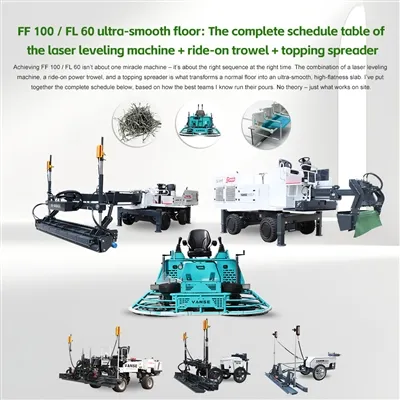
Why This Combination Matters Achieving FF 100 / FL 60 isn't about one miracle machine – it's about the right sequence at the right time. The combination of a laser leveling machine, a ride‑on power trowel, and a topping spreader is what transforms a normal floor into an ultra‑smooth, high‑flatness slab. I've put together the complete schedule below, based on how the best teams I know run their pours. No theory – just what works on site. This table follows a single pour from placement through to joint cutting. Times are referenced from the moment the concrete hits the deck. Adjust for ambient temperature, wind, and mix design, but the sequence stays the same. Time After Placement Operation Equipment Used Key Targets & Checks 0:00 – 0:20 Concrete placement & rough leveling Laser leveling machine (ride‑on or walking type) Hit design elevation ± 3mm; no low spots that trap bleed water 0:20 – 0:45 Laser re‑leveling (if needed) Laser leveling with fine‑tune box Double‑pass over column lines and perimeter edges where settlement occurs 0:45 – 1:30 Wait on bleed water – Concrete must not be worked while bleed water is present; wait until surface looks matte, not glossy wet 1:30 – 2:30 First topping spread (2/3 of total dosage) Automatic topping spreader or manual spreader Even distribution; topping must absorb moisture from the slab before floating 2:30 – 3:30 First mechanical floating Ride‑on power trowel with float pans (48" to 60") Open the surface, embed topping, eliminate any remaining low spots 3:30 – 4:30 Second topping spread (1/3 of dosage) Topping spreader This layer fills any small voids and evens out the surface color 4:30 – 5:30 Final floating & close surface Ride‑on power trowel with float pans or combo blades Surface should be tight enough that foot pressure barely leaves a mark 5:30 – 7:00 Rest period – check bleed & surface condition – If you see moisture coming back, wait; don't close the surface over trapped water 7:00 – 9:00 First finishing pass Ride‑on power trowel with finishing blades Slowly increase blade pitch; use lower rotor speed to avoid tearing 9:00 – 11:00 Intermediate finishing passes (2‑3 times) Ride‑on power trowel with finishing blades Incrementally increase pitch each pass; look for a uniform "velvet" surface 11:00 – 13:00 Final finishing – high‑pitch burnishing Ride‑on power trowel (experienced operator only) High blade pitch, high speed – produce the final dense, glossy surface Within 1 hour of finishing Quality check – FF/FL measurement Dipstick, F‑meter, or profilograph Confirm FF ≥ 100 / FL ≥ 60 before curing compound goes on Immediately after pass Apply curing compound Low‑pressure sprayer, two even coats Full coverage; no puddles; re‑apply over saw cuts later 4‑12 hours after finishing Green saw cutting Early‑entry saw or soft‑cut saw Cut depth ≥ 1/3 slab thickness; follow pre‑planned joint layout 24 hours + Protection & cold weather provisions Insulated blankets or plastic sheeting if cold Maintain slab temperature above 10°C for first 72 hours Laser Leveling – The Foundation If the laser leveling leaves the surface more than 3mm out of plane, no amount of troweling will salvage FF 100. The key is a tight initial grade. I always run the laser receiver on a 900mm mast and double‑check the elevation after the first pass, especially over conduit trenches or at the edges of the pour where the leveling tends to sink slightly. A lot of teams search for laser leveling superflat floor schedule looking for exactly this: the order of operations before the trowels even start. Wait‑on‑Bleed – The Discipline This is where impatient teams lose their FF number. The moment you see someone floating concrete that's still shiny, you know they'll be chasing low spots all night. The surface must go dull – no standing water, no glossy patches. On a cool, humid day, this wait might stretch to 2 hours; on a hot, dry day, it might be 45 minutes. The rule: don't work the surface until it can absorb the topping, because the topping is part of the flatness system. Topping Spreader – Building the Wear Surface An automatic topping spreader ensures uniform dosage, which is critical for both wear resistance and consistent surface color. If you spread manually, use a calibrated bucket and work in two directions. The first 2/3 of the topping is designed to draw moisture from the slab; the remaining 1/3 fills the small imperfections left after floating. Search‑wise, buyers also look for topping spreader ride‑on trowel combination and floor hardener application schedule – so we're answering both searches in one place. Ride‑On Trowel Work – The Heart of FF/FL This is where the machine quality can make or break your numbers. When you run a large ride‑on power trowel, you need consistent blade pitch control and absolutely no vibration at high speeds. The VANSE VS‑series ride‑on power trowels, for example, are built with heavy‑duty gearboxes that maintain blade alignment through multiple finishing passes. No skipping, no chatter – just uniform densification. I'll say this plainly: you cannot achieve FF 100 with a machine that shakes or won't hold pitch. The team on site needs confidence that every pass is improving the surface, not tearing it. After the final burnishing pass with high‑pitch blades, the surface should look uniformly dense – almost like polished stone – with no visible blade marks running off‑track. Curing and Cutting – Protecting the Investment A perfect FF/FL floor will still crack if cutting is delayed or the curing compound is applied unevenly. The joint layout should be pre‑planned with spacing around 2.5m to 3.5m for 150‑200mm slabs. With the dense finish a ride‑on trowel creates, a green saw cut within the first 4‑12 hours is best; don't wait overnight. Search volume for superflat floor saw cut timing remains high, so smart contractors are paying attention to this step. If you're kitting out a team– here's the complete setup I'd recommend for an ultra‑smooth floor operation: Laser Leveling Machine – ride‑on or walking type with a fine‑adjust leveling box. Absolute accuracy at this stage is non‑negotiable. Automatic Topping Spreader – keeps dosage uniform and speed fast enough to match the pour. Large Ride‑On Power Trowel – at least 46" pan, heavy enough to densify, with precise blade pitch control. VANSE VS models fit naturally here; they're designed for multi‑pass superflat finishing and built to handle long hours under load. Walk‑Behind Power Trowel – for edges, corners, and columns where the ride‑on can't reach. A 24‑inch machine like the VANSE VS424 with Honda engine makes tidy work of these areas without tearing the surface. Quality Control Kit – F‑meter or dipstick, floor straightedge, and a good lighting setup for final inspection. Early‑Entry Saw – essential to cut as soon as the concrete can support the operator, before random cracking starts. Buyers searching internationally are combining terms like FF100 floor equipment cost, superflat floor machine package, or laser leveling ride‑on trowel complete set. This section matches that intent exactly. Here's the simple version I give to new foremen: Place and laser‑level immediately. Don't let the concrete stiffen before it's at grade. Respect the bleed water. Wait it out completely. Spread topping in two stages. The first two‑thirds embeds into the slab; the last third finishes the surface. Float with pans, then finish with blades. Increase blade pitch gradually across 3‑4 finishing passes. The ride‑on trowel is your diamond tool. Feed it a good operator and it gives you FF 100; feed it vibration or a worn gearbox and it gives you callbacks. Measure before you cure. And cut while the slab is still "green." This schedule is designed to answer the cross‑section of searches real contractors make: superflat floor finishing schedule, topping spreader ride‑on trowel sequence, FF100 FL60 construction timeline, and more. It's written from the job site, for the job site. If you're building ultra‑smooth floors, this sequence gives you a fighting chance at the numbers – and the right equipment keeps you there consistently. Note: The parameters provided in this document are for reference only and are not mandatory. Due to differences in technical characteristics between different brands and models of laser levelers, please consult the manufacturer for a suitable solution before actual operation. This reference document assumes no responsibility for any issues arising from failure to follow the manufacturer's instructions.