Technical Knowledge
How to calibrate a concrete laser leveling correctly to ensure ±3mm flatness tolerance for super flat floors
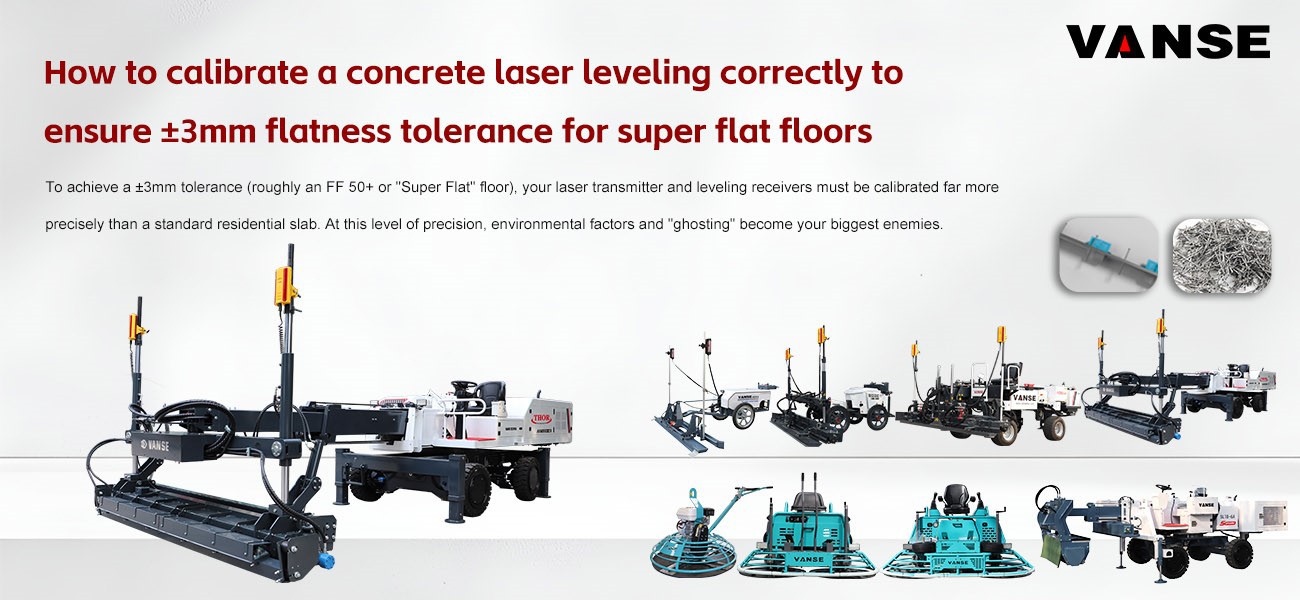
To achieve a ±3mm tolerance (roughly an FF 50+ or "Super Flat" floor), your laser transmitter and leveling receivers must be calibrated far more precisely than a standard residential slab. At this level of precision, environmental factors and "ghosting" become your biggest enemies.
Here is the professional procedure for calibrating a laser leveling system for super flat requirements.
1. Transmitter "Two-Peg" Field Test
Before the pour, you must verify the laser transmitter itself. Even a high-end unit can drift.
The Set-up: Place the laser exactly halfway between two walls (or stakes) approximately 30m (100ft) apart.
Step A: Turn the laser to Face 1 (X-axis). Mark the beam height on Wall A and Wall B.
Step B: Rotate the laser 180° to Face 2. Re-mark Wall A and Wall B.
The Math: If the difference between the two marks on either wall exceeds 1.5mm, the internal pendulum or diode is out of spec.
The "Super Flat" Rule: For ±3mm floors, your transmitter should ideally be accurate to ±1.5mm per 30m to allow for cumulative errors in the receiver and leveling hydraulics.
2. Leveling Receiver Calibration (Auto-Cal)
If you are using a laser leveling (e.g., Vanse), you must calibrate the relationship between the laser receivers and the leveling head.
Hydraulic Warm-up: Run the machine for 15–20 minutes. Cold hydraulic fluid moves slower, causing a "lag" in the auto-leveling that will blow your FF numbers.
Auto-Cal Sequence:
Set the transmitter 20–30m away.
Place the leveling boom at 100% extension.
Enter the machine's "Tuning" or "Service" menu and select Auto-Cal.
The machine will move the cylinders through their full range to "learn" the exact voltage needed to move the head 1mm.
Vibration Check: Ensure the vibrator is ON during the final stages of calibration. The vibration causes "settling" in the head that must be accounted for.
3. Benchmarking the "Grade Rod"
Once the machine is calibrated, you must sync it with the physical site datum.
Establish a Master Benchmark (usually a brass plug or a column mark) away from the pour area.
Set your hand-held laser receiver (grade rod) to this benchmark.
Place the grade rod on the leveling's finish blade (not the plow).
Adjust the leveling's offset until the machine's "On Grade" light matches the grade rod's "On Grade" signal.
4. Critical Factors for ±3mm Flatness
| Factor | Requirement | Why? |
| Wind/Heat | Use a "dead" zone | Wind can vibrate the laser transmitter tripod, causing "beam bounce" (a 1mm shake at the source becomes 5mm at the leveling). |
| Receiver Height | Keep it low | The higher the receivers are on the masts, the more they amplify any "sway" or vibration from the machine. |
| Tripod Stability | Concrete/Solid Earth | Never set the transmitter on a wood deck or loose fill. Use a heavy-duty fiberglass tripod. |
| Overlap | 10–20% | On super flat pours, each pass must overlap the previous one significantly to "erase" the transition line. |
5. Troubleshooting "Digital Drift"
If your numbers are off despite calibration, check for Refraction. On hot days, the laser beam can "bend" as it passes through heat shimmering off the ground.
Solution: Raise the transmitter tripod to 2 meters (6.5 ft) high. This keeps the beam above the hottest air layer near the ground, providing a more stable reference line.
Would you like me to explain how to conduct a "Dipstick" or Floor Profiler test to verify these numbers once the concrete has cured? Contact us NOW
Note: The parameters provided in this document are for reference only and are not mandatory. Due to differences in technical characteristics between different brands and models of laser levelers, please consult the manufacturer for a suitable solution before actual operation. This reference document assumes no responsibility for any issues arising from failure to follow the manufacturer's instructions.
Thanks to All the Friends Who Support and Trust Shandong Vanse Machinery Technology Co., Ltd.
If you want to know more about Shandong Vanse Machinery Technology Co., Ltd. or have any questions, please feel free to contact us:
Our Factory
Shandong Vanse Machinery Technology Co., Ltd.








Share this article

About the Author: Shandong Vanse Machinery Technology Co., Ltd.
Shandong Vanse Machinery Technology Co., Ltd. is a high-tech manufacturer specializing in concrete construction machinery, including laser screeds and related equipment. The company integrates R&D, production, and global sales, with products exported to over 60 countries and widely used in infrastructure projects worldwide.
Previous Post
Next Post
Related Articles
You Might Also Like
Main methods of road leveling
– A grader is a mechanical device specifically used for pavement leveling. It cuts and scrapes the pavement through a scraper and other devices. In roadbed construction, a grader can scrape the ground after filling or excavation to achieve the designed slope and elevation. In the construction of the pavement base and surface layer, a grader can also be used to initially level the paved materials to create conditions for subsequent compaction work. – Pavers are mainly used for paving asphalt pavements or cement concrete pavements. In asphalt pavement construction, the paver spreads the hot-mixed asphalt mixture evenly on the pavement base, and distributes the mixture evenly in the width direction through devices such as spiral spreaders. At the same time, the paving thickness is controlled to ensure the flatness of the pavement. The cement concrete paver spreads the mixed cement concrete on the roadbed, and after vibration, screeding and other processes, a flat cement concrete pavement is formed. – Rollers play a key role in pavement construction. By applying pressure to pavement materials, the particles are squeezed and compacted to achieve the purpose of leveling the pavement and improving the pavement strength. In roadbed compaction, rollers can compact fill and reduce the settlement of the roadbed. In pavement surface construction, different types of rollers such as steel wheel rollers and rubber wheel rollers are used together to compact and level the asphalt pavement or cement concrete pavement so that the pavement meets the specified density and flatness requirements. – In some local areas or small projects, manual leveling is an indispensable supplementary means. Workers use tools such as shovels and rakes to carefully trim the pavement to deal with corners that are difficult to reach by mechanical construction or local unevenness. For example, at the edge of the road, around the inspection well, etc., manual fine-tuning of the material can be done to make it smooth and connected with the overall pavement. In actual road leveling operations, the above methods are usually used in combination according to factors such as road type, construction conditions, and engineering requirements to achieve the ideal road leveling.Welfare! Four steps to clean the laser leveler
With the addition of concrete laser leveling machines in the construction industry and road construction, both quality and speed have been improved, and users have saved a lot of costs. However, in the face of high-frequency use, users cannot ignore the cleaning of the equipment. This step must not be sloppy. Let's take a look at the steps of cleaning the leveling machine! 1. The liquid crystal surface on the body of the laser leveling machine also needs to be cleaned. You can use organic resin or lens cleaning cloth to wipe the dirt. If there is too much dirt, you can use lens cleaning fluid to remove it. 2. There will be a lot of dust and mud on the laser leveling machine after construction. First, wipe the dust on the laser leveling machine clean, and wipe the dirt and oil stains with thin paper or cotton cloth. 3. If the laser signal is lost during the construction of the laser leveling machine, the machine needs to be restarted, and the interval time needs to be more than ten seconds. 4. If there are too many stains, you can soak a soft cloth in water diluted with a neutral detergent, wring it out and wash it. The best laser leveling machine manufacturers remind everyone not to use volatile oil, thinner, gasoline and other chemicals for cleaning and wiping. The laser leveling machine uses a scraper to take away the raised concrete and initially scrape it flat to reach the design elevation. The hydraulically driven vibration motor produces vibrations at a frequency of 4000 times/minute, driving the entire vibration plate to vibrate the concrete together. The laser paver does not need to pull a control line or support a side template to control the ground elevation. Instead, it is controlled in real time by the laser measurement and control system on the laser leveling machine. As long as the laser transmitter is not disturbed, no matter where the laser leveling machine moves, it can ensure that the overall elevation of the paved ground is not affected. The concrete floor laser leveling machine is a construction machine that spreads the mixed concrete along the roadbed according to the given thickness, width and road type requirements, and then completes the paving of the concrete road through vibration, leveling and polishing procedures. The working device of the concrete floor laser leveling machine generally consists of a distributor, a scraper, a vibrator (including a vibrator and a vibrator), a leveler, a trowel and other devices. At the same time, it also requires the organic coordination of the frame, the walking mechanism, the operating control system and some other auxiliary mechanisms. Some models integrate all the devices into one, and some are divided into two or more independent units.How much can the remote monitoring and fault diagnosis system for concrete laser leveling reduce maintenance costs?
The maintenance cost reduction that the remote monitoring and fault diagnosis system for concrete laser leveling machines can bring is a comprehensive figure, and it is difficult to give a fixed percentage as it depends on the usage intensity of the equipment, the backwardness of the original maintenance mode, and the intelligence level of the system. However, we can conduct quantitative analysis from multiple dimensions and provide an estimated range that is generally recognized in the industry. Overall, a mature system can typically reduce the comprehensive maintenance cost by 15% to 30%, and in some extreme or well-optimized cases, it may even be higher. The following is the specific breakdown of cost reduction: Traditional mode: Planned maintenance based on fixed times or hours (maintenance or replacement at the appointed time regardless of whether the equipment is needed or not). This will lead to two kinds of waste: Excessive maintenance: Components that are in good condition are replaced prematurely, wasting spare parts and labor. Insufficient maintenance: Under harsh working conditions, components may break down prematurely but before reaching the maintenance cycle, leading to sudden failures. Remote monitoring mode: The system monitors key parameters such as the engine, hydraulic system, vibration, and temperature in real time. Through data analysis, the remaining service life of components (such as hydraulic pumps, engine cylinder liners, and laser emitters) can be accurately predicted. The reduction in cost is reflected in Extend maintenance intervals: According to actual working conditions, extend the replacement cycle of engine oil and filter elements to save spare parts and labor costs. Avoiding catastrophic failure: Early warning of a bearing that is about to fail can prevent the entire transmission system from being scrapped after its failure, saving tens of thousands or even hundreds of thousands of yuan in maintenance costs and downtime losses Traditional mode: Sudden equipment failure → operator reports → Service engineer rushes to the site (possibly far away) → On-site diagnosis (possibly lacking tools or spare parts) → waiting for spare parts → Repair. The entire process may last for several days. Remote monitoring mode Remote diagnosis: Before or during a fault occurs, the system automatically alarms and transmits the fault code and data back to the monitoring center. Engineers can make a preliminary diagnosis remotely and even guide on-site operators to handle some simple problems. Precise dispatch: Before departure, the fault point and required spare parts are clearly identified to achieve "one visit, problem solved", significantly reducing the maintenance time. The reduction in cost is reflected in For a large-scale construction project, the loss from a key leveling machine being shut down for one day can amount to tens of thousands of yuan (including delayed construction periods, idle worker costs, and breach of contract fines, etc.). Reducing a three-day downtime to one day can save a huge amount of cost. The traditional model: To cope with uncertain maintenance demands, leasing companies or construction enterprises need to stockpile a large number of various types of spare parts, which occupies a significant amount of funds and warehouse space. Remote monitoring mode: Based on predictive maintenance, it can more accurately predict the time and types of spare parts demand. The reduction in cost is reflected in Reduce inventory costs: Cut down on unnecessary spare parts reserves and release working capital. Precise procurement: Purchase as needed to avoid the accumulation of spare parts and their obsolescence and scrapping. Remote monitoring mode: The system can monitor the operating status of the equipment and the operator's operation habits, such as prolonged idling and non-economic zone operation, etc. The reduction in cost is reflected in Reducing fuel consumption: By optimizing operations, it is usually possible to save 5% to 10% of fuel costs, which is a continuous and considerable savings. Reducing improper operation wear and tear: Correcting bad operation habits can reduce equipment wear and tear and indirectly lower long-term maintenance costs. Remote monitoring mode: By always keeping the equipment running in a healthy state and conducting scientific maintenance in a timely manner, it can significantly extend its major overhaul cycle and overall service life. The reduction in cost is reflected in Delay capital expenditure without the need to purchase new equipment in advance. When trading second-hand equipment, complete and traceable digital maintenance records can greatly increase the residual value of the equipment. Cost category Pain points of the traditional model The contribution of the remote monitoring system The expected extent of cost reduction Maintenance and spare parts costs Sudden malfunctions, excessive maintenance, and high spare parts inventory Predictive maintenance, precise spare parts, and avoidance of catastrophic failures Reduce by 20% to 40% Cost of downtime Slow diagnosis, inaccurate assignment of work, and long waiting time Remote diagnosis, precise dispatching, and rapid response Reduce by 30% to 50% Fuel and consumables costs The operation is opaque and inefficient Optimize operations and monitor energy consumption Reduce by 5% to 15% Management and human resource costs Manual recording and scheduling are complex and inefficient Automated management, data-driven decision-making Reduce by 10% to 20% Overall, when all the above factors are combined, a 15% to 30% reduction in the total cost throughout the entire maintenance life cycle is a reasonable and conservative estimate. It should be noted that the prerequisite for achieving these savings is: The system itself is reliable and the data analysis is accurate. There is a professional service team in the background that responds quickly to the data. Enterprises are willing to change their original maintenance processes and embrace a data-driven management model. For large leasing companies or construction enterprises with a large number of devices, investing in such a system usually offers a very considerable return on investment, not only in terms of cost but also strategically significant in enhancing customer satisfaction and building brand competitiveness. Note: The parameters provided in this document are for reference only and are not mandatory. Due to differences in technical characteristics between different brands and models of laser levelers, please consult the manufacturer for a suitable solution before actual operation. This reference document assumes no responsibility for any issues arising from failure to follow the manufacturer's instructions.