Technical Knowledge
How does the concrete power trowel work? Please for example
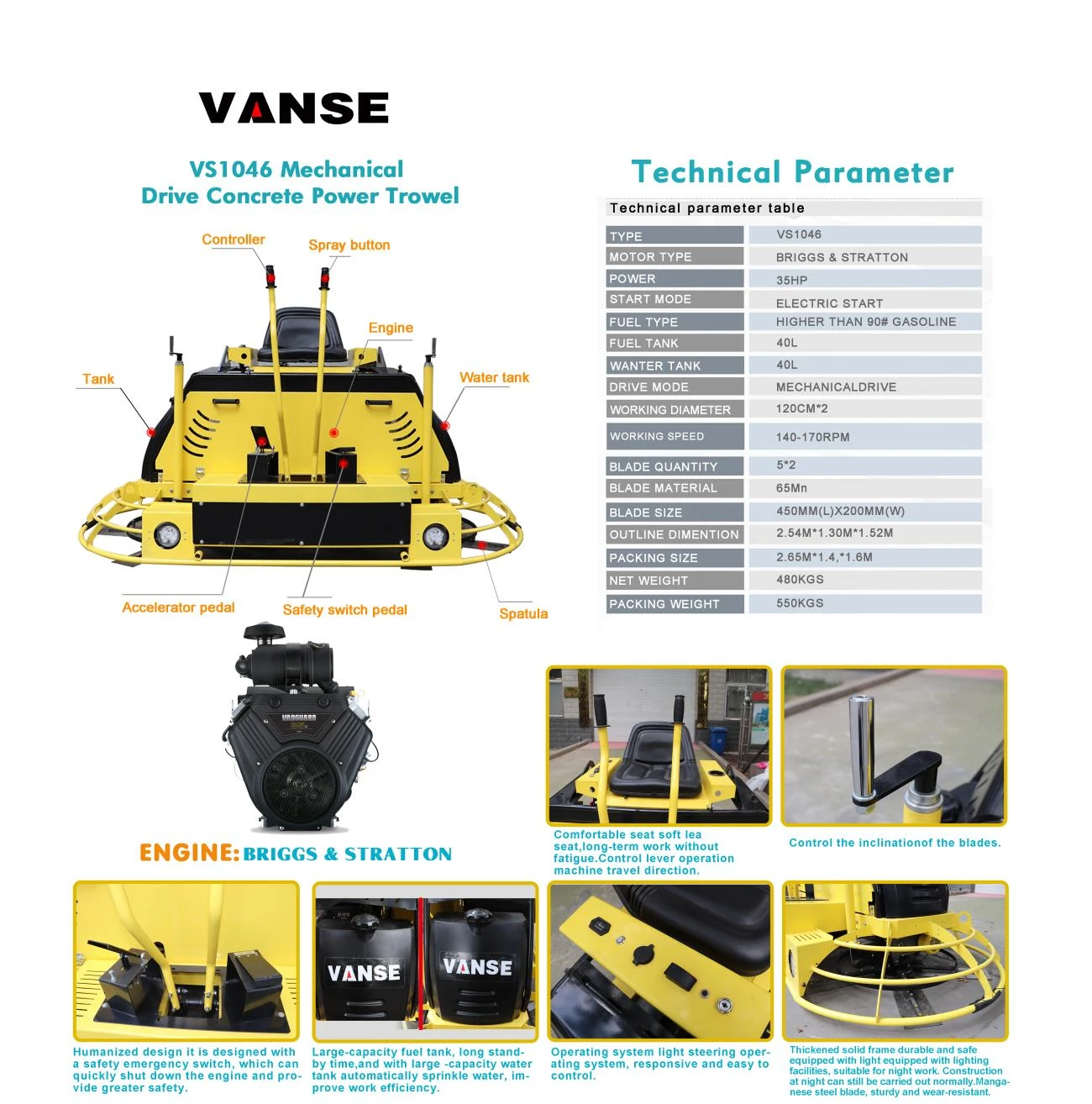
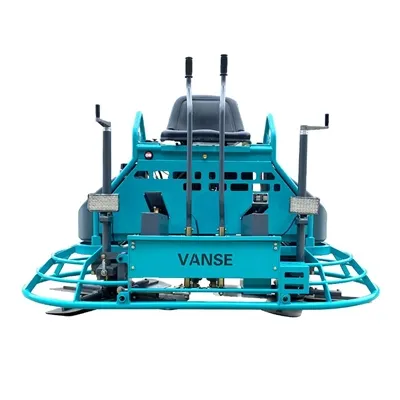
The working principle of the concrete trowel mainly involves the mechanical structure and working power of the machine.
First, a concrete trowel is a machine driven by an electric motor or a fuel engine. When the machine is started, the motor or engine drives the reducer to transmit power to the trowel plate. A trowel is a rotating flat plate equipped with a grinding wheel. The grinding wheel is usually made of high-hardness abrasives or diamonds and can polish cement floors.
Secondly, when the trowel moves flatly, it smoothes and polishes the cement floor. This is because the rotation and pressure of the trowel plate causes the grinding wheel to rub against the concrete floor, thereby grinding and polishing the floor. Through the adjustment device, the movement speed and angle of the trowel plate can be adjusted to meet different construction needs.
In addition, the concrete trowel can also achieve different levels of floor polishing and smoothing by replacing different polishing heads. Different polishing heads can adapt to different concrete strength, texture and surface quality requirements.
To sum up, the working principle of the concrete troweling machine is to use a motor or engine to drive the reducer and transmit the power to the troweling plate, so that the troweling plate can scrape and smooth the cement floor during planar motion. At the same time, the movement speed and angle of the trowel plate can be adjusted through the adjustment device to meet different construction needs.
Thanks to All the Friends Who Support and Trust Shandong Vanse Machinery Technology Co., Ltd.
If you want to know more about Shandong Vanse Machinery Technology Co., Ltd. or have any questions, please feel free to contact us:
Our Factory
Shandong Vanse Machinery Technology Co., Ltd.








Share this article

About the Author: Shandong Vanse Machinery Technology Co., Ltd.
Shandong Vanse Machinery Technology Co., Ltd. is a high-tech manufacturer specializing in concrete construction machinery, including laser screeds and related equipment. The company integrates R&D, production, and global sales, with products exported to over 60 countries and widely used in infrastructure projects worldwide.
Previous Post
Next Post
Related Articles
You Might Also Like
What is the relationship between the compaction effect of the concrete power trowel and the construction efficiency?
-Reduce the number of reworks: When the compaction effect of the concrete trowel is good, the ground is flat and dense, which can effectively avoid the need for re-construction due to uneven or loose ground. For example, in the construction of industrial plant floors with high quality requirements, if the initial compaction and troweling can achieve the standard of flatness deviation within 2-3mm, there is no need for a lot of rework to correct ground defects in the future, thus saving time and labor costs. -Speed up the progress of subsequent construction: The compacted concrete surface is flat and solid, providing a good foundation for subsequent construction (such as laying epoxy floor paint, installing flooring, etc.). For example, when carrying out epoxy floor construction, a well-compacted concrete floor can make the coating of epoxy floor paint more uniform, and the drying speed may also be faster, because the dense concrete surface will not absorb too much solvent in the floor paint, thereby shortening the entire construction cycle. -High one-time molding quality: Concrete with good compaction effect has a more expected strength growth and better surface quality. In some projects with tight construction schedules, the ground that can be formed in one go and meet the quality requirements can be directly put into use or proceed to the next process, greatly improving the overall construction efficiency. For example, when building a parking lot, if the ground strength and wear resistance after the trowel compaction meet the design standards from the beginning, the parking lot can be opened in advance, saving time and money. -Balance between operating speed and compaction quality: If the operating speed of the trowel is excessively increased in pursuit of construction efficiency, the trowel piece will stay in each area for too short a time and cannot fully compact the concrete. For example, in the initial setting stage of concrete, if the trowel passes over the ground quickly, the bubbles inside the concrete may not have time to be discharged, the porosity will increase, and the compaction effect will be affected. Therefore, it is necessary to reasonably improve the construction efficiency while ensuring the compaction effect. -The importance of construction sequence and rhythm: A reasonable construction sequence and rhythm help to ensure both compaction effect and construction efficiency. For example, in the construction of large-area concrete floors, the entire area should be preliminarily compacted first, and then fine compaction and troweling should be carried out. If the construction sequence is chaotic, such as starting fine grinding before completing the initial compaction in some areas, it will lead to uneven ground compaction, which may require rework later, but reduce construction efficiency. At the same time, the rhythm of the construction process is also very important. For example, the start, stop, and turn of the trowel should be smooth and orderly to avoid frequent irregular operations that affect the compaction effect and work efficiency.What are the compatibility requirements between concrete topping spreaders and different concrete surface textures
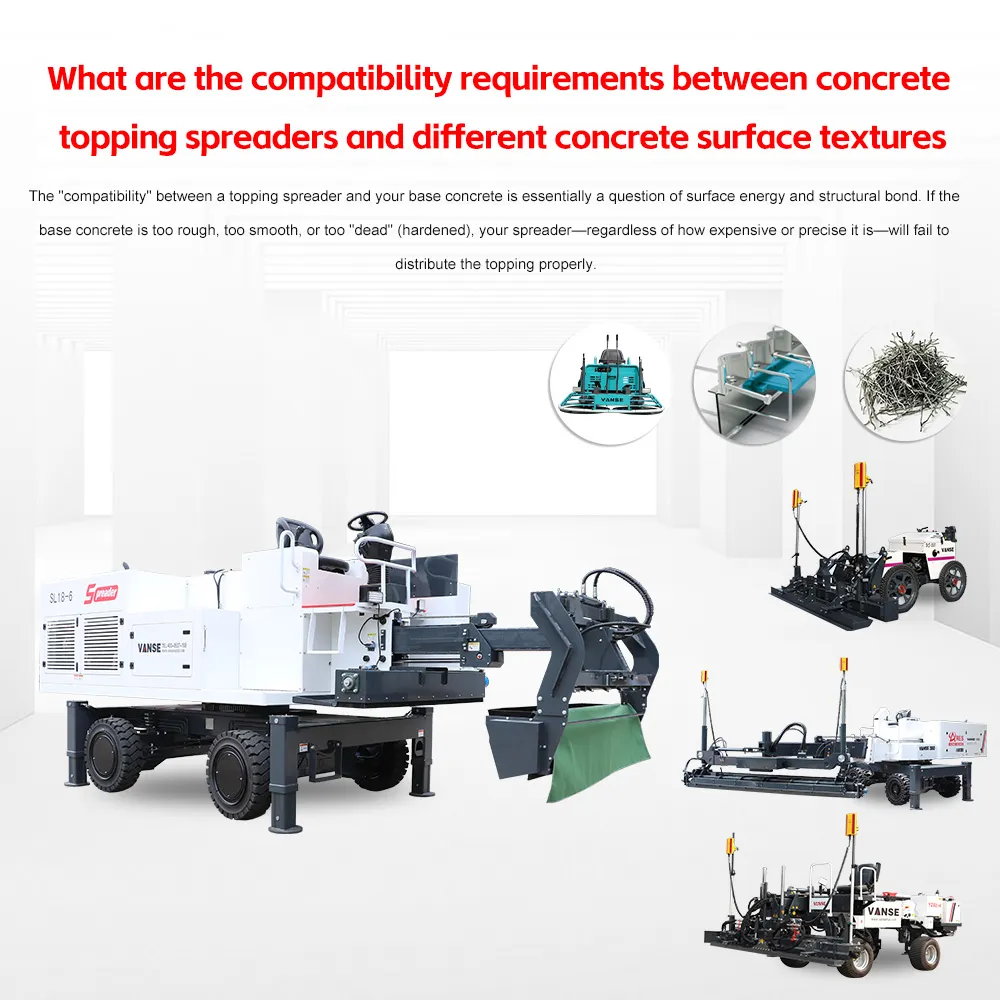
The "compatibility" between a topping spreader and your base concrete is essentially a question of surface energy and structural bond. If the base concrete is too rough, too smooth, or too "dead" (hardened), your spreader-regardless of how expensive or precise it is-will fail to distribute the topping properly. Here is how to match your spreader setup to the surface texture of the base slab. The Texture: A fresh, laser-Levelinged surface is smooth but "open," meaning it still has plenty of exposed paste and moisture. Compatibility: This is the "Goldilocks" zone for spreaders. Spreader Adjustment: You can use high-speed rotary spreaders (the ones that throw material using centrifugal force). Because the surface is open, the topping will immediately "drink" the bleed water and bond instantly. Best Practice: Do not wait too long. If the slab surface begins to "crust" (harden), the topping will just sit on top, leading to delamination later. The Texture: A slab that has already been power-floated once is "closed"-the pores are sealed. Compatibility: This is difficult for standard spreaders. The Challenge: If you try to spread dry-shake on a closed surface, it won't hydrate. The powder will act like a "slip layer" (like ball bearings), causing your finishing machines to slide around, or worse, the topping will never bond. Spreader Adjustment: Use a gravity-drop spreader (not a rotary thrower). You need a very precise, uniform layer. You must also follow the spreader with a trowel-based re-opening pass to break the surface tension and force the topping into the slab. The Texture: Often seen in exterior slabs or ramps. Compatibility: Highly incompatible with standard dry-shake spreaders. The Problem: The peaks of the broom finish will strip the topping off the spreader, causing "streaking" or "clumping." Spreader Adjustment: If you must apply topping to a rough surface, you cannot use a mechanical spreader effectively. You are better off using manual broadcasting techniques or a high-pressure pneumatic blower that can "blast" the powder into the deep valleys of the texture. Base Surface Texture Spreader Compatibility Recommended Spreader Type Key Risk Fresh/Levelinged (Open) Excellent Rotary Spreader Over-spreading (waste) Smooth/Power-Floated Moderate Gravity-Drop Spreader Delamination (lack of bond) Broom/Rough Finish Poor Manual/Pneumatic Only Uneven coverage/streaking Cured/Hardened Incompatible N/A Total failure (no bond) The compatibility isn't just about the physical texture; it's about bleed water. * If your surface texture is "open," it has high moisture availability. You need a fast spreader speed to keep up with the hydration. If your surface texture is "closed," it has low moisture availability. You must reduce the spreader speed and immediately follow with a mechanical disc-trowel to "work" the topping into the slab. If you are spreading on a base that is still very soft (wet), your spreader must use flotation tires or wide tracks. If the spreader sinks into the texture (ruts), it creates physical troughs. The material will naturally accumulate in these troughs, creating a non-uniform floor. Compatibility Fix: Always ensure the spreader is calibrated for the weight-bearing capacity of the specific mix design you are using. A good rule of thumb: The amplitude of your surface texture must be less than the particle size of your topping. If you have a coarse broom finish (deep valleys) and you use a fine-powder pigment, the pigment will vanish into the valleys and won't be visible on the peaks. In this case, you need a larger aggregate size in your topping mix to "bridge" the texture. Would you like me to explain how to conduct a "Pull-off Test" to verify if your topping has successfully bonded to a specific surface texture? Contact us NOW Note: The parameters provided in this document are for reference only and are not mandatory. Due to differences in technical characteristics between different brands and models of laser levelers, please consult the manufacturer for a suitable solution before actual operation. This reference document assumes no responsibility for any issues arising from failure to follow the manufacturer's instructions.Quality Control Methods for Ensuring Uniform Distribution of Wear-Resistant Aggregates
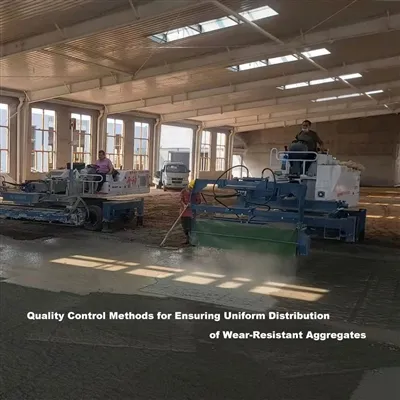
Ensuring the uniform distribution of wear-resistant aggregates (such as corundum and alloy aggregates) is crucial to preventing color differences, peeling, and uneven wear resistance in floor coatings. Quality control should be implemented throughout the entire process, from "base layer treatment" to "mechanical finishing." The following are the core control methods for achieving uniformity: Do not rely solely on experience for random spreading; instead, adopt **"grid management."** Grid division: Based on the total amount used (e.g., 5 kg/m²), divide the construction surface into several equal areas. Quota placement: Pre-place the corresponding weight of aggregate in the center of each area to ensure consistent consumption in each grid cell. The "two-stage application method" effectively re pairs gaps left after the first application. First application (2/3 of the total amount): Applied when the concrete is initially setting (footprint indentation of approximately 5mm), utilizing the bleed water from the base layer to moisten the aggregate. Second application (1/3 of the total amount): After the first application is finished and smoothed, a reinforcing application is performed in a perpendicular direction, focusing on areas with lighter color or sparser aggregate. Mechanical Spreading Machines: For large-area construction, the use of automatic spreading machines is recommended. Compared to manual application, mechanical spreaders can precisely control the amount of material applied per square meter through rotational speed and travel speed, greatly improving consistency. Manual Assistance: When spreading manually, use a "scattering" motion rather than "pouring," and ensure the material is distributed evenly. Edge Prioritization: In areas difficult for large machinery to cover, such as column edges and wall corners, manual application of extra material and manual compaction should be performed first. Joint Treatment: At construction joints, the application amount should slightly overlap to ensure that the hardness and flatness of the joint area are consistent with the main surface. Avoid strong winds: During indoor construction, doors and windows should be closed to prevent drafts that could cause fine aggregates to deviate during placement, resulting in localized areas with insufficient material. Strictly prohibit adding extra water: If the aggregate is locally too dry, direct watering is strictly prohibited. The slurry generated by the power trowel should be used for wetting; otherwise, it will lead to reduced surface strength and color differences. Quality inspection tips: After spreading, assess the consistency of the color (checking for light or dark patches) and the balance of moisture content by visual inspection. If localized areas appear lighter in color, it usually indicates an excess of aggregate or insufficient moisture in that area. Mechanical troweling to bring the mortar to the surface should be performed immediately. Note: The parameters provided in this document are for reference only and are not mandatory. Due to differences in technical characteristics between different brands and models of laser levelers, please consult the manufacturer for a suitable solution before actual operation. This reference document assumes no responsibility for any issues arising from failure to follow the manufacturer's instructions.