Technical Knowledge
How can maintenance of the concrete laser leveling machine ensure safe and stable construction?
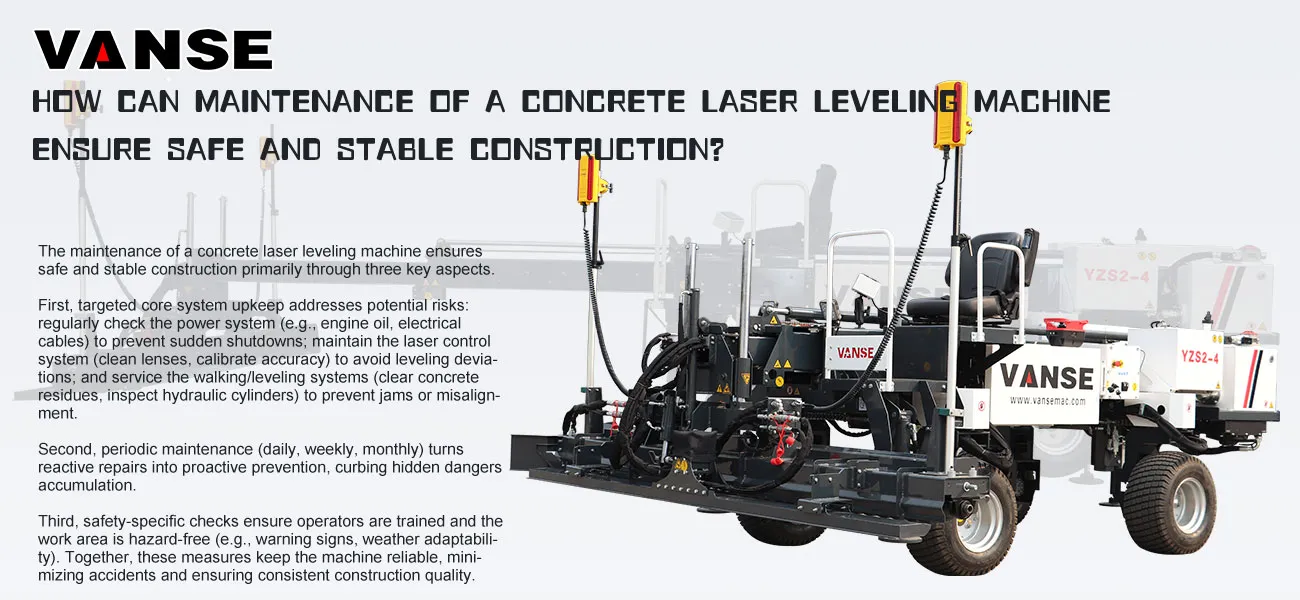
Maintenance of concrete laser screed machines is a key component in ensuring safe and stable construction. Essentially, it involves regularly inspecting, repairing, and maintaining key equipment systems to eliminate potential failures and ensure the equipment maintains a controllable and reliable operating state during construction. The following details how maintenance can achieve safe and stable construction through three key dimensions: core system maintenance, periodic maintenance procedures, and specialized safety inspections:
Ⅰ. Targeted Maintenance of Core Systems: Avoiding Safety Risks at the Source
The safety and stability of laser screed machines depend on the coordinated operation of four core systems: power, laser control, travel, and leveling. Any malfunction in any of these systems can lead to construction deviations, equipment loss of control, or even safety accidents, necessitating targeted maintenance:
1. Power System: Preventing Safety Accidents Caused by Power Interruptions
The power system (engine/motor, fuel/circuit board, cooling system) is the foundation of equipment operation. Failures in the power system can cause sudden equipment shutdown (impacting the initial setting quality of concrete) or unstable power output (causing equipment vibration).
Engine (Fuel Type) Maintenance:
Before each operation, check the engine oil level (must be between the "MIN-MAX" marks on the dipstick), the fuel filter (replace monthly to prevent clogging and fuel shortages), and the air filter (clean every 20 hours to prevent dust from entering the cylinder and causing power loss).
Weekly check the cooling fan blades for damage and the radiator for dust accumulation (clean with compressed air if clogged) to prevent engine overheating, shutdown, or cylinder seizure.
Strictly prohibit the use of inferior fuel (must comply with the fuel grade specified in the equipment manual, such as 0# diesel) to prevent fuel pump wear and power loss.
Motor (Electric) Maintenance:
Before each startup, check the cables for damage and loose connectors (wrap damaged areas with insulating tape and tighten connectors to prevent electrical leakage).
Monthly, check the motor's carbon brushes for wear (replace when worn to 1/3 of their original length) to prevent premature stops or unusual noises caused by poor contact.
2. Laser Control System: Eliminating Construction Safety Hazards Caused by Accuracy Deviations
The laser control system (laser transmitter, receiver, and controller) is the core of the screed's precise operation. Inaccuracies not only result in substandard concrete flatness (requiring rework and increasing construction risks), but can also cause mechanical collisions due to misjudgment of height.
Laser Transmitter Maintenance:
Clean the transmitter lens before each use (wipe with a dust-free cloth to prevent dust from affecting the laser signal). Check the mounting bracket for stability (to prevent the transmitter from tipping over and causing the laser to drift).
Calibrate the laser level weekly (using the device's built-in calibration function or using a level to assist), ensuring the laser plane error is ≤±1mm/10m.
Protect the transmitter from direct sunlight or rain (install a sunshade or rain cover for extended outdoor use) to prevent internal components from moisture and aging.
Receiver and Controller Maintenance:
Check the receiver probe daily for scratches (replace if damaged to prevent signal reception errors).
Clean the controller buttons and display monthly (use an alcohol wipe). Check the connection harness for tightness (to prevent vibration that could cause poor contact and malfunction).
3. Travel and Leveling Systems: Preventing Safety Accidents Caused by Mechanical Failures
The travel system (tires/tracks, drive motor, reduction gearbox) and leveling system (leveling disc, scraper, hydraulic cylinder) come into direct contact with the concrete. Failures can cause the equipment to become stuck or erroneous, potentially cracking the concrete surface and causing injuries to personnel.
Travel System Maintenance:
After each construction phase, clean concrete debris from the gaps between the tires and tracks (use a shovel or high-pressure water jet to prevent hardened debris from causing travel jams).
Check the drive motor gear oil level weekly (must comply with the manufacturer's instructions and replenish promptly if insufficient). For crawler-type equipment, check track tension (too loose can lead to derailment, while too tight can cause wear).
Check the travel wheel bearings monthly for abnormal noise. If any abnormal noise is detected, disassemble and lubricate or replace the bearings to prevent bearing seizure and equipment loss of control.
Leveling System Maintenance:
Check the leveling plate and scraper for wear daily before application (if edge wear exceeds 5mm, repair or replace to prevent loss of leveling accuracy).
Check the hydraulic cylinder seal weekly (check for oil leaks on the cylinder surface. If leaking, replace the seal to prevent insufficient hydraulic pressure from causing the leveling plate to raise and lower slowly or become stuck).
Clean the leveling plate promptly after application (rinse with clean water to prevent concrete from settling on the plate and scratching the concrete surface during subsequent use).
II. Periodic Maintenance Process: Establish a "Prevention-First" Safety Assurance Mechanism
In addition to daily inspections, a periodic maintenance plan should be developed based on the equipment's lifetime. This shifts from "reactive maintenance" to "proactive prevention," ensuring safe and stable construction over time.
| Maintenance cycle | Maintenance content | Safety assurance target |
| Daily maintenance (before/after construction) | 1. Check the powertrain fluid, circuits, and cables; | Eliminate immediate hidden dangers during construction on the same day and ensure that the equipment is stable from the moment it is turned on |
| 2. Clean the laser transmitter and receiver lenses; | ||
| 3. Clean concrete debris from the travel and leveling systems; | ||
| 4. Test run the equipment (run the equipment at no load for 5 minutes to check for abnormal noise or jamming). | ||
| Weekly maintenance | 1. Calibrate the laser control system accuracy; | Repair minor wear or deviation to avoid potential failures caused by accumulation of hidden dangers |
| 2. Check the travel system gear oil and track tension; | ||
| 3. Check the hydraulic cylinder seal and leveling plate wear; | ||
| 4. Clean the equipment's cooling system (radiator, motor fan). | ||
| Monthly maintenance | 1. Replace the engine oil, fuel filter, and air filter (fuel-powered models); | Restore equipment performance and prevent safety accidents caused by aging of key components |
| 2. Replace the motor carbon brushes and check the cable insulation (electric models); | ||
| 3. Lubricate the travel wheel bearings and leveling system connecting shaft (apply grease); | ||
| 4. Thoroughly inspect the equipment's structural components (such as the frame and handrails) for looseness or deformation. | ||
| Quarterly / Annual Maintenance | 1. Disassemble and inspect the gearbox and hydraulic pump (clean out any impurities and replace the hydraulic oil); | In-depth investigation of hidden faults to ensure long-term safe operation of equipment |
| 2. Test the laser control system accuracy (contact the manufacturer or a professional calibration agency); | ||
| 3. Inspect the welds of the equipment's structural components (if cracks are found, repair them to prevent structural failure). | ||
| 4. Replace aging cables, seals, filters, and other vulnerable parts. |
III. Special Safety Inspections: Focusing on the Collaborative Safety of "Human-Machine-Environment"
Maintenance and maintenance not only focus on the equipment itself but also must be combined with "operator specifications" and "adaptation to the construction environment" to avoid safety risks caused by "proper equipment but improper use."
Operator Training and Qualification Verification:
Ensure that operators receive professional training (familiarity with equipment operating procedures and emergency troubleshooting). Unqualified personnel are strictly prohibited from operating the equipment.
Regular maintenance training (such as daily inspection points and simple troubleshooting) is provided to operators to prevent equipment damage or safety accidents caused by operator errors (such as accidentally touching the laser transmitter or improperly adjusting the leveling plate height).
Check the suitability of the construction environment:
Before construction, check the flatness of the work surface. (If the ground is undulating, lay gravel to level it to prevent the equipment from tilting during travel, which could cause laser signal distortion.)
For outdoor construction, pay attention to the weather. (Strong winds and heavy rain are strictly prohibited to prevent laser signal interference or water intrusion and short circuits.)
Warning signs should be posted in the work area to prevent unauthorized access and avoid collisions with the leveling plate or travel system.
Summary
The key to ensuring safe and stable construction through maintenance of concrete laser screeds is to eliminate inherent equipment hazards through "core system maintenance," prevent cumulative failures through "periodic maintenance," and standardize the coordination between man, machine, and the environment through "special safety inspections." Only by integrating maintenance into the entire construction process can we minimize safety risks caused by equipment failures, ensure stable concrete construction quality, and ensure safe and controllable operations.
Note:
The parameters provided in this document are for reference only and are not mandatory. Due to differences in technical characteristics between different brands and models of laser levelers, please consult the manufacturer for a suitable solution before actual operation. This reference document assumes no responsibility for any issues arising from failure to follow the manufacturer's instructions.
Thanks to All the Friends Who Support and Trust Shandong Vanse Machinery Technology Co., Ltd.
If you want to know more about Shandong Vanse Machinery Technology Co., Ltd. or have any questions, please feel free to contact us:
Our Factory
Shandong Vanse Machinery Technology Co., Ltd.








Share this article

About the Author: Shandong Vanse Machinery Technology Co., Ltd.
Shandong Vanse Machinery Technology Co., Ltd. is a high-tech manufacturer specializing in concrete construction machinery, including laser screeds and related equipment. The company integrates R&D, production, and global sales, with products exported to over 60 countries and widely used in infrastructure projects worldwide.
Previous Post
Next Post
Related Articles
You Might Also Like
How to evaluate the flatness of concrete pavement through quality inspection?
The quality inspection of the flatness of concrete pavement is the core link in evaluating the construction effect, and the application of Concrete Laser Leveling Machine can not only improve the construction accuracy, but also provide data support for the inspection through its supporting digital functions. The following is an analysis from the aspects of inspection indicators, methods, equipment and data application, focusing on the relevant role of laser leveling machine in inspection: Standard Flatness tolerance Detection tool Applicable scenarios China GB 50666-2011 ≤3mm/3m (measured with a 3m ruler) 3m ruler, feeler gauge Municipal roads and highway surface US ASTM E1155 ≤2mm/m (measured by laser profiler) Laser profiler, inertial profiler Airport runway, industrial floor European Union EN 13036-1 International Roughness Index (IRI) ≤2.5m/km Laser flatness meter Expressways, urban trunk roads – The flatness error of the road surface constructed by laser leveling machine can usually be controlled within ±2mm/3m, which is better than the ±5mm/3m of traditional technology, and the international flatness index (IRI) can be as low as 1.5-2.0m/km, meeting the requirements of high-grade road surface. 🎨1. Traditional detection method: combination of manual and mechanical – 3m ruler method: – Operation: Place the 3m ruler perpendicular to the driving direction on the road surface, and use a feeler gauge to measure the maximum gap between the ruler and the road surface, measuring 2 places × 10 feet every 200m. – Limitations: Only reflects local flatness, cannot cover the entire section, and is greatly affected by human operation. – Laser leveling machine association: During construction, the real-time elevation data of the leveling machine can be used to predict the key areas of ruler detection (such as equipment joints and corner filling areas) and make corrections in advance. – Continuous Smoothness Tester Method: – Equipment: A trailer-type instrument with a sensor, which continuously measures at a speed of 5km/h, and calculates the standard deviation (σ) to evaluate the smoothness (the smaller the σ, the better the smoothness). – Data Comparison: The σ value of the road section constructed by the laser leveling machine is usually ≤1.2mm, while the σ value of the traditional process is ≥1.8mm, which is a significant difference. – Laser Profiler: – Principle: The laser transmitter emits multiple laser beams (such as 16), scans the longitudinal profile of the road surface, generates 3D elevation data, and calculates IRI, σ and other indicators (as shown in Figure 1). – Detection efficiency: 5-10km can be detected per hour, the data sampling interval is ≤10cm, and the accuracy is ±1mm. – Laser leveling machine data linkage: – The per square meter elevation data recorded during the leveling machine construction (stored in the equipment control system) can be directly imported into the detection software and compared with the measured data. The area with an error of more than ±3mm is automatically marked as "needing re-inspection". – For example: After a laser leveling machine was used for construction in an industrial plant, two elevation deviations (+5mm and -4mm) were found through the profiler detection. The construction record of the leveling machine was traced back to confirm that it was caused by the temporary occlusion of the sensor when the equipment turned, and it was repaired in time to meet the standard. – Inertial navigation flatness inspection vehicle: – Application scenarios: Suitable for long-distance inspections such as highways, integrating laser sensors and inertial navigation systems, driving at a speed of 60-80km/h, and generating real-time flatness cloud maps of the entire road section. – Pre-control value of laser leveling machine: Before construction, the inspection vehicle scans the old road surface and imports the data into the automatic leveling system of the laser leveling machine to achieve "feedforward control" – that is, adjust the leveling beam height in advance according to the deformation characteristics of the old road to reduce the impact of differential settlement in the later stage. – Linkage between laser transmitter and receiver: When the leveling machine is operating, the receiver continuously receives laser signals and updates the leveling beam height ≥10 times per second. If the local elevation deviation is detected to exceed ±4mm (preset threshold), the equipment automatically sounds and lights an alarm and stops moving, prompting the operator to check the concrete slump or foreign matter in the base. Case: During the construction of an airport runway, the receiver detected that the elevation of a continuous 3-meter area was 5mm lower. After the shutdown, it was found that there was loose backfill soil in the base that was not compacted. After timely rework, large-scale rectification was avoided in the later stage. – Intelligent construction report: Some high-end laser levelers (such as a German brand) can generate flatness process control reports, including: – Average elevation and maximum deviation value of each construction zone; – Correlation analysis between leveler travel speed and elevation fluctuation (as shown in Figure 2, the deviation rate increases by 20% when the speed is greater than 1.2m/min); – Comparison of concrete consumption with design value (flatness is more stable when the error is ≤±2%). – Preliminary detection of base layer flatness: Before construction, use the empty machine scanning function of the laser leveler (without paving concrete), drive at a speed of 0.5m/s, collect base layer surface data through the leveling beam sensor, generate a base layer flatness chromatogram (the red area indicates a deviation of >8mm), and guide base layer repair (as shown in Figure 3). – Data comparison: After the base layer flatness σ dropped from 5.0mm to 2.0mm, the surface layer flatness σ dropped from 2.5mm to 1.8mm, indicating that the base layer treatment has a significant impact on the final effect. – Use BIM+GIS technology to integrate test data, mark unqualified areas (such as sections with IRI>3.0m/km) in the 3D model, associate the construction trajectory of the laser screed machine, and analyze the causes of errors (such as vibration leakage in the overlapping area at the equipment handover). – Example: A municipal road inspection found that the IRI of a continuous 100m section was 3.2m/km. Tracing the screed machine data found that the slump in this area changed suddenly during construction (from 140mm to 180mm), resulting in the failure to adjust the screed machine speed in time and local accumulation of concrete. – Local repair: For areas with deviation ≤5mm, use a handheld laser leveler (small equipment, paving width 1-2m) with fine stone concrete for repair, and use built-in sensors to ensure that the elevation after repair is consistent with the original road surface. – Large area rework: If the deviation is greater than 8mm or IRI is greater than 4.0m/km, the original road surface needs to be milled and removed, and the laser leveler is used again for paving to avoid the "patch effect" caused by manual leveling. Advantages Dimensions Traditional technology Laser leveling machine technology Data traceability No data record of the construction process Traceable 10+ parameters including elevation per square meter, speed, slump, etc. Detection efficiency Manual sampling coverage ≤ 20% Process detection coverage is 100%, and finished product detection efficiency is increased by 3 times Error prediction capability Post-testing is the main method Real-time warning during construction, reducing the rate of defective products by more than 80% Cost-effectiveness Corrective cost accounts for 5-10% Corrective cost accounts for ≤2% The coordinate system of the testing instrument must be consistent with the positioning system of the laser leveling machine (such as GPS or total station) to avoid data distortion due to coordinate deviation. Testing should be avoided in high temperature (>35℃) or strong wind (>5 level) weather. At this time, the concrete surface evaporates too quickly and plastic cracks are easily generated, affecting the flatness test results. Technicians operating laser leveling machines need to master basic detection principles (such as IRI calculation logic) so that they can actively adjust parameters to match the detection standards during construction. The inspection and evaluation of the flatness of concrete pavement needs to run through the whole process of "pre-construction base pre-control – dynamic monitoring during construction – comprehensive inspection after construction", and the laser leveling machine has become the core link between construction and inspection through digital construction data and high-precision control capabilities. It is recommended to give priority to the use of advanced equipment such as laser profilers for full-section inspection, and make full use of the process data of the leveling machine for error tracing, to achieve the closed-loop management of "inspection-analysis-rectification", and ultimately ensure that the road surface flatness meets the design requirements and extends the service life. Click the below to jump immediately!!! ARMOUR JOINT LASER LEVELING MACHINE LIGHT TOWER POWER TROWEL SLIPFORM MACHINE STEEL FIBER TOPPING SPREADER TRACKED MINI DUMPERHow to reduce the construction cost of concrete laser leveling machine?
Reducing the construction cost of concrete laser leveling machines is the key to improving the economic benefits of construction projects. This involves not only the purchase and operation costs of equipment, but also maintenance, operator training, construction process management and other aspects. The following is a detailed analysis of how to reduce the construction cost of concrete laser leveling machines. Introduction In the field of construction, concrete laser leveling machines are favored for their high efficiency and high precision. However, in order to remain competitive, construction companies need to constantly seek ways to reduce costs. This article will explore effective cost control strategies. 1. Equipment procurement cost control Equipment procurement is an important part of the initial investment: Cost-effectiveness analysis: When purchasing equipment, conduct a comprehensive cost-effectiveness analysis and select equipment with stable performance and reasonable prices. Financing options: Use reasonable financing options such as installments or leasing to reduce initial capital pressure. 2. Operation cost control Operation costs include fuel, electricity, maintenance, etc.: Energy-saving operation: Optimize operating processes and reduce unnecessary energy consumption. Energy selection: Choose economical energy types, such as electric or alternative energy. 3. Improve equipment efficiency Improving equipment efficiency can reduce the construction cost per unit area: Reasonable scheduling: Arrange construction plans reasonably to avoid equipment idleness. Multi-tasking capability: Choose multi-functional equipment to reduce time and resource waste caused by equipment replacement. 4. Maintenance and repair cost control Timely maintenance and effective repairs can extend equipment life and reduce long-term costs: Regular maintenance: Develop maintenance plans to prevent failures. On-site maintenance capabilities: Cultivate on-site maintenance capabilities to reduce equipment repair time and costs. 5. Operator training Skilled operators can improve construction efficiency and reduce costs caused by incorrect operations: Professional training: Regularly conduct professional skills training for operators. Safety education: Strengthen safety education to reduce accidents caused by improper operation. 6. Construction process management Optimize construction process management and reduce waste: Construction plan: Develop a detailed construction plan and arrange the construction sequence reasonably. Material management: Accurately calculate material requirements and reduce material waste. 7. Construction method innovation Innovative construction methods can improve construction speed and quality and reduce costs: Process improvement: Continuously explore and experiment with new construction processes. Technology integration: Integrate the latest technologies, such as intelligent control systems, to improve the level of intelligent construction. 8. Environmental adaptability Improve the adaptability of equipment and reduce additional costs caused by environmental changes: Environmental monitoring: Real-time monitoring of the construction environment and timely adjustment of the construction plan. Equipment transformation: Appropriately transform the equipment according to the characteristics of the environment. 9. Second-hand equipment and refurbishment Consider using second-hand or refurbished equipment to reduce procurement costs: Second-hand market: Evaluate the condition and price of second-hand equipment and select equipment with high cost performance. Refurbishment service: Use refurbishment services to extend the service life of equipment. 10. Utilization of laws and policies Make full use of laws and policies to obtain tax incentives, etc.: Tax policies: Understand and utilize relevant tax incentives. Government subsidies: Apply for government subsidies for the use of high-efficiency and energy-saving equipment. 11. Conclusion Reducing the construction cost of concrete laser leveling machines requires comprehensive consideration of equipment procurement, operation and maintenance, operator training, construction process management, construction method innovation, environmental adaptability, second-hand equipment utilization, and laws and regulations. Through these measures, construction companies can effectively reduce costs and improve market competitiveness while ensuring construction quality and efficiency.How to use power trowel
A power trowel machine is used to create a level, flat area of concrete, smooth finish on a large, just like a poured patio slab for a deck or an interior floor. A single or multiple blades are used that can rotate in a safety cage. The measurement of this tool is around 24 to 48 inches long and has three types such as finish, floating and combined. In relation and based on the size of work, you can use a riding model or a pushable concrete power trowel. Presented in this article are the steps that you can follow for you to use the tool to the best of its ability. Concrete contractors demand reliable equipment to get the job done right. VANSE concrete power trowel spider assembly uses high-strength wear plates made of trowel steel to prevent wear on key components. Repairing your trowel shouldn't be costly so we make certain our replacement parts are priced right. Spider trowel arm bushings Replacement of these high tolerance bushings assure like new trowel arm alignment. Here are the steps: 1. Select a pushable power trowel for sale with 24 to 36-inch trowel blades if you are planning to level a small area, like those that measure under 1000 square feet. And to smooth the concrete in one series of passes, you can use both the finish and float trowel blades. But if you are working on larger areas or those higher than 1000 square feet, choosing a riding power trowel can be a big help to quickly finish the job before the concrete sets too firmly. The recommended blades to use are those that measure around 36–48 inches. When working with corners, you can change your blade to a 24-inch one. Opt for a different finish or float blades, or a combination trowel blade. 2. Few hours before you use the power trowel, the concrete must be poured. Ensure that the concrete is firm enough to support the power trowel and you, conduct a footprint test. First is to step onto the slab and then measure the depth of the imprint. If the result is less or 1/8 of an inch deep, you can assume that the concrete is ready for troweling. 3. To level the concrete on your first pass, use the trowel with combined blades or float blades. Floating lessens the fills and bumps in the hollows. The machine should be operated at 3/4 speed while keeping the blades flat for the even distribution of weight and to avoid digging into the concrete. The rotational speed will also prevent splatters of still-damp concrete being thrown forward into the path of the machine. Overlap each pass by 1/2 the trowel blades' length as you traverse the poured plate. Once you're done floating the entire slab, turn the power trowel at 90 degrees to your first rows. The technique of crossover floating helps you finish missed spots. 4. Continue with the combined trowel blades or change your tool to finish blades to finish the surface, sealing the porous material. Walk behind power trowel to operate at its top speed, this time with the blades fully pitched downward onto the concrete. Doing so will give the slab that highest pressure. To get that matte, gleaming or light gloss finish, create as many passes at right angles. VANSE's concrete power trowel using high quality meterial and with origional HONDA engine, if you had such needs in this field, welcome for asking~