Technical Knowledge
Emery floor cleaning Emery wear-resistant floor cleaning and maintenance

Emery floor cleaning and emery wear-resistant floor maintenance
Emery flooring is widely used in industrial plants, warehouses, parking lots and other places because of its wear resistance, anti-skid, and easy cleaning. However, long-term use and improper maintenance may cause stains, wear and other problems on the floor, affecting the appearance and usability. Therefore, cleaning and maintenance during operation is very important. This article will introduce the cleaning and maintenance methods of emery floor.
•◆• Emery floor cleaning
1. Remove surface debris:
Use a broom or vacuum cleaner to remove dust, sand and other debris on the ground to ensure that the ground is clean and tidy.
2. Use neutral cleaners:
Choose neutral or weakly alkaline cleaners and avoid using strong acid and alkali cleaners to avoid damage to the floor.
3. Wet cleaning method:
After diluting the detergent, apply it evenly on the ground with a mop or floor washer, then rinse it with clean water and finally use a water absorber to absorb the water.
4. Dry cleaning method:
For minor stains, you can use dry cleaning powder or sandpaper to gently wipe them, and then use a vacuum cleaner to absorb the stains and dust
•◆• Emery wear-resistant floor maintenance
1. Regular cleaning:
It is recommended to clean at least once a day to keep the floor clean and tidy. For special stains such as oil stains and chemicals, they should be cleaned in time to avoid remaining for a long time.
2. Avoid heavy pressure and scratching:
Avoid heavy objects, sharp objects, etc. from direct contact with the ground to avoid scratching or damaging the ground. If heavy equipment needs to be moved, it is recommended to lay protective mats on the floor or use roller devices.
3. Regular maintenance:
Regularly check the wear and tear of the floor. If necessary, perform partial repairs or overall renovation. At the same time, the floor can be polished regularly to restore its gloss and anti-slip properties.
4. Control humidity:
Maintain appropriate indoor humidity and avoid the ground from being too wet or dry. Too much moisture may cause problems such as mildew and deformation of the ground; too much dryness may cause the ground to crack and fall off. To sum up, the cleaning and maintenance of emery floor need to be carried out regularly to maintain its beauty and usability. At the same time, care must be taken to avoid damage to the ground during use to extend its service life.


Thanks to All the Friends Who Support and Trust Shandong Vanse Machinery Technology Co., Ltd.
If you want to know more about Shandong Vanse Machinery Technology Co., Ltd. or have any questions, please feel free to contact us:
Our Factory
Shandong Vanse Machinery Technology Co., Ltd.








Share this article

About the Author: Shandong Vanse Machinery Technology Co., Ltd.
Shandong Vanse Machinery Technology Co., Ltd. is a high-tech manufacturer specializing in concrete construction machinery, including laser screeds and related equipment. The company integrates R&D, production, and global sales, with products exported to over 60 countries and widely used in infrastructure projects worldwide.
Previous Post
Next Post
Related Articles
You Might Also Like
How to distinct laser leveling machine’s purchasability
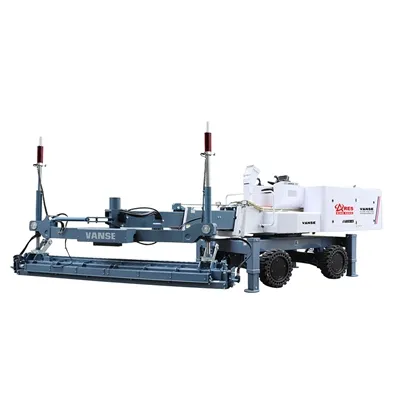
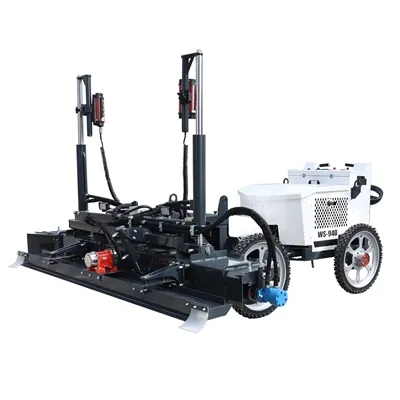
Vanse concrete laser leveling for sale is developed for concrete floor of industrial factory building, large supermarket, freight house and other large area projects, and designed for higher requirements for strength, flatness and levelness of concrete floor. We have a series of laser leveling machine for sale: our equipment adopt advanced laser technology to execute leveling to concrete floor, it is a high-accurate and small error leveling machine. Vibrating frequency is 4000 times per minute, which ensures compactness and one-step molding. Operation is simple and flexible, high degree of automation, construction efficiency is greatly increased, it especially applied to large area floor construction, an area of 3000 sq work can be accomplished only by 8 workers per day, 300 sq area can be accomplished per hour, labor cost and intensity are greatly decreased. laser leveling Which factors should be considered when choosing concrete laser leveling machine? Purchase factors of laser leveling: brand, quality, construction effects and after-sales service. * Brand: prudently to choose green-hand brand, for laser leveling machine a high technology product, quality influence factor is not only manifested by technology innovation but also experience. How to define different size and specification? How to treat floor flatness? How to locate laser leveling? All those questions requires years to master. If customers curtly purchase laser leveling machine from green-hand brand, they might become mouse for experiments,troubles will come to them. Therefore, it's important to chose an experienced brand. * Quality: for users, quality shall be valued when choosing laser leveling machine, if the machine is in bad quality, floor process will occur troubles, the whole construction period will be delayed, the enterprise will face to big lose, so low price shouldn't be the only reason to buy laser leveling, quality is the most important, low price generally makes a mess in market compete, no profit no quality. * After-sales service:another factor customers specially concerns is after-sales service, regular and professional factory should be chosen, only regular factory will provide reliable service, a concrete laser leveling machine is usually used for many years, a long-brand factory will provide persistent after-sales service. After purchase of a satisfying laser leveling check should be executed to laser leveling before paving and leveling, now let Hiking tell you how to do it.Check equipment before installation is to check if the engine oil and gasoline of the equipment are enough.Check if power supply of laser receiver and emitter are enough. Check if accessories(tripod, tool cabinet, rod piece, bolt) of laser leveling machine are taken with integrity. Welcome for asking if you had any needs in the machine.The importance of after-sales service when purchasing a laser leveling machine
Today's building floor construction uses laser leveling machines, and the quality of the floor paved is much better than that of traditional methods – first, the flatness and levelness of the floor are improved by more than 3 times, and the density and strength of the floor are increased by more than 20%. At the same time, it can also shorten the construction period by 40% and save about 49% of labor. It can also greatly save costs in later maintenance, because laser leveling machine construction can more easily lay high-strength concrete, low-slump concrete and fiber mud concrete. The construction effect of the laser leveling machine is good, and it is a step for laser leveling machine manufacturers to gain praise from users, but if they want to gain a long-term foothold, they still need solid after-sales service to support them. As a laser leveling machine manufacturer, Shandong Vanse Machinery has been working hard to provide services to all customers, no matter where you are in the world. But words are not enough. You can only understand our services when you need help. Here are 4 reasons why after-sales support is particularly important when purchasing a laser leveling machine. 1. Time is money When you encounter problems during the construction of your equipment and need assistance, you can immediately contact the after-sales service engineer. You don't have to wait a few days to call. This is why you need excellent after-sales support. It will be critical when you need it, especially when you invest in a laser leveling machine. We know that all contractors are located in different time zones and work at different times. This is why we provide support services for our products. 2. Get solutions immediately when you need them When you encounter problems, our services are always available to help you identify the root cause of the problem and find solutions. The value of our products is that on the job site, you only need to take care of your own affairs. Our excellent products can help you complete most of the work. 3. Make your equipment available anytime, anywhere Before construction, you need to ensure that the machine is properly maintained and in good condition. Whether you are an experienced operator or a novice operator, or your machine has been idle for a long time, we can provide corresponding services. Our service agreement can ensure that you will not encounter any problems when you are ready to work and need to run the machine. 4. Understand how to maintain your laser leveler For every product we manufacture, we will provide after-sales support at any time, and at the same time we hope that our customers will know some knowledge about how to maintain the product. In addition to providing maintenance plans for each customer, customer service will also follow your every step of maintenance. The service life of a leveler is generally very long, and it is inevitable to encounter after-sales maintenance services in the middle, so when purchasing, you must understand the importance of laser leveling after-sales service, and examine the company's after-sales service capabilities.How to operate concrete topping spreaders on uneven base layers without affecting material distribution accurac
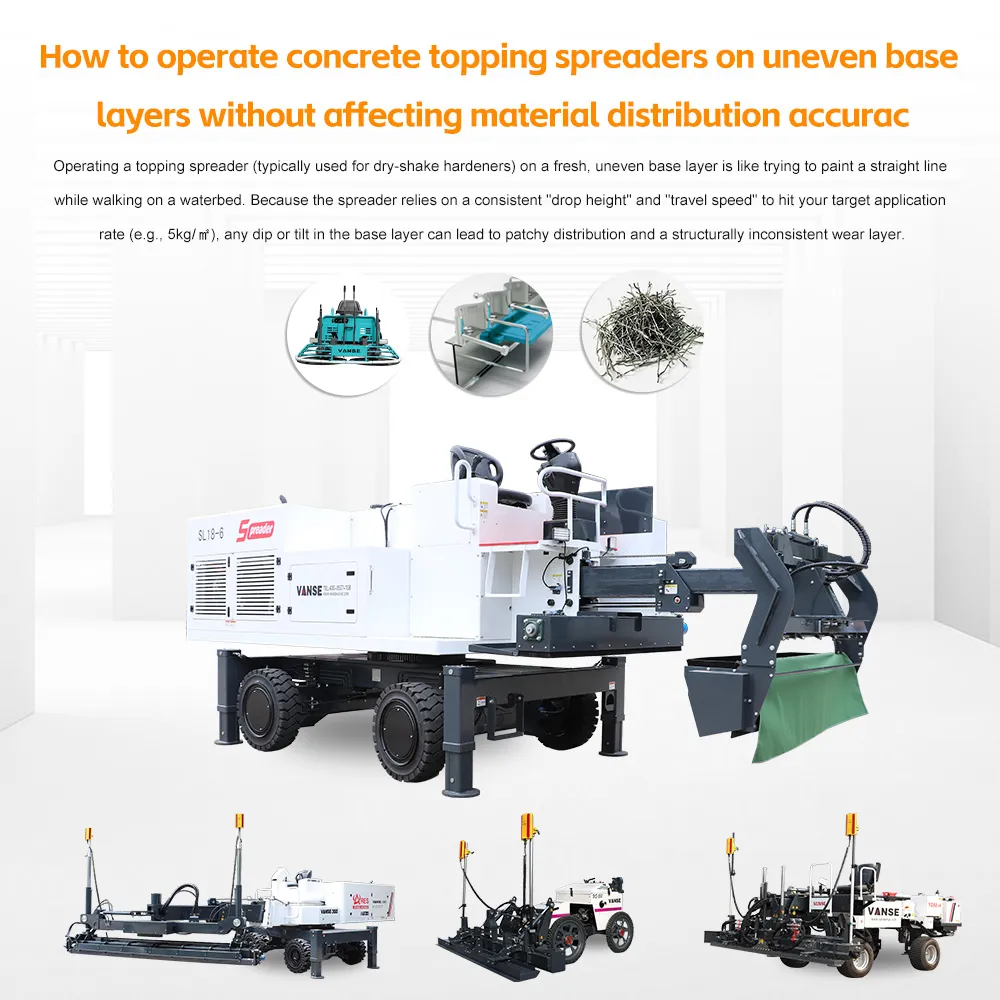
Operating a topping spreader (typically used for dry-shake hardeners) on a fresh, uneven base layer is like trying to paint a straight line while walking on a waterbed. Because the spreader relies on a consistent "drop height" and "travel speed" to hit your target application rate (e.g., 5kg/㎡), any dip or tilt in the base layer can lead to patchy distribution and a structurally inconsistent wear layer. Here is how to maintain precision when the ground beneath you isn't cooperating. The most effective way to handle an uneven base is to avoid driving on it entirely. * How it works: Large-scale spreaders use a telescopic boom that extends over the fresh concrete. The Advantage: Since the machine's tracks or wheels stay on the stable, leveled subgrade or the previously poured (and hardened) lane, the "head" of the spreader remains perfectly level regardless of the "hills and valleys" in the wet concrete. Accuracy: This setup allows for a computer-controlled discharge rate that is decoupled from the unevenness of the wet slab. If you are using a spreader that must travel on the fresh concrete (like a walk-behind or a ride-on), your accuracy depends on Variable Rate Control. The Problem: When a spreader hits a "low spot" or soft patch, the wheels often slip or the operator slows down. If the hopper continues to drop material at a fixed rate, you end up with a "heavy" pile in the low spot. The Fix: Modern spreaders use encoders on the wheels. If the machine slows down due to the uneven terrain, the computer automatically slows the discharge rotor. Pro Tip: If your machine isn't automated, the operator must consciously "feather" the discharge trigger as they navigate difficult patches to avoid material "slugs." On high-tolerance projects with uneven bases, never try to drop the full amount of topping in a single pass. The 50/50 Rule: Apply 50% of the material in one direction (e.g., North-South) and the remaining 50% in the perpendicular direction (East-West). The Benefit: This cross-hatching pattern naturally "averages out" any distribution errors caused by the spreader tilting or surging over uneven spots. It ensures that even if one pass was slightly "light" due to a bump, the second pass will likely compensate for it. Accuracy starts before the spreader arrives. The laser Leveling must be used to create a "flat-enough" surface for the spreader to navigate. Strategy Action Result Initial Strike-off Laser Leveling makes a fast, leveling pass. Provides a consistent "bed" for the topping. Wait Time Allow the "bleed water" to disappear. Firms up the base so the spreader doesn't sink/bog down. Mechanical Integration Attach the spreader head to the laser Leveling (if compatible). Uses the laser's elevation accuracy to drop material at a precise height. The Solution: Use low-pressure flotation tires or wide tracks to spread the weight of the machine. Immediate Follow-up: A bull float or a "highway straightedge" must follow the spreader immediately to "knit" the topping into the base and erase the tracks before the material begins to hydrate. Technical Warning: If you are using metallic dry-shakes, distribution accuracy is even more critical. "Clumps" of metallic topping caused by uneven spreading can lead to localized delamination because the topping won't have enough moisture from the base slab to hydrate properly. Would you like me to detail the "Wash-out" test used to verify if your spreader is actually hitting the kg/㎡ target across the entire floor? Slump Consistency: If the concrete slump varies by even 1 inch (e.g., from a 5-inch slump to a 6-inch slump), the vibratory Leveling will "sink" differently. For Superflat results, the concrete must be identical truck-to-truck. Head-to-Head Overlap: When using a handheld vibratory Leveling, ensure each pass overlaps the previous one by 20–30%. This "erases" the line between passes. Would you like a list of the specific F-number tolerances required for "Category 1" VNA (Very Narrow Aisle) floors versus standard warehouse floors?. Contact us NOW Note: The parameters provided in this document are for reference only and are not mandatory. Due to differences in technical characteristics between different brands and models of laser levelers, please consult the manufacturer for a suitable solution before actual operation. This reference document assumes no responsibility for any issues arising from failure to follow the manufacturer's instructions.