Technical Knowledge
Economic Value Analysis of Superflat Floors in VNA (Very Narrow Aisle) Warehouses
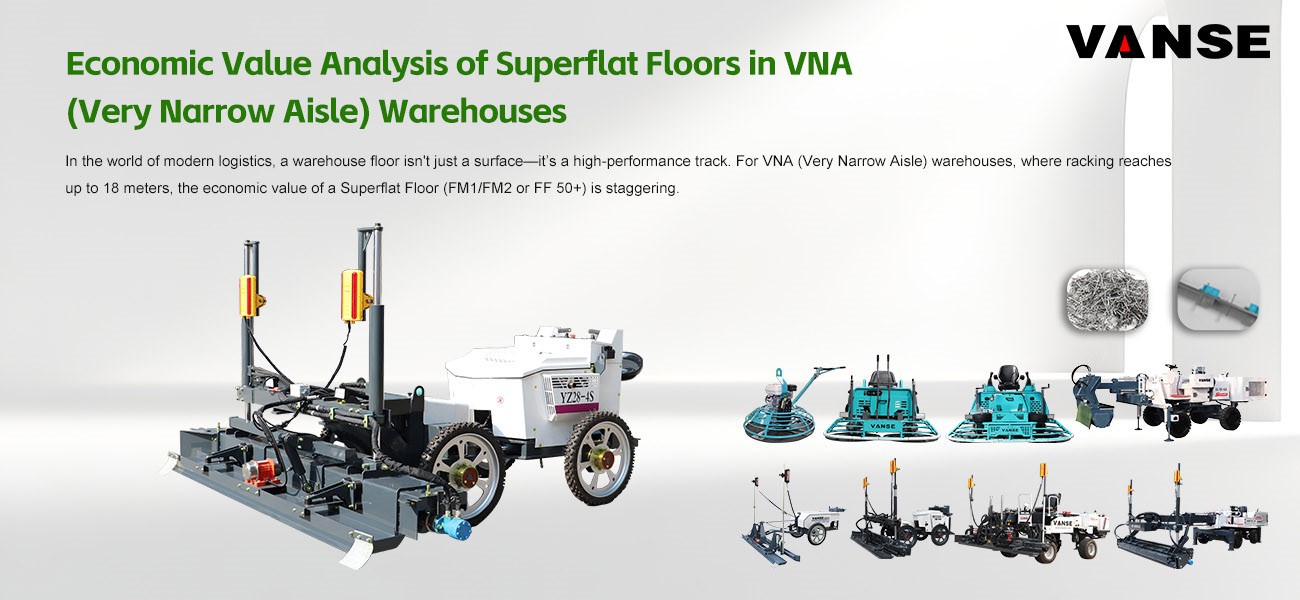
In the world of modern logistics, a warehouse floor isn't just a surface-it’s a high-performance track. For VNA (Very Narrow Aisle) warehouses, where racking reaches up to 18 meters, the economic value of a Superflat Floor (FM1/FM2 or FF 50+) is staggering.
A 1mm deviation at the base of a VNA forklift can translate into a dangerous 15cm "sway" at the top of the mast. If you’re a facility owner or developer, here is why investing in the "Vanse standard" for flooring isn't an expense-it’s a massive ROI driver.
1. Increased Throughput (Efficiency = Revenue)
In a VNA warehouse, the speed of the forklift is limited by the flatness of the floor. On a standard floor, trucks must slow down to avoid vibration and mast-lean.
The Economic Lift: A Superflat floor allows trucks to operate at maximum speed. This can increase "picks per hour" by 20% to 40%. In a high-volume logistics hub, that speed translates into millions of dollars in additional annual revenue.
The Vanse Edge: To hit these numbers, the floor must be leveled with surgical precision. The Vanse YZ30-4E Telescopic Boomed Laser leveling allows for the long-strip pours essential for VNA lanes, ensuring the "track" is perfect from end to end without the "tire tracks" that traditional machines leave behind.
2. Massive Maintenance Savings (OpEx Reduction)
VNA trucks are expensive pieces of machinery with sensitive electronic components and high-pressure tires.
The Economic Lift: Bumpy floors cause "shock loading" on forklift axles and wear out tires 3x faster. A Superflat floor can reduce annual maintenance costs for a fleet of VNA trucks by up to 50%.
The Vanse Edge: Surface durability is just as important as flatness. By using a Vanse Automatic Topping Spreader to apply wear-resistant hardeners uniformly, followed by the high-torque burnishing of a Vanse VS1046H Ride-on Power Trowel, you create a rock-hard finish that won't "spall" or "dust," protecting your trucks for decades.
3. Maximum Space Utilization (Real Estate ROI)
The whole point of VNA is to pack more pallets into a smaller footprint.
The Economic Lift: Without a Superflat floor, you simply cannot use VNA racking safely. A high-quality floor enables you to build higher and narrower, potentially increasing your pallet capacity by 30% within the same building footprint.
The Vanse Edge: For multi-story or tight-access warehouses, the Vanse Mini Dumper and Concrete Distributor allow for precise material placement without disturbing the subgrade, ensuring that even the most difficult-to-reach bays meet the Superflat spec.
Economic Comparison: Standard vs. Vanse-Leveled Superflat Floor
| Feature | Standard Industrial Floor | Vanse Superflat (FM1/VNA) |
| Forklift Speed | Limited (40-60% capacity) | Maximum (100% capacity) |
| Truck Maintenance | High (Vibration damage) | Low (Smooth operation) |
| Space Density | Wide Aisles / Lower Racks | VNA Aisles / High-Bay Racks |
| Project Risk | High (Potential for grinding) | Low (Hit the spec first time) |
| Joint Integrity | Often spalled/ragged | Clean with Floor Saws |
The "Vanse Solution" for High-Value Flooring
When you browse www.vansemac.com, you’re not just looking at machines; you’re looking at Profitability Tools.
YZ Series Laser leveling: Hit the FF/FL specs that VNA trucks require.
Topping Spreaders: Guarantee the wear-resistance needed for repetitive wheel paths.
Power Trowels: Provide the dense, burnished finish that resists high-pressure tire wear.
Concrete Cutting Machines: Protect your joints from the heavy point-loads of VNA traffic.
Final Word
In the logistics world, the floor is the "engine room" of the business. A cheap floor is a constant drain on your profits through slow speeds and high maintenance. A Vanse-leveled Superflat floor is a one-time investment that pays dividends every single hour your warehouse is in operation.
Don't let your floor be a bottleneck. Visit Vanse Machinery today to see how we can help you maximize the economic value of your warehouse.
Note: The parameters provided in this document are for reference only and are not mandatory. Due to differences in technical characteristics between different brands and models of laser levelers, please consult the manufacturer for a suitable solution before actual operation. This reference document assumes no responsibility for any issues arising from failure to follow the manufacturer's instructions.
Thanks to All the Friends Who Support and Trust Shandong Vanse Machinery Technology Co., Ltd.
If you want to know more about Shandong Vanse Machinery Technology Co., Ltd. or have any questions, please feel free to contact us:
Our Factory
Shandong Vanse Machinery Technology Co., Ltd.








Share this article

About the Author: Shandong Vanse Machinery Technology Co., Ltd.
Shandong Vanse Machinery Technology Co., Ltd. is a high-tech manufacturer specializing in concrete construction machinery, including laser screeds and related equipment. The company integrates R&D, production, and global sales, with products exported to over 60 countries and widely used in infrastructure projects worldwide.
Previous Post
Next Post
Related Articles
You Might Also Like
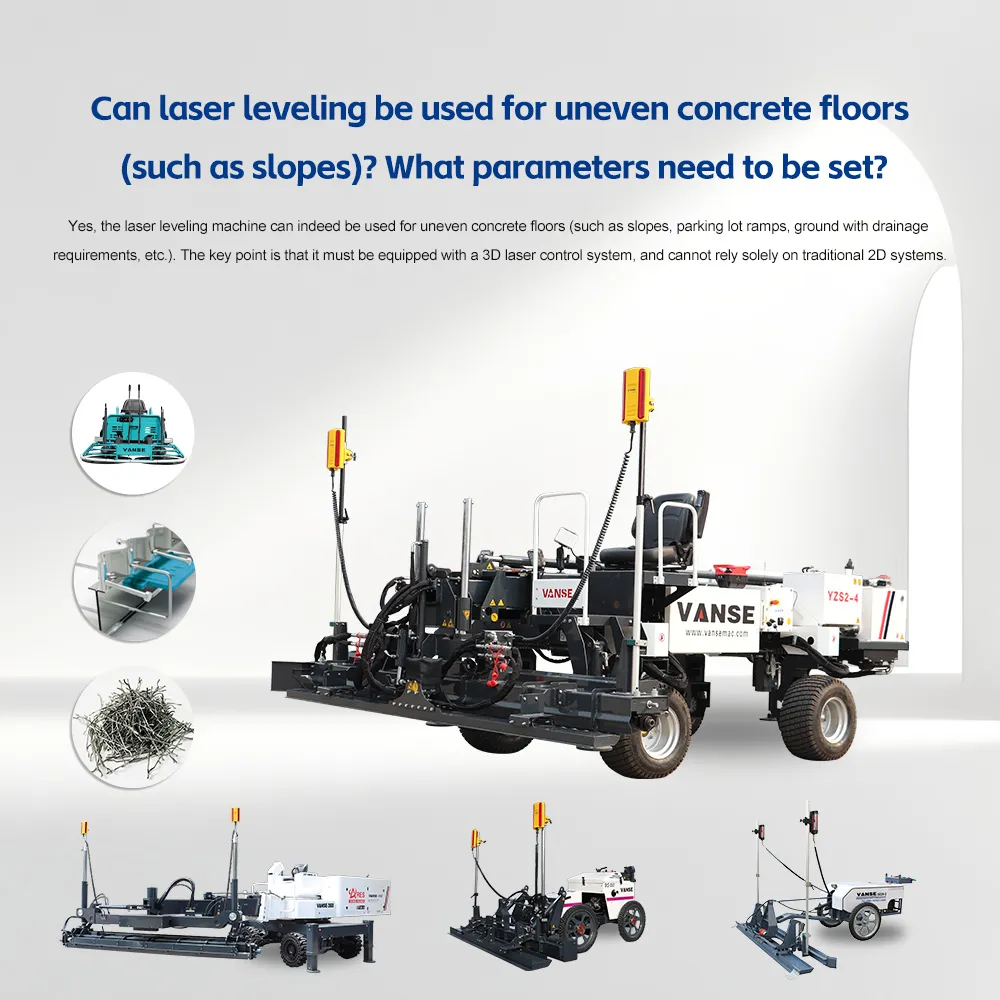
Can laser leveling be used for uneven concrete floors (such as slopes)? What parameters need to be set?
Yes, the laser leveling machine can indeed be used for uneven concrete floors (such as slopes, parking lot ramps, ground with drainage requirements, etc.). The key point is that it must be equipped with a 3D laser control system, and cannot rely solely on traditional 2D systems. According to the information provided on the Vanse Machinery website, the YZ30-4E model clearly indicates "Sloping ground" in the "Special project" section, and states that "with the 3D laser system, it can precisely level ground with drainage slopes (such as parking lot ramps)". This provides a direct basis for your question. To achieve precise leveling of the slope, the following key parameters need to be set, which are usually accomplished through the control panel of the 3D system or the accompanying software: Parameter Categories Specific settings: Function and Description 1. Slope Direction and Ratio Set the slope values for the X-axis (horizontal) and Y-axis (vertical). Usually expressed as percentages (%) or angles. For example, set a slope from point A to point B, with a 1 cm drop per meter (i.e., 1% slope). This is the core data that defines the shape of the slope, informing the machine about the direction and angle at which the ground slopes. 2. Elevation Reference Point Input the absolute elevation of at least one known point on the slope as the reference for the entire slope calculation. The 3D system will use this as a starting point, combined with the slope parameters, to automatically calculate the target elevation of any point on the slope. 3. Import of 3D Digital Model For complex slopes (such as bidirectional slopes, curved surfaces), directly import the 3D design drawings from the design institute (in formats like DXF, DWG). This is the most efficient and accurate method. The machine can "understand" the design intent and automatically guide the leveling head operation. 4. Settings of Laser Emitter Set the laser emitter to slope mode (instead of horizontal mode), and adjust the prism or tilt sensor inside the emitter head according to the input slope parameters. Ensure that the laser plane emitted is itself an accurate slope, providing the machine with the correct reference benchmark. Apart from parameter settings, there are also specific requirements during the construction process: Equipment selection: It is preferable to use telescopic arm type or large seated laser leveling machines (such as the YZ series and WS series from Vanse). These types of equipment have good stability and provide a good field of vision for the operator, making them more suitable for safe and precise operation on slopes. Construction from low to high: The sequence of concrete pouring and leveling should start from the lowest point at the bottom of the slope and progress towards the top. This allows the use of the self-weight and fluidity of the concrete to facilitate the control of elevation and density. Controlling concrete slump: Slope construction has higher requirements for the fluidity of the concrete. If the slump is too large, the concrete will flow downward after vibration, making it difficult to form; if it is too small, it will be difficult to level. Generally, the slump should be reduced appropriately compared to flat construction (for example, controlled at 12 ± 2 cm), and adhesives may be needed to enhance the concrete's anti-flowing ability. Strengthening formwork support: The formwork at the bottom of the slope needs to withstand greater lateral pressure and must be reinforced and supported to prevent the formwork from shifting during pouring, resulting in distorted slope. Manual assistance: At the top, edges, or blind spots where machines cannot operate, manual replenishment and assistance for leveling are necessary to ensure the overall slope is consistent and coherent. Using a laser leveling machine equipped with a 3D system for slope construction, the accuracy and efficiency are far superior to traditional methods. The key lies in digitally transmitting the design intent to the machine (through slope parameters or 3D models), and having experienced operators adjust it flexibly during the construction process. If your project has specific slope requirements (such as one-way or two-way slope? What is the slope percentage?), please let me know. I can help you further analyze the parameter settings or details of equipment selection. Contact us NOW Note: The parameters provided in this document are for reference only and are not mandatory. Due to differences in technical characteristics between different brands and models of laser levelers, please consult the manufacturer for a suitable solution before actual operation. This reference document assumes no responsibility for any issues arising from failure to follow the manufacturer's instructions.Does the automatic elevation adjustment function of the intelligent concrete laser leveling have a high error rate in actual construction?
The simple and straightforward answer is: The automatic elevation adjustment function of the intelligent concrete laser leveling has an extremely low error rate in actual construction, and its precision and efficiency are far beyond those of traditional manual methods. Below, I will explain in detail why its error rate is low and in what circumstances errors might occur. The high precision of the intelligent laser leveling mainly relies on the closed-loop control composed of its three major systems: Laser emitter: A fixed laser emitter is set up in the center of the construction area, which will form an absolutely horizontal laser reference plane covering the entire working surface. The precision of this laser plane is extremely high, typically reaching ±1.0mm/10m or even higher. Compared with the traditional approach: It has replaced the visual and human errors caused by relying on manual threading, rulers, etc. in the traditional way. Laser receiver: The mast on the leveling is equipped with a laser receiver to capture laser signals in real time. The controller: The receiver transmits the signal to the on-board computer (PLC), which calculates in real time the precise height difference between the current bottom of the scraper of the leveling and the laser reference surface. Compared with the traditional way: This "brain" replaces the experience and judgment of the master, eliminating human uncertainty. Hydraulic cylinder: According to the instructions of the "brain", the hydraulic system will instantly (with a response time measured in milliseconds) drive the lifting cylinders at both ends of the flattening head, keeping the scraper precisely at the height set by the laser reference. Compared with the traditional method: No matter how the foundation undulates (such as being soft or hard below), the leveling head can automatically adjust and maintain a constant elevation, while manual operation will be "deceived" by the unevenness of the foundation, resulting in an uneven ground in the end. This "eye-brain-hand" system works in coordination to form a real-time, closed-loop automatic control system, thus ensuring the ultimate accuracy of the elevation. Elevation accuracy: Under normal operation, the intelligent laser leveling can control the flatness of the floor within ±3mm/3m. For large-area integral floors, the overall elevation error can be easily controlled within ±5mm. Some high-end models can even perform better under ideal conditions. Construction efficiency: Its efficiency is 10 to 20 times that of manual labor, significantly shortening the construction period. Ground quality: As high-frequency vibration and leveling are carried out simultaneously, the density of the concrete is uniform, which can effectively avoid problems such as hollowing and peeling. Although the machine itself is of extremely high precision, the principle of "garbage in, garbage out" still applies. The errors in actual construction mainly stem from factors outside the machine rather than the failure of the machine's own automatic adjustment function. Source of error Explanation How to avoid 1. Incorrect benchmark setting The laser emitter itself was not leveled or was set up unstably and knocked over. This is the most fatal mistake, which can cause the entire working surface to tilt or go wrong. After erection, conduct a double inspection to ensure its stability and accuracy within the allowable range. 2. Improper handling at the grassroots level The flatness of the foundation (crushed stone cushion layer) is too poor, and the height fluctuation is too large. Although the leveling can adjust automatically, extreme drops may exceed its adjustment range or cause uneven concrete thickness. Strictly control the laying and compaction flatness of the base layer. 3. Concrete batching and paving Unstable slump of concrete (sometimes dry and sometimes thin), uneven particle size of aggregates, or excessive differences in initial flatness during paving will all bring difficulties to fine leveling. Ensure the stability of concrete quality. When spreading, it should be roughly uniform, and there should be no piles of materials that are too high or too low. 4. Operator skills The operator's lack of proficiency and improper planning of the walking path have led to leakage vibration or height differences at the junctions. Employ experienced operators and receive professional training. 5. Later Maintenance and load If people or equipment are placed on the concrete before it reaches sufficient strength, or if it is improperly maintained (such as losing water too quickly), causing uneven shrinkage and cracking, it will damage the already formed flatness. Strictly carry out post-maintenance and prohibit loading until the strength is reached. The automatic elevation adjustment function of the intelligent concrete laser leveling is itself very reliable with an extremely low error rate. It is a mature technology, and its features of high precision and high efficiency have been fully verified in large-scale floor construction in factories, warehouses, shopping malls, etc. both at home and abroad. The final construction accuracy does indeed depend on the combination of "advanced equipment + standardized procedures + qualified personnel". The laser leveling machine has solved the problems of "equipment" and most of the "process", automating and digitizing the most crucial and labor-dependent link of elevation control, thereby minimizing human errors and fundamentally ensuring the ultra-high flatness of floor construction. Therefore, as long as the preparatory work in the early stage and the maintenance in the later stage are in place, the error rate of construction using it can be completely controlled at an extremely low level. Note: The parameters provided in this document are for reference only and are not mandatory. Due to differences in technical characteristics between different brands and models of laser levelers, please consult the manufacturer for a suitable solution before actual operation. This reference document assumes no responsibility for any issues arising from failure to follow the manufacturer's instructions.New technology application of concrete laser leveling machine
Based on the current application of new technologies and major trends in the construction industry, its future development will focus on the core dimensions of "intelligence," "unmanned operation," "greening," and "integration." The following is a detailed outlook: This is one of the ultimate goals of future development. Current automation only assists operators, but in the future, true "unmanned operation" will be achieved. Environmental Perception and Obstacle Avoidance: leveling machines will be integrated with advanced sensors such as LiDAR, millimeter-wave radar, and computer vision cameras, enabling real-time perception of their surroundings, identifying obstacles (such as materials, workers, and other equipment), and automatically planning paths or initiating emergency braking to ensure construction safety. High-Precision Navigation and Positioning: Combining GNSS (Global Navigation Satellite System), RTK (Real-Time Kinematic), and SLAM (Simultaneous Localization and Mapping) technologies, leveling machines will achieve centimeter-level positioning and autonomous movement in the dynamic and unstructured environment of construction sites, without the need for human intervention. Cluster collaborative work: On a large construction site, multiple unmanned leveling machines, unmanned trowels, and unmanned transport vehicles will be uniformly dispatched and directed by a central control system ("honeycomb brain"), working together like a swarm of bees, automatically dividing areas, and efficiently and seamlessly connecting to achieve 24-hour uninterrupted construction. AI will be upgraded from a "support" role to a "decision-making" one. AI Predicting Construction Quality: Using machine learning models, AI can analyze data such as vibration frequency, concrete slump feedback, and ambient temperature and humidity during the leveling process in real time to predict potential quality issues (such as cracking and sanding) in the final floor, and instantly adjust leveling parameters (such as speed and vibration intensity) to avoid defects. Intelligent Path Planning and Optimization: AI algorithms will automatically calculate and select the most efficient and appropriate leveling path and sequence based on factors such as the work area shape and the initial setting time of concrete, maximizing equipment utilization and construction efficiency. Predictive Maintenance Upgrade: Future systems will not only generate alarms but also accurately predict the remaining life of components (such as engines and hydraulic pumps) by analyzing historical data and real-time operating status (such as hydraulic oil temperature and engine vibration spectrum). This allows for pre-ordering of parts and scheduling of repairs, significantly reducing the risk of unplanned downtime. The leveling machine will become a key data collection terminal for building a "digital twin construction site." Real-time Mapping: Sensors on the leveling machine will simultaneously generate a high-precision digital twin model of the physical floor during construction. This model includes not only geometric dimensions but also attribute data such as construction time and compaction level. Full Traceability: Owners and project managers can review every moment of floor construction and access construction data at any point, enabling precise tracing of quality issues and significantly streamlining the acceptance process. Providing a Foundation for Subsequent Processes: The resulting high-precision digital model can be directly used for subsequent automated construction (such as AGV navigation and rack installation), facilities management (FM), and operations and maintenance (BIM operations and maintenance), becoming the data cornerstone for building lifecycle management. Full-Scale Adoption of Pure Electric Vehicles: With increasing battery energy density and decreasing costs, pure electric levelings will become mainstream, particularly in indoor applications and areas with stringent environmental requirements. Their advantages of quiet operation, zero emissions, and low operating costs are irreplaceable. Exploring Hydrogen Fuel Cells: For large-scale, outdoor projects requiring long, continuous operations, hydrogen fuel cells may become a complementary solution, offering faster energy replenishment and longer battery life, enabling truly zero-carbon construction. Lightweighting and New Material Applications: The use of more advanced composite materials and optimized structural designs can reduce equipment weight, reducing stress on unpaved floors and improving energy efficiency. Quick-Change Attachments: The main machine design will be more modular, allowing for quick connection and replacement of actuators with different functions, such as switching from a "leveling head" to a "dry hardener spreader" or "curing agent sprayer." This allows for multiple uses of one machine and reduces equipment investment costs. Adaptability to Diverse Materials: With the increasing use of new concrete materials (such as self-leveling, ultra-high-strength, and fiber-reinforced concrete), the leveling machine's vibration system and scraper design will become more intelligent and adjustable to adapt to the rheological properties of different materials for optimal application results. The future concrete laser leveling will no longer be a single-function construction machine, but a self-driving robot with an integrated AI brain and perceptual capabilities. It will be an intelligent node in the smart construction site network, seamlessly connected to all aspects of the process, including design, scheduling, and operations and maintenance, via the cloud. For construction companies, this means: Ultimate Quality: Construction results will closely resemble the perfect design of the digital model. Maximize Efficiency: Labor costs will drop dramatically, and construction cycles will be significantly shortened. Digital Management: Decisions will be based on real, comprehensive data, resulting in more transparent and precise management. Safer/Greener Operations: Reduced manual labor risks will enable low-carbon, environmentally friendly construction. Click the below to jump immediately!!!