Technical Knowledge
Diagnosis and Solution of Abnormal Walking System of Concrete Laser Leveling Machine
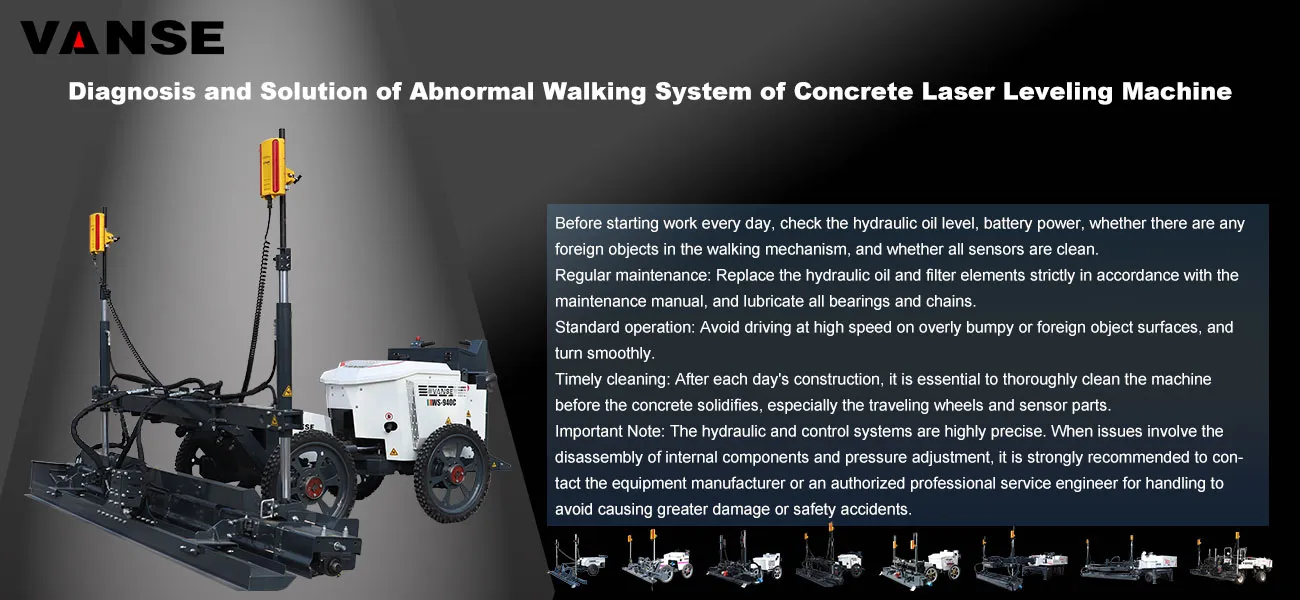
The walking system of the Concrete Laser Leveling is one of its core functions. Once it malfunctions, it will directly affect the construction efficiency and the flatness of the floor. The following is a systematic review of the diagnostic steps and solutions for abnormal walking systems for you.
Ⅰ. Classification of Fault Phenomena
First, make a preliminary classification based on different fault phenomena:
Completely unable to walk: The leveling machine is completely stationary.
Weak walking/Slow speed: Can walk, but lacks power and cannot reach the set speed.
Unstable walking/shaking: Stammering during walking or severe shaking of the body.
Abnormal walking on one side: One side is normal, while the other side is motionless, weak or in the wrong direction.
Walking deviation: Unable to walk in a straight line, automatically veers to one side.
Ⅱ. Systematic Diagnostic Process and Solutions
Follow the principle of conducting the investigation from simple to complex and from the outside to the inside.
Step 1: Preliminary appearance and basic inspection
Emergency stop switch and mode selection
Diagnosis: Check whether the emergency stop switch on the operation console or remote control has been pressed and whether the working mode (such as manual/automatic) has been selected correctly.
Solution: Release the emergency stop switch and select the correct working mode.
Power supply and line connection:
Diagnosis: Check whether the main power switch and battery terminals are loose, corroded or have insufficient power (for battery-powered models). Check whether the plugs at the main control cabinet and the walking motor are loose.
Solution: Tighten all terminal blocks, clean the battery terminals, charge the battery or replace it. Make sure all the plugs are securely connected.
Jamming of mechanical transmission components
Diagnosis: Check whether the walking wheels (tracks), drive shafts, chains or gears are jammed by solidified cement, crushed stones or other foreign objects.
** Solution ** : Immediately stop the machine and thoroughly clear all obstructions. Check the lubrication condition of the chain or gearbox and add or replace the specified grease if necessary.
Step 2: Hydraulic System Diagnosis (Common Fault Points)
If there are no issues found during the initial inspection, focus on checking the hydraulic system.
Hydraulic oil level and oil quality
Diagnosis: Insufficient hydraulic oil can cause the pump to run dry, resulting in weak or no movement during movement. Deteriorated oil (turning black, foaming, or having metal shavings) can damage hydraulic components.
Solution: Check the oil level while the machine is shut down and replenish it to the specified mark. If the oil quality is substandard, the hydraulic oil and filter element of the original factory-specified model must be completely replaced.
Walking motor and drive pump
Diagnosis (Unilateral abnormality) : If only one side of the walking is abnormal, you can try to swap the hydraulic pipelines of the walking motors on both sides. If the fault phenomenon then shifts to the other side, it indicates that the walking motor or pump on the original side is faulty.
Solution: Please contact professional maintenance personnel. It may be necessary to inspect or replace the walking motor, variable pump or related control valves. This job requires professional knowledge and tools. Do not disassemble it by yourself.
Hydraulic system pressure
Diagnosis: Use a hydraulic pressure gauge to check whether the overflow pressure of the main safety valve and the walking circuit of the system has reached the specified value. Low pressure can lead to weakness when walking.
Solution: Have a professional technician adjust the corresponding relief valve to the standard pressure. Do not adjust it at will, otherwise the hydraulic system may be damaged.
Step 3: Control system and sensor diagnosis
For laser leveling machines that adopt advanced control systems.
Laser control system
Diagnosis: Check whether the laser transmitter is working properly and whether the signal is stable. Check whether the laser receiver on the leveler is clean and firmly installed. Signal loss or instability can cause the machine to move in confusion or stop.
Solution: Ensure that the laser transmitter is stably set up and the signal covers the entire construction area. Clean the laser receiver rod and sensor head. Recalibrate the system.
Control module and sensor
Diagnosis: Observe whether there are any fault code alarms on the control panel. Check whether the walking speed sensor, Angle sensor, etc. are damaged or the circuit is disconnected.
Solution: Check the cause according to the fault code manual. Check and plug in the sensor wiring tightly. Replace it if any damage is found.
Remote control/line controller
Diagnosis: Weak signal, insufficient battery power or internal faults of the remote control can cause instructions to fail to be sent correctly, resulting in abnormal walking.
Solution: Check the battery level of the remote control and try frequency matching or restarting. If possible, switch to the line control mode for comparative testing to determine whether the problem lies with the machine or the remote control.
Ⅲ. Quick Reference Table of Common Fault Phenomena and Targeted Solutions
| Fault phenomenon | Possible reasons | Solution |
| Completely unable to walk | 1. The emergency stop switch is activated | 1. Release the emergency stop switch |
| 2. Main power supply disconnected/Battery discharged | 2. Check and connect the power supply/charge | |
| 3. Failure of the main hydraulic pump | 3. Overhaul the main pump | |
| 4. Control signal interruption | 4. Check the remote control, receiver and wiring | |
| Weakness in walking | The hydraulic oil level is too low or the oil quality is poor | 1. Add or change the oil |
| 2. The hydraulic filter element is clogged | 2. Replace the hydraulic filter element | |
| 3. System pressure is too low | 3. Adjust the pressure by professionals | |
| 4. Leakage inside the walking motor or pump | 4. Inspect or replace hydraulic components | |
| One side not moving/weak | The track/wheel on this side is mechanically jammed | 1. Remove foreign objects |
| 2. The walking motor on this side is faulty | 2. Swap the hydraulic pipelines for testing and then carry out the repair after confirmation | |
| 3. The valve core of the control valve on this side is stuck or damaged | 3. Clean or replace the valve assembly | |
| 4. The speed sensor on this side is faulty | 4. Check or replace the sensor | |
| Shaking/Unstable walking | There is air in the hydraulic system | 1. Perform the exhaust operation |
| 2. The signal of the flow/speed sensor is unstable | 2. Check the sensors and circuits | |
| 3. Hydraulic oil contamination leads to discontinuous valve core operation | 3. Replace the hydraulic oil and filter element | |
| Walking off course | 1. The laser signal is inaccurate | Recalibrate the laser system |
| 2. The tension of the tracks on both sides is inconsistent | 2. Adjust the tracks to the same tension | |
| 3. The bearing of one of the walking wheels is damaged | 3. Replace the damaged bearing | |
| 4. Calibration error of the control system | 4. Re-perform the walking calibration |
Ⅳ. Safety Precautions and Daily Maintenance
Before starting work every day, check the hydraulic oil level, battery power, whether there are any foreign objects in the walking mechanism, and whether all sensors are clean.
Regular maintenance: Replace the hydraulic oil and filter elements strictly in accordance with the maintenance manual, and lubricate all bearings and chains.
Standard operation: Avoid driving at high speed on overly bumpy or foreign object surfaces, and turn smoothly.
Timely cleaning: After each day's construction, it is essential to thoroughly clean the machine before the concrete solidifies, especially the traveling wheels and sensor parts.
Important Note: The hydraulic and control systems are highly precise. When issues involve the disassembly of internal components and pressure adjustment, it is strongly recommended to contact the equipment manufacturer or an authorized professional service engineer for handling to avoid causing greater damage or safety accidents.
Note: The parameters provided in this document are for reference only and are not mandatory. Due to differences in technical characteristics between different brands and models of laser levelers, please consult the manufacturer for a suitable solution before actual operation. This reference document assumes no responsibility for any issues arising from failure to follow the manufacturer's instructions.
Thanks to All the Friends Who Support and Trust Shandong Vanse Machinery Technology Co., Ltd.
If you want to know more about Shandong Vanse Machinery Technology Co., Ltd. or have any questions, please feel free to contact us:
Our Factory
Shandong Vanse Machinery Technology Co., Ltd.








Share this article

About the Author: Shandong Vanse Machinery Technology Co., Ltd.
Shandong Vanse Machinery Technology Co., Ltd. is a high-tech manufacturer specializing in concrete construction machinery, including laser screeds and related equipment. The company integrates R&D, production, and global sales, with products exported to over 60 countries and widely used in infrastructure projects worldwide.
Previous Post
Next Post
Related Articles
You Might Also Like
During the operation of concrete laser leveling/ leveling machine,what safety matters need to be paid attention to
The concrete laser leveler is a piece of equipment widely used at construction sites to achieve fast, high-precision leveling of the ground. When operating this kind of machinery, a series of safety regulations and operating procedures must be followed to ensure the safety of operators and the quality of construction. The following are safety matters that need to be paid attention to during the operation of the concrete laser leveling: •••★••• Preparation before operation 1. Check the equipment: Before operation, a comprehensive inspection of the leveling machine should be carried out, including the mechanical structure, electrical system, laser system, hydraulic system, etc., to ensure that all components are intact and working properly. Pay special attention to check the wear of wearing parts such as blades and scrapers, and replace them in time if necessary. 2. Check the surrounding environment: Clean up debris and obstacles at the construction site and ensure that the leveler is operated on a flat, obstacle-free ground. At the same time, check whether there are other construction workers or equipment around to ensure that they will not interfere with each other during the operation. 3. Wear protective equipment: Operators should wear protective equipment that meets safety regulations, including safety helmets, work shoes, protective glasses, gloves, etc. Do not wear loose clothing or clothing that can easily get caught in the machine. •••★••• Precautions during operation 1. Comply with operating procedures: Operators should be familiar with the operating procedures of the leveling machine and strictly follow the operating procedures. Do not change operating procedures or ignore safety warnings. 2. Maintain a stable speed: During operation, you should maintain a stable driving speed and avoid operations such as rapid acceleration, rapid deceleration, or sharp turns. This can reduce the instability factors of the machine and improve the leveling accuracy. 3. Pay attention to the use of the laser system: The laser system is the core component of the leveling machine and should be inspected and maintained regularly. During operation, ensure that the laser transmitter, receiver and control system are working properly. Avoid operating if the laser system is disturbed or damaged. 4. Maintain a safe distance: During operation, a safe distance should be maintained from surrounding people and equipment. It is prohibited to operate in areas with dense crowds or lots of equipment. At the same time, pay attention to changes in the surrounding environment and respond to emergencies in a timely manner. 5. Avoid overload operation: When the leveling machine carries a load that is too heavy or exceeds its design range, it may cause mechanical failure or safety accidents. Therefore, operators should operate in strict accordance with the specified load capacity of the equipment to avoid overloading. 6. Unauthorized modification is prohibited: The structure and performance of the leveling machine are professionally designed and manufactured. It is prohibited to modify the equipment or add non-standard accessories without authorization. If you need to make changes, you should contact professional manufacturers or technicians for evaluation and guidance. •••★••• Emergency measures 1. Shut down and inspect: During operation, if any abnormality or malfunction is found in the equipment, it should be shut down immediately for inspection. Do not continue until the cause is identified and the fault is eliminated. 2. Personal injury treatment: If a personal injury accident occurs, stop the machine immediately and turn off the power supply. Then quickly treat the injured and call the emergency hotline to seek professional medical assistance. At the same time, report to superior leaders and relevant departments to investigate and handle the accident. •••★••• What to do after the operation is over 1. Cleaning and maintenance: After the operation, the leveling machine should be comprehensively cleaned and maintained. Remove debris and stains from the fuselage, check the wear of various components and perform necessary lubrication and tightening. 2. Equipment storage: Park the leveling machine in a dry, ventilated, and safe place, and take measures to prevent theft and fire. Do not park the device in a place that is humid, hot, or subject to external impact. •••★••• Summary Safety matters during the operation of the concrete laser leveling involve many aspects, including preparations before operation, precautions during operation, emergency measures, and work after the operation. Operators should strictly abide by safety regulations and operating procedures to ensure their own safety and the safety of others. At the same time, the equipment should be maintained and maintained regularly to ensure the normal operation of the equipment and extend its service life. By strengthening safety management and training and education, we can improve the safety awareness and skill level of operators and provide a strong guarantee for safe production at construction sites. Please note that the above content is based on general safe operation principles and requirements. In actual operation, adjustments and supplements may be required based on specific equipment models, construction environments, and engineering requirements. Therefore, during actual operation, be sure to refer to the operation manual and safety guide provided by the equipment manufacturer, and strictly abide by relevant laws, regulations and standards. At the same time, regular safety training and education are conducted to improve the safety awareness and emergency response capabilities of operators to ensure the safe and efficient operation of concrete laser leveling machines.How serviceable is the concrete laser leveling machine?
Maintenance of concrete laser leveling machines is crucial to ensure the normal operation and service life of the machine. Here are some suggestions for maintenance and repair of concrete laser levelings: ★Regular inspection: All components of the concrete laser leveling machine, including laser transmitter, receiver, drive system, control system, etc., should be inspected regularly to ensure the normal operation of the machine. In addition, the machine's cables and plugs should be checked regularly for loose or damaged cables to prevent electrical failures. ★Keep it clean: The concrete laser leveling machine should be kept clean, especially to avoid dust and other impurities from entering the inside of the machine during use. When cleaning the machine, use a dry cloth to wipe the surface of the machine and avoid water or other liquids from entering the inside of the machine. ★Replace consumables: Some parts of the concrete laser leveling, such as the laser transmitter and receiver, may require regular replacement of consumables. These parts should be inspected and replaced regularly according to the recommendations and operating instructions provided by the manufacturer to ensure the normal operation of the machine. ★Adjustment and calibration: The concrete laser leveling machine should be adjusted and calibrated regularly during use to ensure the accuracy and reliability of the machine. This includes calibration of the laser transmitter and receiver, as well as adjustments to the height and level of the machine. ★Preventive maintenance: Concrete laser leveling machines should undergo preventive maintenance to reduce machine failures and extend service life. This includes regular inspections of the machine's lubrication system, cleaning of deposits inside the machine, checking of wires and plugs, etc. ★Training and maintenance manual: A training and maintenance manual should be provided for the concrete laser leveling machine to ensure that the operator can properly use and maintain the machine. These manuals should include operating instructions, maintenance recommendations, troubleshooting guides, etc. so that operators can reference and learn as needed. Overall, concrete laser leveling machine maintenance requires attention and maintenance in terms of regular inspections, keeping it clean, replacing consumables, adjustments and calibrations, preventive maintenance, and providing training and maintenance manuals. Through correct maintenance, the normal operation and service life of the concrete laser leveling can be ensured, and the efficiency and accuracy of the machine can be improved.What are the specific safe operation and maintenance procedures for concrete laser leveling machines?
Concrete Laser Leveling Machine Safety Operation and Maintenance Procedures Performance Requirements: Operators must undergo rigorous training and be familiar with the equipment's performance, operating methods, and safety regulations. Unlicensed operators are strictly prohibited. Dress Code: Wear personal protective equipment (PPE), including a hard hat, reflective clothing, puncture-resistant shoes, and protective gloves. On-site Inspection: Survey the construction site, clear any obstructions, and confirm the site's sufficient bearing capacity to prevent equipment from sinking. Set up clear construction cordons and prohibit unauthorized personnel from entering the work area. Equipment Inspection (mandatory before daily startup): Walk around the machine: Check all machine components for damage or cracks, especially the scraper, vibrator, and track. Fastener Inspection: Check for loose bolts and nuts in key areas (such as scraper attachment bolts and vibrator mounting bolts). Leak Check: Check the engine, hydraulic system, and fuel system for oil or water leaks. Lubrication Inspection: Check the lubricating and hydraulic oil levels to ensure they are within normal ranges. Power System: Check the coolant level and engine air filter for cleanliness. Laser System: Check the laser transmitter battery level to ensure the signal is stable; clean the laser receiver sensor lens. Start up: Ensure all control levers are in the neutral or park position. Sound the horn or sound an alarm to alert nearby personnel that the equipment is about to start. Start the engine smoothly and let it idle for 3-5 minutes to warm up, especially in cold weather. Moving and Traveling: Before moving, check your surroundings to ensure there are no people or obstacles. When working in potholes, on slopes, or near edges, exercise extreme caution and maintain a low speed to prevent tipping. When turning, pay attention to the position of accessories such as scrapers to avoid collisions with others or objects. Operation Process: Laser Setup: Properly set up the laser transmitter, ensuring it remains stable and stationary. Regularly check the reference surface for accuracy throughout the application process. Focused Operation: Pay close attention to the front and rear of the machine, as well as the feedback from the laser control system, and keep your hands on the joystick. Keep Out of the Way: While the machine is operating, no one is allowed to stand in the danger zone directly in front of or behind the machine. Abnormal Handling: If the machine experiences unusual noises, vibrations, alarms, or a sudden drop in performance, immediately shut it down for inspection. Operations can only resume after the problem has been corrected. Emergency: Familiarize yourself with the location of the emergency stop button and press it immediately in any emergency. If a fire occurs, immediately use the provided fire extinguisher to extinguish the fire. Shutting Down the Machine: Park the machine on a flat, solid, and safe area. Lower the scraper and ensure it rests flat on the ground. Shutting Down the Engine: Turn off the engine and remove the key for safekeeping. Cleaning: Do this immediately! Before the concrete sets, thoroughly clean any concrete slurry from the equipment, especially any buildup on the scraper, vibrator, and travel mechanism. Never use a sledgehammer to strike precision components. When flushing, avoid splashing the engine exhaust, bearing housing, laser electrical components, and other areas. Handover: Complete the equipment operation log, recording the operating hours, any abnormalities detected, and any maintenance performed during the shift. Maintenance is implemented through a system that combines daily maintenance, scheduled maintenance, and seasonal maintenance. Cleaning: Thoroughly clean the entire machine. Inspection and Tightening: Inspect and tighten all connecting bolts. Lubrication: Fill all lubrication points (such as the cutter head support, lift screw, travel bearings, etc.) with the specified grease according to the instructions in the manual. (Especially important: the scraper lift screw must be lubricated after each use!) Leak Check: Inspect the hydraulic system and engine for leaks. Oil Level Check: Check the engine oil, coolant, and hydraulic oil levels. Cycle Maintenance Details Maintenance Details Every 50 hours 1. Complete all daily maintenance items. 2. Inspect the scraper and vibrator for wear and adjust or replace if necessary. 3. Check the engine belt tension. Every 250 hours 1. Complete all 50-hour maintenance items. 2. Change the engine oil and oil filter. 3. Clean or replace the engine air filter element (requires shorter intervals in dusty environments). 4. Inspect the equipment structure for cracks or deformation. Every 500 hours 1. Complete all 250-hour maintenance items. 2. Replace the hydraulic oil suction and return filters. 3. Inspect the track and tires for wear and tension. 4. Check all electrical connections for tightness and deterioration. Every 1000-2000 hours 1. Complete all 500-hour maintenance items. 2. Completely replace all hydraulic oil. 3. Clean the hydraulic oil tank and breather. 4. Professional service engineers will fully calibrate the laser system accuracy and conduct a comprehensive overhaul of the equipment. Clean the equipment according to regulations. Apply grease to all exposed metal parts (such as scrapers and screws) to prevent rust. Fill the fuel tank with fuel to prevent rust on the inside. Disconnect the negative battery cable. Store the equipment in a dry, flat indoor environment. Safety First, Prevention First: All operations and maintenance must be conducted with safety in mind. Cleanliness is Key: Concrete is extremely difficult to clean after setting, which can severely damage equipment. Immediate cleaning after each shift is paramount. Lubrication Ensures Longevity: Use the specified brand of lubricant/grease strictly in accordance with the manual and refill on schedule. Follow the Manual: This procedure is a general guideline only. For specific operations, be sure to follow the official manual for your equipment. Implementing this procedure in daily operations will greatly ensure personnel safety, extend equipment life, and ensure construction quality. Note: The parameters provided in this document are for reference only and are not mandatory. Due to differences in technical characteristics between different brands and models of laser levelers, please consult the manufacturer for a suitable solution before actual operation. This reference document assumes no responsibility for any issues arising from failure to follow the manufacturer's instructions.