Technical Knowledge
Correct operation process of concrete laser leveling machine
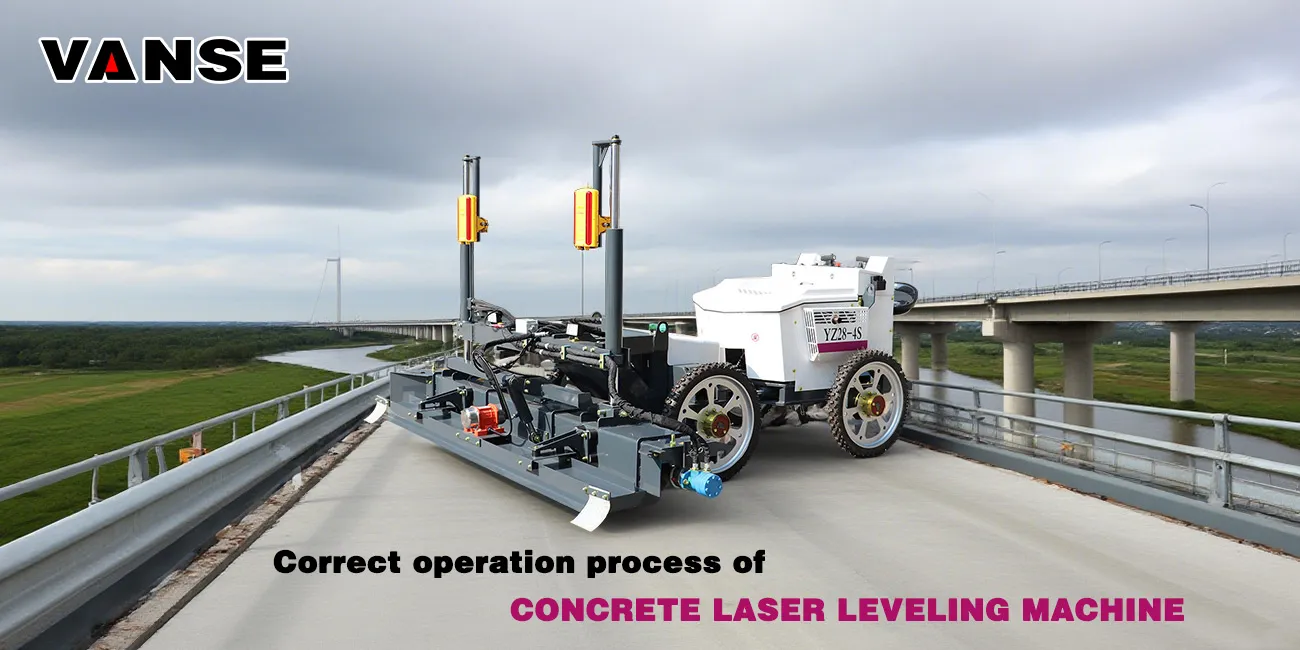
Correct operation of a concrete laser screed is key to ensuring construction quality, equipment safety, and extending its service life. Strictly adhere to the four-stage process of "
Preparation → Commissioning → Operation → Finishing.
" The following are detailed steps:
Pre-operation Preparation: Identify potential hazards and ensure equipment is in good condition.
1. Site and Environmental Inspection
Clean the work surface:
Remove debris such as rebar, rocks, and wood chips from the site to prevent damage to the machine chassis and scraper blades. If the ground is wet or muddy, lay down steel plates or gravel to prevent the machine from getting stuck or the tires from slipping.
Confirm laser signal coverage:
Check the work area for obstacles (such as scaffolding or walls) that could block the laser signal. Ensure there is no obstruction between the laser transmitter and receiver to prevent signal interruption and leveling errors.
Safety precautions:
Post warning signs (such as "Construction in Progress" and "Do Not Enter") around the work area to prevent non-operating personnel from entering. Operators must wear hard hats, non-slip shoes, and reflective clothing.
2. Equipment Condition Inspection
Visual Inspection of Core Components:
Structural Inspection:
Check the vibrating plate and scraper for deformation or cracks, and check whether the connecting bolts (such as the vibrating frame fixing bolts) are loose. If any abnormalities are found, shut down the machine for repair.
Pipe and Line Inspection:
Check the hydraulic lines and connectors for leaks, check the wires for aging or damage, and check whether the laser receiver lens is clean and free of scratches.
Fluid and Consumable Inspection:
Fluids:
Check the engine oil, hydraulic oil, and coolant levels to ensure they are within the normal range (inadequate engine oil may cause engine seizure, and insufficient hydraulic oil may cause pump wear).
Fuel:
Add fuel of the correct grade (according to the engine manual, usually 0# diesel). Avoid using fuel with excessive impurities that could clog the filter element.
Condition of Consumable Parts:
Check tire pressure (wheeled equipment) or track tightness (crawler equipment). Replace any severely worn scraper or vibrating plate wear strips.
Equipment Commissioning: Accurately Set Parameters to Ensure Laser System Stability
1. Laser System Deployment and Calibration
Install the Laser Transmitter:
Secure the laser transmitter on a tripod and place it near the work area (3-10 meters from the equipment to avoid vibration interference). Level the tripod so that the transmitter is level (use the transmitter's built-in level to confirm).
Set the Laser Elevation:
Adjust the height of the laser transmitter according to the concrete elevation specified in the construction drawings, ensuring that the laser plane aligns with the designed elevation (a tape measure can be used as an aid).
Calibrating Receiver Sensitivity:
Mount the laser receiver on the leveling machine's pole. After powering on the receiver, check that it is receiving the laser signal properly (a solid green light indicates normal operation; a flashing or red light indicates an abnormal signal). If the signal is unstable, reposition the transmitter or clean dust from the lens.
2. Equipment Parameter Adjustment
Vibration Frequency Setting:
Adjust the vibration frequency based on the concrete slump (usually between 3,000 and 6,000 vibrations per minute). For low slumps (dry, hard concrete), increase the frequency to enhance compaction; for high slumps, reduce the frequency to prevent concrete segregation.
Travel Speed Adjustment:
Set the travel speed based on the concrete pour thickness (usually 5-30 cm). For thicker concrete, slow down the speed (recommended 0.5-1 m/min) to ensure adequate vibration. For thinner concrete, increase the speed appropriately (1-2 m/min).
Scraper Height Calibration:
Use the equipment's operating lever to adjust the initial scraper height slightly above the laser mark (allowing for vibration sinkage). Before the first operation, test the speed at a corner to confirm the appropriate height.
Operation During Operation: Standardized Operation and Real-Time Monitoring
1. Starting and Preheating the Engine
Starting the Engine:
Insert the key and power on the machine for a self-test (wait 3-5 seconds to confirm there are no fault warning lights on the instrument panel). Then, start the engine at idle speed. Avoid sudden acceleration during a cold start.
Preheating the Equipment:
After starting the engine, let it idle for 3-5 minutes. Observe the hydraulic system pressure (normal range: 15-25 MPa) and the water temperature gauge (operate only when the water temperature rises above 50°C at idle). Ensure there are no abnormal noises or oil leaks.
2. Leveling Operation Procedure
Starting Operation:
Shift the machine's travel gear to "Forward" and slowly push the travel joystick to smoothly enter the concrete area. Avoid sudden acceleration, which could cause the scraper to push against the concrete and create accumulations.
Vibrating and Leveling:
After the machine enters the concrete, turn on the vibration switch. The scraper height is automatically adjusted based on the feedback signal from the laser receiver. (When the receiver senses the laser signal, the hydraulic system drives the scraper up and down to ensure the concrete surface is aligned with the laser elevation.) During operation, maintain a straight line, with adjacent work surfaces overlapping by 5-10 cm to avoid vibration leakage. Manual leveling (using a scraper or vibrator) is required when encountering laser signal blind spots such as corners and column bases.
Observe the concrete condition in real time:
If honeycombing or roughness is observed on the surface, this may indicate insufficient vibration frequency or excessive travel speed, requiring prompt adjustment. If excessive water seepage occurs, pause operations and wait for the water to evaporate before resuming.
Turning and reversing: When turning or exiting the work area, first turn off the vibration switch, slow down, and steer smoothly to avoid sudden turns in the concrete that could cause sanding. When reversing, ensure there are no obstacles behind you. Obtain guidance from a designated operator if necessary.
Key Monitoring Points During Operation
Listen:
Monitor the engine, hydraulic pump, and vibrator motor for any unusual noises (such as metallic friction or high-frequency squealing). Immediately stop and inspect any abnormal noises.
Observe:
Check the instrument panel for normal pressure and temperature (hydraulic oil temperature should not exceed 80°C, engine water temperature should not exceed 95°C), the stability of the laser receiver signal, and any oil or fluid leaks.
Measurement: Use a ruler to check the flatness of the concrete surface every 10-20 meters (the error should be ≤3mm/2m). If any deviation is found, calibrate the laser system or scraper height in time.
Finish after work: Cleaning and maintaining, standardized storage
1. Shutdown operation
After the operation is completed, first turn off the vibration switch, drive the equipment to a solid ground outside the concrete area, run at idle for 3-5 minutes (let the engine and hydraulic system cool down), and then turn off the engine.
Disconnect the laser transmitter power supply, disassemble the transmitter and receiver and store them properly (avoid collisions and moisture).
2. Equipment cleaning and maintenance
Remove residual concrete:
Use a high-pressure water gun or a shovel to clean the residual concrete on the fuselage, vibrating plate, and scraper (focus on cleaning the gaps on the bottom of the scraper and vibrating plate to prevent the concrete from solidifying and affecting the next operation), clean the surface moisture and avoid rust.
Core component maintenance:
Add grease to rotating parts such as vibrating bearings, walking motor gearboxes, etc. (according to the model specified in the instruction manual, such as lithium-based grease).
Check whether the hydraulic pipeline joints are loose, and replace the seals in time if there is leakage; clean the dust on the surface of the air filter element (the replacement cycle needs to be shortened in dusty environments).
Site Cleanup:
Retrieve the laser transmitter tripod and warning signs, clean the work surface and tools, and ensure the site is clean.
3. Equipment Storage
Short-term Storage (for same-day completion):
Park the equipment on a flat, dry surface, apply the parking brake, and place wooden planks under the tires to prevent moisture. Store the laser components separately in the tool box.
Long-term Storage (over 3 days):
Check the fuel level in the tank (it is recommended to fill it up to reduce rust on the inner wall), turn off the main power, spray rust inhibitor on exposed metal parts, and cover with a tarp to protect from sunlight and rain.
Operating Taboos and Precautions
Do not use the vibration function on non-concrete surfaces (such as hardened floors or steel plates) to avoid damage to the vibration bearings and scrapers.
Prohibit Overloading:
Do not exceed the equipment's maximum leveling thickness (generally ≤30 cm) or climbing angle (≤15°) to prevent overloading the hydraulic system.
Do not force operation when the laser signal is interrupted. Stop the machine to troubleshoot signal issues (such as cleaning the lens or adjusting the transmitter position) to avoid height differences. Do not add fuel or check the engine oil while the engine is running to avoid fire or burns; the system pressure must be released before repairing the hydraulic system to prevent oil from spraying and injuring people.
Summary: The key to proper operation of a concrete laser screed is thorough preparation, precise control during operation, and standardized maintenance afterward. Strictly following these procedures not only ensures laser-grade surface flatness but also reduces equipment failures, extends service life, and reduces construction costs. Operators must undergo professional training and pass a professional assessment before taking up their duties. Unlicensed operation or illegal operations are strictly prohibited.
Click the below to jump immediately!!!


CONCRETE LASER LEVELING MACHINE


SLIPFORM MACHINE

TOPPING SPREADER

Thanks to All the Friends Who Support and Trust Shandong Vanse Machinery Technology Co., Ltd.
If you want to know more about Shandong Vanse Machinery Technology Co., Ltd. or have any questions, please feel free to contact us:
Our Factory
Shandong Vanse Machinery Technology Co., Ltd.








Share this article

About the Author: Shandong Vanse Machinery Technology Co., Ltd.
Shandong Vanse Machinery Technology Co., Ltd. is a high-tech manufacturer specializing in concrete construction machinery, including laser screeds and related equipment. The company integrates R&D, production, and global sales, with products exported to over 60 countries and widely used in infrastructure projects worldwide.
Previous Post
Next Post
Related Articles
You Might Also Like
Vanse Machinery kindly reminds you what to pay attention to when purchasing a ride-on laser leveling machine
With the continuous increase in domestic labor costs, construction companies are increasingly in need of high-efficiency, short-term, and low-cost laser machinery. The ride-on laser leveling machine is easy and quick to operate, suitable for different engineering needs, and has become the mainstream nowadays. When purchasing a ride-on laser leveling machine, pay attention to the following aspects: 1. Look at the model: mainly based on the construction site and area for selection and determination. 2. Look at the use effect of the machine. 3. Leveling speed 4. Leveling accuracy requirements 5. Look at the manufacturer: The strength of the manufacturer directly affects the quality of the equipment. 6. Look at the price: If the price of a machine is too low than the average price of the industry, then the buyer should be alert. Without the conditions of large-scale production, too low prices do not mean low profits, but low costs, which will directly affect the life and use of the machinery, and even imply that the company will not invest too much in after-sales and R&D. Don't just look at the price because you don't know the technology very well, and in the end it's not worth the loss, so you can only buy it again. Not only waste money, but also delay your own production. 7. Look at safety: When choosing a laser leveling machine, you must also fully consider the braking performance and operational safety of the laser leveling machine. The parts of Vanse Machinery's laser leveling machines are all products produced by large manufacturers in advanced countries such as Germany and the United States. The production process is strictly in accordance with national standards, enterprise standards, and quality control assurance systems to ensure that the product quality meets or exceeds the requirements of enterprise standards and relevant national standards, and is trusted and praised by users for its excellent quality, excellent performance, and superior cost performance. Shandong Vanse Machinery's series of products have been widely used in factories, and customers are all over the country, inside and outside the Great Wall, and have been recognized by partners and customers of many engineering projects such as workshops, underground garages, floors, access bridges, square floors, logistics warehousing, etc.Performance Characteristics And Usage Advantages Of Concrete Laser Leveling Machine
▷▷•▪◇ Introduction With the continuous advancement of science and technology, the construction industry is gradually moving towards a new era of efficient, precise and environmentally friendly construction. In this context, concrete laser leveling machines have gradually become the new favorite in the field of floor construction with their unique performance characteristics and usage advantages. This article will deeply explore the performance characteristics and usage advantages of concrete laser levelings, and analyze them based on specific cases, in order to provide reference and inspiration for relevant practitioners: ▷▷•▪◇ Performance characteristics of concrete laser leveling machine 1. Efficient construction: The concrete laser leveling machine adopts advanced laser measurement and control system and leveling device, which can realize large-area, fast and efficient concrete floor leveling operations. Compared with traditional construction methods, the use of laser leveling machines can greatly improve construction efficiency and shorten the construction period. 2. Precise control: The laser measurement and control system guides the leveling device to perform operations through precise laser beams to ensure that ground elevation, flatness and other parameters meet the design requirements. This precise control method can reduce construction errors and improve construction quality. 3. High degree of automation: The concrete laser leveling machine has a high degree of automation, which can reduce manual intervention and operation difficulty. Through intelligent handle operation, construction workers can easily control the entire construction process, improving the safety and convenience of operations. 4. Easy to operate: The laser leveling machine adopts an intelligent operating system and humanized design, allowing construction personnel to operate without professional training. This simple operation method not only reduces labor intensity, but also improves construction efficiency. 5. Wide scope of application: Concrete laser leveling machine is suitable for concrete floor construction of various sizes, shapes and materials. Whether it is indoors or outdoors, whether it is a large project or a small project, it can exert its excellent performance. ▷▷•▪◇ Advantages of using concrete laser leveling machine 1. Cost savings: Using a concrete laser leveler for construction can greatly improve construction efficiency and shorten the construction period, thereby reducing labor costs and equipment rental costs. In addition, laser leveling machines can effectively reduce the waste and rework rate of concrete materials, further saving costs. 2. Improve quality: Because laser leveling machines have precise control capabilities and efficient construction efficiency, they can significantly improve the quality of concrete floors. Using laser leveling machines for construction, ground flatness, elevation and other parameters are more in line with design requirements, reducing the occurrence of quality problems such as cracks and hollows. 3. Reduce labor intensity: The laser leveling machine has a high degree of automation and can turn heavy physical labor into mechanical operations, thereby reducing the labor intensity of construction workers. This advantage not only helps protect the physical health of construction workers, but also improves their work efficiency. 4. Enhance environmental protection: The laser leveling machine produces less noise, dust and other pollution during the construction process, which meets environmental protection requirements. In addition, using laser leveling machines for construction can also reduce the use of formwork and waste of concrete materials, further reducing the impact on the environment. ▷▷•▪◇ Actual case analysis In order to more intuitively demonstrate the performance characteristics and usage advantages of the concrete laser leveling machine, the following is an analysis based on a practical case. In a large-scale commercial complex project, the construction quality of the ground has an important impact on the appearance and functionality of the overall building. Traditional construction methods are difficult to meet the project's requirements for ground quality, construction period, and environmental protection. Therefore, the project party decided to use a concrete laser leveler for ground construction During the construction process, the laser leveler successfully achieved large-area, high-quality concrete floor leveling operations by virtue of its efficient, precise, and automated waiting points. Compared with traditional construction methods, the use of laser leveling machines not only improves construction efficiency and quality, but also significantly reduces labor costs and material waste. In addition, since the laser leveling machine produces less noise and dust during the construction process, it also meets the project party's environmental protection requirements. After strict testing and acceptance, the ground construction quality of this commercial complex project reached the expected goals. The project party is very satisfied with the performance and results of the laser leveling machine and believes that it provides a strong guarantee for the successful implementation of the project. ▷▷•▪◇ Conclusion and Outlook In summary, the concrete laser leveling machine shows broad application prospects in the field of floor construction with its efficient, accurate, automated performance characteristics and usage advantages. With the continuous advancement of science and technology and the continuous expansion of the market, it is believed that laser leveling machines will play a more important role in the future and provide strong support for the sustainable development and innovation of the construction industry. At the same time, we also expect more advanced technologies and equipment to continue to emerge, injecting new vitality into the green, smart, and efficient development of the construction industry.How serviceable is a concrete laser leveling machine?
The maintainability of the concrete laser leveling is one of its important characteristics, which directly affects the reliability and service life of the equipment. Here's a 2,000-word analysis of the serviceability of concrete laser levelings: 1. The importance of maintainability Maintainability refers to the ability of equipment to be easily repaired and parts replaced to restore its normal working condition after failure or damage. For concrete laser levelings, the importance of maintainability is reflected in the following aspects: Equipment reliability and longevity The maintainability of the concrete laser leveling directly affects the reliability and service life of the equipment. If equipment is difficult to repair or parts can be replaced after a failure, the reliability of the equipment will be severely affected and its service life will be shortened. Production efficiency and cost control If the repairability of the concrete laser leveling is not good, it will take more time and cost to repair and replace parts after the equipment fails. This will affect production efficiency and increase the company's operating costs. Safety If the serviceability of the concrete laser leveling is not good, there may be safety risks involved during the repair process. For example, if parts need to be replaced manually, the operator may be exposed to hazards such as high temperatures or high pressures. 2. Factors affecting maintainability Equipment design and construction The design and structure of a concrete laser leveling are important factors affecting its maintainability. If the design and structure of the equipment are not reasonable, you may encounter difficulties during the repair process or even be unable to repair it. Replacement of parts The replaceability of concrete laser leveling machine parts is also an important factor affecting its maintainability. If parts are difficult to purchase or replace, it will take more time and cost to repair the equipment after it fails. Operator skills and experience The operator's skills and experience are also important factors affecting the maintainability of the concrete laser leveling. If the operator does not receive adequate training or experience, effective repairs may not be possible after equipment failure. 3. Measures to improve maintainability Optimize equipment design and structure In order to improve the maintainability of the concrete laser leveling, its design and structure should be optimized. For example, the convenience of maintenance should be taken into consideration during the design process, and modular and standardized designs should be adopted as much as possible to reduce difficulties that may be encountered during the maintenance process. Improve part replaceability In order to improve the maintainability of the concrete laser leveling, the replaceability of components should be improved. For example, choose components that are easy to purchase and replace and avoid parts or materials that are too specialized. In addition, a complete spare parts inventory system should be established to ensure that parts can be replaced in time when equipment fails. Improve operator skills and experience In order to improve the maintainability of concrete laser leveling machines, the operator's skills and experience should be improved. Operators should receive adequate training and skills improvement programs to understand the performance and use of equipment, as well as how to perform effective repairs when equipment malfunctions. In addition, operators should be regularly organized to conduct experience exchanges and technical seminars to improve the technical level of operators. Develop maintenance plans and record maintenance logs In order to improve the maintainability of the concrete laser leveling, a reasonable maintenance plan should be developed and a maintenance log should be recorded. By formulating a reasonable maintenance plan, potential fault problems can be discovered and solved in time to avoid the expansion of faults. At the same time, recording maintenance logs can help operators understand the maintenance history and fault conditions of the equipment, and provide reference for subsequent maintenance and upkeep. 4. Summary The maintainability of the concrete laser leveling is one of its important characteristics, which directly affects the reliability and service life of the equipment. In order to improve the maintainability of equipment, a series of measures should be taken, including optimizing equipment design and structure, improving the replaceability of components, improving operator skills and experience, formulating maintenance plans and recording maintenance logs, etc. These measures can help companies improve production efficiency and cost control capabilities while ensuring the safety and reliability of equipment.