Technical Knowledge
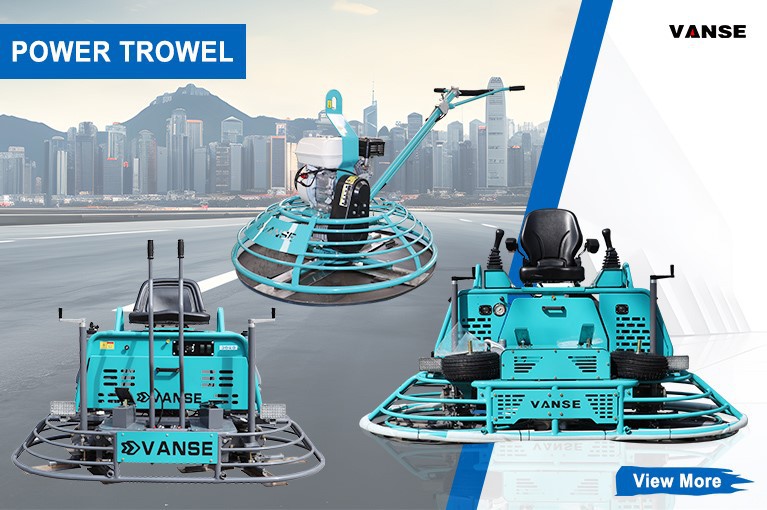
Power Trowel trowelling machine
Daily maintenance

-
After each work, clean the concrete and dust on the machine timely.
-
It is recommended to replace the air filter once every 100 hours. In many dust areas, the frequency of cleaning and replacement should be increased.
-
Replace the oil after the first 20 hours of operation, and then replace it every 100 hours. When disposing of the waste oil, it is recommended to put it in a sealable container and give it to the recycling center to protect the environment and soil
-
Grease the grease nipple above the cross for daily maintenance
Thanks to All the Friends Who Support and Trust Shandong Vanse Machinery Technology Co., Ltd.
If you want to know more about Shandong Vanse Machinery Technology Co., Ltd. or have any questions, please feel free to contact us:
Our Factory
Shandong Vanse Machinery Technology Co., Ltd.

Share this article

About the Author: Shandong Vanse Machinery Technology Co., Ltd.
Shandong Vanse Machinery Technology Co., Ltd. is a high-tech manufacturer specializing in concrete construction machinery, including laser screeds and related equipment. The company integrates R&D, production, and global sales, with products exported to over 60 countries and widely used in infrastructure projects worldwide.
Previous Post
Next Post
Related Articles
You Might Also Like
Detailed explanation of application scope of laser leveling machine
Concrete laser leveling machine is widely used. It is an advanced machine used to super-flatten and level concrete floors. Its application range can be roughly divided into two categories: indoor floor engineering and outdoor floor engineering. These two categories are further subdivided. The following is a detailed introduction to the use of concrete laser leveling machine and the projects of this type that Vanse Machinery's products have done. Nowadays, concrete laser leveling machines are being used more and more widely. The specific scope of application can be divided into two categories: Vanse Machinery has done such projects as Harbin Haier workshop, Beijing Benz workshop, Baoding Great Wall Motors No. 5 spraying workshop, Shandong Classic Group steel structure production line workshop and other projects. Vanse Machinery has done such projects as: Suzhou Samsung Electronics Factory, Shandong Xingda Ecological Winery, Shandong Parkson Biological Workshop, Shandong Yuda Medical Workshop and other projects. Such projects that Vanse Machinery has done include: Xi'an Fuju Home Plaza, Shenzhen Walmart Supermarket, Wuhan Vipshop Logistics Park, Guangxi Convention and Exhibition Center, Tianjin Yupei Logistics Park and other projects. Such projects that Vanse Machinery has done include: Hubei Xiangzhou Industrial Park, Shanxi Shenlong Energy Coking and other projects. Such projects that Vanse Machinery has done include: Shandong Xinbaihui underground parking plant, Changchun FAW-Volkswagen parking lot, Hebei Hualian Supermarket large underground parking lot, Sichuan Wanda Plaza large underground parking lot, Hubei Xiangyang Dongjin Century City underground parking lot and other projects Such projects that Vanse Machinery has done include: Nanjing Huawei Electronics Company floor, Shenyang Electronics Factory floor integration, Sichuan Hualian Plaza, Hubei Xiangyang Dongjin Century City and other projects. Shandong Yanzhou Vanse Machinery Technology Co., Ltd. is the only high-tech enterprise in China that integrates R&D, manufacturing, sales, and technical services, specializing in concrete laser leveling machines. The use of "" brand concrete laser leveling machines can reduce about 60% of high-intensity labor, save about 50% of construction costs, shorten about 50% of construction period, and increase the strength and density of the floor by about 25%. The company has always been based on the tenet of "people-oriented, leading technology, honest management, and creating a well-known brand". We will provide customers with reliable products and perfect services, develop together, and create good results.How operable is the concrete laser leveling machine?
The operability of a concrete laser leveling depends largely on the skill and experience of the operator, as well as the model and capabilities of the machine. The following is a detailed analysis of the operability of concrete laser leveling machines: ☛Ease of operation: The concrete laser leveling machine should have a simple design and a friendly operating interface for easy understanding and use. Some advanced machines may be equipped with automated functions, such as automatic navigation, automatic leveling, etc., which can greatly simplify the operation process. ☛Safety: Since the concrete laser leveling is a heavy machine, its operation should focus on safety. Operators should receive appropriate training and understand the machine's capabilities, limitations, and operating procedures. During operation, safety regulations should be followed and attention should be paid to protecting the safety of yourself and others. ☛Accuracy: The concrete laser leveler should have high-precision leveling capabilities. Using laser technology, the flatness and precision of the plane can be ensured. In addition, some advanced machines may be equipped with sensors and feedback systems to monitor and adjust the smoothing process in real time. ☛Adaptability: The concrete laser leveling machine should have good adaptability and be able to cope with different construction environments and requirements. For example, the machine should be able to operate on various types of concrete floors, while also being able to adapt to different construction processes and specifications. ☛Maintenance: The maintenance of the concrete laser leveling is crucial to ensure its operability. Operators should understand the maintenance requirements of the machine and perform regular maintenance. At the same time, any faults or problems should be repaired promptly or professional help should be sought. ☛Cost-Effectiveness: The cost-effectiveness of a concrete laser leveling is an important factor considering its operability. Although the one-time investment of such a machine may be higher, its long-term operating costs may be lower because construction efficiency can be improved and labor costs and material waste reduced. In addition, the reliability and durability of the machine are also important factors in assessing its cost-effectiveness. ☛Sustainability: Sustainability is also an important consideration when choosing a concrete laser leveling. Machines that use environmentally friendly energy sources, such as electricity or solar energy, should be chosen to reduce carbon emissions and impact on the environment. In addition, it is crucial to choose machine parts that can be recycled and reused. ☛Training and support: After purchasing a concrete laser leveling machine, the operator may need to receive relevant training to understand the machine's performance, operation and maintenance. The supplier or manufacturer should provide the necessary training and support to ensure that operators can take full advantage of the machine's capabilities. ☛After-sales service: Choosing a manufacturer that provides comprehensive after-sales service can ensure timely help when problems arise with the machine. This will help reduce downtime and increase productivity. ☛Future development: As technology continues to advance, concrete laser levelings may become more advanced and intelligent. Considering the needs of future development, you can choose machines with upgrade potential and adaptability to future construction requirements. In summary, the operability of a concrete laser leveling depends on the combined influence of several factors. When selecting and using such machinery, factors such as its design, performance, adaptability and support should be fully considered to ensure efficient, safe and sustainable construction results.What details should be paid attention to during the debugging and calibration of the concrete laser leveling machine?
The commissioning and calibration of a concrete laser leveling machine is crucial for ensuring high-quality flooring (high flatness and levelness). This process requires meticulousness and patience. The following are key details to consider, divided into several key phases: Before beginning any commissioning, thorough preparation is the foundation for safety and success. Mechanical part: Check the leveler's structural parts, hydraulic cylinders, scrapers, and vibrators for damage, looseness, or oil leakage. Ensure that the tracks and tires are intact and free of damage. Hydraulic system: Check that the hydraulic oil level is within the standard range and that the oil is clean. After starting the engine, listen for any abnormal noises coming from the hydraulic pump and motor. Power system: Check whether the fuel, oil, and coolant are sufficient. Ensure that the battery is fully charged and the wiring connections are secure. Stability: Mount the laser transmitter on a solid, stable, vibration-free tripod. Avoid placing it on soft ground or in a location where it may be hit by people or equipment. Position and height: The installation position should cover the entire construction area and be as close to the center as possible to reduce the slight error caused by distance. The height should be raised so that the laser beam is higher than the working range of the receiver on the leveling machine. Leveling: This is the most critical step! Use the laser transmitter's built-in bubble or electronic level to accurately adjust it to a horizontal state (usually in 360° rotation scanning mode). Even a slight tilt will cause the entire working surface to have a slope error. Accuracy selection: Select the appropriate accuracy level according to the construction requirements (for example, ±10mm/@30m or ±3mm/@30m). The higher the accuracy, the higher the debugging requirements. Elevation benchmarks: Verify the on-site elevation benchmarks (usually provided by a surveyor) with the construction crew and double-check them at multiple locations using a handheld laser receiver. Base treatment: Ensure that the flatness and density of the base (usually crushed stone or compacted soil) basically meet the standards, without obvious bumps. This is the core link, the purpose of which is to enable the machine to accurately respond to laser signals. Securely mount the laser receiver on the mast of the leveling machine to prevent it from shaking. Check the receiver's battery level to ensure it is functioning properly. Verify that the indicator lights or display on the receiver are functioning properly. Drive the leveler to the area covered by the laser transmitter signal, preferably close to the transmitter and where the ground elevation is close to the design elevation. Manual mode: Operate the machine to raise or lower the scraper bottom until it is exactly at the designed elevation (which can be verified by measurement). Calibrating the Receiver: At this correct height, adjust the receiver up and down on the mast so that its center point (usually the green light or display "0") is aligned with the laser beam. Locking the reference: Execute "Set reference point", "Reset to zero" or similar operations on the control panel. The control system will remember this height as the "0" position of the laser signal (i.e. the designed elevation). Sensitivity: Sets the hydraulic system's response sensitivity. A setting that's too high will cause the scraper to frequently adjust up and down, creating a "chasing wave" phenomenon that affects smoothness. A setting that's too low will result in a sluggish response and poor accuracy. Usually, start with a mid-range value. Deadband: Set a small allowable error range (such as ±1-2mm). Within this range, the system will not operate to avoid excessive fine-tuning of the hydraulic system and improve construction fluency. After setting the benchmark, do not start pouring immediately. Instead, drive the machine forward, backward, left, and right within the signal range while observing the height display on the control panel. Observe whether the scraper can rise and fall smoothly and accurately according to the instructions. Stop the machine at different points with known elevations, use a ruler or level to actually measure the height of the scraper bottom, and compare it with the designed elevation to verify the height accuracy of the control system. Commissioning and calibration are not a one-time thing and require continuous monitoring during construction. Every 1-2 hours, or when a collision is suspected, the laser transmitter must be rechecked to ensure it is still in an absolutely horizontal state. Vibrations, wind or accidental contact can cause it to deviate. Regularly use a ruler to spot-check the surface elevation of leveled but not initially set concrete, and cross-verify it with the machine display value. The slump (dryness or thinness) of concrete significantly impacts leveling results. If the material is too dry, the machine will experience significant resistance and may "climb a slope"; if the material is too thin, the machine will easily "get stuck." Maintaining consistent concrete supply quality is crucial. Plan the movement path of the leveler to ensure it is always within the effective coverage of the laser signal and avoid signal blind spots. Lost signal: Once the receiver alarm indicates that the laser signal is lost, construction should be stopped immediately, the cause should be found out (blocked, transmitter power off, out of range, etc.), and the signal should be restored and recalibrated before continuing. Accuracy deviation: If a systematic deviation (overall high or low) is found during spot checks, the machine should be stopped immediately and the laser transmitter level and the leveling machine's reference settings should be rechecked. Personnel safety: When debugging and running the machine, make sure there is no one around, especially pay attention to the height of the laser beam to avoid direct exposure to human eyes. Equipment safety: When moving the leveler, be careful to avoid obstacles such as steel mesh and elevation piles to prevent damage to the tracks and hydraulic cylinders. Stage Core details Purpose Prepare Laser transmitter is installed absolutely horizontally Establishing an accurate horizontal reference plane Check site elevation benchmarks Ensure consistency between design and site Calibration Benchmark the machine at a known correct elevation Let the machine "learn" what the design elevation is Trial operation and actual test verification Cross-check to ensure system accuracy Construction Regularly review laser leveling and machine accuracy Prevent errors caused by vibration and collision Monitor concrete material properties and signal status Ensure a stable and reliable construction process Only by following the above details, strictly following the equipment manual, and working closely with on-site surveyors can the technical advantages of the laser leveling machine be fully utilized to cast ultra-high-precision high-quality floors.