Technical Knowledge
Concrete laser levelling machine VS manual construction, where is the difference?
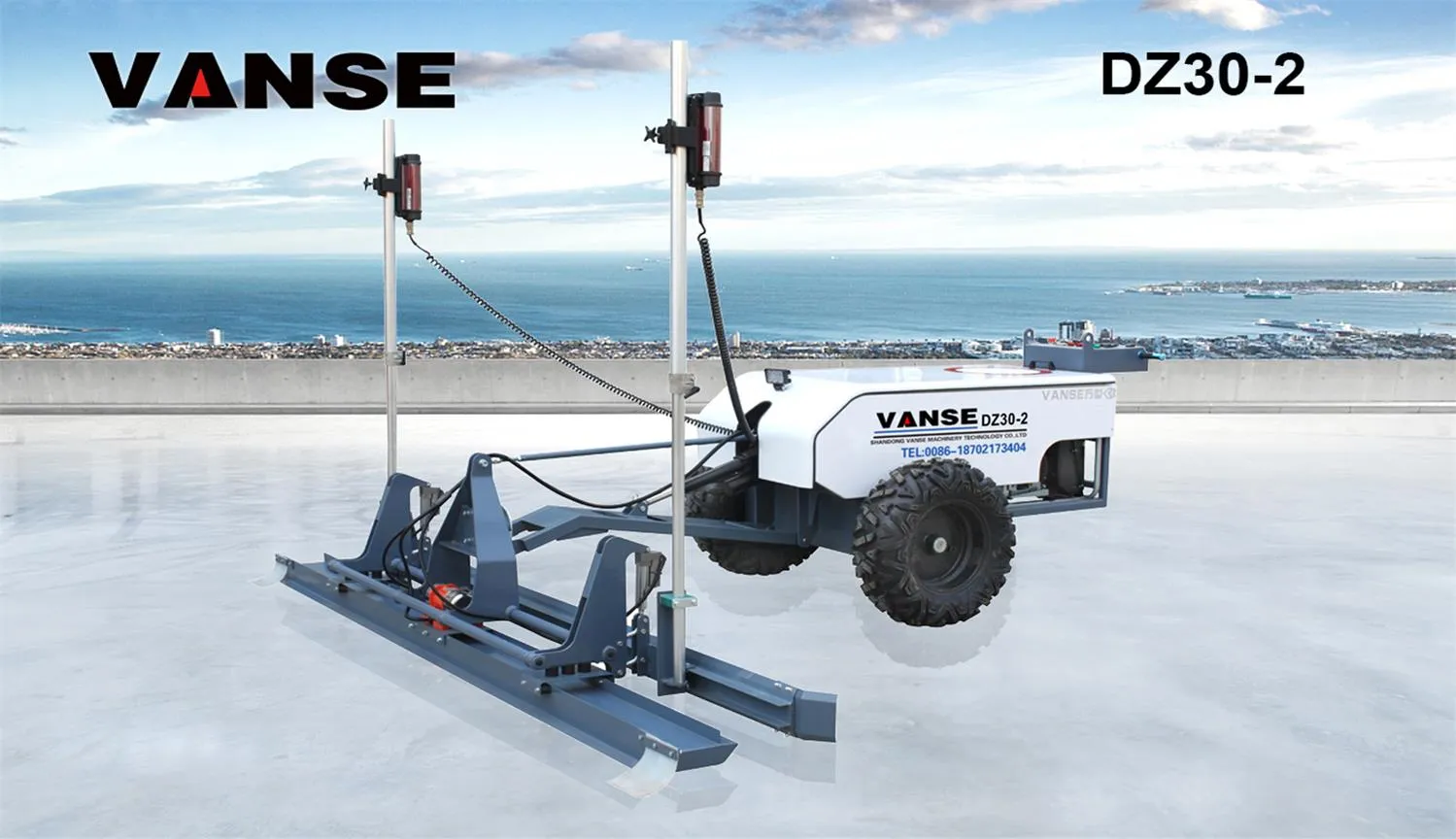
| In recent years, with the continuous development of the economy and society, the construction demand of large areas such as parking lots, large squares, industrial plants is also increasing, because these sites mainly use concrete to pour the foundation, and then cover the floor tile or floor paint, so higher requirements are put forward for the flatness of the base layer. In order to ensure that the ground flatness after construction reaches an ideal level, it is necessary to use a concrete laser levelling machine. So, what is the difference between the construction of concrete laser levelling machine and manual construction? What are the significant construction advantages of the concrete laser leveling machine itself? |
|
█ Traditional construction method
The common concrete floor construction method is to manually level, and then use a polishing machine to wipe. This method requires a lot of labor, the quality of the construction process is not controlled, the need for manual correction many times, repeated measurement and adjustment of the ground under construction, and the efficiency is not high. A large area of concrete floor construction needs to use a large number of wood or metal plates to form the side formwork in advance, and measure the height of the side formwork by the level to control the height of the concrete after laying. Due to the need to use the level for multi-point measurement, the side template must be retested after laying to ensure accuracy. Therefore, the process is prone to human error. In addition, the removal of the side template also requires a lot of labor. |
|
█ Intelligent construction method
1. Operation principle
2. Construction advantages
|
| Summary of this chapter: Although the concrete laser levelling machine is an emerging new equipment with excellent technology in recent years, it is widely used in airport runways, high-speed rail platforms, large workshop pavements and other projects with high requirements for ground smoothness. If it can be widely popularized and promoted, it will bring very considerable construction benefits. |
Thanks to All the Friends Who Support and Trust Shandong Vanse Machinery Technology Co., Ltd.
If you want to know more about Shandong Vanse Machinery Technology Co., Ltd. or have any questions, please feel free to contact us:
Our Factory
Shandong Vanse Machinery Technology Co., Ltd.








Share this article

About the Author: Shandong Vanse Machinery Technology Co., Ltd.
Shandong Vanse Machinery Technology Co., Ltd. is a high-tech manufacturer specializing in concrete construction machinery, including laser screeds and related equipment. The company integrates R&D, production, and global sales, with products exported to over 60 countries and widely used in infrastructure projects worldwide.
Previous Post
Next Post
Related Articles
You Might Also Like
What is the standard maintenance procedure for laser leveling machine?
No matter what kind of mechanical equipment, if you want to effectively extend its service life, you need to do regular maintenance and maintenance of the equipment, and this is no exception for laser leveling machines. In view of the fact that there is no detailed analysis of the maintenance standards for laser leveling machines in the relevant technical materials, our company will combine years of work experience to make a simple summary of the correct maintenance methods for each component of the laser leveling machine. I hope that the majority of users and friends We must follow this standard scientific operation. ►Engine maintenance: Choose an antifreeze solution suitable for the local temperature and replace it every 1 year. Before winter, the winter fuel should be replaced with a laser leveler in advance to avoid waxing of ordinary diesel in the filter and pipeline due to low temperature. As a result, the engine does not start properly, the anti-icing device of the compressed air system is turned on, and the ether level is checked regularly. Many engines require some additive in the coolant, known as SCA (Supply Coolant Additive), which usually acts on aluminum. More effective protection against metal corrosion, mineral deposits, air pockets and blistering of the cylinder liner during fitting contact with coolant. ►Parts maintenance: Before the laser leveling machine is parked for a long time in winter, the bearings should be mechanically hinged, lubricated and maintained. Check the integrity of the dust cover of the concrete laser leveling machine, and replace the damaged sealing ring in time. The metal contact surfaces exposed to the air should be rust-proof, the engine should be started regularly, and all reduction gearboxes should be operated to prevent shaft seals in the gearbox, rubber seals from being damaged by parking and gear oil for a long time. ►Hydraulic system maintenance: Regularly start the laser leveling machine and turn on all hydraulic functions on the machine, so that the hydraulic drive parts work regularly to prevent the related seals from being damaged due to long-term parking, and the metal parts such as cylinder rods from rusting, as much as possible. Retract all cylinder rods into the hydraulic cylinder housing to better protect the surface of the cylinder rods. ►Electrical system maintenance: Please start the laser leveling machine engine every two months, charge the battery, and run all hydraulic actuators, such as rotary hydraulic motors, telescopic cylinders, etc., do not remove the battery from the machine to prevent long-term parking equipment to control internal software Program failure is lost. Special reminder: Once the laser leveling machine is improperly operated, maintained, and managed, it will affect the efficiency and life of the equipment, and may even cause equipment failure and shutdown. Therefore, only the daily maintenance and management of each system and the whole machine should be done well. , can effectively reduce the probability of equipment failure, ensure the normal operation of equipment, and improve production efficiency.The standardized construction process of coarse grinding followed by fine grinding, and the timing for switching between the trowel disc and the trowel on the power trowel.
Let's take a detailed look at the standardized construction process of concrete plastering, especially the technique of "rough grinding first and then fine grinding", as well as the key switching timing between the grinding plate and the power trowel. This is the core link to ensure that the concrete floor (especially the industrial floor) achieves a dense, flat and high-strength surface. This process is a dynamic one that advances based on the setting state of the concrete. The entire process can be summarized into the following stages: Concrete pouring: Ensure that the concrete pouring is smooth and slightly higher than the designed elevation. Vibration and leveling: Use a vibration rod to compact it tightly, and then perform an initial leveling with a long straightedge or a laser screed. Natural settlement and bleeding: Let the concrete settle naturally and bleed out. No mechanical operations are allowed before the bleeding water has completely evaporated. Core objective Slurry lifting: Bringing the slurry rich in cement and fine aggregates on the surface to the surface layer. Preliminary leveling: Eliminate the large undulations left by the straightedge, and slightly press the aggregate down to make the large area basically flat. Seal the pores: Compact the surface layer to lay a solid foundation for subsequent fine grinding. Entry timing (first disc operation) : Concrete condition: When a person stands on it, it sinks by 3 to 5 millimeters, with clear footprints but no obvious overflow of slurry water. This is the critical point of "initial condensation". Test method: The same as the finger pressure method and scratch method mentioned above. This is the signal for the first entry of the power trowel machine. Key points of operation Installation disc: Ensure that the power trowel machine is equipped with a plastic or magnesium alloy power trowel disc. Blade Angle: Adjust the power trowel blade (even if not in use) or keep the chassis parallel to the ground. Operation mode Start the machine and slowly cut into the concrete area at an Angle. Operate along an overlapping route to ensure that each path overlaps with the previous one by one-third. Maintain a slow and steady moving speed to allow the disc sufficient time to knead and lift the slurry. When encountering uneven areas, you can appropriately increase the rotational speed or stay in the local area for a while longer. Effect inspection: After rough grinding is completed, the surface should be a uniform and moist layer of cement slurry, without obvious exposed stones, and the large area should be smooth. Core objective Compact the surface layer: Further enhance the surface density and strength. Final leveling and smoothing: Eliminate the fine scratches left by the disc to achieve the designed flatness and smoothness. Surface sealing: Seal the surface capillary pores to enhance wear resistance, impermeability and dust resistance. Entry timing (first blade operation) : Concrete condition: This is the most crucial judgment throughout the entire process. After completing the first disc operation, it is necessary to wait for the concrete to continue hardening. When the following phenomena occur, it can be switched to blade: Surface moisture disappearance: The previously moist and reflective surface layer has become dull and lackluster. When people walk on it, they leave only very shallow marks or no footprints at all. When touched by hand, there is a distinct sense of resistance (roughness), but it does not stick to the slurry. In simple terms: When the surface of the concrete changes from "wet bright" to "dry dark" and has a certain load-bearing capacity. Key points of operation Switch the power trowel: Remove the disc and install the metal power trowel (blade). Make sure the blade is installed flat. Adjust the Angle: For the final finishing, you can slightly lift the tail of the power trowel to form a small Angle (about 5°) between the front edge of the blade and the ground. This will achieve a better shearing and calendering effect. Operation mode Cross-operation methods (for example, one horizontal pass and one vertical pass) can be adopted to ensure flatness. Increase the machine's rotational speed appropriately and speed up the lateral movement. Perform multiple rounds of polishing, each lighter and faster than the previous one, with the aim of "flattening" the surface. Final polishing: Before the concrete is about to set, a final fine polishing is carried out. At this time, the best bright effect can be achieved. For a more intuitive understanding, we can summarize the switching timing as follows: Component Homework stage Core role Judgment of switching timing (Key signal) Description of concrete state Grinding plate/disc Rough grinding Slurry extraction and initial leveling First entry: The concrete reaches initial setting. "Wet soft and malleable" Subsequent disc operation: When the surface is damaged due to operation and slurry needs to be lifted again. • The footprint depth is 3 to 5mm • Scratches can be maintained • No free bleeding Spatula/blade Fine grinding Compact and finally smooth The first switch: After rough grinding, the moisture on the surface of the concrete evaporates and its hardness increases. "Dry, dark, tough and astringent" • The surface water luster disappears • The footprints are extremely shallow or non-existent • It feels rough when touched and is not sticky to the hand Important Notes: Dynamic adjustment: This process is not static. If, after the first blade operation, it is found that the surface is not hard enough and "waves" or "blade marks" appear, it indicates that the switch was made too early. The disc should be switched back or wait further. If the switch is too late and the surface has hardened, it will not be able to effectively collect light and is prone to surface cracking. Environmental sensitivity: Temperature, wind speed and humidity can greatly affect the time Windows of each stage. In summer, on sunny days, the window period is very short and needs to be closely connected. In winter or humid environments, a long wait is required. The "Better late than early" principle: When it comes to the timing of switching blades, it is better to do it a little later (as long as it can still produce luster) than too early. Switching too early will tear the surface, causing irreparable damage. Summarize the process chain Pouring → Leveling → standing (waiting for initial setting) → Rough grinding of [disc] (lifting slurry) → Waiting (surface dries and darkens) → Fine grinding of [blade] (finishing) → curing Mastering this process and timing judgment proficiently is an essential skill for producing high-quality concrete floors. Note: The parameters provided in this document are for reference only and are not mandatory. Due to differences in technical characteristics between different brands and models of laser levelers, please consult the manufacturer for a suitable solution before actual operation. This reference document assumes no responsibility for any issues arising from failure to follow the manufacturer's instructions.Cement concrete pavement engineering quality inspection and evaluation standard
The following are the relevant contents of the quality inspection and evaluation standards for cement concrete pavement projects: – Testing method: Take one point every 100 meters of half-width, take one point if less than 100 meters but more than 50 meters, and do not take points if less than 50 meters. The points are determined by lottery, with each 10 meters in the longitudinal direction as a selection section and three selection points in the transverse direction. One point is selected every 1000 meters of half-width, and a separate lottery is conducted when encountering a bridge or culvert. Drill and core, mark the points, perform pressure testing, convert the flexural strength, and calculate the qualified rate. – Evaluation method: If the qualified rate reaches 90% and the flexural strength of all points is higher than 90% of the design value, it will be rated as excellent. The result of one-time coring shall prevail. If the supplementary measurement or rework meets the standard, it shall not be rated as excellent. – Testing method: Based on the concrete core taken for testing the flexural strength, use a caliper to detect four points according to the cross line and take the average value. – Evaluation method: The actual test value is qualified within ±2cm of the design value, and the pass rate can be rated as excellent only when it is above 85%. The one-time test result shall prevail. The supplementary test or rework that meets the standard shall not be rated as excellent. – Testing method: Use a 3-meter ruler to test, and each piece must be tested. Take the maximum value. Flatness exceeding 5mm is considered unqualified, and the pass rate is calculated by piece. – Evaluation method: The pass rate is above 85%, and the proportion of flatness exceeding 8mm does not exceed 5% to be rated as excellent, otherwise it shall not be rated as excellent. – Testing method: Test the center line and two lines 20cm away from the edge line, one section every 10 meters, the plane alignment allowable error is ±10mm, the longitudinal elevation is ±10mm, and the pass rate is calculated by plane alignment and longitudinal elevation. – Evaluation method: The qualified rates of plane line type and longitudinal elevation are both above 85%, and the ratio of plane line type error exceeding 20mm and the ratio of longitudinal elevation exceeding 15mm are not more than 5%, which is rated as excellent. Otherwise, it shall not be rated as excellent. – Pavement color uniformity: Taking the main color of the road surface as the basic color, the color difference area accounts for more than 5%, which shall not be rated as excellent. – Surface damage: According to the three categories of damage area, number of points and number of damage points. If the damage area exceeds 400cm² and the proportion exceeds 2%, the damage area of 4-400cm² exceeds 5 per kilometer, and the damage area of 1-4cm² exceeds 10 per kilometer, this sub-item shall not be rated as excellent. – Whether there is mortar adhesive tape at the joint: The adhesive tape rate exceeds 2%, and this sub-item shall not be rated as excellent. – Seam cutting: The seam cutting qualification rate is more than 90%, measured by six standards: plate length, seam straightness, seam width, butt joint, seam end, and seam depth. – Seam carving: The seam carving qualification rate is more than 90%, calculated according to the concrete plate, and measured by five indicators: seam spacing, straightness, seam washing, butt joint, and seam depth. – Seam filling material uniformity, density, and adhesive tape situation: The qualified rate is more than 95%, the seam width is uniform, and there is no debris at the bottom of the seam material and it is not adhesive tape. When the project length exceeds 2 kilometers, each kilometer is an assessment section, and the last part less than 1 kilometer is assessed in the same way as the previous section. If all five indicators reach excellent grades and the road surface anti-skid property meets the specified requirements, the assessment section is rated as an excellent project, otherwise it cannot be rated as excellent. If the flexural strength is lower than 90% of the design strength, or the thickness of the concrete slab is lower than the design value by 2cm, it is considered an unqualified project. When each assessment section is rated as an excellent project, the project is rated as an excellent project. The above content is for reference only. The actual assessment standards may vary depending on factors such as region and project requirements. They should be implemented in accordance with relevant national standards and industry specifications. Click the below to jump immediately!!! ARMOUR JOINT LASER LEVELING MACHINE LIGHT TOWER POWER TROWEL SLIPFORM MACHINE STEEL FIBER TOPPING SPREADER TRACKED MINI DUMPER