Technical Knowledge
Concrete laser leveling machine traditional method construction process
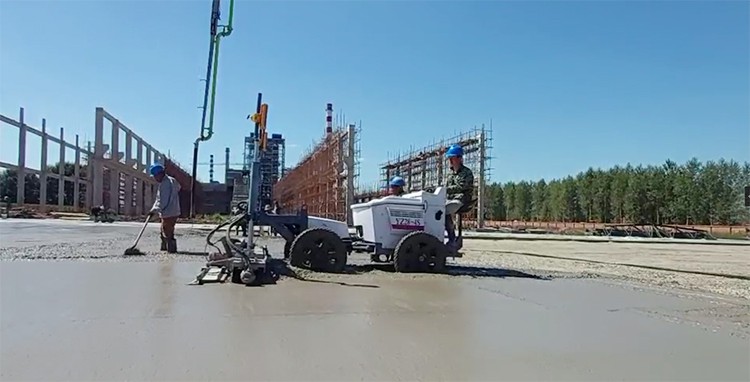
Need to RBI support line, branch channel steel, support the channel down the concrete, paved after the roll with the side of the roller and then scraping scraping again. After the completion of the initial condensate, and then polished machine.
1, RBI, pull the air line
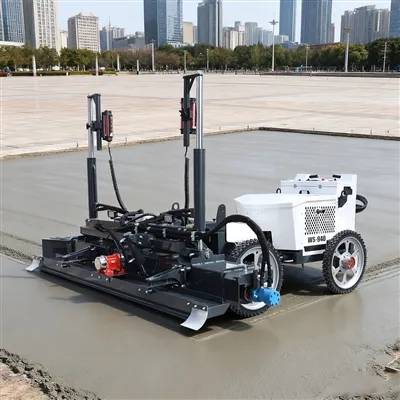
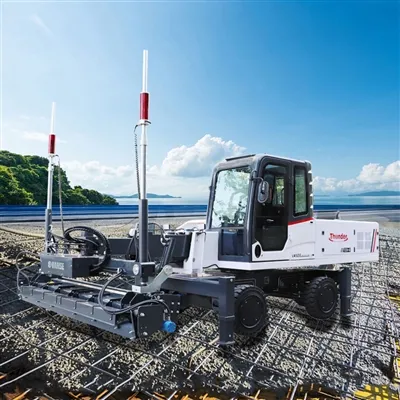
The use of machine construction technology: Lei Long – concrete laser leveling machine is to use the scraper will be higher concrete and take the initial level, to achieve the design requirements of the elevation. Using two-wheel automatic walking system, the vibration frequency of 4000 times / min, driven by the entire vibration plate with concrete vibrating effect. Lei Long concrete laser leveling machine construction width of 2.5 meters.
Laser leveling machine leveling does not need to pull the control line, do not need to control the ground side of the template elevation, and by the leveling machine on the laser measurement and control system in real time control, as long as the laser transmitter without disturbance, regardless of the leveling machine to move to where, Can ensure that the pavement after the overall elevation of the ground is not affected.
Using the machine construction process: first through the reference point, find the elevation, adjust the laser launcher control elevation. And then directly down the concrete, the machine a one-time scratch, mention pulp, compaction. To achieve large area paving.
Thanks to All the Friends Who Support and Trust Shandong Vanse Machinery Technology Co., Ltd.
If you want to know more about Shandong Vanse Machinery Technology Co., Ltd. or have any questions, please feel free to contact us:
Our Factory
Shandong Vanse Machinery Technology Co., Ltd.








Share this article

About the Author: Shandong Vanse Machinery Technology Co., Ltd.
Shandong Vanse Machinery Technology Co., Ltd. is a high-tech manufacturer specializing in concrete construction machinery, including laser screeds and related equipment. The company integrates R&D, production, and global sales, with products exported to over 60 countries and widely used in infrastructure projects worldwide.
Previous Post
Next Post
Related Articles
You Might Also Like
The Purpose and Significance of Management and Maintenance of Concrete Laser Leveling Equipment
As core equipment for high-precision, high-efficiency floor leveling in modern construction, the management and maintenance of Concrete Laser Levelings not only impacts the stable performance of the equipment but also directly impacts project quality, construction costs, and enterprise competitiveness. The following analysis examines the purpose and significance of Concrete Laser Leveling management and maintenance: Laser Leveling machines achieve millimeter-level precision control through their laser transmitters and receivers. Issues such as calibration deviations, sensor failure, or mechanical wear can directly result in substandard floor flatness, leading to rework and quality disputes. Regular maintenance ensures that key components, such as the laser system, vibration motor, and travel mechanism, are in optimal condition, ensuring that construction accuracy meets design requirements. Concrete construction is a harsh environment, and equipment is susceptible to cement corrosion, mechanical vibration, and dust abrasion. Through scientific management (such as standardized operating procedures and maintenance records) and preventive maintenance (such as regular cleaning, lubrication, and replacement of wearing parts), unplanned downtime can be reduced, equipment degradation can be delayed, and repair costs and the frequency of replacements can be significantly reduced. Equipment failure or performance degradation can lead to construction interruptions and reduced efficiency. For example, loss of laser system signal may require recalibration, which is time-consuming and impacts progress. Routine inspections and rapid maintenance can minimize downtime, ensure continuous and efficient equipment operation, and contribute to on-time project delivery. Laser Leveling machines involve high-speed rotating parts, hydraulic systems, and overhead work (such as telescopic boom models). Improper maintenance can lead to mechanical failure, hydraulic leaks, or even casualties. Regularly inspecting safety devices (such as emergency stop buttons and protective covers), hydraulic lines, and electrical systems can eliminate potential safety hazards and protect both operators and equipment. Surface flatness is a core indicator of concrete construction quality, directly impacting subsequent floor laying, equipment installation, and building aesthetics. Precise maintenance of the laser transmitter, receiver, and screed head ensures surface flatness within ±2mm, meeting the requirements of high-standard industrial plants, logistics warehouses, and other scenarios, while avoiding customer complaints or claims due to quality issues. Reduce direct costs: Preventive maintenance costs are far lower than repair costs. For example, regularly changing hydraulic oil can prevent system downtime caused by oil line blockage, saving tens of thousands of yuan in repair costs. Improve equipment utilization: By optimizing maintenance plans, equipment idle time can be reduced, increasing output per unit time and indirectly increasing company revenue. Enhance market competitiveness: Stable and reliable equipment performance is key to earning customer trust, helping companies establish a professional image and expand into the high-end market. Standardized equipment management (such as establishing a maintenance database and applying IoT monitoring technology) can accumulate extensive operational data, providing a basis for optimized equipment design, fault prediction, and intelligent maintenance, driving the industry's development towards digitalization and refinement. Furthermore, a comprehensive maintenance system helps standardize construction standards and elevate the industry's overall technical capabilities. Extending equipment lifespan and reducing resource waste are key aspects of green construction. Reducing equipment scrap rates through scientific maintenance can reduce the consumption of raw materials such as metals and plastics, lower carbon emissions, and help the construction industry achieve its "dual carbon" goals. The management and maintenance of Concrete Laser Leveling machines is crucial for ensuring construction quality, controlling costs, improving efficiency, and ensuring safety. Companies should establish a full lifecycle management system that prioritizes prevention and prioritizes maintenance. Incorporating intelligent monitoring technologies, these systems enable real-time monitoring of equipment status and optimal allocation of maintenance resources. This will help companies gain an advantage in the fiercely competitive market and promote high-quality development in the industry. Note: The parameters provided in this document are for reference only and are not mandatory. Due to differences in technical characteristics between different brands and models of laser levelers, please consult the manufacturer for a suitable solution before actual operation. This reference document assumes no responsibility for any issues arising from failure to follow the manufacturer's instructions.Large-area concrete floor seamless and laser leveling construction technology
– **Material preparation**: Select a suitable concrete mix ratio to ensure the fluidity and strength of the concrete. Commonly used materials include cement, sand, gravel and additives. – **Equipment preparation**: Use laser leveling machine, concrete mixer, pumping equipment, vibrator, trowel, etc. – **Site preparation**: Ensure that the construction site is flat and clean, the base treatment meets the requirements, and the elevation control is accurate. – **Laser leveling machine construction**: The laser leveling machine forms a reference plane through the laser beam emitted by the laser transmitter, and the receiver on the leveling machine controls the leveling head in real time to achieve high-precision leveling. During the leveling process, it is necessary to ensure the accurate alignment of the laser transmitter and the receiver, as well as the stable operation of the leveling head. – **Concrete pouring**: Pumped concrete is used for pouring to ensure the uniformity and density of concrete. The pouring should be carried out in layers, and the thickness of each layer should not be too large to ensure compaction. – **Vibration and leveling**: Use a vibrator to fully vibrate the concrete to ensure density. Then, use a laser leveling machine to level it. The elevation and flatness need to be checked continuously during the leveling process. – **Smoothing and finishing**: After the initial setting of the concrete, use a trowel to smooth it and rub the slurry. Then finish it to ensure a smooth and flat surface. – **Skip warehouse construction**: Divide the ground into multiple grid blocks. Each concrete pouring should be continuous and uninterrupted. The pouring interval between adjacent grid blocks should be long enough to ensure the volume stability of the concrete. – **Construction joint treatment**: The construction joint should be standardized and straight, and the elevation control should be precise. Use angle steel to fix the ground elevation to ensure that the joints are smooth and straight. – **Maintenance**: After the concrete is poured, it should be maintained in time. Use maintenance blankets or non-woven fabrics to cover and water to keep the concrete surface moist. – **High flatness**: Laser leveling technology can achieve high-precision ground flatness, with an error control within ±2mm. – **Good integrity**: Through skip-bin construction and fine treatment of construction joints, the overall seamless effect of the ground is achieved. – **High construction efficiency**: The laser leveling machine integrates scraping, vibrating and leveling, with a high coverage rate, which greatly improves the construction efficiency. This technology is suitable for construction projects such as industrial plants, logistics warehouses, and large public places that have high requirements for ground flatness and integrity. Through the application of the above technologies, the construction quality of ultra-large concrete floors can be effectively improved, the later maintenance costs can be reduced, and the service life of the floor can be extended. 🎈Concrete finishing equipment for high FF scores
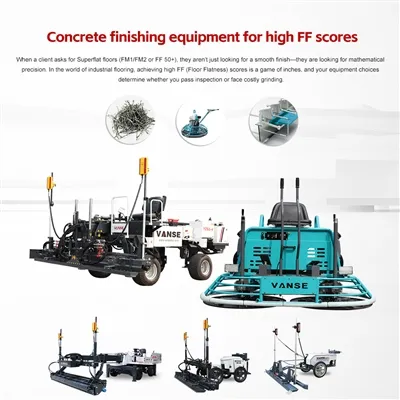
When a client asks for Superflat floors (FM1/FM2 or FF 50+), they aren't just looking for a smooth finish-they are looking for mathematical precision. In the world of industrial flooring, achieving high FF (Floor Flatness) scores is a game of inches, and your equipment choices determine whether you pass inspection or face costly grinding. To consistently hit those high-spec numbers, you need a synchronized fleet. Here is the professional equipment breakdown for high FF scores, featuring the specialized lineup from Vanse Machinery. You can't finish a floor flat if it wasn't placed flat. The Concrete Laser Leveling Machine is the most critical variable for FF scores. The Vanse Approach: For large-scale warehouse projects, the Vanse YZ30-4E Telescopic Boomed Laser leveling is the industry standard. Its 360-degree rotation and 6-meter telescopic boom allow the leveling head to reach out and strike off the concrete while the machine remains stationary. This prevents "tire track" deviations. For tighter workspaces, the WS940/WS940C/YZ28-4S/YZ25-4 offers the same high-frequency vibration and laser precision in a more agile frame. Consistency is the enemy of "dips" and "mounds." If your concrete is dumped in massive, uneven piles, the leveling has to work harder, which can lead to inconsistencies in FF scores. The Workflow: Use a Vanse Concrete Distributor to ensure an even "ribbon" of concrete is placed across the bay. To get material into the strips quickly without disturbing the subgrade, the Vanse Mini Dumper (available in electric and gasoline) is the perfect support tool. It allows for controlled, precise dumping that makes the laser leveling's job much easier. High FF floors often require a dry-shake hardener for wear resistance. If you spread this manually, you risk creating "hills" and "valleys" that ruin your flatness numbers. The Vanse Approach: The Vanse Automatic Topping Spreader applies the material with mechanical consistency. By linking the spreader's output to the machine's travel speed, you get a uniform layer that integrates perfectly with the wet concrete, preserving the flatness achieved by the laser leveling machine. Once the slab is leveled, you need to densify it. However, a "chattering" trowel can actually lower your FF score. The Workflow: Transition to a Vanse VS1046 Ride-on Power Trowel. With its heavy-duty gearbox and high-torque BRIGGS & STRATTON engine, it provides the steady, powerful compaction needed to "burnish" the floor. Its precision pitch control allows the operator to make micro-adjustments to the blades, smoothing out the surface to a mirror finish without introducing new waves into the slab. Even a Superflat floor will fail if the joints are ragged or spalled. The Workflow: As soon as the concrete can support it, use a Vanse Concrete Cutting Machine (Floor Saw) for your contraction joints. A stable, high-speed saw ensures the edges of the joints stay crisp, which is vital for the long-term maintenance of FF scores once heavy forklift traffic begins. When you browse www.vansemac.com, you're looking at a complete Superflat Solution. Here's why this workflow is the gold standard for international buyers: Labor Efficiency: A full Vanse fleet can turn a 12-man manual crew into a high-output 5-man team. Data-Driven Results: These machines are designed to meet ACI 117 and TR34 standards. When you use a Vanse laser leveling followed by a Vanse power trowel, you are practically guaranteed higher F-numbers. Reliability: In high-spec flooring, equipment downtime can ruin a pour. Vanse uses world-class components (Honda, Rexroth, Danfoss) to ensure your fleet keeps moving until the last pass is done. Achieving high FF scores isn't a secret-it's a process. By combining the placement precision of the Concrete Distributor, the leveling power of the Laser leveling, and the finishing torque of the Power Trowel, you create a floor that isn't just flat-it's Vanse Flat. Visit www.vansemac.com to see our full lineup and start hitting those FM1 numbers on your next project. Note: The parameters provided in this document are for reference only and are not mandatory. Due to differences in technical characteristics between different brands and models of laser levelers, please consult the manufacturer for a suitable solution before actual operation. This reference document assumes no responsibility for any issues arising from failure to follow the manufacturer's instructions.