Technical Knowledge
Concrete cutting machine used are
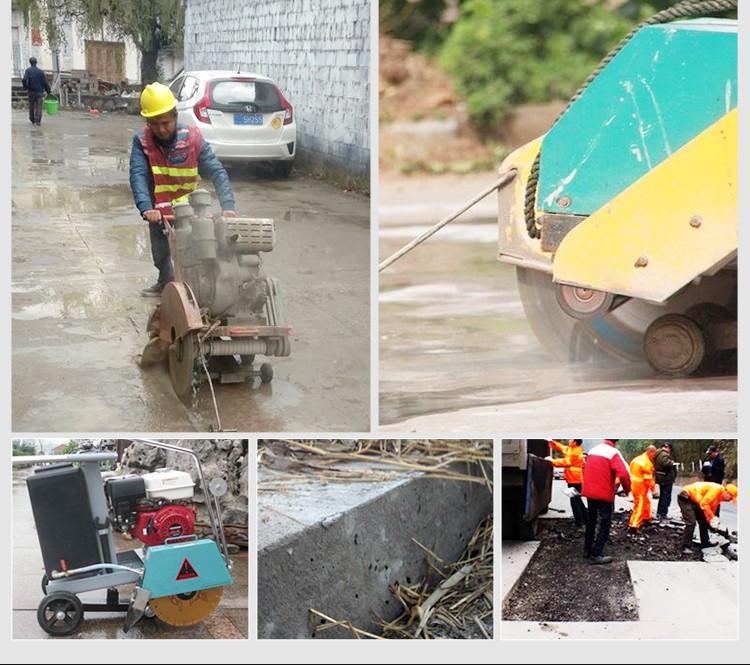
(Also known as hydraulic wall saw cutting machine), electric wall saw cutting machine, hand chain sawing machine, road cutting machine, large-scale road cutting machine, diamond drilling cutting equipment, ultra-high pressure Water cutting machine (also known as high pressure water gun cutting machine: due to the cost and construction of expensive, the current market has not been widely used) and other equipment for cutting concrete construction.
Thanks to All the Friends Who Support and Trust Shandong Vanse Machinery Technology Co., Ltd.
If you want to know more about Shandong Vanse Machinery Technology Co., Ltd. or have any questions, please feel free to contact us:
Our Factory
Shandong Vanse Machinery Technology Co., Ltd.








Share this article

About the Author: Shandong Vanse Machinery Technology Co., Ltd.
Shandong Vanse Machinery Technology Co., Ltd. is a high-tech manufacturer specializing in concrete construction machinery, including laser screeds and related equipment. The company integrates R&D, production, and global sales, with products exported to over 60 countries and widely used in infrastructure projects worldwide.
Previous Post
Next Post
Related Articles
You Might Also Like
How economical is a concrete laser leveling machine?
The economics of concrete laser levelinging machines I. Introduction As a modern construction machinery and equipment, concrete laser leveling machine has been widely used around the world. In addition to its efficient construction capabilities and environmentally friendly performance, the economy of concrete laser levelings is also one of the important reasons why it is favored by the construction industry. This article will delve into the economics of concrete laser levelings and their importance in the construction industry. 2. Advantages of concrete laser leveling machine ★Improve construction efficiency: The concrete laser leveling machine can quickly and accurately complete concrete leveling work, thereby shortening the construction cycle and improving construction efficiency. This helps reduce labor costs and equipment rental fees, creating more business opportunities and economic benefits for enterprises. ★Reduce material costs: Because the concrete laser leveling machine has a high-precision leveling effect, it can reduce the amount of concrete used and also reduce the dependence on additional materials. This helps reduce the purchase cost of building materials and saves a certain amount of money for the company. ★Reduce labor costs: Using a concrete laser leveling can reduce dependence on skilled labor and reduce labor costs. At the same time, this kind of mechanical equipment can improve the accuracy and efficiency of construction, avoid errors and rework caused by human factors, and reduce labor costs for enterprises. ★Improve project quality: Concrete laser levelings can achieve precise control of the concrete surface, thereby reducing the need for rework and repair. This helps to improve the quality of the project, reduce the cost of later maintenance and repairs, and save money for the company. ★Increase market competitiveness: The use of concrete laser leveling machines can improve construction efficiency and project quality, thereby improving the market competitiveness of enterprises. In the context of increasingly fierce competition in the construction market, having efficient, environmentally friendly, and high-quality construction capabilities is the key for companies to win market share. 3. Economic Benefits of Concrete Laser Leveling Machine ★Short-term economic benefits: The use of concrete laser leveling machines can shorten the construction cycle and improve construction efficiency, thereby saving labor costs and equipment rental fees for enterprises. At the same time, this kind of mechanical equipment can improve the accuracy and efficiency of construction, avoid errors and rework caused by human factors, and reduce labor costs for enterprises. These short-term economic benefits help companies achieve profitability goals in a short period of time. ★Long-term economic benefits: The use of concrete laser leveling machines can play an important role in reducing energy consumption, reducing material waste, and reducing noise pollution. These environmental features benefit businesses in the long term. First of all, this kind of mechanical equipment helps reduce the pressure on natural resource extraction and lower energy costs. Secondly, reducing material waste can reduce the cost of purchasing building materials. Finally, reducing noise pollution can improve the construction environment, increase the satisfaction of surrounding communities, and establish a good social image for the company. These long-term economic benefits help enterprises maintain an advantageous position in market competition. ★Market prospects: With the global emphasis on environmental protection and the transformation and upgrading of the construction industry, the market demand for concrete laser levelings will continue to grow. This kind of machinery and equipment has efficient, environmentally friendly, and high-quality construction capabilities and meets the market's demand for green and sustainable development. At the same time, the technology of concrete laser levelings is constantly updated, which will further improve its economy and competitiveness. Therefore, investing in concrete laser leveling machines has broad market prospects and development potential. 4. Conclusion To sum up, the economy of the concrete laser leveling is mainly reflected in improving construction efficiency, reducing material costs, reducing labor costs, improving project quality and increasing market competitiveness. These characteristics make concrete laser leveling an efficient, economical, and environmentally friendly construction method, providing strong support for the construction industry to achieve sustainable development goals. As the market continues to expand and technology advances, the economy and competitiveness of concrete laser levelings will be further enhanced, creating more business opportunities and economic benefits for the construction industry.How to evaluate the economic benefits of laser leveling machines in municipal engineering?
– Laser leveling machines have a high degree of automation and can greatly reduce manpower input compared to traditional manual leveling methods. In municipal engineering, such as concrete leveling operations on roads and squares, the use of laser leveling machines can complete large-scale construction tasks with fewer operators. For example, traditional manual leveling may require 10-15 workers, while the use of laser leveling machines may only require 3-5 operators, including machine operators, auxiliary personnel, etc. Calculated based on the labor cost per person per day, a large amount of labor costs can be saved in projects with longer construction periods. – Moreover, the operation of laser leveling machines is relatively simple, and personnel who have undergone short-term training can start working, reducing dependence on senior technical workers and indirectly saving labor costs. Because the wages of senior technical workers are usually much higher than those of ordinary workers. – Laser leveling machines can accurately control the paving thickness and flatness of concrete. In municipal road construction, it can accurately lay concrete according to design requirements to avoid excessive laying or uneven thickness of concrete due to imprecise manual operation. For example, manual leveling may cause the concrete thickness error to reach ±10 – 15mm due to lack of experience or improper operation, while the laser leveling machine can control the error within ±3 – 5mm. Such precise control can effectively reduce the waste of concrete, because concrete materials are more expensive in municipal engineering, and reducing waste means reducing material costs. – At the same time, due to the high flatness of the ground leveled by the laser leveling machine, the amount of materials required for subsequent construction (such as paving asphalt, installing curbstones, etc.) is also more accurate, and there will be no additional material consumption due to uneven ground, thereby further reducing material costs. – The laser leveling machine has high working efficiency and can quickly complete large-area leveling tasks. Taking the construction of the municipal square as an example, traditional manual leveling may take several days or even weeks to complete the leveling of a large square, while the laser leveling machine can complete the same workload in a shorter time. For example, a 1,000-square-meter square may take 5 to 7 days to be leveled manually, while a laser leveler may only take 2 to 3 days. – Shortening the construction period can bring many economic benefits. On the one hand, it can enable the project to be put into use ahead of schedule. For example, the early opening of municipal roads can relieve traffic pressure, bring social benefits, and may also obtain additional economic benefits due to early operation; on the other hand, shortening the construction period can reduce the indirect costs of the project, such as construction site management costs, equipment rental costs, etc., which will increase accordingly when the construction period is extended. – The laser leveler is relatively less affected by external factors such as weather, and can maintain stable working efficiency as long as it is under suitable construction conditions. In municipal engineering, especially some key projects with construction period requirements, stable project progress is very important. For example, in areas with more rainy seasons, laser levelers can quickly resume construction in a short time after the rain stops, while manual leveling may delay construction due to factors such as wet ground, thus affecting the progress of the entire project. Stable project progress helps to arrange subsequent construction procedures reasonably, avoid the chain reaction of the entire project caused by the delay of a certain process, and reduce the economic losses that may be caused by project delays. – The ground leveled by the laser leveler has high flatness and good quality. In municipal road projects, a flat road surface can reduce the bumps when vehicles are driving and reduce the probability of cracks, potholes and other diseases caused by uneven force on the road surface. For example, under normal use, the time when road diseases appear on roads treated by laser levelers may be 2-3 years later than that on roads leveled by traditional manual leveling. – Reducing later maintenance can not only save maintenance materials and labor costs, but also avoid indirect economic losses such as traffic congestion caused by road maintenance. For municipal engineering, some lanes may need to be closed during road maintenance, which will affect traffic flow, reduce vehicle traffic efficiency, and generate economic costs. – High-quality leveling effects enhance the overall stability of municipal engineering structures (such as roads, squares, etc.), allowing them to withstand greater loads and longer use. Taking the concrete bridge deck construction of municipal bridges as an example, the use of laser leveling machines can make the bridge deck flatness reach a higher standard. Within the design service life of the bridge, it can better resist the impact of repeated vehicle loads and reduce damage to the bridge deck structure caused by poor flatness, thereby extending the service life of the bridge. In the long run, this will undoubtedly bring huge economic benefits.Comparison of Multiple Troweling VS Single High-Intensity Troweling Impact on Wear Resistance
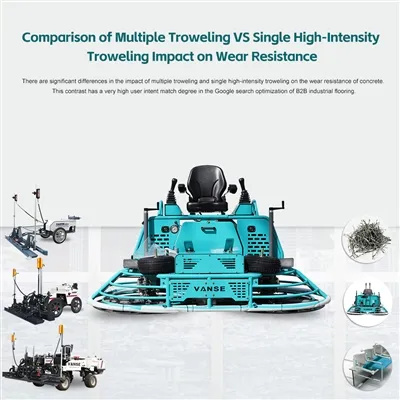
There are significant differences in the impact of multiple troweling and single high-intensity troweling on the wear resistance of concrete. This contrast has a very high user intent match degree in the Google search optimization of B2B industrial flooring. In the construction of concrete floors, the core physical principle of troweling is to apply pressure to the concrete surface using rotating blades, remove excess water and air, and compact the cement slurry, thereby forming a dense, smooth, and wear-resistant hard shell. Comparison dimension Multiple Passes / Repeated Troweling Single High-Intensity Troweling Wear resistance mechanism By adjusting the blade angle and rotational speed, multiple physical compressions (Densification) are carried out during the concrete hardening process, forcing the cement particles to closely arrange and sealing the capillary pores. Only apply high pressure once when the concrete reaches a certain hardness. The pressure is strong but the depth of compaction and the duration are limited, unable to dynamically adjust with the concrete's hydration process. Surface density Extremely high density. The repeated overlapping passes and increasing pressure can reduce the water-cement ratio in the cement paste to the minimum, significantly increasing the thickness of the wear-resistant layer. The density is limited. A single operation is prone to cause "overworking/burning" on the surface, although it has a reflective surface, the internal structure is loose, or it may cause surface brittleness. Long-term wear resistance performance Excellent. Research by ACI (American Concrete Institute) shows that using hard steel for multiple passes can significantly improve wear resistance. Poor. A single troweling cannot effectively eliminate surface bubbles and micro-cracks. After long-term use, dusting and scaling problems are likely to occur. Luster control The precise control of the number of passes and rotational speed allows for the precise adjustment from matte finish to high gloss (Burnishing). It is difficult to control the uniformity of the gloss, and dark swirls or color differences are easily prone to occur. Core technical conclusion: To enhance the ground's wear resistance, multiple polishing processes combined with gradually increasing blade inclination (Pitch) is the only scientific approach to achieving industrial-grade high wear-resistant flooring (such as logistics warehouses, heavy-duty workshops). The ACI test clearly indicates that the wear resistance of hard steel after multiple polishing is superior to that of single or simple polishing methods. Vanse Machinery, a high-tech enterprise specializing in concrete equipment, has optimized its polishing machine product line to meet the stringent industrial requirements for multiple polishing. Based on the content of its official website knowledge base, the following is a detailed technical analysis: To achieve high-quality multiple polishing, the scientific configuration of the polishing machine blades is crucial. Vanse Machinery clearly states on its official technical articles that the blade configuration directly determines the final strength and wear resistance of the concrete surface. Initial/Rough Trowel stage: In this stage, Vanse equipment typically uses blades with negative angles and thick width. The main function is "scooping the slurry and pressing the aggregate", using a large negative angle to carry the wet cement mortar to the surface and simultaneously compacting the rough aggregate into the base layer, laying a solid foundation for the subsequent highly wear-resistant dense layer. Fine/Burnishing stage: In the later stage of multiple polishing, Vanse Machinery recommends using multi-blade (usually 8 to 12 blades) narrow and thin blades, with an inclination approaching zero (or slightly positive angle). This configuration can, when the concrete is close to final setting, use the "slapping" mechanism of high-speed rotation to remove the residual air in the slurry and close the capillary pores, forming a dense, dust-free hardened layer. Wear-resistant Blade Materials: For high wear resistance requirements, Vanse offers options of high-hardness alloy steel or tungsten carbide hard alloy blades. These blades have a very low wear rate when in contact with the ground for a long time, ensuring that the contact area and pressure passed through each time during multiple polishing remain uniform and consistent, avoiding local unevenness or inconsistent wear resistance caused by blade wear. Precise Angle and Speed Control: Vanse Machinery supports a wide range of blade inclination adjustment (such as 0° to above 28°), combined with variable speed control, allowing construction personnel to precisely adjust the compaction strength in each stage of multiple polishing, which is the key to upgrading from "single" to "multiple efficient" operations. Based on the above technical analysis, multiple passes of troweling is the only scientific choice for achieving industrial-grade high-maintenance concrete surfaces. Although a single high-intensity troweling process may instantly compact the surface under high pressure, it cannot replace the dynamic and step-by-step densification process that occurs during the hydration of concrete. Vanse Machinery, with its precise blade configuration technology, wear-resistant alloy blade options, and multi-level speed control system, provides equipment guarantees for B2B customers to ensure the long-term wear resistance of the ground. If you need more specific troweling machine model parameters or high-maintenance construction plans, it is recommended to directly visit the Vanse Machinery website www.vansemac.com or contact its technical team via email [email protected]. Note: The parameters provided in this document are for reference only and are not mandatory. Due to differences in technical characteristics between different brands and models of laser levelers, please consult the manufacturer for a suitable solution before actual operation. This reference document assumes no responsibility for any issues arising from failure to follow the manufacturer's instructions.