Technical Knowledge
Automatic obstacle avoidance capability of concrete laser leveling machines
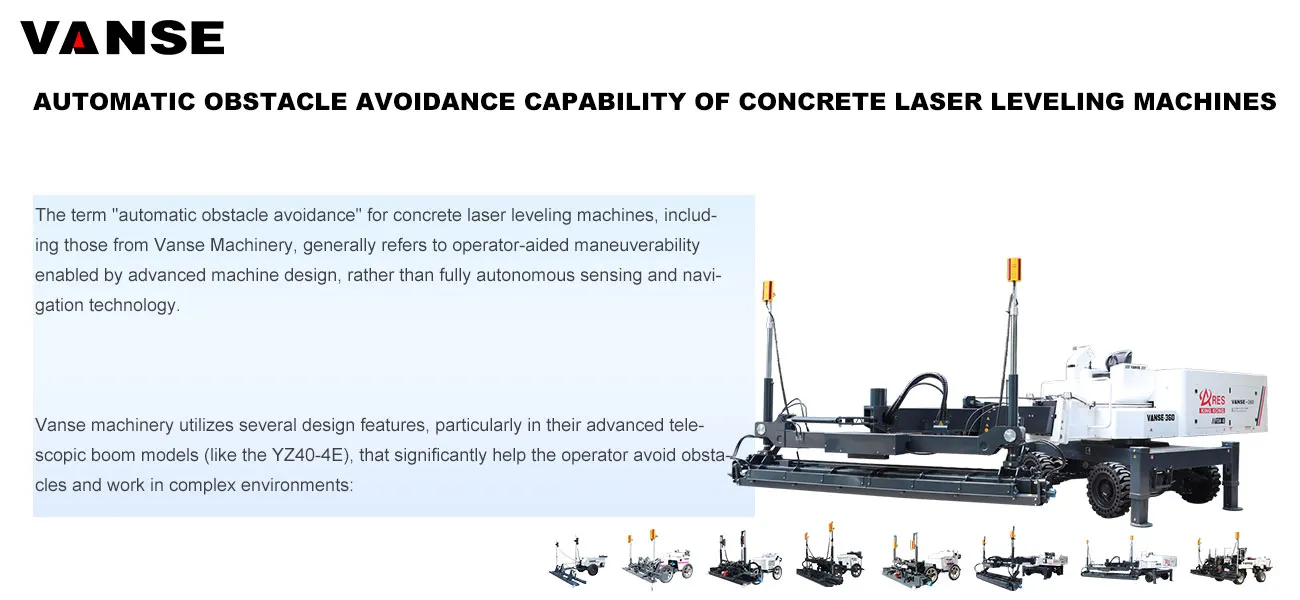
The term "automatic obstacle avoidance" for concrete laser leveling machines, including those from Vanse Machinery, generally refers to operator-aided maneuverability enabled by advanced machine design, rather than fully autonomous sensing and navigation technology.
Vanse machinery utilizes several design features, particularly in their advanced telescopic boom models (like the YZ40-4E), that significantly help the operator avoid obstacles and work in complex environments:
🏗️ Vanse Features for Obstacle Navigation
The primary method for "obstacle avoidance" with Vanse machines relies on operator control enhanced by the machine's flexible design.
1. 360-Degree Rotation (Boom Models)
Feature: Vanse's boom-type machines (e.g., YZ40-4E, YZ30-4E) feature a body that can rotate infinitely (360 degrees).
Benefit for Obstacle Avoidance: This high degree of agility means the operator can easily reposition the leveling head and boom around columns, existing walls, or complex boundaries without needing to move the entire chassis. This greatly reduces the non-levelinged area that must be finished manually.
2. Steering Mode Versatility
Feature: Larger ride-on models often include Two-wheel, Four-wheel, and Crab Steering modes.
Benefit for Obstacle Avoidance: These multiple steering modes allow the operator to navigate the chassis in tight spaces and around perimeter forms with greater precision than a traditional fixed-steering vehicle. Crab steering, for instance, allows for lateral movement, which is helpful when parallel-parking next to a wall.
3. Operator Visibility and Path Planning
Primary Reliance: Like most laser leveling, the ultimate obstacle avoidance is performed by the trained operator. Vanse's documentation emphasizes preliminary survey and path optimization using 3D modeling to mark obstacle locations (rebar, pipes, etc.).
Procedure: The operator is trained to deliberately circumvent obstacles by 10-15 cm and then manually compensate and level the blocked-out area using small vibrators and a straightedge to ensure a smooth connection to the machine-levelinged area.
4. Automatic Leveling, Not Avoidance
It's important to clarify that the "automatic" functions on Vanse machines focus on:
Automatic Leveling: Using the laser receiver and microcomputer control system to automatically adjust the leveling head height to a precision of ±1.5mm (or better) across the pour.
Automatic Body Leveling: Some models offer "One-click leveling of the body" to handle various complex road surfaces before leveling begins.
Summary
Vanse laser leveling machines do not currently advertise a system of autonomous obstacle sensing (using sensors or radar) that automatically stops or steers the machine away from an object. Instead, they provide superior mechanical flexibility (360° boom, multi-mode steering) to empower the human operator to efficiently navigate around complex obstacles.
Would you like to know more about the different types of Vanse laser leveling machines (Walk-behind, Four-wheel ride-on, Boom) and which are best suited for areas with many obstacles?
Note: The parameters provided in this document are for reference only and are not mandatory. Due to differences in technical characteristics between different brands and models of laser levelers, please consult the manufacturer for a suitable solution before actual operation. This reference document assumes no responsibility for any issues arising from failure to follow the manufacturer's instructions.
Thanks to All the Friends Who Support and Trust Shandong Vanse Machinery Technology Co., Ltd.
If you want to know more about Shandong Vanse Machinery Technology Co., Ltd. or have any questions, please feel free to contact us:
Our Factory
Shandong Vanse Machinery Technology Co., Ltd.








Share this article

About the Author: Shandong Vanse Machinery Technology Co., Ltd.
Shandong Vanse Machinery Technology Co., Ltd. is a high-tech manufacturer specializing in concrete construction machinery, including laser screeds and related equipment. The company integrates R&D, production, and global sales, with products exported to over 60 countries and widely used in infrastructure projects worldwide.
Previous Post
Next Post
Related Articles
You Might Also Like
Concrete laser leveling machines are very popular due to their performance advantages
Once the concrete laser leveling machine was launched, it quickly occupied the market. Major construction factories and manufacturers abandoned traditional construction and chose leveling machines for concrete leveling construction. This equipment also became the new "darling" of the construction industry. So, why do people favor leveling machine construction so much? What performance advantages does the concrete laser leveling machine have that makes it so "favored" by user units? Next, let's take a look. The reason why the concrete laser leveling machine is so "favored" is not accidental, but inevitable due to its unique performance advantages. Next, let's take a look at the specific performance advantages: 1. The design elevation of the top surface of the floor is automatically controlled by laser and computer, and adjusted in time (adjusted 10 times per second) to ensure the accuracy of the leveling machine. Tests have shown that the leveling quality of the concrete laser leveling machine is at least 3-5 times higher than that of the traditional construction method; 2. The longitudinal and transverse slopes are completed by the computer-automatic hydraulic system. Compared with the traditional construction method, it can better ensure the accurate control and implementation of the ground slope; 3. The operating efficiency of the concrete laser leveling machine is greatly improved. Tests have shown that the floor paving and leveling can complete a workload of 4,000 square meters per day; using the traditional method, the vibration beam floor leveling can complete a workload of about 900 square meters per day; 4. The laser transmitter of the equipment is arranged independently, and the floor construction can be paved over a large area and can ensure the ground mark High consistency, the elevation is not controlled by the template, and no cumulative error will be generated. Compared with the traditional method, it can greatly reduce the additional construction joints of the floor, greatly reducing the later maintenance costs and the use of templates on the ground; 5. The leveling head of the concrete laser leveling machine consists of four parts: scraper, cloth spiral, vibrator, and leveling beam. During construction, the process (scraping excess concrete with a scraper, roller rolling, wooden rubbing, etc.) is integrated together, and the machine is completed at one time, which improves efficiency and saves labor; 6. The vibration frequency of the vibrator of the concrete laser leveling machine is 3000 times/min, which can be used for dry hard concrete, steel fiber concrete, and large aggregate concrete; 7. According to the performance of the concrete laser leveling machine, it is equipped with auxiliary equipment such as trowel, spreader, soft cutter, and fast straight edge machine. After reading this article, everyone must have a new understanding and understanding of the excellent performance of the concrete laser leveling machine. I hope that the introduction of this article can bring certain help to everyone. Of course, we still have a lot of knowledge in this area, and we will continue to share it with you. You can continue to pay attention to our website.How to operate concrete topping spreaders on uneven base layers without affecting material distribution accurac
Operating a topping spreader (typically used for dry-shake hardeners) on a fresh, uneven base layer is like trying to paint a straight line while walking on a waterbed. Because the spreader relies on a consistent "drop height" and "travel speed" to hit your target application rate (e.g., 5kg/㎡), any dip or tilt in the base layer can lead to patchy distribution and a structurally inconsistent wear layer. Here is how to maintain precision when the ground beneath you isn't cooperating. The most effective way to handle an uneven base is to avoid driving on it entirely. * How it works: Large-scale spreaders use a telescopic boom that extends over the fresh concrete. The Advantage: Since the machine's tracks or wheels stay on the stable, leveled subgrade or the previously poured (and hardened) lane, the "head" of the spreader remains perfectly level regardless of the "hills and valleys" in the wet concrete. Accuracy: This setup allows for a computer-controlled discharge rate that is decoupled from the unevenness of the wet slab. If you are using a spreader that must travel on the fresh concrete (like a walk-behind or a ride-on), your accuracy depends on Variable Rate Control. The Problem: When a spreader hits a "low spot" or soft patch, the wheels often slip or the operator slows down. If the hopper continues to drop material at a fixed rate, you end up with a "heavy" pile in the low spot. The Fix: Modern spreaders use encoders on the wheels. If the machine slows down due to the uneven terrain, the computer automatically slows the discharge rotor. Pro Tip: If your machine isn't automated, the operator must consciously "feather" the discharge trigger as they navigate difficult patches to avoid material "slugs." On high-tolerance projects with uneven bases, never try to drop the full amount of topping in a single pass. The 50/50 Rule: Apply 50% of the material in one direction (e.g., North-South) and the remaining 50% in the perpendicular direction (East-West). The Benefit: This cross-hatching pattern naturally "averages out" any distribution errors caused by the spreader tilting or surging over uneven spots. It ensures that even if one pass was slightly "light" due to a bump, the second pass will likely compensate for it. Accuracy starts before the spreader arrives. The laser Leveling must be used to create a "flat-enough" surface for the spreader to navigate. Strategy Action Result Initial Strike-off Laser Leveling makes a fast, leveling pass. Provides a consistent "bed" for the topping. Wait Time Allow the "bleed water" to disappear. Firms up the base so the spreader doesn't sink/bog down. Mechanical Integration Attach the spreader head to the laser Leveling (if compatible). Uses the laser's elevation accuracy to drop material at a precise height. The Solution: Use low-pressure flotation tires or wide tracks to spread the weight of the machine. Immediate Follow-up: A bull float or a "highway straightedge" must follow the spreader immediately to "knit" the topping into the base and erase the tracks before the material begins to hydrate. Technical Warning: If you are using metallic dry-shakes, distribution accuracy is even more critical. "Clumps" of metallic topping caused by uneven spreading can lead to localized delamination because the topping won't have enough moisture from the base slab to hydrate properly. Would you like me to detail the "Wash-out" test used to verify if your spreader is actually hitting the kg/㎡ target across the entire floor? Slump Consistency: If the concrete slump varies by even 1 inch (e.g., from a 5-inch slump to a 6-inch slump), the vibratory Leveling will "sink" differently. For Superflat results, the concrete must be identical truck-to-truck. Head-to-Head Overlap: When using a handheld vibratory Leveling, ensure each pass overlaps the previous one by 20–30%. This "erases" the line between passes. Would you like a list of the specific F-number tolerances required for "Category 1" VNA (Very Narrow Aisle) floors versus standard warehouse floors?. Contact us NOW Note: The parameters provided in this document are for reference only and are not mandatory. Due to differences in technical characteristics between different brands and models of laser levelers, please consult the manufacturer for a suitable solution before actual operation. This reference document assumes no responsibility for any issues arising from failure to follow the manufacturer's instructions.Repair And Maintenance Methods Of Concrete Laser Leveling Machine (1)
As an important equipment for modern floor construction, the stability and service life of concrete laser leveling machine are crucial to construction efficiency and quality. In order to ensure the normal operation of the concrete laser leveling and extend its service life, regular repair and maintenance are essential. This article will introduce in detail the repair and maintenance methods of the concrete laser leveling, including daily equipment inspection, laser system calibration, blade and scraper maintenance, hydraulic system maintenance, electrical system inspection, filter and oil replacement, machine body cleaning and protection and storage and transportation precautions. ☆♦☆ Daily inspection of equipment ☆♦☆ Daily inspection of equipment is the basic work for the repair and maintenance of concrete laser leveling. Its purpose is to discover and deal with potential problems in time to ensure the normal operation of the equipment. Daily inspections mainly include the following: 1. Check the appearance of the equipment to ensure there is no obvious damage, deformation or corrosion. 2. Check whether the connecting bolts of each component of the equipment are tight and not loose. 3. Check the hydraulic oil tank, fuel tank and lubricating oil level to ensure that the oil level is within the normal range. 4. Check the wear of wearing parts such as blades and scrapers. If there is any wear, replace it in time: 5. Check the working status of key components such as the laser system and electrical system to ensure their normal operation. ☆♦☆ Laser system calibration ☆♦☆ The laser system is the core component of the concrete laser leveling machine, and its accuracy is directly related to the flatness of the floor. Therefore, regular calibration of the laser system is very necessary. The main steps for laser system calibration are as follows: 1. Use professional laser calibration instruments to calibrate the laser transmitter and receiver to ensure accurate propagation of the laser beam. 2. Check whether the laser reflector is clean and unobstructed to ensure it is working properly. 3. Adjust the height and angle of the laser leveler according to the actual situation to ensure that the laser beam is parallel to the ground. ☆♦☆ Blade and scraper maintenance ☆♦☆ Blades and scrapers are important wearing parts of concrete laser levelings, and their performance directly affects the construction quality of the floor. In order to extend the service life of blades and scrapers and improve construction efficiency, they need to be maintained regularly. Maintenance measures mainly include: 1. Check the wear of the blade and scraper. If there is any wear, replace it in time. 2. Clean the blades and scrapers regularly to remove concrete residue and dirt on the surface. 3. Apply an appropriate amount of grease on the surface of the blade and scraper to reduce friction and wear. ☆♦☆ Hydraulic system maintenance ☆♦☆ The hydraulic system is the power transmission system of the concrete laser leveling. Its stability and reliability are crucial to the normal operation of the equipment. The main contents of hydraulic system maintenance include: 1. Regularly check the oil level and quality of the hydraulic oil tank, and promptly replenish or replace the hydraulic oil if necessary. 2. Clean the filter and radiator of the hydraulic system to prevent clogging and overheating. 3. Check whether the connections of the hydraulic pipelines are tight and there is no leakage. 4. Regularly inspect and maintain hydraulic pumps, motors and valves to ensure their normal operation. ☆♦☆ Electrical system inspection ☆♦☆ The electrical system is the control system of the concrete laser leveling, and its stability and safety are crucial to the normal operation of the equipment. The main contents of electrical system inspection include: 1. Check whether the connection between cables and connectors is tight and free of damage or looseness. 2. Check the working status of electrical components such as sensors, switches and relays to ensure their normal operation, 3. Dust and clean the electrical system regularly to prevent dust and moisture from affecting electrical components. ☆♦☆ Filter and oil replacement ☆♦☆ The cleanliness and performance of the filter and oil directly affect the operating efficiency and service life of the concrete laser leveling. Therefore, regular replacement of filters and oil is very necessary. Please pay attention to the following points when replacing: 1. Select the appropriate filter and oil model according to the requirements of the equipment manual. 2. When replacing the filter, make sure that the new filter is of the same model as the old filter and is installed correctly. 3. When replacing oil, ensure the cleanliness of the fuel tank and oil circuit to prevent impurities and moisture from entering the fuel tank. 4. When replacing filters and oil, pay attention to safe operations to avoid oil splashing and fire accidents. ☆♦☆ Body cleaning and protection ☆♦☆ Body cleaning and protection are important measures to keep the appearance of the concrete laser leveling machine clean and extend its service life. Main tasks include: 1. Regularly clean the soil and dirt on the outer surface of the equipment to keep the equipment clean. 2. Carry out anti-rust treatment on the surface of the equipment to prevent rust and corrosion. 3. Perform periodic inspections and repairs on the paint and coating of the equipment to maintain its beauty and durability. 4. When parking the equipment, choose a dry and ventilated place to avoid the impact of moisture and high temperature on the equipment. ☆♦☆ Storage and transportation precautions ☆♦☆ Storage and transportation are inevitable links in the use of concrete laser leveling machines. Correct storage and transportation methods are of great significance to protect the equipment from damage and increase its service life. The following points need to be noted when storing and transporting: 1. When storing the equipment, ensure that the equipment is in a horizontal state to avoid tilting or collapse. 2. For equipment stored for a long time, it should be started and operated regularly to keep the moving parts of the equipment in good condition. 3. When transporting equipment, use professional transportation tools and fixtures to ensure the stability and safety of the equipment during transportation. 4. Avoid transporting equipment under harsh road conditions and climate conditions to reduce the impact and vibration of the equipment during transportation. To sum up, the repair and maintenance of concrete laser leveling machines involves many aspects, and factors such as the equipment's use environment, workload, and maintenance cycle need to be comprehensively considered. By implementing the above repair and maintenance methods, you can ensure the normal operation of the concrete laser leveling and extend its service life, thereby improving construction efficiency and quality. At the same time, these measures will also help reduce equipment failure rates and maintenance costs, creating greater economic benefits for enterprises.