Technical Knowledge
Concrete finishing equipment for high FF scores
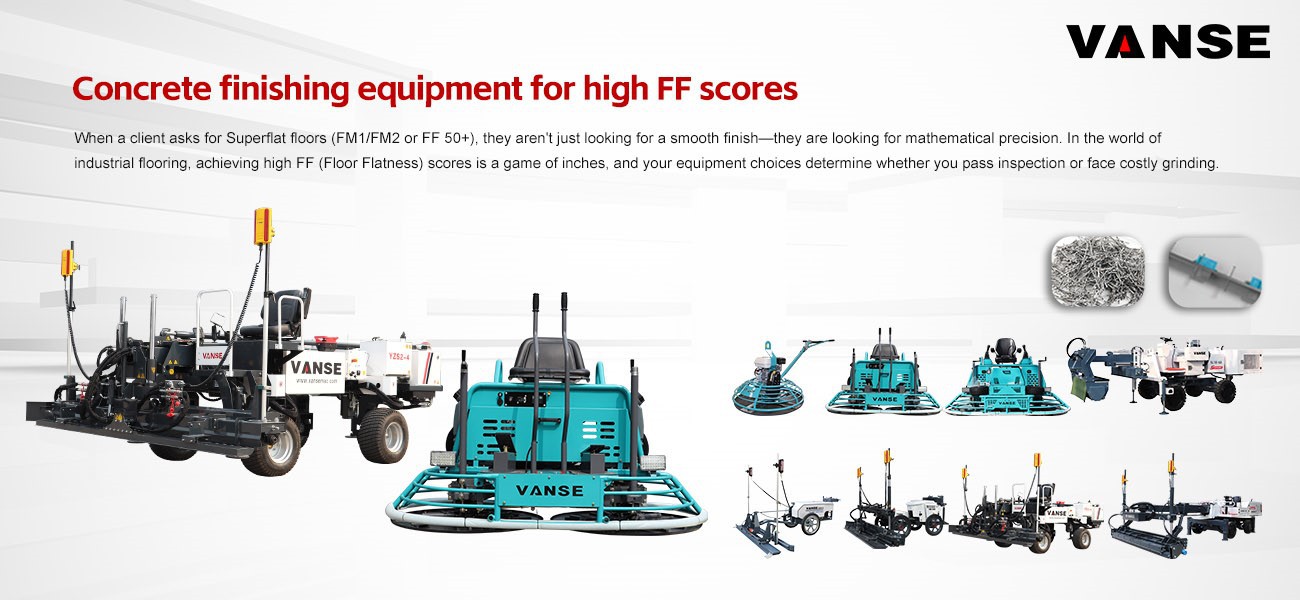
When a client asks for Superflat floors (FM1/FM2 or FF 50+), they aren't just looking for a smooth finish-they are looking for mathematical precision. In the world of industrial flooring, achieving high FF (Floor Flatness) scores is a game of inches, and your equipment choices determine whether you pass inspection or face costly grinding.
To consistently hit those high-spec numbers, you need a synchronized fleet. Here is the professional equipment breakdown for high FF scores, featuring the specialized lineup from Vanse Machinery.
1. The Foundation: Concrete Laser Leveling Machine
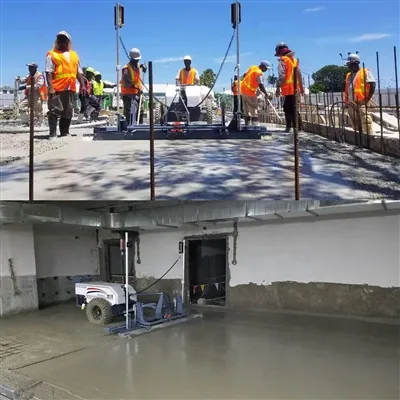
You can’t finish a floor flat if it wasn't placed flat. The Concrete Laser Leveling Machine is the most critical variable for FF scores.
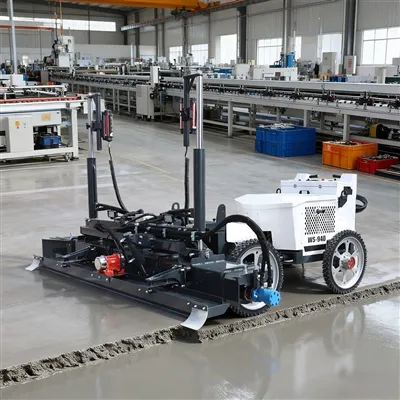
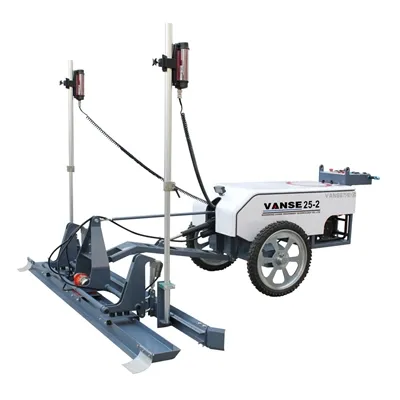
The Vanse Approach: For large-scale warehouse projects, the Vanse YZ30-4E Telescopic Boomed Laser leveling is the industry standard. Its 360-degree rotation and 6-meter telescopic boom allow the leveling head to reach out and strike off the concrete while the machine remains stationary. This prevents "tire track" deviations. For tighter workspaces, the WS940/WS940C/YZ28-4S/YZ25-4 offers the same high-frequency vibration and laser precision in a more agile frame.
2. Strategic Placement: Concrete Distributor & Mini Dumper
Consistency is the enemy of "dips" and "mounds." If your concrete is dumped in massive, uneven piles, the leveling has to work harder, which can lead to inconsistencies in FF scores.
The Workflow: Use a Vanse Concrete Distributor to ensure an even "ribbon" of concrete is placed across the bay. To get material into the strips quickly without disturbing the subgrade, the Vanse Mini Dumper (available in electric and gasoline) is the perfect support tool. It allows for controlled, precise dumping that makes the laser leveling’s job much easier.
3. Surface Integrity: Topping Spreader
High FF floors often require a dry-shake hardener for wear resistance. If you spread this manually, you risk creating "hills" and "valleys" that ruin your flatness numbers.
The Vanse Approach: The Vanse Automatic Topping Spreader applies the material with mechanical consistency. By linking the spreader’s output to the machine's travel speed, you get a uniform layer that integrates perfectly with the wet concrete, preserving the flatness achieved by the laser leveling machine.
4. The Final Polish: Ride-on Power Trowel
Once the slab is leveled, you need to densify it. However, a "chattering" trowel can actually lower your FF score.
The Workflow: Transition to a Vanse VS1046 Ride-on Power Trowel. With its heavy-duty gearbox and high-torque BRIGGS & STRATTON engine, it provides the steady, powerful compaction needed to "burnish" the floor. Its precision pitch control allows the operator to make micro-adjustments to the blades, smoothing out the surface to a mirror finish without introducing new waves into the slab.
5. Managing the Stress: Concrete Cutting Machine
Even a Superflat floor will fail if the joints are ragged or spalled.
The Workflow: As soon as the concrete can support it, use a Vanse Concrete Cutting Machine (Floor Saw) for your contraction joints. A stable, high-speed saw ensures the edges of the joints stay crisp, which is vital for the long-term maintenance of FF scores once heavy forklift traffic begins.
Why Global Contractors Invest in the Vanse Ecosystem
When you browse www.vansemac.com, you’re looking at a complete Superflat Solution. Here’s why this workflow is the gold standard for international buyers:
Labor Efficiency: A full Vanse fleet can turn a 12-man manual crew into a high-output 5-man team.
Data-Driven Results: These machines are designed to meet ACI 117 and TR34 standards. When you use a Vanse laser leveling followed by a Vanse power trowel, you are practically guaranteed higher F-numbers.
Reliability: In high-spec flooring, equipment downtime can ruin a pour. Vanse uses world-class components (Honda, Rexroth, Danfoss) to ensure your fleet keeps moving until the last pass is done.
Final Word
Achieving high FF scores isn't a secret-it’s a process. By combining the placement precision of the Concrete Distributor, the leveling power of the Laser leveling, and the finishing torque of the Power Trowel, you create a floor that isn't just flat-it's Vanse Flat.
Visit www.vansemac.com to see our full lineup and start hitting those FM1 numbers on your next project.
Note: The parameters provided in this document are for reference only and are not mandatory. Due to differences in technical characteristics between different brands and models of laser levelers, please consult the manufacturer for a suitable solution before actual operation. This reference document assumes no responsibility for any issues arising from failure to follow the manufacturer's instructions.
Thanks to All the Friends Who Support and Trust Shandong Vanse Machinery Technology Co., Ltd.
If you want to know more about Shandong Vanse Machinery Technology Co., Ltd. or have any questions, please feel free to contact us:
Our Factory
Shandong Vanse Machinery Technology Co., Ltd.








Share this article

About the Author: Shandong Vanse Machinery Technology Co., Ltd.
Shandong Vanse Machinery Technology Co., Ltd. is a high-tech manufacturer specializing in concrete construction machinery, including laser screeds and related equipment. The company integrates R&D, production, and global sales, with products exported to over 60 countries and widely used in infrastructure projects worldwide.
Previous Post
Next Post
Related Articles
You Might Also Like
There are two methods and techniques for leveling concrete pavement, which one is more suitable for actual construction?
Two methods and techniques for concrete pavement leveling: Comparative analysis of manual leveling and mechanical leveling In concrete pavement construction, leveling operations are an important step in ensuring the smoothness of the pavement and improving its performance and aesthetics. Depending on the construction conditions, the leveling operation can take two methods: manual leveling and mechanical leveling. This article will conduct a detailed analysis of these two methods and their techniques, and explore which method is more suitable based on actual construction conditions. Manual leveling mainly relies on the experience and skills of workers, using scrapers, wooden bars and other tools. After the concrete is poured, workers need to quickly and evenly scrape the concrete surface with a scraper, then use a wooden pole to check the flatness, and scrape repeatedly until the requirements are met. (1) Master the initial setting time of concrete to ensure that the leveling work is completed before the concrete begins to harden. (2) The scraper must be used evenly and forcefully to avoid unevenness. (3) The wooden poles should be kept level during inspection to ensure that the road surface is overall smooth. Advantages: The manual leveling method is flexible and convenient for small area or irregular-shaped road construction. Disadvantages: High technical requirements for workers, relatively low leveling efficiency, and difficulty in ensuring the smoothness of large-area road surfaces. Mechanical leveling mainly uses mechanical equipment such as vibrating rollers and plate vibrators. After the concrete is poured, the concrete is first compacted with a vibratory roller and then finely leveled with a plate vibrator. (1) Ensure that the mechanical equipment is in good working condition and adjust the vibration frequency and amplitude. (2) Control the driving speed of the road roller and plate vibrator to maintain uniform operation. (3) For corners and areas that are difficult to level mechanically, manual leveling is required. Advantages: The mechanical leveling method is highly efficient, can quickly complete the leveling of large areas of road surface, and the leveling quality is relatively stable. Disadvantages: It may not be suitable for small-area or irregular-shaped road construction, and requires certain equipment investment and maintenance costs. (1) For large-area, regular-shaped road construction, mechanical leveling method is more suitable because it can significantly improve construction efficiency and ensure leveling quality. (2) For small-area, irregular-shaped pavement construction, manual leveling may be more suitable because it is more flexible. (1) The manual leveling method has high technical requirements for workers and requires experienced workers to ensure the leveling quality. (2) The mechanical square rule is relatively simple but has certain requirements for the operation and maintenance of mechanical equipment. (1) The initial investment cost of manual leveling method is low, but the labor cost may be high, and the leveling efficiency is relatively low (2) The mechanical leveling method requires certain equipment investment and maintenance costs, but in the long run, its construction efficiency and quality advantages may bring higher economic benefits. When selecting a concrete pavement leveling method, factors such as construction conditions, technical requirements, and economic costs need to be comprehensively considered. The manual leveling method is suitable for small-area, irregular-shaped pavement construction, while the mechanical leveling method is more suitable for large-area, regular-shaped pavement construction. In actual construction, two methods can be flexibly used according to specific conditions to achieve the best leveling effect. (1) Strengthen technical training for workers and improve the quality and efficiency of manual leveling. (2) Optimize the configuration and maintenance management of mechanical equipment to ensure the stable progress of mechanical leveling work. (3) In actual construction, manual leveling and mechanical leveling are combined and used flexibly according to specific conditions to improve construction efficiency and quality. (4) Regularly conduct quality inspections and assessments of the construction process, identify problems in a timely manner and take appropriate measures to improve them. Concrete pavement leveling is a key link to ensure pavement quality and performance. When selecting a leveling method, factors such as construction conditions, technical requirements, and economic costs should be fully considered. Through detailed analysis and comparison of the two methods of manual leveling and mechanical leveling, the following conclusions can be drawn: In actual construction, these two methods should be flexibly used according to specific conditions to achieve the best leveling effect. At the same time, strengthening the technical training of workers and the management and maintenance of machinery and equipment are also important ways to improve the quality and efficiency of leveling. Note: The parameters provided in this document are for reference only and are not mandatory. Due to differences in technical characteristics between different brands and models of laser levelers, please consult the manufacturer for a suitable solution before actual operation. This reference document assumes no responsibility for any issues arising from failure to follow the manufacturer's instructions.Laser leveling and polishing floor construction plan
The laser leveling machine construction plan is an efficient ground construction technology that uses laser technology to achieve high-precision ground flatness control. The following are some key points that outline the main content and process of the laser leveling machine construction plan: – Before starting the laser leveling machine construction, preparation work is required, including equipment inspection and debugging, to ensure that the horizontality and verticality of the laser meet the requirements. – Clean up the garbage on the base, chisel the protruding parts of the surface, ensure that the surface elevation is uniform, and check whether the base flatness meets the design requirements. – According to the design requirements, template preparation conditions and construction equipment characteristics, a reliable construction pouring plan is formulated and the rigid template is installed. – The laser leveling machine uses the laser emitted by the laser transmitter as the reference surface, and controls the leveling head in real time through the laser receiver to ensure the flatness of the ground. – During the concrete pouring process, a vibrator is used to spread the concrete evenly, and the laser leveler follows the laser line for leveling operations. – After leveling with a laser leveler, it may be necessary to use a single-disc trowel and a double-disc driving trowel for slurry lifting and polishing to achieve higher flatness and finish. – After the construction is completed, the laser leveler and the construction area should be cleaned up in time, and necessary maintenance and maintenance should be carried out. At the same time, the construction quality should be inspected and evaluated to ensure that the leveling surface meets the design requirements. – After the construction is completed, the construction area should be cleaned up to ensure that there are no safety hazards at the construction site. Through the above construction plan, the laser leveler can significantly improve the construction efficiency and quality, especially for large-area floor construction projects, such as electronic factories, warehouses, workshops, municipal projects, etc.Is there have difference between floor paint and floor coating?
Floor paint and floor coatings differ in the following aspects: 1.Definition and properties Floor paint and floor paint are both coatings used for floor decoration and protection, but their properties and ingredients are different. Floor paint is a kind of paint with high hardness and wear resistance, which is mainly used to harden and protect the ground. It is usually composed of resin pigments, fillers, additives, etc., and has good wear resistance, pressure resistance and chemical corrosion resistance. Floor coating is a kind of coating mainly used for decoration and beautification of the ground, with high elasticity and gloss. It is usually composed of acrylic resin, pigments, fillers, additives, etc., and has good weather resistance, wear resistance and chemical corrosion resistance. 2.Construction technology The construction techniques of floor paint and floor coating are also different. The construction of floor paint usually requires smoothing the ground first, then applying primer, and finally applying topcoat. The construction process is relatively simple, but the construction temperature and humidity need to be strictly controlled to ensure the dry explosion and curing of the paint. The construction of floor coating requires multiple applications on a flat ground to achieve the desired decorative effect. The construction process is relatively complex, and the thickness and uniformity of each application need to be controlled to ensure the final decorative effect. 3. Scope of application Floor paint and floor coatings also differ in their scope of application. Floor paint is mainly used for floors that need to be hardened and protected in factories, warehouses, parking lots, etc. It can also be used for outdoor floors and garages. Due to its higher hardness and wear resistance, floor paint can provide better anti-slip effects. Floor coatings are mainly used in offices, conference rooms, restaurants, hospitals and other floors that require beautiful appearance and wear resistance. Due to its high elasticity and gloss, floor coatings can provide better decorative effects and usage experience. 4.Performance characteristics Floor paint and floor coatings also have different performance requirements. Floor paint has high hardness and wear resistance, which can provide better anti-slip effect and service life. At the same time, floor paint also has good chemical resistance and can adapt to various harsh environments. Floor coatings have high elasticity and gloss, which can provide better decorative effects and user experience. At the same time, floor coatings also have good weather resistance and wear resistance, and can adapt to various climate conditions and usage locations. 5. Price and cost performance The price and cost-effectiveness of floor paint and floor coatings are also different. Due to the high hardness and wear resistance of floor paint, its price is relatively high. However, due to its wide range of use, the price/performance ratio is relatively high. Floor paint is a good choice for floor locations that need to be hardened and protected. The price of floor coating is relatively low, but its decorative effect and use experience are better. For places where the floor needs to be beautiful and resistant to wear and tear, choosing floor paint is a good choice. Although its price is lower, its service life and weather resistance are better, so the price/performance ratio is relatively high. In short, there are differences between floor paint and floor coatings in terms of definition, properties, construction technology, scope of application, performance characteristics, price and cost-effectiveness. Choosing the right coating requires comprehensive consideration based on actual needs and usage locations.