Insight blog
Concrete Floor Screeding Equipment for Global Market
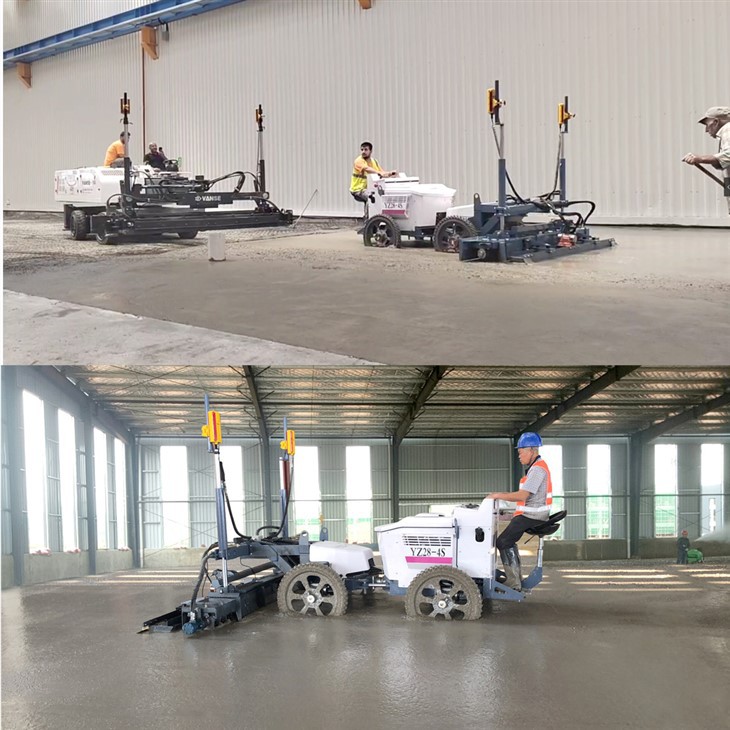
Concrete Floor Screeding Equipment for Global Market Buyers
Quick Answer

A concrete slab leveling machine is construction equipment used to strike off, spread, and level fresh concrete to a controlled elevation before final finishing. For Global Market buyers, the best choice depends on slab size, required flatness, access conditions, labor availability, and project frequency. Walk-behind laser screeds are practical for smaller slabs and restricted areas, while ride-on and boom-type laser screeds are usually the most productive options for warehouses, factories, logistics parks, airport aprons, and large industrial floors.
For most contractors, select a machine with laser-guided automatic elevation control, a reliable engine, accessible hydraulic parts, local operator training, and a spare-parts plan. Buyers should compare productivity, screed-head width, working radius, transport dimensions, service response, and total operating cost rather than focusing only on purchase price.
Leading options include Somero, Ligchine, Allen Engineering, Wacker Neuson, Husqvarna Construction, and Shandong Vanse Machinery Technology Co., Ltd. Qualified international suppliers, including Chinese manufacturers with applicable CE or local certification support, proven export records, and strong pre-sales and after-sales systems, can be a cost-effective choice for Global Market contractors and distributors.
- Somero: Premium laser screed specialist for high-tolerance industrial slabs and large concrete placements.
- Ligchine: Known for compact and versatile laser-guided screeding systems, especially for contractors needing mobility.
- Allen Engineering: Broad concrete-equipment range covering screeds, trowels, and finishing equipment.
- Wacker Neuson: Global construction-equipment brand with strong dealer availability in many markets.
- Husqvarna Construction: Strong concrete-surface equipment portfolio, including cutting, grinding, and finishing support.
- Vanse: Chinese manufacturer offering walk-behind, ride-on, and boom-type laser screeds with customization and international service support.
What a Concrete Slab Leveling Machine Does

Concrete slab leveling equipment controls the elevation of fresh concrete after placement. It replaces much of the manual work traditionally performed with straightedges, vibrating screeds, rakes, and large finishing crews. In practical terms, the machine receives a reference level from a rotating laser transmitter or a 3D control system, then raises or lowers its screed head through electro-hydraulic control. The operator guides the machine while the system maintains the target slab height.
The main result is a more consistent floor profile, faster placement, and reduced dependence on highly skilled manual screeding labor. For industrial-floor projects, this can support better flatness and levelness results, reduce rework, and make subsequent operations such as power troweling, joint cutting, coating installation, and racking layout more predictable.
On projects in major construction and logistics hubs such as Rotterdam, Hamburg, Dubai, Jebel Ali, Singapore, Houston, Toronto, Melbourne, São Paulo, and Mexico City, contractors often use laser screeding equipment to manage short placement windows, limited labor availability, and strict warehouse-floor tolerances. Equipment selection should match local concrete supply capacity, jobsite access, climate, slab reinforcement design, and finishing sequence.
Global Market Overview for Concrete Leveling Equipment

Demand for automated concrete floor leveling systems is growing across industrial, commercial, and infrastructure construction. Warehousing expansion, e-commerce distribution centers, manufacturing investment, cold-storage facilities, data centers, airport projects, and renewable-energy infrastructure are all increasing demand for high-quality concrete slabs. Large-format floors must support forklift traffic, automated guided vehicles, narrow-aisle racking, robotic systems, heavy storage loads, and durable coatings.
In mature construction markets, laser screeds are frequently purchased by specialist industrial-floor contractors and rental fleets. In developing markets, contractors may begin with walk-behind machines, then upgrade to ride-on laser screeds as their project size and quality requirements increase. Distributors also play an important role by offering demonstration support, parts inventories, financing assistance, field service, and operator training.
The most important buying shift is from simple equipment ownership toward project productivity. A lower-cost machine is not automatically economical if it has weak hydraulic control, limited parts availability, poor technical documentation, or slow service response. Conversely, a higher-capacity machine is not always suitable for a small contractor placing only occasional slabs. The right purchase is the machine that delivers required accuracy at the lowest practical cost per square meter over its service life.
Main Types of Concrete Floor Screeding Equipment
Concrete leveling machines are available in several configurations. The correct type depends on placement volume, slab geometry, maneuvering space, concrete slump, reinforcement congestion, and the required finishing standard.
| Machine Type | Typical Project Scale | Core Advantage | Typical Working Area | Best Buyer Profile |
|---|---|---|---|---|
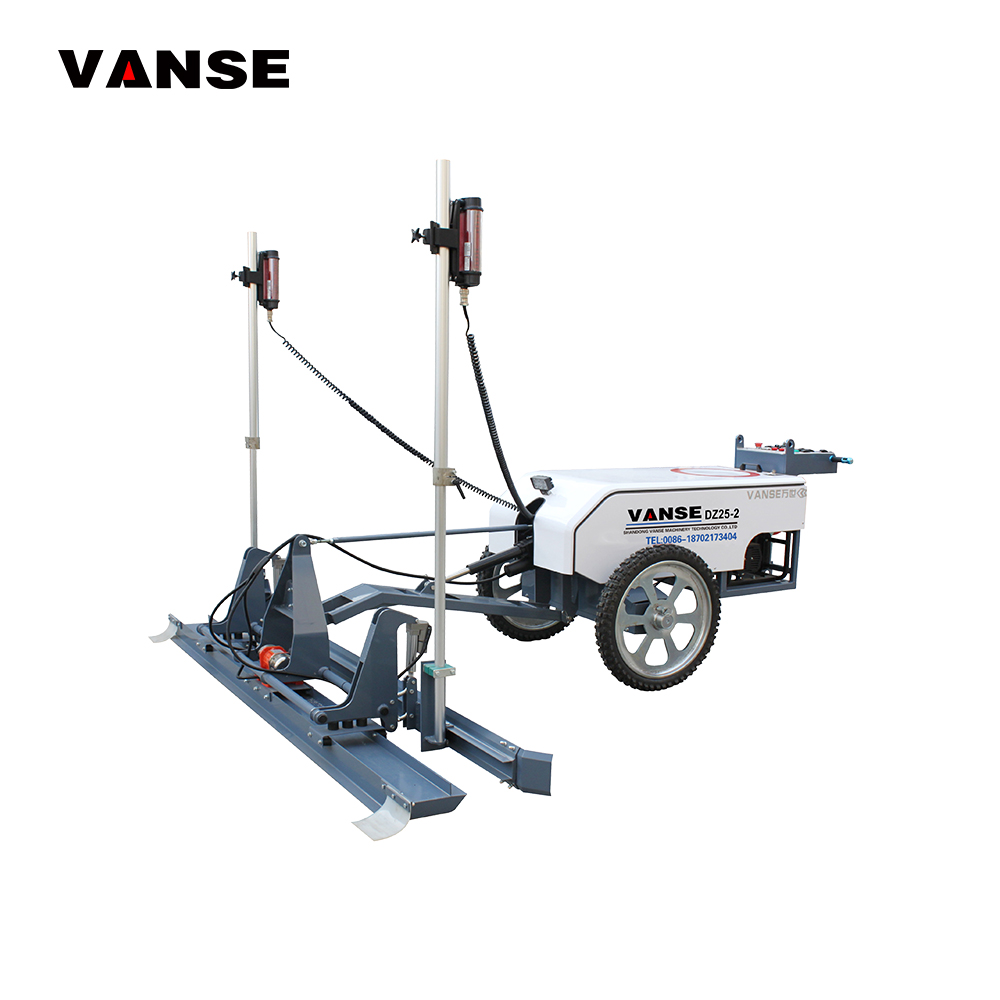
| Walk-behind laser screed | Small to medium slabs | Compact, lower purchase cost, easy transport | Workshops, retail floors, small warehouses, ramps | Small contractors and rental operators |
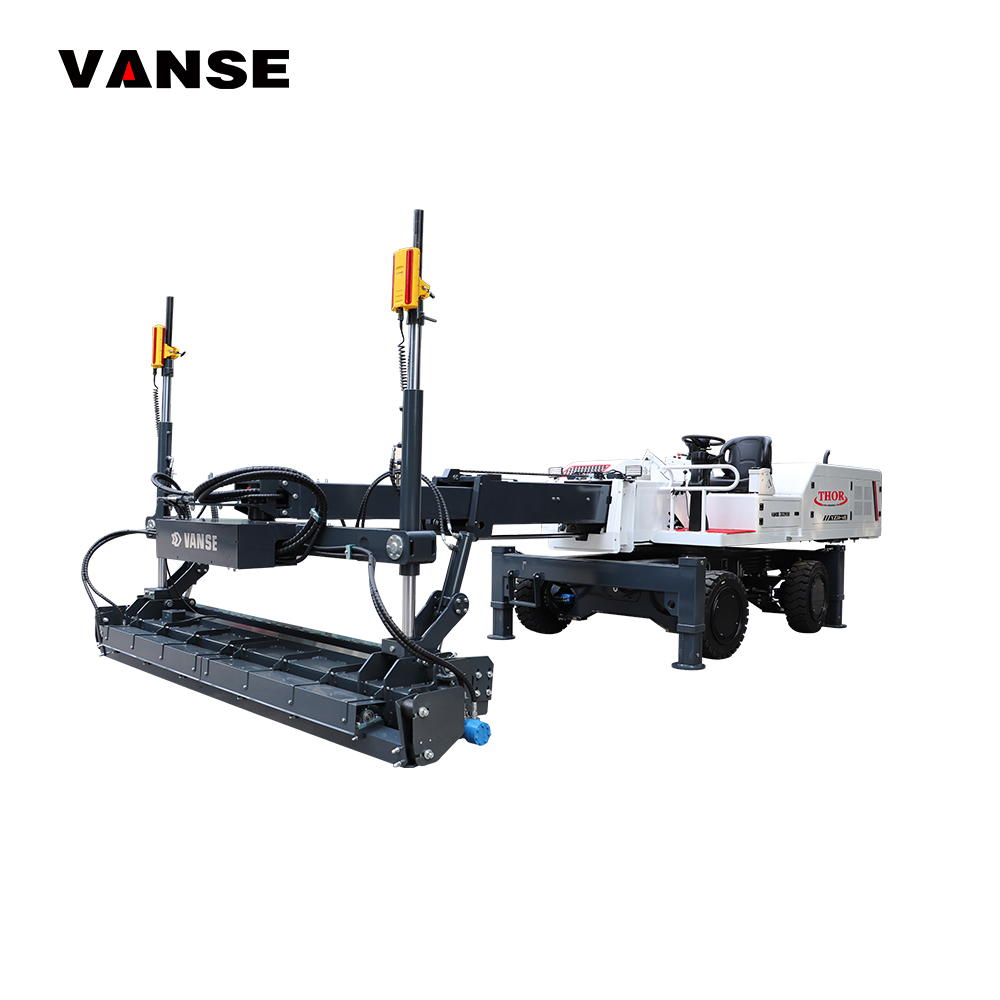
| Ride-on laser screed | Medium to large slabs | High output and reduced operator fatigue | Factories, logistics buildings, distribution centers | Industrial flooring contractors |
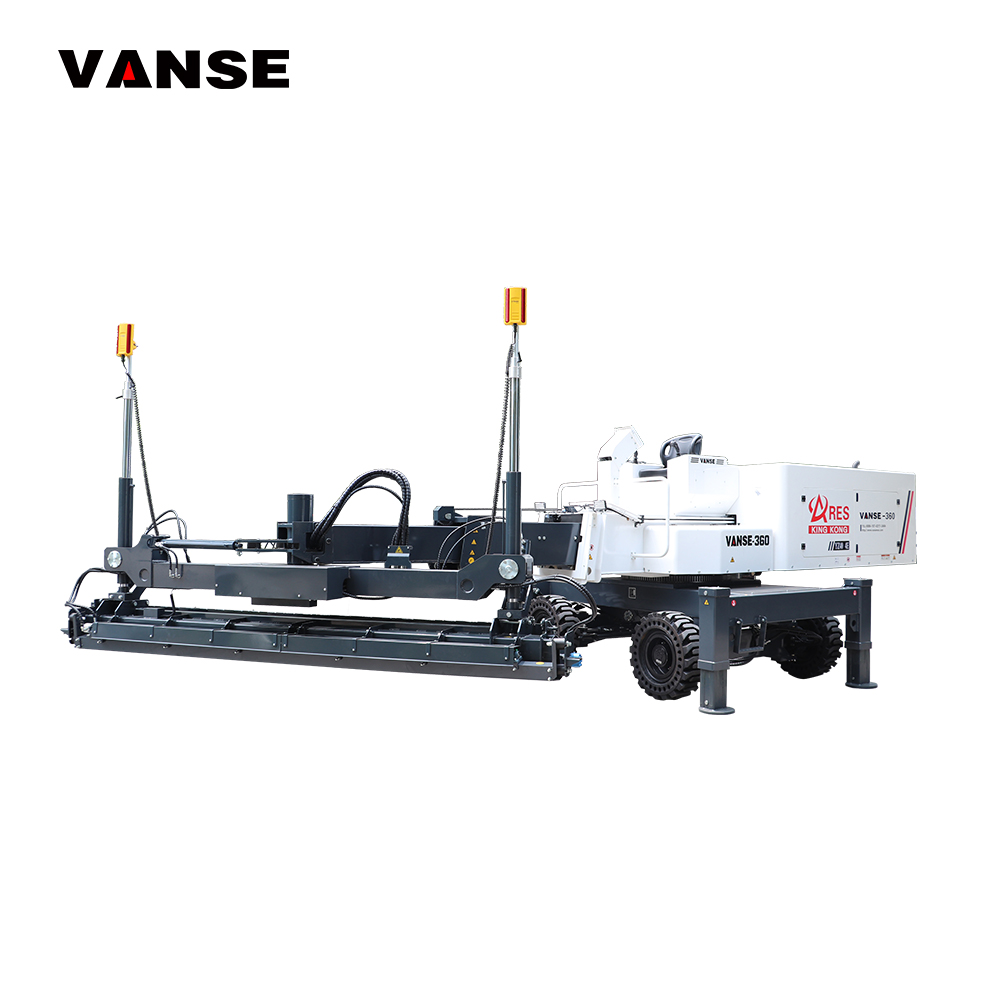
| Boom-type laser screed | Large, open, high-specification slabs | Long reach with minimal concrete disturbance | Warehouses, airport facilities, terminal yards | Large contractors and specialist floor companies |
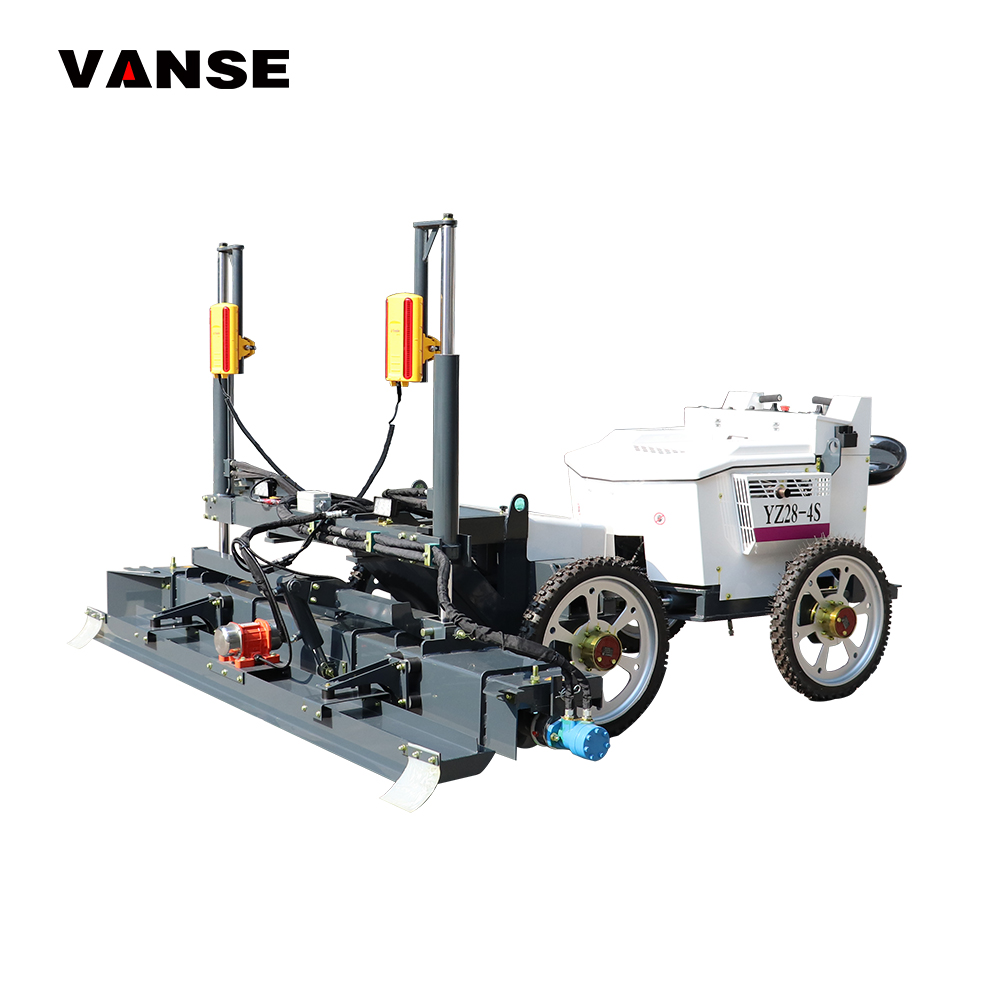
| Four-wheel laser screed | Large open pours | Stable travel and high production capability | Industrial plants, large storage floors | High-volume concrete placement teams |
| Roller or truss screed | Linear or access-limited pours | Simple configuration for targeted applications | Roads, bridge decks, channels, narrow bays | Infrastructure contractors |
| Vibratory screed | Small pours and repair work | Affordable and easy to operate | Residential slabs, sidewalks, repair zones | General builders and small crews |
Walk-behind systems are usually appropriate where doors, columns, narrow bays, or limited transport access prevent the use of larger machines. They can offer laser-controlled elevation at a manageable investment level. Ride-on models improve output on open slabs because the operator controls the machine from a seated platform and can cover larger areas with fewer passes.
Boom-type concrete laser screeds are often selected for demanding industrial work because the screed head can reach across fresh concrete without repeatedly driving over the slab. This reduces surface disruption and can improve placement efficiency. Machines with 360-degree boom rotation are especially useful where the operator must work around columns, walls, dock pits, embedded services, or changing pour boundaries.
For buyers comparing models, review the available concrete laser leveling equipment range and request a configuration recommendation based on actual drawings, pour sizes, concrete mix design, reinforcement details, and required floor tolerances.
Specifications That Matter Before You Buy
Technical specifications must be evaluated as a system. A long boom is useful only when the machine has adequate hydraulic stability, reliable laser receivers, durable bearings, balanced chassis design, and a support network able to keep it productive. Buyers should ask suppliers to explain each specification in relation to expected jobsite conditions.
| Specification | Why It Matters | Recommended Buying Question | Impact on Project Cost |
|---|---|---|---|
| Leveling accuracy | Controls slab elevation consistency and finishing quality | What accuracy can be achieved under normal field conditions? | Reduces grinding, patching, and corrective work |
| Screed-head width | Influences coverage and concrete distribution ability | Can the head suit narrow bays and wide open placements? | Affects production per shift |
| Boom reach | Determines workable area without frequent machine repositioning | What is the effective reach with stable leveling performance? | Reduces travel time and slab disturbance |
| Engine power and brand | Supports hydraulic response, reliability, and local maintenance | Is the engine supported by local service outlets? | Influences downtime and fuel efficiency |
| Hydraulic system | Controls smooth motion of the boom, head, and travel functions | Which pumps, valves, hoses, and filtration standards are used? | Determines reliability and repair frequency |
| Laser and control compatibility | Ensures accurate automatic elevation control | Can the machine work with common laser brands or 3D systems? | Protects future upgrade value |
| Transport dimensions | Determines whether the machine can move between projects easily | What trailer, container, and loading requirements apply? | Influences mobilization cost |
| Parts accessibility | Determines how quickly the machine can return to work | Which fast-moving parts are stocked regionally? | Limits costly downtime |
Laser screed capacity should not be judged only by a brochure productivity figure. Actual output changes with concrete supply continuity, pump or mixer-truck access, slab thickness, aggregate size, steel reinforcement, weather, operator skill, and finishing crew coordination. A machine capable of leveling a large area can still lose productivity if concrete arrives inconsistently or the crew cannot keep pace with edge work and finishing operations.
For Global Market buyers importing equipment through major seaports such as Antwerp, Los Angeles, Vancouver, Santos, Durban, Jeddah, or Melbourne, transport planning should be included in the procurement process. Confirm container dimensions, machine disassembly requirements, shipping weight, customs documentation, spare-parts packages, and local compliance needs before issuing a purchase order.
Typical Price Ranges and Total Cost Considerations
Concrete slab leveling machine prices vary significantly by configuration, brand, automation level, engine, control system, and included service package. A compact vibratory screed may cost a small fraction of a laser screed, while a large boom-type model can represent a major capital investment. Buyers should request a detailed commercial quotation showing standard equipment, optional accessories, laser transmitter, spare parts, shipping, commissioning, training, and warranty coverage.
Price should be considered alongside the machine’s expected annual utilization. A specialist contractor completing frequent warehouse and factory slabs may recover the investment through labor savings, faster placement, improved flatness, and reduced corrective grinding. A contractor with irregular demand may benefit more from rental, subcontracting, or a smaller machine configuration.
| Equipment Category | Indicative Price Position | Primary Cost Drivers | Typical Use Case |
|---|---|---|---|
| Vibratory screed | Entry-level | Beam length, engine type, vibration system | Small slabs and general construction |
| Roller screed | Entry to mid-range | Roller width, drive system, control arrangement | Roadwork and narrow concrete sections |
| Walk-behind laser screed | Mid-range | Laser controls, screed head, engine, hydraulics | Commercial floors and restricted-access slabs |
| Ride-on laser screed | Upper mid-range | Machine size, travel system, sensors, boom reach | Medium and large industrial floors |
| Boom-type laser screed | High-investment | Boom length, 360-degree rotation, controls, engine | High-output warehouse and factory projects |
| 3D-capable laser screed system | Premium | 3D control hardware, software, sensors, commissioning | Complex profiles, drainage slopes, infrastructure |
Beyond acquisition cost, budget for operator training, scheduled maintenance, hydraulic oil and filters, wear parts, screed-head maintenance, laser calibration, transport, insurance, and backup equipment planning. A supplier that offers remote diagnostics and local technical support can materially reduce lifecycle cost when equipment is working on time-sensitive pours.
How to Select the Right Machine for Your Project
Start with the slab, not the machine. Review the typical annual square meters poured, maximum pour size, average slab thickness, concrete strength class, floor-tolerance requirement, placement method, and site constraints. Then determine whether the machine will be operated by an internal crew, rented out, or deployed through multiple regional branches.
- Choose a walk-behind laser screed for smaller industrial areas, complex rooms, repair projects, and contractors entering automated screeding.
- Choose a ride-on laser screed when regular slab pours require higher production and open working space is available.
- Choose a boom-type screed for high-volume industrial floors, distribution centers, airport areas, and large slabs with demanding quality expectations.
- Choose 3D compatibility when the project includes slopes, drainage profiles, curved surfaces, or digitally controlled grade requirements.
- Choose a supplier with parts support close to your operating region when downtime has a direct impact on placement schedules.
Request a demonstration using a representative concrete mix whenever possible. The demonstration should show machine travel, automatic elevation response, screed-head behavior, hydraulic smoothness, turnaround ability, laser reception, cleaning access, and operator controls. It is also important to verify the supplier’s ability to train personnel in daily inspection, safe operation, fault diagnosis, cleaning, lubrication, calibration, and basic maintenance.
Professional contractors should also consider how the screed works with the complete floor-construction process. Concrete placement, laser leveling, edging, bull floating, power troweling, curing, saw cutting, joint protection, and grinding should be planned as one coordinated system. Vanse provides related concrete equipment including ride-on laser screeds, power trowels, floor grinders, cutting machines, topping spreaders, armor joints, and fibers for integrated flooring projects.
Industries and Applications
Automated slab leveling is used wherever large concrete areas need consistent elevation and efficient construction. The highest-value applications are generally projects where floor quality affects long-term operations, such as forklift travel, racking installation, robotic movement, drainage, heavy equipment foundations, or coating performance.
| Industry | Common Application | Recommended Equipment Direction | Key Quality Focus |
|---|---|---|---|
| Warehousing and logistics | Distribution centers and fulfillment hubs | Ride-on or boom-type laser screed | Flatness for forklift and racking operations |
| Manufacturing | Factory floors and production halls | Ride-on screed with strong hydraulic control | Durability, levelness, equipment foundations |
| Airports and ports | Aprons, terminal yards, service areas | Boom screed or specialized paving equipment | Large-area productivity and heavy-load performance |
| Commercial construction | Shopping centers, basements, parking areas | Walk-behind or ride-on laser screed | Access, drainage, and finishing coordination |
| Cold storage | Temperature-controlled warehouses | Laser screed with reliable service support | Joint layout, insulation interface, flatness |
| Infrastructure | Road sections, bridge decks, utility structures | Roller, truss, or profile-control screed | Specified grade and drainage profile |
| Data centers | Technical floors and support areas | Laser-guided screed with accurate control | Consistent level for equipment layouts |
For warehouse and logistics projects, floor flatness is often linked directly to operating efficiency. Uneven slabs can increase vibration in material-handling equipment, accelerate wheel wear, affect rack systems, and complicate automated vehicle travel. For manufacturing facilities, accurate screeding reduces later correction work before epoxy, polyurethane, dry-shake hardener, or polished concrete finishes are applied.
Top Suppliers for Global Market Buyers
The following companies are recognized suppliers or manufacturers of concrete leveling and related concrete-construction equipment. Availability differs by country, so buyers should confirm dealer coverage, certification requirements, lead time, commissioning capability, and local spare-parts access for their own market.
| Company | Service Regions | Core Strengths | Key Offerings |
|---|---|---|---|
| Somero Enterprises | North America, Europe, Asia-Pacific, Middle East, selected global markets | Specialist laser screeding technology and high-tolerance slab expertise | Laser screeds, boom screeds, floor-placement solutions |
| Ligchine International | North America and international distributor markets | Compact laser screeds and contractor-focused machine design | Laser-guided screeds, compact ride-on systems, support services |
| Allen Engineering | United States and global dealer markets | Broad concrete finishing portfolio and established contractor brand | Screeds, power trowels, riding trowels, concrete finishing tools |
| Wacker Neuson | Europe, Americas, Asia-Pacific, Africa, Middle East | Global dealer network and wide construction-equipment range | Vibratory screeds, concrete vibrators, compact equipment, service |
| Husqvarna Construction | Global distribution network | Concrete cutting, grinding, dust management, and surface preparation | Floor grinders, saws, trowels, surface-preparation equipment |
| Shandong Vanse Machinery Technology Co., Ltd. | More than 80 countries, with Southeast Asia and Canada service resources | Laser screed specialization, flexible configurations, export experience | Walk-behind, ride-on, boom-type laser screeds and flooring equipment |
Somero is often evaluated for premium industrial-floor applications where contractors place a high value on established laser screed specialization and project-specific productivity. Ligchine is commonly considered by contractors looking for compact, flexible machines that can move efficiently between jobs. Allen Engineering is a practical source for buyers who want screeding and finishing equipment from a broad concrete-equipment portfolio.
Wacker Neuson and Husqvarna Construction may be especially relevant where a buyer needs established regional dealer channels and related equipment such as vibrators, cutting machines, grinders, and surface-preparation tools. Vanse is a competitive option for buyers seeking laser screed configurations, factory customization, and a supplier able to support distributors and direct project customers internationally.
Vanse Equipment and Global Support
Shandong Vanse Machinery Technology Co., Ltd. has manufactured concrete construction equipment since 2013 and serves contractors, industrial flooring companies, distributors, rental businesses, and project owners across more than 80 countries and regions. Its laser screed range includes walk-behind, ride-on, and boom-type models engineered around laser control, hydraulic technology, dependable engine options, durable structural components, and practical maintenance access. Vanse supports ISO 9001 and CE quality requirements, holds more than 50 invention patents and over 200 utility model and design patents, and applies manufacturing and testing controls intended to meet international project expectations. For Global Market partners, Vanse offers direct sales, wholesale, retail supply, OEM and ODM production, private branding, customized voltage and engine configurations, regional distribution cooperation, and long-term technical partnerships for end users, dealers, distributors, brand owners, and individual buyers. The company has physical service resources in Southeast Asia and Canada, supported by dealer networks, spare-parts channels, multilingual online consultation, remote diagnosis, operator training, commissioning, and on-site technical assistance when required. This is backed by a team of more than 100 technical experts, engineers, and after-sales specialists, helping customers protect uptime rather than relying on a remote export-only relationship. Vanse provides EPC, turnkey, and customer-owned plant solutions where a complete project delivery scope is needed; it does not operate BOO models or on-site bulk supply services. Buyers can discuss selection, layout, commissioning, maintenance planning, and local support through Vanse technical service resources and its global service channel.
Project Examples and Buying Scenarios
Large logistics warehouse: A contractor constructing a 35,000-square-meter distribution center may select a boom-type laser screed to cover open slab areas efficiently. The purchase decision should include a backup laser receiver, spare hydraulic hoses, filters, wear parts, operator training, and a defined maintenance interval. The contractor should coordinate concrete supply and power trowel capacity so placement does not exceed finishing capability.
Factory extension with columns: A manufacturing-site extension may have frequent columns, loading-bay interfaces, and narrow zones beside existing structures. A ride-on laser screed with good turning ability and a suitable screed-head width can be more practical than a very large boom machine. The supplier should review slab drawings before recommending the final configuration.
Regional rental fleet: A rental company serving commercial builders may favor robust walk-behind laser screeds that can be transported easily and operated after standardized training. In this case, simplified maintenance, clear manuals, common engine parts, and remote service support can be more valuable than maximum production capacity.
Airport service yard: A contractor working on a large external concrete apron may require profile control, durable components, and high-output capability. The machine should be assessed together with concrete paving logistics, reinforcement layout, weather planning, jointing, curing, and compliance with the project’s technical specification.
Future Trends for 2026 and Beyond
Concrete leveling technology is moving toward higher automation, stronger data integration, lower environmental impact, and better lifecycle service. In 2026, buyers are expected to place more value on machines that can document work quality, connect with digital project controls, and minimize unnecessary material use.
- 3D grade control: More projects will use 3D profiling systems for ramps, drainage slopes, curved surfaces, and infrastructure applications where a single flat elevation is not enough.
- Telematics and remote diagnostics: Fleet owners will increasingly expect service teams to identify maintenance needs, error codes, and operating hours remotely before failures stop a pour.
- Lower-emission power: Engine-emission rules, indoor-work requirements, and sustainability targets will encourage cleaner engines, improved hydraulic efficiency, and gradual development of alternative-power solutions.
- Material efficiency: More accurate screeding can reduce excess concrete placement, corrective grinding, and material waste, supporting lower embodied-carbon strategies.
- Labor optimization: Skilled labor shortages will continue to accelerate adoption of automated leveling systems that allow smaller crews to place larger slabs consistently.
- Integrated floor systems: Contractors will increasingly source screeding, troweling, cutting, grinding, joints, and fibers as coordinated solutions rather than isolated equipment purchases.
Policy requirements vary across the Global Market, but buyers should expect closer attention to machine safety, operator training, emissions, noise, equipment documentation, and responsible construction practices. Choosing a supplier with clear manuals, traceable parts, certification support, and practical local service will become increasingly important.
Frequently Asked Questions
What is the difference between a laser screed and a vibrating screed?
A laser screed uses automatic laser-based elevation control to level fresh concrete accurately over a large area. A vibrating screed mainly consolidates and strikes off concrete along a guide line or formwork edge. Laser screeds generally offer higher productivity and more consistent elevation control for large floors.
Is a walk-behind laser screed enough for a warehouse project?
It can be enough for small or segmented warehouse areas, but large open warehouse slabs usually benefit from a ride-on or boom-type machine. The correct decision depends on total area, pour size, access, tolerance requirements, and construction schedule.
How accurate can a concrete laser screed be?
Accuracy depends on the machine, laser setup, calibration, operator skill, concrete conditions, and project procedures. Some advanced systems are designed to achieve millimeter-level elevation control under suitable field conditions. Buyers should confirm expected results through demonstrations and project-specific discussions.
What spare parts should be ordered with a new machine?
Recommended initial parts normally include filters, hydraulic hoses, seals, wear plates, receiver-related consumables, electrical connectors, engine-service items, and other fast-moving components identified by the supplier. The exact package should reflect local service availability and expected annual use.
Can an international supplier provide local support?
Yes, if it has regional branches, distributors, service partners, spare-parts stock, multilingual technical support, and a defined warranty process. Buyers should request written details of response times, training, commissioning, parts supply, and escalation procedures before purchasing.
Should contractors buy or rent concrete leveling machinery?
Buying is generally suitable when the machine will be used regularly and can improve project profitability over multiple pours. Renting or subcontracting may be better for occasional projects, uncertain workloads, or first-time users who want to test the technology before investing.
Can one supplier provide a full industrial-floor equipment package?
Yes. Many specialist suppliers can combine laser screeds with power trowels, grinders, cutting equipment, topping spreaders, joints, fibers, and technical support. A coordinated equipment package can simplify training, maintenance planning, and project execution.
Final Buying Checklist
Before selecting concrete floor screeding equipment, define your slab requirements, compare machine configurations, verify service coverage, and calculate total ownership cost. Ask each supplier for technical specifications, applicable certification documents, delivery terms, warranty conditions, training plans, spare-parts pricing, and references for comparable projects. A well-matched laser screed can improve leveling consistency, accelerate placement, reduce labor dependence, and strengthen long-term competitiveness in the Global Market.
For a project-specific recommendation, buyers can start with the Vanse concrete construction equipment website and provide slab drawings, planned concrete volume, local operating conditions, target delivery port, and preferred machine configuration.
Share this article

About the Author: Shandong Vanse Machinery Technology Co., Ltd.
Shandong Vanse Machinery Technology Co., Ltd. is a high-tech manufacturer specializing in concrete construction machinery, including laser screeds and related equipment. The company integrates R&D, production, and global sales, with products exported to over 60 countries and widely used in infrastructure projects worldwide.