Insight blog
Global Market Guide to Concrete Slab Leveling Equipment
Global Market Guide to Concrete Slab Leveling Equipment
Quick Answer

A concrete floor leveling machine is selected according to slab size, required flatness, concrete volume, access conditions, and labor availability. For small workshops and repair areas, walk-behind power trowels, vibrating screeds, and grinders are usually sufficient. For warehouses, factories, logistics centers, and distribution hubs, a laser screed or ride-on concrete leveling machine delivers faster placement, better consistency, and lower labor demand. For large airport, terminal, road, and high-bay warehouse slabs, boom-type laser screeds with 3D profiling capability are usually the most productive choice.
In the Global market, leading equipment brands include Somero, Ligchine, Allen Engineering, Wacker Neuson, Husqvarna Construction, and Shandong Vanse Machinery Technology. Buyers should compare not only the machine purchase price but also laser-control accuracy, engine support, spare-parts access, operator training, concrete placement compatibility, and service response near active construction hubs such as Rotterdam, Dubai, Singapore, Houston, Sydney, Hamburg, São Paulo, Toronto, and Jebel Ali.
Qualified international suppliers, including Chinese manufacturers with CE, ISO 9001, relevant local certifications, export experience, and strong pre-sales and after-sales support, can be a practical option because they often provide competitive cost-performance, customized engines, voltage configurations, branding, and regional dealer cooperation.
Concrete Floor Leveling Machine Market Overview

The global market for concrete slab leveling equipment is being driven by industrial flooring construction rather than residential work alone. E-commerce warehouses, cold-storage facilities, automotive factories, data centers, manufacturing plants, airport logistics areas, port yards, retail distribution centers, and infrastructure projects all require flatter, stronger, and more durable concrete surfaces. In these applications, the cost of poor slab quality can be significant. Uneven floors may reduce forklift speed, increase wear on wheels and racking equipment, create drainage issues, cause cracking, and lead to costly grinding or overlay work.
A concrete floor leveling machine is a broad category that includes laser screeds, vibrating truss screeds, roller screeds, power trowels, ride-on trowels, concrete grinders, scarifiers, and related measuring systems. The right equipment does not merely make the slab look smoother. It helps contractors control elevation, improve flatness and levelness, reduce manual raking, improve placement speed, and create a more repeatable finishing process.
Laser screed technology has become particularly important in large industrial projects. A laser transmitter establishes a reference plane, while the machine receiver and automatic control system adjust the screed head elevation. This method can help reduce dependence on string lines and manual grade checking. Contractors working on large pours often use laser screeds together with ready-mix delivery planning, concrete pumps, spreaders, ride-on trowels, curing systems, joint-cutting machines, and floor testing procedures.
Market demand differs by region. North America has a mature warehouse, logistics, and industrial-flooring sector with high expectations for service, machine availability, and F-number performance. Europe places strong emphasis on CE compliance, emissions regulations, operator safety, energy efficiency, and dense urban jobsite access. The Middle East continues to require high-output equipment for logistics parks, airports, industrial cities, and commercial developments. Southeast Asia and Latin America are expanding industrial capacity rapidly, creating demand for reliable equipment with accessible spare parts and training. Australia, Canada, and coastal markets with large port and mining infrastructure also value durable equipment that can operate in harsh conditions.
Types of Concrete Slab Leveling Equipment

Concrete leveling equipment should be matched to the placing method, slab thickness, project geometry, and finishing standard. A machine that performs well on a 500 square meter workshop may not be suitable for a 20,000 square meter logistics floor. Likewise, a boom screed intended for open slabs may be inefficient inside a narrow building with many columns.
| Equipment Type | Typical Project Size | Core Function | Best-Fit Applications | Key Advantages | Important Buying Check |
|---|---|---|---|---|---|
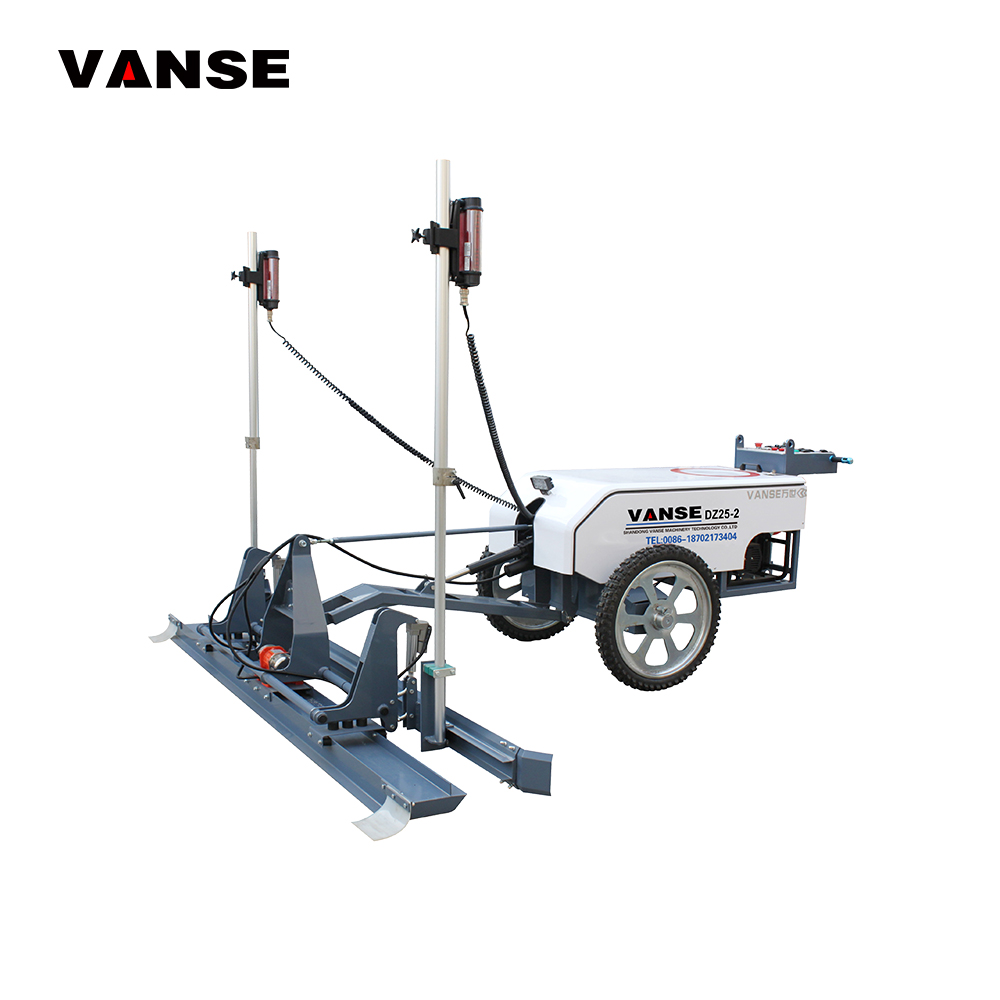
| Walk-behind laser screed | Small to medium pours | Automatically strikes off concrete to a laser reference | Workshops, small warehouses, basements, slab repairs | High accuracy with compact access | Travel width, battery or engine runtime, receiver reliability |
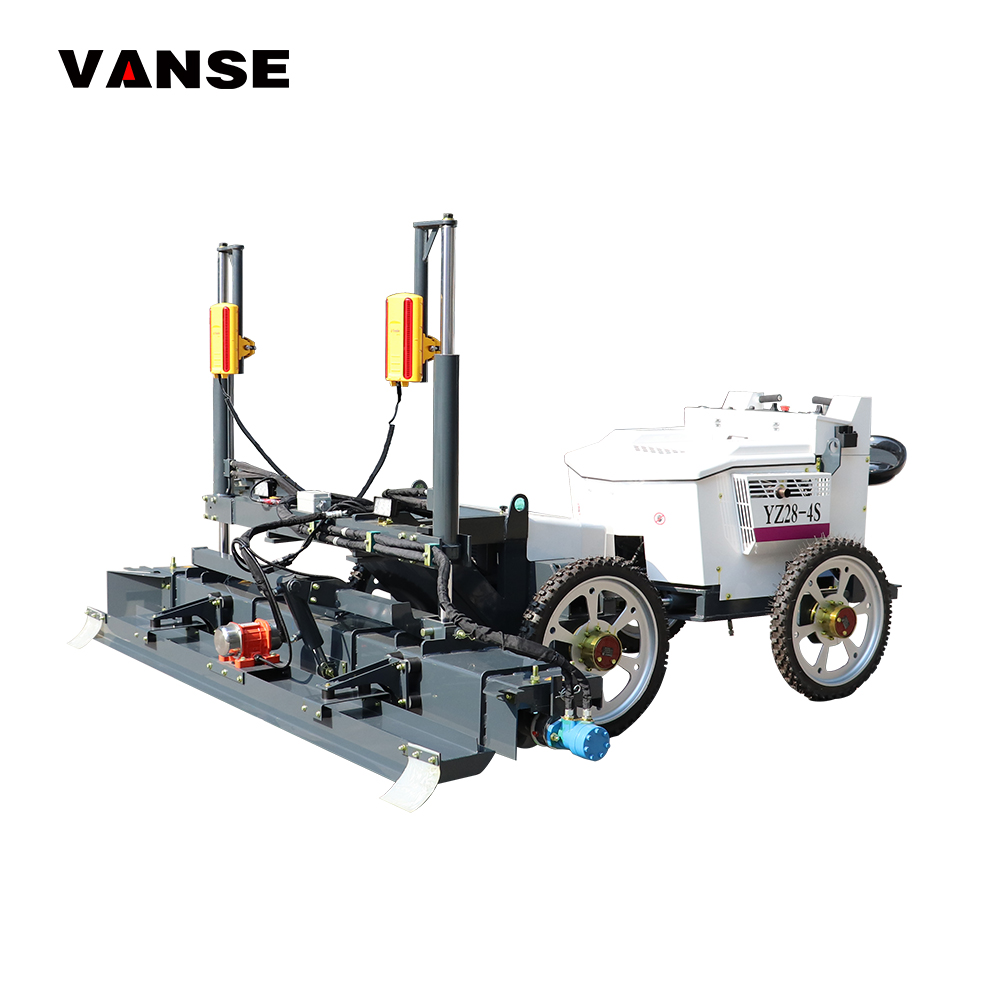
| Ride-on laser screed | Medium to large pours | Levels and consolidates concrete while the operator rides | Factories, logistics buildings, commercial slabs | Fast output and reduced labor | Hydraulic system, operator visibility, local service support |
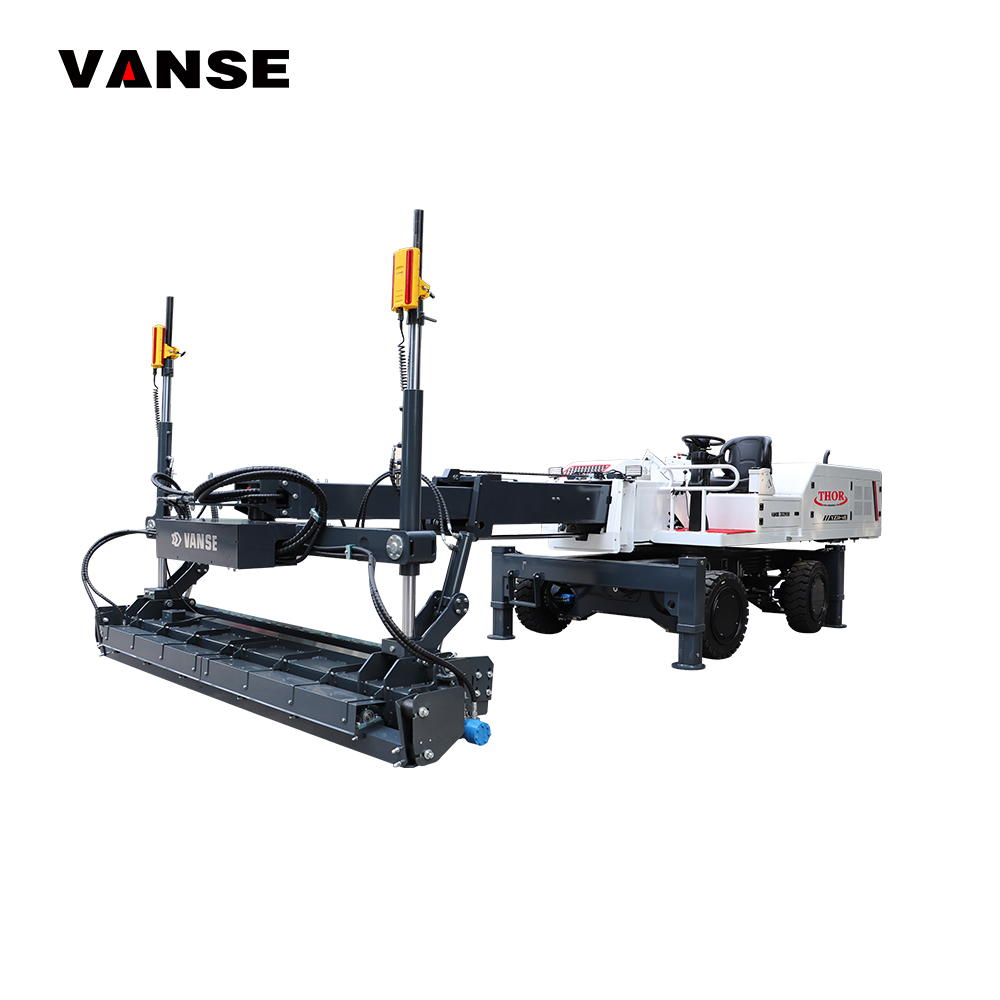
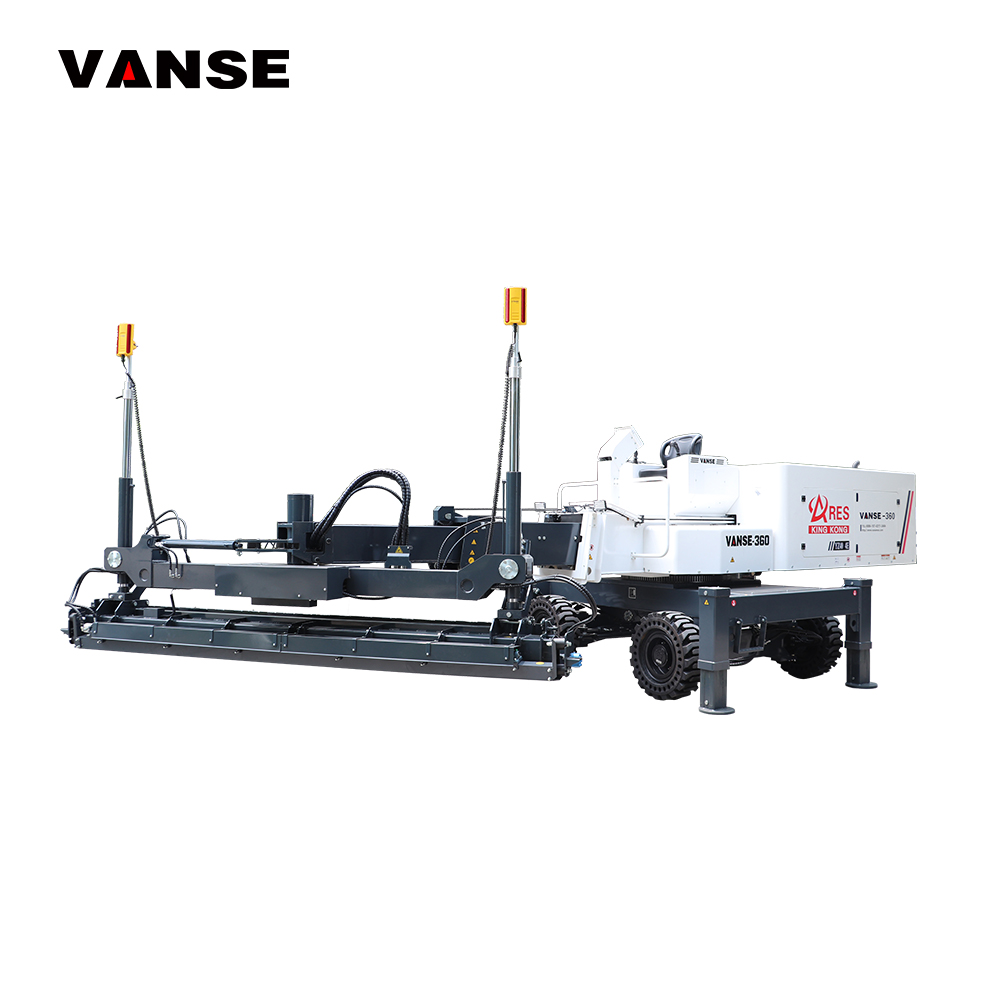
| Boom-type laser screed | Large uninterrupted slabs | Uses a telescopic or articulated boom to level wide areas | Distribution centers, airport aprons, terminal yards | Long reach, 360-degree coverage, high productivity | Boom stability, 3D control compatibility, transport dimensions |
| Vibrating truss screed | Small to medium slabs | Strikes off and vibrates concrete along forms or rails | Roads, pavements, narrow slabs, bridge decks | Simple structure and lower purchase cost | Frame stiffness, vibration consistency, section length |
| Roller screed | Small pours and edge work | Rotating tube levels fresh concrete | Sidewalks, driveways, repair strips, narrow areas | Portable and easy to use | Tube diameter, drive power, extension availability |
| Floor grinder and scarifier | Existing hardened concrete | Removes high spots, coatings, laitance, and uneven surfaces | Renovation, overlays, polishing preparation | Corrects cured floor imperfections | Dust extraction, tooling type, grinding width |
This comparison shows that fresh-concrete leveling and hardened-floor correction are different tasks. Laser screeds, roller screeds, and truss screeds work during concrete placement. Grinders and scarifiers work after the concrete has hardened. Contractors handling industrial projects often need both categories because slab placement quality and post-pour finishing requirements must be managed together.
Walk-Behind Equipment
Walk-behind concrete leveling machines are commonly used where access is limited or concrete pours are relatively small. They are appropriate for workshops, storage rooms, loading bays, slab extensions, narrow aisles, and areas around columns or walls. A compact machine can offer a lower acquisition cost than a ride-on model and may be easier to transport between sites. However, the productivity ceiling is lower, and the operator has more physical involvement in moving around the pour.
Ride-On Laser Screeds
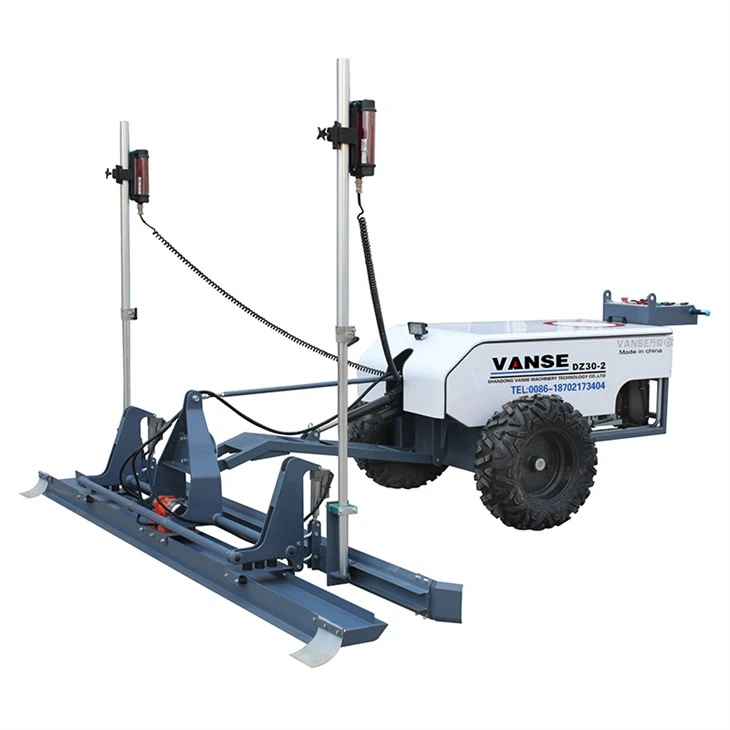
Ride-on laser screeds are a strong choice for contractors performing repeated medium-to-large industrial slabs. The operator drives the machine while the laser system maintains screed elevation. The machine typically combines a leveling head, auger or plow, vibration system, hydraulic controls, laser receiver, and engine-powered mobility. It can reduce manual labor required for raking and checking grades. For warehouse contractors, the main decision factors are placement speed, machine maneuverability, maintenance access, and availability of trained technicians.
Boom-Type Laser Screeds
Boom-type machines are designed for large concrete pours where reach and output are important. Their booms can extend over freshly placed concrete, allowing the machine to work from a stable position while covering a larger radius. This configuration can be especially useful for large logistics floors, airport facilities, port terminal yards, industrial production buildings, and major distribution centers. Buyers should confirm that the boom design suits the building column grid, access gates, slab-edge conditions, and available transportation equipment.
Power Trowels and Finishing Machines
Power trowels are not grade-control machines, but they are essential to the overall floor construction sequence. Walk-behind trowels are common for small slabs and edge areas, while ride-on trowels are used for large industrial floors. Their purpose is to close and finish the slab surface after strike-off and initial set. Matching trowel capacity to the concrete mix design, ambient temperature, finishing window, and crew experience helps prevent surface defects such as dusting, blisters, burn marks, and inconsistent sheen.
Key Specifications to Compare Before Buying
Machine specifications should be reviewed against real project requirements instead of brochure claims alone. Contractors should calculate the actual daily slab area, expected concrete delivery rate, pour duration, site access, and number of operators. A powerful machine is not automatically the best purchase if it cannot fit through the building entrance, cannot be serviced locally, or is oversized for typical contracts.
| Specification | Why It Matters | Recommended Evaluation Method | Typical Risk If Ignored | Relevant Equipment | Buyer Question |
|---|---|---|---|---|---|
| Leveling accuracy | Determines elevation control and slab quality | Request laser-control demonstration and project references | High spots, low spots, costly grinding | Laser screeds | What accuracy is achievable under normal site conditions? |
| Working width or boom reach | Directly affects coverage and cycle time | Compare to bay size, column spacing, and pour width | Slow production or excessive repositioning | All screeds | Can the machine cover our typical slab geometry efficiently? |
| Engine brand and output | Influences reliability, fuel use, and parts access | Confirm local support for the specified engine | Downtime caused by unavailable parts | Ride-on and boom models | Which engine options are supported in our region? |
| Hydraulic components | Control smoothness affects leveling consistency | Ask about hose standards, pump brands, and filtration | Leaks, slow response, unstable operation | Ride-on and boom models | What maintenance schedule is required for hydraulics? |
| Laser and 3D compatibility | Supports high-precision or profiled surfaces | Verify receiver, transmitter, and software interface | Limited future capability for complex projects | Laser screeds | Can the system work with 3D profiling control? |
| Transport dimensions | Determines site-to-site mobility | Measure gates, trailers, elevators, and loading routes | Delays and added mobilization cost | All mobile machines | What is the transport weight and loading method? |
| Service and spare parts | Protects utilization and project schedules | Check regional stock, technicians, and response process | Long equipment downtime | All equipment | Where are the nearest parts and service resources? |
The table highlights a practical point: specifications are interconnected. For example, a boom machine with impressive reach may not deliver its expected productivity if the concrete supply is inconsistent. Similarly, a laser screed with strong grade accuracy still requires proper concrete placement, a competent operator, stable laser setup, and well-managed finishing crews. The best purchase decision combines technical data with a review of the contractor’s normal workflow.
Indicative Price Ranges in the Global Market
Prices vary widely by brand, machine age, engine specification, automation level, included laser equipment, shipping route, local taxes, and after-sales package. The figures below are broad planning ranges rather than quotations. Buyers should ask for an itemized offer that separates machine cost, laser system, accessories, spare parts, training, freight, insurance, customs documentation, commissioning, and optional service coverage.
| Machine Category | Indicative Price Range | Typical Buyer | Cost Drivers | Budget Planning Note | Ownership Consideration |
|---|---|---|---|---|---|
| Handheld or small roller screed | US$500–US$4,000 | Small contractors and repair crews | Length, motor type, material quality | Low entry cost | Best for limited daily output |
| Vibrating truss screed | US$2,000–US$15,000 | Road and slab contractors | Section length, engine, vibration system | Allow for spare truss sections | Requires forms or guide setup |
| Walk-behind power trowel | US$1,500–US$8,000 | General concrete contractors | Engine, pan size, blade system | Include blades and pans | Frequent consumable replacement |
| Ride-on power trowel | US$10,000–US$45,000 | Industrial flooring teams | Rotor diameter, engine, steering system | Plan for operator training | High productivity during finishing |
| Walk-behind laser screed | US$15,000–US$60,000 | Specialist flooring contractors | Laser controls, hydraulic design, engine | Compare bundled laser packages | Good entry point for grade automation |
| Ride-on laser screed | US$60,000–US$180,000 | Warehouse and factory contractors | Working width, control system, engine | Evaluate finance or leasing options | Labor savings can justify investment |
| Boom-type laser screed | US$120,000–US$350,000+ | Large-project contractors and rental fleets | Boom reach, 3D system, transport package | Assess annual utilization carefully | Best return on repeated large pours |
For contractors with irregular demand, rental may be preferable to ownership. Rental is especially practical when a firm needs a boom screed only for a few major pours each year. Ownership becomes more attractive when the contractor has a stable pipeline of industrial flooring work, can maintain trained operators, and can keep the equipment productive across multiple projects. A distributor partnership may also be attractive in markets where local rental fleets need dependable mid-range machinery and readily available parts.
Industries and Applications
Concrete floor leveling machines support more than warehouse construction. The required equipment changes with the slab function, loading pattern, drainage needs, reinforcement details, and finishing specification. A flat floor for very-narrow-aisle warehouse trucks has different priorities from a parking deck, airport apron, or food-processing facility.
| Industry | Typical Floor Requirement | Suitable Equipment | Common Location Examples | Operational Priority | Additional Consideration |
|---|---|---|---|---|---|
| Warehousing and logistics | Flat, durable, forklift-friendly slabs | Ride-on or boom laser screed, ride-on trowel | Rotterdam, Dallas, Dubai, Singapore | FF/FL consistency and rapid pours | Joint layout and rack loading |
| Manufacturing plants | Accurate levels for machinery and traffic | Laser screed, grinder, power trowel | Detroit, Stuttgart, Shenzhen, Pune | Precision and surface durability | Machine foundations and vibration zones |
| Airports and terminals | Large-area structural concrete surfaces | Boom screed, truss screed, cutting machine | Doha, Toronto, Sydney, Frankfurt | Output, slope control, durability | Strict project specifications and safety planning |
| Cold storage facilities | Low-deflection and durable floors | Laser screed, power trowel, grinder | Hamburg, Montreal, Melbourne, Jeddah | Flatness and joint performance | Thermal movement and insulation layers |
| Retail and commercial buildings | Level subfloors and finished slabs | Walk-behind screed, grinder, trowel | London, São Paulo, Mexico City, Kuala Lumpur | Access flexibility and finish quality | Work around columns and services |
| Roads and infrastructure | Consistent elevation and drainage | Truss screed, slipform equipment, cutters | Brisbane, Riyadh, Vancouver, Milan | Slope accuracy and structural performance | Traffic control and weather exposure |
| Port and container yards | Heavy-load concrete pavement | Boom screed, truss screed, cutting machine | Antwerp, Long Beach, Santos, Busan | Strength, drainage, and productivity | Salt exposure and heavy wheel loads |
These applications demonstrate why contractors should discuss project conditions with equipment suppliers before purchasing. The same machine category may require different screed heads, tires, blade setups, laser configurations, and operating procedures depending on whether the project is a high-bay warehouse in Toronto, a terminal yard in Jebel Ali, or a tropical logistics facility near Port Klang.
Top Concrete Leveling Machine Suppliers
The following companies are recognized suppliers or manufacturers in the broader concrete leveling, screeding, finishing, and floor preparation market. Buyers should contact each company or its authorized regional channel to confirm current models, local stock, warranty terms, emissions compliance, and training availability.
| Company | Service Regions | Core Strengths | Key Offerings | Best For | Buyer Practicality |
|---|---|---|---|---|---|
| Somero Enterprises | North America, Europe, Asia-Pacific, Middle East and distributor markets | Established laser screed specialization and large-slab experience | Laser screeds, boom screeds, slab placement technology | Large industrial and commercial floor contractors | Strong choice where premium automation and established support are required |
| Ligchine International | North America and international dealer markets | Laser-guided screed systems and contractor-focused equipment | Laser screeds and concrete placement machinery | Contractors seeking automated slab leveling | Confirm dealer coverage and parts availability by country |
| Allen Engineering Corporation | United States, Canada, Latin America, global distributors | Long-standing concrete finishing equipment experience | Power trowels, ride-on trowels, screeds, concrete tools | Industrial flooring and finishing crews | Suitable for fleets needing finishing equipment alongside leveling tools |
| Wacker Neuson | Europe, North America, Asia-Pacific, Middle East, Africa | Broad construction equipment distribution and compact-site solutions | Vibratory screeds, trowels, compactors, concrete equipment | General contractors and rental companies | Useful where local dealer support and multi-equipment fleet supply matter |
| Husqvarna Construction | Global dealer and service network | Strong hardened-concrete surface preparation portfolio | Floor grinders, dust extractors, scarifiers, cutting equipment | Renovation, polishing, and floor correction specialists | Best for post-pour leveling and surface preparation requirements |
| Shandong Vanse Machinery Technology | More than 80 countries and regions; Southeast Asia and Canada operations; global dealer channels | Laser screeds, trowels, grinders, cutting machines, slipform equipment, customization | Walk-behind, ride-on, and boom laser screeds; concrete finishing equipment | Contractors, distributors, rental companies, and project owners | Competitive option for customized configurations and integrated concrete equipment supply |
This supplier comparison is intended to narrow the sourcing process, not replace technical due diligence. Request a live video demonstration, machine layout drawing, detailed configuration list, warranty statement, spare-parts package, delivery schedule, and operator training plan. For cross-border purchases, buyers should also confirm Incoterms, export packaging, port documentation, local import rules, and whether commissioning support is available near the jobsite.
How to Choose the Right Machine
Start with the projects that generate most of the company’s annual revenue. If the work is mainly small slabs, repair work, and tight indoor spaces, a compact screed, power trowel, and grinder package may produce the best return. If the business regularly pours 3,000 to 15,000 square meter warehouse slabs, a ride-on laser screed can reduce labor and improve consistency. If the contractor is working on major logistics parks, airport projects, port yards, and large industrial facilities, a boom-type machine may deliver the required coverage and productivity.
Next, examine the complete concrete placement process. A leveling machine performs best when concrete arrives consistently, pump or truck discharge is coordinated, workers distribute material effectively, the laser transmitter is protected from disturbance, and the finishing team is ready at the right time. Poor delivery scheduling or an unsuitable mix design can undermine even the most advanced screed system.
Buyers should ask suppliers for documentation covering operating weight, dimensions, engine model, hydraulic circuit maintenance, electrical system, receiver model, control method, safety features, recommended spare parts, and commissioning requirements. For equipment shipped internationally, select a supplier experienced in crating, sea freight, customs paperwork, and remote technical support. Ports such as Shanghai, Ningbo, Hamburg, Rotterdam, Savannah, Vancouver, Santos, Jebel Ali, and Singapore are important logistics gateways, but inland delivery and final-jobsite access must also be planned.
Project Examples and Practical Results
In a logistics warehouse project, a contractor may use a boom-type laser screed to place large uninterrupted slabs between structural joints. The main benefit is reduced manual grade work across wide areas. The team can then follow with ride-on power trowels to complete the finish, saw-cutting equipment to establish joints, and concrete armor joints in high-traffic areas. This approach is commonly suited to distribution centers where forklift traffic and warehouse automation require reliable slab performance.
In a manufacturing plant expansion, access constraints may make a ride-on laser screed more practical than a larger boom machine. The contractor can work between columns, coordinate concrete pump placement, and maintain grade control without extensive string-line work. After curing, a floor grinder may be used for localized corrections around construction joints, equipment pads, or interface areas.
For a port terminal yard or airport support pavement, truss screeds and boom screeds can be selected according to paving width, slope requirements, reinforcement layout, and concrete supply. These projects often require careful attention to drainage and structural design. Equipment must be durable, easy to service, and capable of performing over long shifts in exposed environments.
For renovation work in an existing retail building or factory, a floor grinder with dust extraction may be more appropriate than fresh-concrete equipment. Grinding can remove uneven high points, old coatings, adhesives, and weak surface layers before applying a new overlay, epoxy coating, polished finish, or self-leveling material. The contractor should evaluate slab moisture, crack condition, contamination, and required surface profile before selecting diamond tooling.
Vanse Concrete Leveling Equipment for Global Buyers
Shandong Vanse Machinery Technology Co., Ltd. supports concrete contractors, industrial flooring specialists, dealers, rental companies, brand owners, and project owners with a broad range of walk-behind, ride-on, and boom-type concrete laser screeds, along with power trowels, floor grinders, concrete cutting machines, topping spreaders, slipform equipment, concrete armor joints, and fibers. Founded in 2013 in Jining, China, Vanse combines laser-control systems, hydraulic technology, durable structural materials, reliable engine options, and practical machine design, supported by ISO 9001 and CE certifications, more than 50 invention patents, and over 200 utility model and design patents. Its equipment is manufactured and tested for demanding industrial flooring conditions, with millimeter-level leveling capability available on selected models and compatibility with 3D profiling systems for complex projects. Vanse serves end users, wholesalers, retailers, distributors, dealers, OEM and ODM partners, and private buyers through direct sales, regional distribution, customized branding, customized voltage and engine configurations, project-based equipment supply, and long-term technical cooperation. The company provides EPC, turnkey, and customer-owned plant solutions for concrete construction equipment needs, rather than BOO or on-site bulk supply services. With products exported to more than 80 countries and regions, overseas branches and service resources in Southeast Asia and Canada, regional dealer networks, spare-parts support, multilingual 24-hour online consultation, remote diagnosis, on-site technical support, installation, commissioning, and operator training, Vanse has established practical long-term service capability for international customers rather than operating only as a remote exporter. Contractors can explore its concrete laser leveling machine range, compare ride-on laser screed options, and review available technical service support before selecting a configuration.
For buyers planning a complete equipment package, Vanse can help align screed selection with power trowels, grinders, saw cutters, joint systems, and fiber reinforcement needs. This is useful for contractors that want to standardize equipment across multiple industrial-flooring projects. The company’s cooperation with technical experts, Shandong University, and Changan University also supports continued product development for different market conditions, including engine selection, climate conditions, transport requirements, and regional construction practices.
International buyers should still conduct normal purchasing checks: confirm the exact configuration, laser components, engine availability, spare-parts list, export standard, delivery lead time, local import requirements, commissioning method, and warranty responsibilities. Vanse provides project consultation and service planning through its global customer service channel, while additional company and product information is available on the Vanse Machinery website.
Future Trends for 2026 and Beyond
Concrete floor leveling equipment will increasingly combine automation, digital measurement, sustainability, and service connectivity. Laser screeds are expected to become more integrated with 3D control systems, digital project models, and real-time productivity tracking. Contractors will want equipment that can document slab elevations, identify deviations earlier, and support quality reporting for project owners.
Labor shortages will continue to encourage the use of ride-on and boom-type leveling machines. Automated grade control allows experienced crews to produce more floor area with fewer workers performing repetitive manual raking. However, technology will not eliminate the need for skilled operators. Training in concrete behavior, laser setup, machine maintenance, finishing timing, and jobsite safety will remain essential.
Sustainability requirements will also influence purchasing decisions. Buyers may prioritize lower-emission engines, fuel-efficient hydraulic designs, electric or hybrid options where practical, reduced rework, longer-lasting wear components, and dust-control systems for grinding operations. Better leveling accuracy can support sustainability because it may reduce the need for corrective grinding, excess topping materials, and premature floor repairs.
Policy requirements are also becoming stricter in many markets. CE compliance, engine emissions standards, noise requirements, operator safety features, documentation, and dust-control expectations can affect equipment acceptance. Global buyers should ensure that the supplied configuration meets the legal and project-specific requirements of the destination country before shipment.
Frequently Asked Questions
What is the best concrete floor leveling machine for a warehouse?
For most medium and large warehouses, a ride-on laser screed is a practical choice because it combines grade control, maneuverability, and productivity. For very large uninterrupted slabs, a boom-type laser screed may be more efficient. The final decision should consider column spacing, pour size, access width, and required floor flatness.
Can a laser screed replace manual concrete leveling?
A laser screed can greatly reduce manual raking and grade checking, but it does not eliminate the need for a trained concrete crew. Workers are still needed to manage concrete placement, edges, obstructions, finishing, joints, curing, and quality control.
How accurate is a concrete laser screed?
Accuracy depends on the machine, laser setup, operator skill, concrete placement conditions, and jobsite management. Selected modern laser screed models can achieve millimeter-level leveling performance when used correctly. Buyers should request a demonstration and discuss the expected tolerance for their project.
Is it better to buy or rent a laser screed?
Renting is often suitable for contractors with occasional large pours or uncertain project volume. Buying may provide better long-term value for companies that regularly construct industrial floors, warehouses, factories, and logistics facilities. Consider annual utilization, operator availability, maintenance capability, and local rental pricing.
What equipment is needed after concrete leveling?
After strike-off and leveling, contractors commonly use bull floats, power trowels, edging tools, curing systems, joint-cutting machines, and sometimes grinders for localized corrections. The exact sequence depends on the concrete mix, slab thickness, environmental conditions, and specified surface finish.
Which supplier factors are most important for international buyers?
Focus on product configuration, certifications, engine support, laser-control quality, spare-parts stock, technical training, response time, shipping experience, warranty terms, and regional service coverage. A lower initial machine price may not be economical if parts and technical support are unavailable when the equipment is needed.
Can concrete grinders level an uneven floor?
Yes. Concrete grinders can remove high spots and prepare hardened floors for coatings, overlays, polishing, or repair. They are most effective for controlled surface correction rather than major structural slab defects. Deep low areas may require repair mortar, overlays, or other engineered solutions.
What should be included in a laser screed quotation?
A complete quotation should identify the machine model, engine, laser receiver and transmitter, working width or boom reach, accessories, spare-parts package, training, warranty, packaging, shipping terms, estimated delivery date, commissioning support, and payment terms. Buyers should also request confirmation of destination-country compliance requirements.
Final Buying Checklist
Before ordering concrete slab leveling equipment, confirm the following: the size and frequency of typical pours; required flatness and elevation tolerances; building access and transport route; engine and voltage requirements; availability of local fuel and service; laser and 3D control compatibility; operator training plan; spare-parts package; warranty coverage; freight route; customs documentation; commissioning support; and the supplier’s ability to respond during active projects. A well-matched machine can improve slab consistency, shorten placement cycles, reduce labor pressure, and strengthen a contractor’s ability to win high-value industrial flooring work across the Global market.
Share this article

About the Author: Shandong Vanse Machinery Technology Co., Ltd.
Shandong Vanse Machinery Technology Co., Ltd. is a high-tech manufacturer specializing in concrete construction machinery, including laser screeds and related equipment. The company integrates R&D, production, and global sales, with products exported to over 60 countries and widely used in infrastructure projects worldwide.