Technical Knowledge
Determining the initial setting time of concrete and mastering the optimal timing for power trowel operation
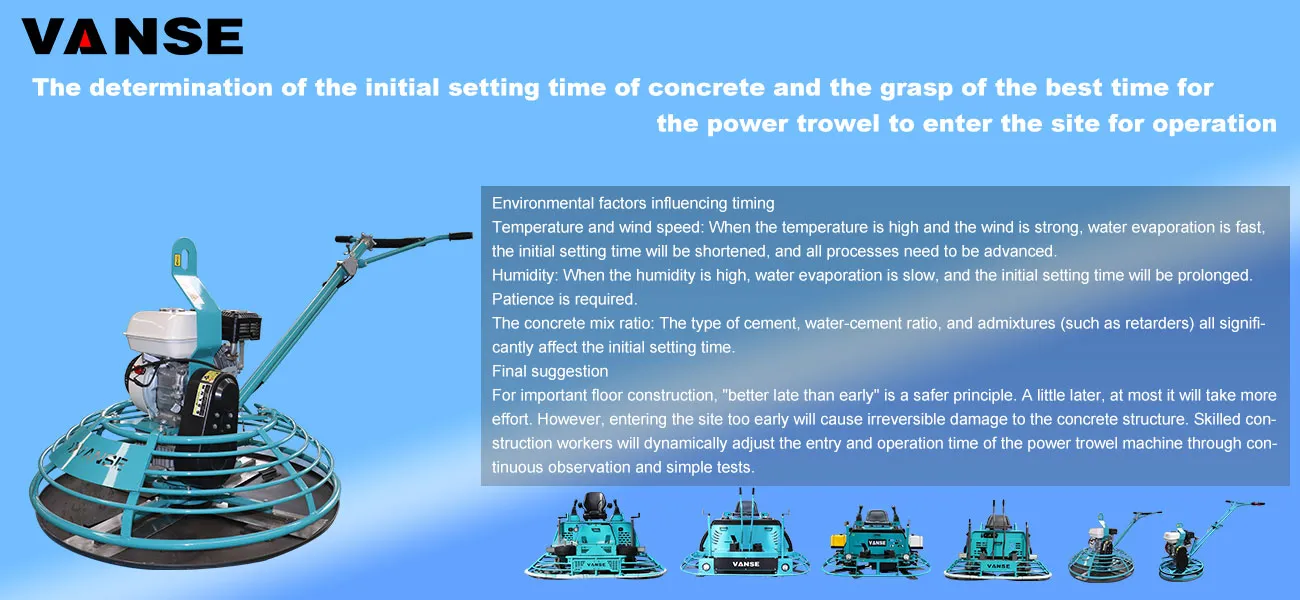
The determination of the initial setting time of concrete and the timing of the entry of the power trowel machine are the keys to ensuring that the floor is flat, solid and free of cracks.
Below, I will elaborate in detail in two parts: one is how to determine the initial setting time of concrete, and the other is how to grasp the best time for the power trowel to enter the site for operation.
Part One: Judgment of the Initial Setting Time of Concrete
Initial setting refers to a "critical point" at which concrete begins to transform from a plastic state to a solid state. At this point, the concrete loses its fluidity but has not yet acquired strength.
Ⅰ. Professional Definitions and Testing Methods (Precise Judgment)
According to the national standard "Standard Test Methods for Performance of Ordinary Concrete Mixtures", the initial setting time is scientifically determined by a penetration resistance meter.
Method: Sift out the mortar from the concrete mixture and load it into a specific container. From the start of pouring, test with a penetration resistance meter at regular intervals (such as 30 minutes).
The determination criterion: When the penetration resistance reaches 3.5 MPa, the corresponding time is the initial setting time.
Applicable scenarios: Laboratories or major project sites, where precise data is required to guide construction.
Ⅱ. On-site Practical Experience Judgment (Most Commonly Used)
In actual construction, workers rely on simple and effective empirical methods:
Acupressure method (the most classic) :
Operation: Press the concrete surface firmly with your fingers (or feet).
Judgment
Too early: If the fingers can easily press down very deep and cement slurry overflows, it indicates that it is far from beginning to set.
Close to initial setting: When pressed hard, only a clear fingerprint of 3-5 millimeters is left on the surface, but no cement slurry overflows. This is a very important signal.
Initial condensation: It requires a great deal of force to leave a very shallow mark.
Footprint method
Operation: Construction workers stand on the concrete surface and observe the sinking of the footprints.
Judgment
Too early: Deep footprints, obvious subsidence, and cement slurry being squeezed out around.
Close to initial setting: The depth of the footprints is relatively shallow (about 5mm), and the edges of the footprints are clear, with no obvious precipitation of slurry water. At this point, people can walk on it, but there is a slight sense of sinking.
Scratch method
Operation: Use a nail, screwdriver or power trowel to make a mark on the concrete surface.
JudgmentToo early: The scratch will close quickly and be filled with cement slurry.
Near initial setting: The scratch can maintain its shape, with the edge slightly raised and no longer closed. This is a strong indication that the first power trowel operation can begin.
Part Two: Grasping the Best Entry Time for the power trowel Machine for Operation
The entry and operation of the power trowel machine are not completed in one go, but are carried out in stages. Mistiming can lead to serious consequences:
Entering the site too early: The concrete is too soft, and the machine will sink and stick to the slurry, damaging the concrete structure and causing the surface to peel and the strength to decrease.
Entering the site too late: The concrete is already too hard, and the power trowel machine cannot effectively lift the slurry and smooth it out, which is time-consuming and laborious, and is prone to surface cracking.
The best time and process for work
The operation of a power trowel machine is usually divided into two key stages:
Phase One: Initial smoothing (lifting the slurry and finishing the surface)
Timing: The concrete is at or slightly above its initial setting point.
Specific status
When a person stands on it, the depth of the footprints is about 3 to 5 millimeters.
By using the scratch method, the scratch can remain clear.
When the power trowel blade is placed on it, it will not sink obviously.
Assignment purpose:
Press the aggregates (stones) slightly into the lower layer.
Lift the surface cement slurry up.
Carry out large-scale preliminary leveling.
Key points of operation
The operation is carried out using a disc (rubbing disc).
The machine should not run too fast. It should move smoothly and slowly.
Pay attention to overlapping areas that have been worked on to ensure no omissions.
Phase Two: Fine grinding and polishing
Timing: After the initial smoothing, when the moisture and luster on the concrete surface disappear and almost no footprints are left when stepped on (approximately 1-3 hours after the initial setting, depending on the environment).
Specific status
The color of the concrete surface begins to darken and become darker.
There is a rough feeling when touched, but no hard or brittle sensation.
At this point, the concrete has already possessed an initial load-bearing capacity.
Assignment purpose:
Eliminate the tiny scratches left by the disc operation.
Further compact and smooth the surface to achieve the required flatness and smoothness.
Seal the surface capillary pores to enhance wear resistance and impermeability.
Key points of operation
Remove the disc and use a blade (spatula) to carry out the operation.
The rotational speed and moving speed of the machine can be appropriately increased.
Cross-operation, multiple times of polishing, each time more meticulous than the previous one.
Summary and key points
| Stage | Description of concrete state | Test method | Operation of the power trowel machine | Purpose |
| Waiting period | Soft, deep footprints, with bleeding | Finger pressure/footprint method | No entry allowed | Let the concrete settle naturally and bleed water to evaporate |
| Initial freezing point | The footprints are 3 to 5mm deep, the scratches are clear, and there is no bleeding | Finger pressure/scratch method | Prepare to enter | Determine the timing of the first operation |
| First assignment | Reach or slightly exceed the initial freezing point | The same as above | Install the disc and smooth it out at low speed | Slurry extraction and initial leveling |
| Fine grinding operation | The surface water luster disappears, and the footprints are extremely shallow or non-existent | Observe the color and footprints | Replace the blade and polish at medium to high speed | Compact, smooth surface, and seal |
Environmental factors influencing timing
Temperature and wind speed: When the temperature is high and the wind is strong, water evaporation is fast, the initial setting time will be shortened, and all processes need to be advanced.
Humidity: When the humidity is high, water evaporation is slow, and the initial setting time will be prolonged. Patience is required.
The concrete mix ratio: The type of cement, water-cement ratio, and admixtures (such as retarders) all significantly affect the initial setting time.
Final suggestion
For important floor construction, "better late than early" is a safer principle. A little later, at most it will take more effort. However, entering the site too early will cause irreversible damage to the concrete structure. Skilled construction workers will dynamically adjust the entry and operation time of the power trowel machine through continuous observation and simple tests.
Note: The parameters provided in this document are for reference only and are not mandatory. Due to differences in technical characteristics between different brands and models of laser levelers, please consult the manufacturer for a suitable solution before actual operation. This reference document assumes no responsibility for any issues arising from failure to follow the manufacturer's instructions.
Thanks to All the Friends Who Support and Trust Shandong Vanse Machinery Technology Co., Ltd.
If you want to know more about Shandong Vanse Machinery Technology Co., Ltd. or have any questions, please feel free to contact us:
Our Factory
Shandong Vanse Machinery Technology Co., Ltd.








Share this article

About the Author: Shandong Vanse Machinery Technology Co., Ltd.
Shandong Vanse Machinery Technology Co., Ltd. is a high-tech manufacturer specializing in concrete construction machinery, including laser screeds and related equipment. The company integrates R&D, production, and global sales, with products exported to over 60 countries and widely used in infrastructure projects worldwide.
Previous Post
Next Post
Related Articles
You Might Also Like
There are many things to pay attention to when adding oil to a laser leveling machine. Don’t operate it recklessly if you don’t understand it!
Any kind of mechanical equipment needs to add an appropriate amount of oil during normal use to ensure the safe operation and service life of the machinery. This is no exception for the laser leveling machine, a new type of concrete pavement leveling equipment. Although the addition of oil to the laser leveling machine seems simple, it is actually quite a science. In order to avoid unnecessary trouble, our company has specially sorted out several common misunderstandings when adding oil to the laser leveling machine. I hope everyone will avoid them in time. ▼ Do not use the lubricating oil if it turns black: the lubricating oil turns black, which means that the lubricating oil has deteriorated: modern lubricating oils have added appropriate amounts of various additives to improve their lubrication properties. It is normal for the lubricating oil of internal combustion machinery with detergent dispersant to turn black shortly after use. It cannot be easily replaced because it is considered that the "oil has deteriorated"; lubricating oil with additives often makes the bearing surface black during use, which is also a normal phenomenon. Therefore, when we determine whether the lubricating oil has deteriorated, we cannot judge it by sight alone, but conduct a comprehensive analysis. When conditions permit, the oil should be tested and tested to ensure that the oil is changed according to the quality; ▼ The oil grade specified in the laser leveling machine manual is for general working conditions. In the practice of machine oil change and maintenance, the actual use conditions must also be considered. If the actual use conditions are more stringent than the specified use conditions, a higher grade oil should be selected (through testing) or the oil change cycle should be appropriately shortened; ▼ It is better to have more oil than less: We know that a small amount of laser leveling oil will cause insufficient oil supply and poor lubrication, leading to mechanical accidents. Therefore, when refueling, you should not "prefer to add more" for fear of insufficient oil. In fact, too much oil will not only increase the power consumption of the crankshaft due to increased rotational resistance, but also the oil is prone to bubbles, emulsification and leakage, resulting in poor lubrication; ▼ Using high-viscosity oil can solve the problems of engine powerlessness and oil leakage: Engine powerlessness, oil consumption and oil leakage are external characteristics of the deterioration of the engine's technical condition. There is insufficient basis for "using high-viscosity oil to solve the above problems". On the contrary, it will increase the starting resistance of the laser leveling machine engine, deteriorate the lubrication performance, and aggravate the wear of the parts; ▼ Oil with high viscosity is more beneficial to the engine than oil with low viscosity: If the viscosity grade of lubricating oil is too high, it will cause poor pumping performance of the oil pump, reduce flow, and deteriorate its lubricity, washing and heat dissipation, which will easily cause semi-dry friction of the laser leveling machine parts, causing failures such as burning and shaft sticking. The above are several common wrong behaviors when adding oil to the laser leveling machine. In order to ensure the normal use of the equipment and avoid unnecessary maintenance costs, it is also hoped that the relevant maintenance managers must strictly follow the product manual to reasonably add oil and actively avoid common misunderstandings.Characteristics of different types of concrete laser leveling machines
Concrete laser leveling machines mainly include two-wheeled hand-held, four-wheeled ride-on, and large telescopic arm types. The following are the characteristics of different types of concrete laser leveling machines: Flexible and compact: The weight is generally around 300kg, and the two wheels move independently. Through the electric drive of the two-wheel walking system, the wheels can move independently, and the movement is convenient and flexible. It is suitable for cast-in-place floors, underground garages and other places with relatively complex terrain or working environment. Simple operation: It adopts hand-push operation and intelligent handle control, and one person can construct. Good leveling effect: Equipped with an integrated aviation magnesium alloy leveling head, it integrates multiple processes such as leveling, leveling, and vibrating, and is completed by the machine at one time. The high-frequency vibrator with ultra-high vibration per minute can make the concrete floor dense and avoid cracking of the ground. Precise elevation control: The laser transmitter is arranged independently, and the laser measurement and control system automatically controls the elevation, which can ensure the flatness of the ground and reduce construction joints and later maintenance costs. High construction efficiency: Usually ride-on operation, which is more labor-saving than two-wheel, and built-in hydraulic drive to avoid slipping during construction. The construction area can reach more than 500 square meters per hour, and the daily workload can reach more than 4,000 square meters. Wide application range: The weight is generally around 900 kilograms, which can be used for large-area floor construction such as large warehouses and multi-story buildings, and is also suitable for a variety of indoor and outdoor floor scenes, such as industrial plants, airport runways, etc. High degree of automation: Some models have an intelligent handle operation mode, which is flexible to control and can also realize a fully automatic construction mode. Through the integration of the laser system, remote control system and hydraulic system, the elevation can be automatically adjusted. Save labor: With a auger, the excess concrete can be turned to one side, without the need for manual paving, reducing manpower investment. Flexible steering and operation: Electric joystick is used to control steering, driving, telescopic arm and rotation. It has multiple steering modes such as 4-wheel steering, 2-wheel steering and crab steering, and a 360-degree rotating platform, which is flexible and efficient to operate. Large leveling range: The telescopic arm length can reach 6 meters, the leveling working width is 3-4 meters, and 18-24 square meters of concrete can be leveled per minute, which can meet the needs of large-area, high-standard floor construction. High leveling accuracy: Equipped with advanced laser control system and full hydraulic control system, it can control the height of the scraper and cloth rotation, so that the concrete construction ground is more accurate and compact, which can ensure that various high-standard engineering construction standards are met. Click the below to jump immediately!!! ARMOUR JOINT CONCRETE LEVELING MACHINE LIGHT TOWER POWER TROWEL SLIPFORM MACHINE STEEL FIBER TOPPING SPREADER TRACKED MINI DUMPERIntroduction to the construction process and precautions of laser leveling machine
Regarding the construction process and precautions of the laser leveling machine, I believe this is also a question that operators are more concerned about. We all know that if we want to use the laser leveling machine better, we need to understand its construction process and precautions. In order to help everyone use the equipment better, we will introduce this aspect to you in the next article. I hope you will be interested in it. Check whether the outer template has been fully supported, confirm that the laser leveling construction equipment is intact, find the specified elevation, and install the laser transmitter; check whether the slump of the concrete on site meets the requirements of laser leveling. When using the precision laser leveling machine, the slump of the concrete is required to be 160±10mm; and confirm that the concrete can be supplied continuously. Be careful to avoid obstacles when installing the laser transmitter; the speed of the laser leveling machine should not be too fast during leveling; the concrete should be initially leveled before leveling, and the concrete after initial leveling should be higher than the established elevation. 1. Before starting work, one operator shall check the machine equipment, set up the transmitter with the operator, and install the handheld receiver; adjust the scraper of the floor machine in a static state, and there shall be no error at two points; operate the laser leveling machine, observe whether the machine is working properly, check whether the laser receiver is in a horizontal position, and supervise whether the material replenisher is scraping and filling in time; at the end of the construction on the same day, clean the machine after the machine cools down, and check whether the functions of the machine are normal; check the power of the transmitter. 2. One operator shall assist the operator in installing and debugging the machine, and set up the transmitter with the main operator and install the handheld receiver. Check whether the transmitter is placed safely; measure the height of the concrete after preliminary paving; measure the height of the concrete after leveling. Focus: the edge of the concrete and the concrete surface scraped by hand; at the end of the construction on the same day, clean the machine after the laser leveling machine cools down, and check the power of the handheld receiver. 3. When the laser leveling machine is not operated, two material replenishers shall perform preliminary leveling of the concrete with the paving worker. When following the machine, they shall obey the instructions of the main operator and scrape and fill the machine scraper position. 4. 2-4 pavers need to follow the command of the operator and perform preliminary leveling of the concrete. The above are the precautions and construction processes for the use of laser leveling machines introduced by the manufacturer. I hope it can provide you with some effective reference opinions. If you have any questions or don't understand the above issues, you can call us for consultation. We will patiently answer your questions.