Technical Knowledge
How to evaluate and improve the effect of concrete pavement leveling through quality inspection?
Evaluating and improving the smoothing effect of concrete pavement through quality inspection is a systematic work involving multiple links. The following will elaborate on how to evaluate and improve the smoothing effect of concrete pavement through quality inspection.
•◆•1•◆◆
Assessment
1. Smoothness test:
Smoothness is an important indicator for evaluating the quality of concrete pavement. By using a flatness detector to continuously measure the surface of the concrete pavement, record the unevenness at different locations and generate a pavement flatness index. According to the distribution and value range of the flatness index, the quality of road surface smoothness can be judged. The smaller the value, the better the smoothness.
2. Compaction degree test:
Compaction degree is an important parameter to test the strength of concrete pavement. Detecting the compaction of the road surface by coring method or radar wave method can reflect the density of the concrete road surface. The higher the degree of compaction, the denser and more durable the pavement material is.
3. Anti-skid performance test:
Anti-skid performance is an important indicator of the safety of concrete pavement. Use a pendulum friction meter to measure the friction coefficient of the road surface to understand the anti-skid ability of the road surface. The larger the friction coefficient, the better the anti-skid performance.
4. Damage detection:
Regularly conduct damage surveys on concrete pavement, record various cracks, pits, looseness and other damage conditions, analyze the causes of damage, and provide basis for pavement repair and maintenance.
•◆•2•◆◆ Improvement
1. Material control:
Strengthen the quality testing of raw materials to ensure that the quality of cement, aggregate and other materials meets the requirements. The use of high-quality raw materials can improve the strength and durability of concrete, thereby improving the smoothness of the road surface.
2. Mix ratio design:
Optimize concrete mix ratio design and select appropriate water-cement ratio, sand rate and aggregate gradation. Determine the best mix ratio through experiments to improve the working performance and compactness of the concrete.
3. Construction process optimization:
Strengthen quality control during the construction process to ensure adequate concrete mixing, transportation, paving and vibration. The use of advanced construction techniques and technologies, such as slip form paving, three-roller unit paving, etc., can improve the smoothness and compaction of the road surface.
4. Health care and maintenance:
Strengthen the early health care and maintenance of concrete pavement, take appropriate moisturizing and health care measures, control traffic load, and repair damaged parts in a timely manner. Health care and maintenance can reduce the occurrence of quality problems such as cracks and potholes, and improve the service life and smoothness of the road surface.
5. Quality inspection standardization:
Develop detailed quality inspection standards and operating procedures to ensure the accuracy and reliability of inspection work. Discover existing problems and deficiencies through statistical analysis of quality inspection data, and continuously improve construction technology and quality management systems.
6. Training and awareness improvement:
Strengthen training and technical exchanges for construction personnel to improve their understanding of the importance of quality inspection and operational skills. Through training and awareness raising, construction personnel's sense of responsibility and quality awareness can be enhanced to promote continuous quality improvement.
7. Introduce advanced technology:
Pay attention to and introduce advanced construction technology and quality inspection instruments to improve construction efficiency and quality inspection levels. For example, a high-precision GPS positioning system is used for measurement and setting out, and an automated flatness detector is used for continuous measurement. The application of these advanced technologies can improve the accuracy of data collection and processing efficiency, providing strong support for quality assessment and improvement.
In summary, evaluating and improving the effectiveness of concrete pavement leveling through quality testing is a comprehensive process. In actual work, multiple methods should be adopted for evaluation and improvement based on specific conditions to ensure that the flatness and durability of the concrete pavement meet the expected requirements. At the same time, we will strengthen the construction of quality management systems and technological innovation to continuously improve the quality level of concrete pavement construction.


Thanks to All the Friends Who Support and Trust Shandong Vanse Machinery Technology Co., Ltd.
If you want to know more about Shandong Vanse Machinery Technology Co., Ltd. or have any questions, please feel free to contact us:
Our Factory
Shandong Vanse Machinery Technology Co., Ltd.








Share this article

About the Author: Shandong Vanse Machinery Technology Co., Ltd.
Shandong Vanse Machinery Technology Co., Ltd. is a high-tech manufacturer specializing in concrete construction machinery, including laser screeds and related equipment. The company integrates R&D, production, and global sales, with products exported to over 60 countries and widely used in infrastructure projects worldwide.
Previous Post
Next Post
Related Articles
You Might Also Like
How to ensure flatness during the construction of concrete laser leveling machine?
Concrete laser leveling machine is an efficient equipment used to ensure the flatness of the ground in construction. It controls the flatness and precision of the ground by using laser technology, thereby improving construction efficiency and ground quality. However, ensuring the flatness during the construction process does not only rely on the equipment itself, but also requires a series of fine management and operation. The following is a detailed analysis of how to ensure flatness during the construction of the concrete laser leveling machine. Introduction In modern construction, the flatness of the concrete floor has an important impact on subsequent construction and use. As an advanced construction equipment, the construction effect of the concrete laser leveling machine directly affects the flatness and overall quality of the ground. 1. Preparation before construction The first step to ensure flatness is to do a good job of preparation before construction: Equipment inspection: Make sure that all parts of the laser leveling machine are in good condition, especially the laser transmitter and receiver. Construction plan: Develop a detailed construction plan according to the construction requirements, including the mix ratio of concrete, pouring thickness, etc. Construction personnel training: Ensure that the operator is familiar with the equipment operation and construction process, and understands how to control the flatness. 2. Real-time monitoring during construction Real-time monitoring is the key link to ensure flatness: Laser system monitoring: Ensure that the laser system works stably and adjust the laser plane in time to adapt to different construction conditions. Ground flatness detection: Use professional equipment to regularly detect the flatness of the concrete surface to ensure that it meets the construction standards. 3. Concrete pouring quality control The quality of concrete directly affects the final flatness: Concrete proportion: Strictly carry out concrete proportioning in accordance with design requirements to ensure the fluidity and plasticity of concrete. Pouring speed: Control the pouring speed to avoid affecting the uniformity of concrete due to pouring too fast or too slow. 4. Laser leveling machine operation skills Operating a laser leveling machine requires certain skills and experience: Equipment adjustment: Adjust the height and speed of the leveling machine according to the actual situation of the concrete. Operation continuity: Maintain the continuity of operation to avoid inconsistent flatness due to interruptions in operation. 5. Control of the construction environment The construction environment also affects the flatness of concrete: Temperature and humidity: Control the temperature and humidity of the construction site to avoid the coagulation and hardening of concrete due to environmental changes. Construction sequence: Arrange the construction sequence reasonably to avoid the impact of cross-construction on the leveled ground. 6. Maintenance management after construction Maintenance after construction is also important to ensure flatness: Timely covering: Cover the concrete surface in time after construction to prevent moisture from evaporating too quickly. Curing time: Ensure sufficient curing time to fully harden the concrete. 7. Recording and analysis of construction data Recording and analyzing construction data helps to continuously improve construction quality: Data recording: Record various parameters during the construction process, such as concrete temperature, pouring speed, etc. Data analysis: Analyze the data, find out the factors affecting flatness, and continuously optimize the construction plan. 8. Acceptance standards for construction quality Establish clear acceptance standards for construction quality: Acceptance process: Establish a standardized acceptance process to ensure that each construction link meets quality requirements. Acceptance tools: Use professional tools for flatness acceptance, such as F-Number measuring instruments, etc. 9. Problem solving during construction When problems are encountered during construction, they need to be solved in a timely manner: Problem identification: Quickly identify problems that occur during construction, such as concrete segregation, surface bubbles, etc. Problem handling: According to the nature of the problem, take appropriate measures to deal with it, such as re-leveling, repairing, etc. 10. Conclusion Ensuring the flatness of the concrete laser leveling machine during construction requires comprehensive management from multiple aspects such as pre-construction preparation, monitoring during construction, concrete quality control, equipment operation skills, construction environment control, maintenance management, data recording and analysis, quality acceptance standards and problem solving. Through the implementation of these measures, the flatness of the concrete floor can be effectively improved to meet the construction quality and use requirements.The proper maintenance schedule for the hydraulic systems of the concrete laser leveling machine
The hydraulic system of the concrete laser leveling is its "heart" and "muscle", responsible for driving all key actions such as the lifting, vibration, movement of the leveling head and the extension and retraction of the boom. A scientific and rigorous maintenance plan for the hydraulic system is the core to ensuring the reliability, accuracy and long service life of the equipment. The following is a well-structured and highly operational correct maintenance plan for the hydraulic system of a concrete laser leveling: More than 70% of the faults in the hydraulic system are caused by oil contamination (particles, water, air) and excessively high oil temperature. Therefore, the maintenance plan should revolve around "keeping the oil clean and cool". Oil level check: When the equipment is parked on a level ground and all oil cylinders are retracted, check the oil level gauge of the hydraulic oil tank to ensure that the oil level is between the upper and lower limits marked. Low oil level can cause the pump to run dry, the system to overheat and components to be damaged. Visual inspection Leakage inspection: Quickly inspect the oil pump, valve block, cylinder piston rod, all pipe joints and hose surfaces for visible oil leakage or dripping. Pipeline inspection: Check for any abnormal bulges, wear, cracks or friction with adjacent components in the hydraulic hose. Start preheating: In cold weather, after starting the engine, it should be run at medium to low speed without load for 3 to 5 minutes to allow the hydraulic oil to circulate and heat up, improve fluidity, and prevent dry grinding of components. Cleaning and inspection: After the operation, check whether the oil filling port of the hydraulic oil tank, the vent valve (breather), and the surface of the hydraulic components are contaminated by cement mortar. Clean them in time to prevent contaminants from entering the system. Temperature perception: Before shutting down, use the back of your hand to sense whether the temperature of the fuel tank and the main valve blocks is abnormally hot to the touch (usually not exceeding 80℃). Continuous high temperatures will accelerate the oxidation and deterioration of the oil. This is the main body of the maintenance plan. It must be carried out strictly in accordance with the intervals in the manufacturer's manual and detailed records must be made. Maintain the project Period/Frequency Specific operations and standards Hydraulic oil replacement First replacement: 200 to 500 hours after a new machine or major overhaul. 1. Change the oil while it's still hot: Perform this when the equipment has just been shut down and the oil temperature is still hot. Regular replacement: Every 1,000 to 2,000 working hours or once a year (whichever comes first). 2. Thorough empting: Drain the old oil from the fuel tank and oil lines. If necessary, flush with fresh oil. The cycle needs to be shortened under harsh working conditions. 3. Clean the fuel tank: Use a non-fibrous cloth to clean the inner wall of the fuel tank and the magnetic drain plug. 4. Strict oiling: Add new hydraulic oil of the specified grade and viscosity level to the prescribed oil level through a high-precision filter. Replacement of the oil suction/return oil filter element Every 500 hours or simultaneously with each oil change. When replacing, pay attention to cleaning the area around the filter element seat to prevent dirt from falling in. 2. Never reuse the filter element after cleaning it. High-pressure pipeline filter (if any) Alarm according to the clogging indicator on the filter, or as stipulated in the manual (usually synchronized with the oil change cycle). Timely replacement and checking the type of residue on the filter element can help determine the internal wear condition of the system (for example, if there is a lot of metal shavings, there may be abnormal wear of components). Hydraulic oil quality testing Every 6 months to 1 year (applicable to high-value or high-intensity usage equipment). Samples are sent to a professional laboratory for oil spectral analysis to detect water content, contamination degree, acid value and metal wear particles. This is the most effective means of predictive maintenance, which can detect potential faults in advance. System tightening and inspection Monthly or every 250 hours. 1. Inspect and tighten all pipe joints, flanges and valve block installation bolts (in accordance with torque requirements). 2. Check all the piston rods of the oil cylinders for any scratches, rust or bends. Minor scratches should be repaired immediately with an oilstone. 3. Check the pre-charge pressure of the accumulator (if any). Cooling system cleaning Weekly or depending on the cleanliness of the environment. Clean the fins of the hydraulic oil radiator to ensure there is no blockage from dust, willow catkins, cement powder, etc., to guarantee the heat dissipation efficiency. This is the key to controlling the oil temperature. Overloading is strictly prohibited: Avoid the leveling machine operating at its maximum load for a long time, as this will cause excessive system pressure and a sharp increase in oil temperature. Avoid shock: Operate the control handle smoothly to reduce the shock load on the hydraulic system. Cylinder protection: During operation, pay attention to protecting the piston rod to avoid direct impact or scratches from concrete or crushed stones. Proper parking: When parked for a long time, all cylinders (especially the exposed piston rods) should be retracted to reduce corrosion and deformation. High-temperature environment: Enhance the cleaning of the radiator. Consider using hydraulic oil with higher viscosity (as recommended in the manual), and add auxiliary cooling if necessary. High humidity/water environment: Strengthen the inspection of oil level and water content in oil products, and keep the vent valve of the oil tank dry. The replacement cycle of the filter element can be shortened. In extremely cold environments: Use low pour point hydraulic oil. The equipment should be parked in a warm warehouse and fully preheated before startup. Park the equipment in a dry room and completely retract all the oil cylinders. Fill the fuel tank to the brim to reduce the formation of condensation on the inner walls. Start the engine every month and let the hydraulic system run idle for 10 to 15 minutes to lubricate all components and remove moisture. Slow and weak operation: It may be due to low oil level, pump wear, or malfunction of the main relief valve. Abnormal system noise (pump beeping) : It may be due to clogged oil suction filter element, excessively high oil viscosity, pump suction or cavitation. Abnormal increase in oil temperature: cooler blockage, severe internal leakage, improper oil level, and the set value of the relief valve being too high. Cylinder crawling or shaking: Air inside the system, leakage from the cylinder, or oil contamination causing the valve core to get stuck. Stop the machine immediately for inspection: If any of the above abnormalities occur, stop the machine immediately and start checking from the simplest aspects such as oil level, filter element, and leakage. Eliminate operating while faulty: Hydraulic system failures can deteriorate in a chain reaction, and minor issues can quickly turn into major overhauls. Professional maintenance: Complex operations such as pressure adjustment and disassembly of pumps and valves should be carried out by professional maintenance personnel. Before disassembling any hydraulic components, the system pressure must be completely released. Strictly adhere to the cycle: execute by the hour or calendar, and establish maintenance logs. Oil product management is at the core: only specified oil products are used, strictly filtered, and regularly replaced and tested. Cleanliness is the top priority: keep the oil clean, the refueling process clean, and the radiator clean. Pay attention to detailed inspection: Daily visual and tactile checks can detect most early problems. Equal emphasis on operation and maintenance: Standardized operation is the fundamental way to prevent abnormal stress in the hydraulic system. Ultimately, please be sure to take the manufacturer's regulations in your equipment's "User and Maintenance Manual" as the primary basis, and formulate and implement your maintenance plan in combination with your specific working conditions. Note: The parameters provided in this document are for reference only and are not mandatory. Due to differences in technical characteristics between different brands and models of laser levelers, please consult the manufacturer for a suitable solution before actual operation. This reference document assumes no responsibility for any issues arising from failure to follow the manufacturer's instructions.Cost-benefit analysis of using power trowels VS manual polishing for commercial concrete floors
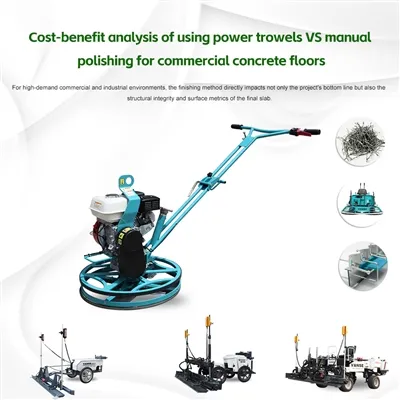
Here is a comprehensive cost-benefit analysis comparing the use of power trowels (both ride-on and walk-behind) against manual finishing and polishing for commercial concrete floors. For high-demand commercial and industrial environments, the finishing method directly impacts not only the project's bottom line but also the structural integrity and surface metrics of the final slab. Manual Polishing: * Costs: Requires minimal upfront capital. Hand trowels, floats, and basic low-speed floor buffers represent a negligible equipment investment. Benefits/Drawbacks: The savings in equipment are rapidly eclipsed by labor costs (OpEx). Manual finishing requires a large crew of skilled finishers to cover a commercial-sized pour before the concrete sets. In regions like North America, Europe, or Australia where skilled labor rates are at a premium, this operational cost scales linearly and aggressively with the square footage of the project. Power Trowels: Costs: Involves a moderate to high initial capital investment, particularly for advanced, multi-blade ride-on trowels powered by reliable, heavy-duty engines. Benefits/Drawbacks: The primary benefit is a drastic reduction in OpEx. A single operator on a ride-on power trowel can finish thousands of square meters in a fraction of the time it takes a manual crew. The labor savings generated on just a few large-scale warehouse or logistics center projects typically deliver a full return on investment (ROI) for the machinery. Manual Polishing: * Human application is inherently inconsistent. Changes in operator fatigue, pressure, and technique make it virtually impossible to achieve the high FF/FL numbers required for modern commercial applications, such as high-bay warehouses where even minor undulations can disrupt forklift operations. Power Trowels: * Mechanized troweling provides uniform pressure and consistent blade pitch across the entire slab. When paired with concrete laser leveling leveling beforehand, power trowels ensure the slab maintains strict FF (Flatness) and FL (Levelness) tolerances. This precision is increasingly demanded by global e-commerce and logistics clients who require perfectly flat floors for automated sorting systems and racking. Manual pressure is insufficient to deeply compress the concrete surface. The resulting finish may look smooth initially but often lacks the deep compaction needed to prevent long-term wear, dusting, or delamination under heavy commercial traffic. The heavy mechanical weight of the equipment, combined with the high-speed rotation of the float pans and finishing blades, creates a "burnished" finish. This aggressive mechanical compaction forces the aggregate down and brings the cement paste to the surface, significantly increasing the concrete's surface density and wear resistance. A denser floor lowers long-term maintenance costs for the end-user and extends the lifecycle of the facility. Pours are limited by the size of the finishing crew. If the weather changes rapidly or the concrete accelerates its curing time, a manual crew can easily be outpaced, leading to cold joints or poorly finished sections that require expensive remediation grinding later. Power trowels mitigate the risk of the concrete "getting away" from the contractor. They allow for massive daily pours (often exceeding 2,000–3,000 square meters per day). Faster project turnaround allows general contractors to move on to the next phase of construction sooner, optimizing the overall build schedule. While manual finishing remains necessary for edge work, tight corners, and small residential spaces, it is fundamentally non-viable for modern commercial floors. The integration of Power Trowels is a necessity for commercial concrete contractors. The higher initial equipment cost is thoroughly justified by the elimination of extensive labor hours, the mitigation of risk during large pours, and the ability to definitively meet the strict, high-tolerance FF/FL specifications demanded by today's international construction market. Note: The parameters provided in this document are for reference only and are not mandatory. Due to differences in technical characteristics between different brands and models of laser levelers, please consult the manufacturer for a suitable solution before actual operation. This reference document assumes no responsibility for any issues arising from failure to follow the manufacturer's instructions.