Technical Knowledge
Causes and preventive measures of cracks in emery wear-resistant floor

1. Analysis of the causes of cracks
The emergence of cracks in the emery wear-resistant floor during use not only affects its aesthetics, but may also reduce its service life. The causes of cracks mainly include the following points:
♦ Material quality issues:
If the quality of the emery wear-resistant material used is not up to standard, contains impurities or does not meet the design requirements, it will cause the floor to crack during use.
♦ Improper construction technology:
If the laying, compaction, and maintenance steps during the construction process are not standardized or are not carried out in accordance with the construction requirements, it may also cause the floor to crack.
♦ Effect of temperature stress:
Due to temperature changes, especially the large temperature difference between winter and summer, the floor material will expand due to thermal expansion and contraction, resulting in stress. When the stress exceeds the tolerance range of the material, cracks will appear.
♦ Ground foundation problems:
If the ground foundation is not handled properly, such as insufficient ground flatness, insufficient foundation strength, etc., it will affect the construction quality of the emery wear-resistant floor, which will lead to the occurrence of cracks.
2. Overview of preventive measures
In view of the above causes of cracks, in order to ensure the quality and service life of the emery wear-resistant floor, the following preventive measures should be taken:
♦ Material selection and inspection:
Select emery wear-resistant materials with stable quality and reliable performance, and conduct material quality inspection before construction to ensure that they meet the design requirements.
♦ Construction process control:
Carry out construction in strict accordance with the construction requirements to ensure that every step meets the specification requirements, especially key steps such as laying, compaction, and maintenance.
♦ Temperature control and management:
During the construction process, pay attention to temperature changes, especially in seasons with large temperature differences, and take corresponding measures, such as using temperature control equipment, to reduce the impact of temperature stress on the floor.
In summary, in order to ensure the quality of emery wear-resistant flooring, comprehensive measures should be taken from the aspects of material selection, construction technology, temperature control, etc. to prevent the occurrence of cracks.
Thanks to All the Friends Who Support and Trust Shandong Vanse Machinery Technology Co., Ltd.
If you want to know more about Shandong Vanse Machinery Technology Co., Ltd. or have any questions, please feel free to contact us:
Our Factory
Shandong Vanse Machinery Technology Co., Ltd.








Share this article

About the Author: Shandong Vanse Machinery Technology Co., Ltd.
Shandong Vanse Machinery Technology Co., Ltd. is a high-tech manufacturer specializing in concrete construction machinery, including laser screeds and related equipment. The company integrates R&D, production, and global sales, with products exported to over 60 countries and widely used in infrastructure projects worldwide.
Previous Post
Next Post
Related Articles
You Might Also Like
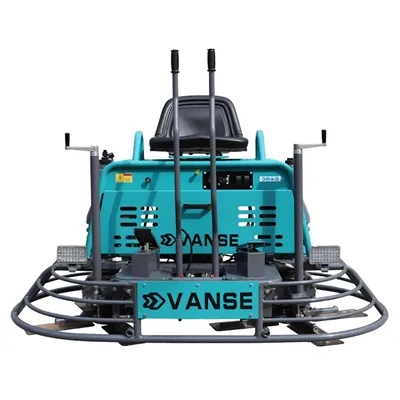
What factors affect the compaction effect of concrete power trowel?
– Trowel type and weight – Different types of trowels, such as walk-behind and ride-on, have different compaction effects. Ride-on trowels are usually heavier, and their own weight can provide greater pressure for the compaction process. They are generally suitable for compacting large areas and thicker concrete. Walk-behind trowels are relatively light, and may require the operator to apply additional pressure when compacting thicker concrete. For example, a ride-on trowel can weigh hundreds of kilograms, and through its own gravity and the pressure generated by the operation of the machine, it can effectively compact a concrete layer of 10-15 cm deep; a walk-behind trowel generally weighs tens of kilograms, and for the same thickness of concrete, it may be necessary to achieve similar compaction effects through repeated operations or increased downward operating force. – The size and number of trowel discs on the trowel also affect the compaction effect. Larger trowel discs can cover more ground area when rotating, making the pressure more evenly distributed, which helps to improve the compaction effect. Compared with a single-disc trowel, a double-disc trowel can apply pressure to concrete from two directions at the same time, making the pressure on the concrete surface more balanced, thereby enhancing the compaction effect to a certain extent. For example, the diameter of the two trowel discs of a double-disc ride-on trowel can reach about 1 meter, which can better compact a large area of concrete during operation and reduce the height difference of the ground. – Power and speed of trowel – A powerful trowel can better overcome the resistance of concrete during operation, allowing the trowel blade to embed deeper into the concrete surface, thereby improving the compaction effect. For example, a gasoline-powered trowel has more power than an electric trowel of the same type. When dealing with hard concrete, it can drive the trowel blade to rotate with higher torque to effectively compact the concrete. – The speed of the trowel also has an important impact on the compaction effect. A trowel with a moderate speed can make the trowel blade fully contact with the concrete surface and evenly transfer the pressure to the concrete. If the speed is too high, the friction between the trowel and the concrete will increase, which may cause the trowel to jump and affect the uniformity of compaction; if the speed is too low, it will not generate enough centrifugal force and pressure, and the compaction effect will be greatly reduced. Generally speaking, the speed of the trowel machine is more suitable between 70 and 150 rpm. The specific speed should be adjusted according to the slump, hardness and other factors of the concrete. – Concrete slump – Slump is an indicator of the fluidity of concrete. Concrete with a large slump has good fluidity and is easier to be compacted under the action of the trowel. However, if the slump is too large and the concrete is too thin and soft, the trowel may sink into the concrete during operation, affecting the compaction effect and work efficiency. On the contrary, concrete with a small slump is relatively dry and hard, requiring greater pressure to compact, and the trowel of the trowel machine may be difficult to penetrate into the concrete, which is prone to uneven surface compaction. For example, concrete with a slump of 50-90 mm is more suitable for trowel compaction, which can ensure the compaction effect while making the trowel work normally. – Concrete mix ratio and aggregate characteristics – The mix ratio of concrete (the ratio of cement, sand, gravel and water) directly affects its performance. A reasonable mix ratio can make concrete have good workability and strength, which is conducive to compaction. For example, an appropriate increase in the amount of cement can improve the cohesion of concrete, making it easier to form a dense structure during compaction. – The characteristics of aggregates (sand and gravel) are also critical. The particle size, shape and gradation of aggregates will affect the compaction effect of concrete. Aggregates with moderate particle size, regular shape and good gradation can better fill each other in concrete, reduce pores, and make it easier for concrete to reach a dense state under trowel compaction. If the aggregate particle size is too large or too small, or the gradation is unreasonable, it may cause more pores inside the concrete, and it is difficult to achieve the ideal density even after trowel compaction. – Operation speed and pressure control – The operation speed of the trowel has a significant impact on the compaction effect. If the operation speed is too fast, the trowel blade will stay in each position for too short a time and cannot fully compact the concrete; if the operation speed is too slow, the work efficiency will be reduced. In actual operation, it is necessary to adjust the appropriate operation speed according to the state of the concrete and the performance of the trowel. For example, when compacting and troweling concrete after initial setting, the operation speed of the hand-held trowel is generally controlled at 2-4 meters per minute. – The pressure applied by the operator to the trowel is also important. Appropriately increasing the pressure can improve the compaction effect, but excessive pressure may cause excessive wear of the trowel blade and even damage the concrete surface. The operator needs to reasonably control the pressure according to the hardness of the concrete, the type of trowel and the trowel stage (rough grinding or fine grinding). In the rough grinding stage, the pressure can be appropriately increased to compact the concrete; in the fine grinding stage, the pressure should be reduced to obtain a smooth surface. – Operation trajectory and number of times – A reasonable operation trajectory can make the concrete surface subject to uniform pressure and improve the compaction effect. Usually, a zigzag, circular or spiral operation track is used. For example, in the construction of large-scale concrete floors, a circular operation track is used to gradually compact and smooth from the edge to the center or from the center to the edge to ensure that the entire floor can be evenly treated. – The number of operations will also affect the compaction effect. Generally speaking, multiple smoothing and compacting of concrete, with each smoothing direction perpendicular to each other, can make the concrete surface smoother and denser. However, too many operations may cause the mortar layer on the concrete surface to be too thick, resulting in surface cracking and other problems, so the number of operations needs to be controlled according to actual conditions.Application cases and effect display of concrete laser leveling machine
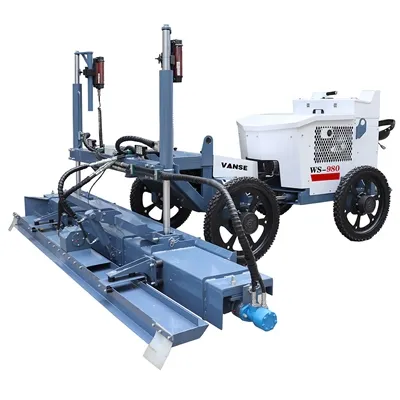
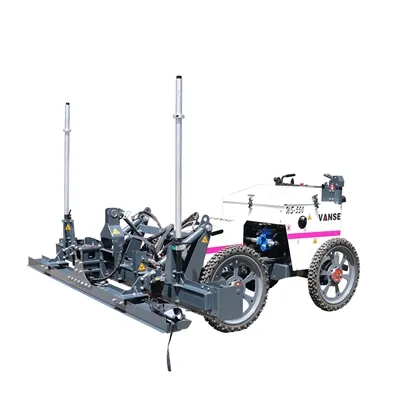
The concrete laser leveling is a piece of equipment widely used in the field of concrete construction. Its appearance has greatly improved the efficiency and accuracy of concrete construction. The application cases and effect demonstrations of concrete laser leveling machines will be introduced below. Case 1: Highway construction A highway construction project requires the laying of a large amount of concrete pavement. The traditional manual construction method is inefficient and difficult to ensure the smoothness and quality of the pavement. After using the concrete laser leveling, the equipment completed the laying of large areas of concrete in a short time, and the smoothness and quality of the road surface were greatly improved. After using a concrete laser leveler, the construction efficiency can be increased several times, and unevenness and quality problems caused by human factors are avoided. Case 2: Bridge construction During the construction of a certain bridge, a layer of high-quality concrete needs to be laid on the bridge deck. Due to the complex shape of the bridge deck, traditional manual construction methods are difficult to ensure the quality and flatness of the concrete. After using the concrete laser leveling machine, the equipment can complete the laying of bridge deck concrete in a short time and ensure the quality and flatness of the concrete. Using a concrete laser leveling can greatly improve the efficiency and safety of bridge construction. Case 3: Large workshop floor construction In the ground construction of a large workshop, a large area of concrete needs to be laid, and the flatness and precision of the ground are required to be very high. Traditional manual construction methods are difficult to meet the requirements. After using the concrete laser leveling machine, the equipment completed the laying of large areas of concrete in a short time, and the flatness and accuracy of the ground were greatly improved. Using a concrete laser leveling can improve construction efficiency and quality, while also improving workshop safety and productivity. Show results Concrete laser leveling machine has the following effects in application: Improve construction efficiency: Using a concrete laser leveling machine can quickly complete large-area concrete laying, which is more efficient than traditional manual construction methods. Improve construction quality: The concrete laser leveling can ensure the flatness and precision of concrete, avoid unevenness and quality problems caused by human factors, and improve construction quality. Improve economic benefits: The use of concrete laser leveling machines can shorten the construction cycle, reduce labor costs, improve construction efficiency, and also reduce rework and maintenance costs caused by quality problems. Improve production safety: The use of concrete laser levelinging machines can reduce the time and frequency of personnel exposure to hazardous environments, reducing workers' labor intensity and the risk of safety accidents. In summary, concrete laser levelings have broad application prospects and advantages in construction projects in highways, bridges, large workshop floors and other fields. Its emergence can not only improve construction efficiency and quality, but also improve economic benefits and production safety. Therefore, it is very necessary to choose a suitable concrete laser leveler for various concrete construction projects.What is the working efficiency of the concrete laser leveling machine in construction?
The working efficiency of the concrete laser leveler is affected by many factors such as equipment model, construction conditions, concrete properties, etc., and varies greatly in different scenarios. The following is an explanation from three aspects: core influencing factors, typical efficiency data and improvement strategies: Leveling width: The leveling width of common models is 2.5-6 meters. Wide-width equipment (such as 6 meters) covers a larger area in a single operation, and the efficiency is increased by about 30%. Travel speed: The conventional construction speed is 1-3 meters/minute, and the high-frequency vibrating model (such as 100 times/minute) can appropriately increase the speed to 2-4 meters/minute. Automation degree: The fully automatic hydraulic drive model is 20%-50% more efficient than the semi-automatic model, and no frequent manual adjustment is required. Site scale: When a large area is continuously constructed (such as more than 5000㎡), the equipment does not need to be frequently transferred, and the efficiency can reach 1.5-2 times that of a small area (<1000㎡). Terrain complexity: Complex terrain with high flatness requirements (such as slopes and arc angles) requires multiple round trips, and the efficiency is 30%-40% lower than that of a flat site. Slump: Concrete with a slump of 180-220mm has good fluidity and its leveling efficiency is about 25% higher than that of concrete with a low slump (<150mm). Initial setting time: Concrete with an initial setting time of 4-6 hours can be constructed continuously. If the initial setting is too fast (<3 hours), it needs to be worked in blocks, and the efficiency drops by about 40%. Indicators Laser leveling machine Traditional manual labor + ordinary machinery Efficiency improvement ratio Daily operation area 1500-3500㎡ 500-800㎡ 3-4.5 times Staffing 3-5 people (including operation and assistance) 8-12 people 50%-60% manpower saving Smoothness error ±3-5mm/2m ±8-15mm/2m Precision improvement of more than 50% Construction period 10,000㎡ site about 5-7 days 10-15 days Shortening of construction period by 50% Choose the machine model according to the size of the site: choose a wide model (5-6 meters) for more than 5000㎡, and a narrow model (2.5-3 meters) for narrow areas. Maintain equipment regularly: keep the hydraulic system pressure stable (standard pressure 16-20MPa), replace worn scrapers (when the wear amount is >2mm), and avoid downtime due to equipment failure. Block construction planning: divide the construction blocks according to the principle of "from inside to outside, zone flow", and control the area of each block to 1000-1500㎡ to reduce the transfer time. Multi-machine collaborative operation: Large-scale projects can use the combination of "1 laser leveling machine + 1 concrete pump truck + 2 concrete placing machines" to improve the efficiency of placing and leveling. Strictly control the slump: the slump of pumped concrete should be 180-220mm, and the slump of non-pumped concrete should be 150-180mm, to avoid the leveling speed being affected by over-dry or over-thin concrete. Reasonably arrange the pouring time: avoid high temperature (>35℃) or low temperature (<5℃) periods. When the temperature is high, a retarder can be added to extend the initial setting time to 6-8 hours. Operators need to master the "rough leveling first and then fine leveling" process: the rough leveling speed is 3-4 meters/minute, and the fine leveling speed is 1-2 meters/minute to avoid excessive vibration at one time. Assistants need to handle the corner areas in time: Edges that cannot be covered by the laser leveling machine (such as corners and column roots) need to be leveled by a dedicated person with a small vibrator to avoid secondary rework. Attenuation scenarios Efficiency reduction ratio Countermeasures Construction in rainy season (flooding on the ground) 30%-50% Drain water in advance and lay steel roadbed to reduce the risk of equipment getting stuck Construction at night (lack of lighting) 20%-30% Install high-brightness LED light sets, and operators wear night vision assistance equipment Multi-task cross-operation 25%-40% Define construction restricted areas and coordinate process connections (e.g., prohibit people from entering within 4 hours after leveling) Concrete supply interruption Calculated by interruption time Put aside 2 concrete mixer trucks to ensure supply continuity The average working efficiency of the concrete laser leveling machine is about 1500-3500㎡/day (single machine), which is 3-4.5 times that of traditional manual leveling. Its efficiency depends on the coordination of equipment selection and construction management. By optimizing machine configuration, controlling concrete performance and standardizing construction processes, the equipment efficiency can be maximized to achieve dual optimization of construction period and cost. In actual application, it is necessary to flexibly adjust the strategy according to the characteristics of the project to achieve the best construction efficiency.