How to improve the environmental performance of concrete laser leveling machine?
August 6, 2024
How to improve the environmental performance of concrete laser leveling machine? 4
As a highly efficient construction equipment, the improvement of the environmental performance of the concrete laser leveler is of great significance to the realization of green buildings and sustainable development. The following is a detailed analysis of how to improve the environmental performance of the concrete laser leveler.
Introduction
With the increasing global awareness of environmental protection, the construction industry is also seeking more environmentally friendly construction technologies and equipment. As an advanced construction equipment, the improvement of the environmental performance of the concrete laser leveler not only helps to reduce environmental pollution during the construction process, but also improves construction efficiency and quality.
1. Overview of the environmental performance of the concrete laser leveler
The concrete laser leveler uses laser technology to achieve precise leveling of the concrete surface. Compared with traditional manual leveling, it reduces material waste and construction noise, and has better environmental performance.
2. Reduce energy consumption To improve the environmental performance of the concrete laser leveler, we must first start with reducing energy consumption: – **Efficient energy utilization**: optimize equipment design, improve energy conversion efficiency, and reduce energy waste. – **Energy saving mode**: develop energy saving mode, adjust equipment power according to construction needs, and reduce unnecessary energy consumption.
3. Reduce noise pollution Noise pollution during construction is an important factor affecting environmental performance: – **Soundproof design**: Add soundproof materials to the equipment design to reduce the generation and spread of noise. – **Low-noise components**: Use low-noise engines and hydraulic systems to reduce the noise during equipment operation.
4. Reduce exhaust emissions Concrete laser leveling machines may produce exhaust gas during operation, and measures need to be taken to reduce emissions: – **Clean energy**: Use clean energy such as electric or hydrogen fuel cells to replace traditional fuel to reduce exhaust emissions. – **Emission control technology**: Apply emission control technology, such as catalytic converters, to reduce the emission of harmful gases. 5. Recycling of materials and resources Improving the environmental performance of concrete laser leveling machines also requires consideration of the recycling of materials and resources: – **Durable design**: Design durable equipment components to extend the service life of the equipment and reduce resource consumption. – **Modular design**: The use of modular design facilitates equipment upgrades and component replacements, and improves resource utilization efficiency.
6. Reduce construction waste The waste generated during the construction process burdens the environment, and measures need to be taken to reduce waste generation: – **Precision construction**: Use the high-precision characteristics of the laser leveling machine to reduce waste caused by construction errors. – **Waste recycling**: Establish a waste recycling system to classify, recycle and reuse the waste generated during the construction process. 7. Improve the level of equipment intelligence The application of intelligent technology can improve construction efficiency and indirectly improve environmental performance: – **Intelligent control system**: Develop an intelligent control system to automate and optimize the construction process. – **Remote monitoring**: Monitor the equipment status in real time through a remote monitoring system to reduce construction delays and resource waste caused by equipment failure. 8. Environmental management during construction Environmental management during construction is crucial to improving the environmental performance of concrete laser leveling machines: – **Environmental training**: Train construction personnel on environmental awareness and improve their environmental operation skills. – **Construction plan**: Develop an environmental construction plan, arrange construction time and process reasonably, and reduce the impact on the environment. 9. Technological innovation and R&D Technological innovation is the key to improving the environmental performance of concrete laser leveling machines: – **New materials**: Research and develop and apply new environmentally friendly materials, such as coatings and lubricants with low volatile organic compounds (VOC). – **New processes**: Explore and develop new construction processes to reduce the impact on the environment. 10. Conclusion Improving the environmental performance of concrete laser leveling machines is a systematic project, which requires comprehensive consideration from multiple aspects such as reducing energy consumption, reducing noise pollution, reducing exhaust emissions, recycling materials and resources, reducing construction waste, improving the level of equipment intelligence, environmental management during construction, and technological innovation and R&D. Through these measures, the environmental performance of concrete laser leveling machines can be effectively improved and the green development of the construction industry can be promoted.
How to improve the environmental performance of concrete laser leveling machine? 5How to improve the environmental performance of concrete laser leveling machine? 6
About the Author: Shandong Vanse Machinery Technology Co., Ltd.
Shandong Vanse Machinery Technology Co., Ltd. is a high-tech manufacturer specializing in concrete construction machinery, including laser screeds and related equipment. The company integrates R&D, production, and global sales, with products exported to over 60 countries and widely used in infrastructure projects worldwide.
How to monitor the status of concrete laser leveling machine in real time through vibration sensor?
To monitor the status of the concrete laser leveling in real time through a vibration sensor, the following steps can be taken: 1. Install vibration sensors: Install vibration sensors on key parts of the concrete laser leveling machine, such as the scraper or leveling beam. 2. Connect the sensor and control system: Connect the vibration sensor to the control system of the concrete laser leveling. 3. Set the alarm value: Set the alarm value of the vibration sensor as needed. When the vibration of the leveling machine exceeds the preset alarm value, the system will automatically sound an alarm and notify the operator to take appropriate action. 4. Real-time monitoring: The control system will monitor the data of the vibration sensor in real time and display the data to the operator through the control interface. The operator can check the vibration status of the leveler at any time and understand the operation of the leveler. 5. Abnormal handling: When the vibration sensor detects abnormal vibration, the control system will immediately issue an alarm and automatically take corresponding measures, such as shutting down or adjusting working parameters, etc., to protect the leveling machine from damage. 6. Recording and data analysis: The control system will also automatically record vibration data, and process and analyze the data through data analysis software. Through these data, the operator can fully understand the status of the leveling machine and provide a basis for equipment maintenance and upkeep. In summary, real-time monitoring of the status of the concrete laser leveling through vibration sensors requires steps such as connecting the vibration sensor to the control system, setting alarm values, real-time monitoring, recording and data analysis. In this way, abnormal conditions of the leveling machine can be discovered in time, ensuring the normal operation of the equipment, and improving construction efficiency and construction quality.
Read More
March 20, 2025
How to check whether the laser receiver of the concrete laser leveling machine is working properly?
– Appearance inspection: Carefully check whether the shell of the laser receiver is damaged or cracked, and whether the connecting line is damaged or loose. If these problems exist, it may cause signal transmission failure, and the damaged parts need to be repaired or replaced in time. – Power supply check: Make sure the receiver is connected to the power supply and the power indicator is on normally. If the indicator light is off, check whether the power socket and power cord are normal, and whether the power switch of the receiver is turned on. – Observe the signal indicator: Most laser receivers have a signal indicator. When receiving a laser signal, the indicator will have a corresponding display, such as lighting up or flashing. When the laser transmitter is turned on, observe the signal indicator of the receiver. If the indicator does not respond, the receiver may not receive the signal and further investigation is required. – Manual blocking test: When the laser transmitter is emitting laser normally, use an opaque object to temporarily block the receiving window of the laser receiver and observe the changes in the signal indicator. If the indicator light goes out or changes state when blocked, it means that the receiver responds to the laser signal, and the initial judgment is that the receiving function is normal; if the indicator light does not change, the receiver may have a fault. – Slope control function test: If the concrete laser leveler has a slope control function, set different slope parameters and observe whether the laser receiver can accurately control the leveler to perform construction according to the set slope. If the leveler cannot work according to the set slope, there may be a problem with the slope control function of the laser receiver. – Flatness detection function test: Run the concrete laser leveler on a test platform or ground with known flatness, let the laser receiver work and record the flatness data it measures. Compare the data with the actual flatness to check whether the measurement result is within the allowable error range. If the deviation is large, it means that the flatness detection function of the laser receiver may be inaccurate and needs to be calibrated or repaired. – Different position test: In the working area of the concrete laser leveler, select multiple different positions, including positions close to, far from, and at different angles from the laser transmitter, and observe whether the laser receiver can receive signals normally and work accurately at these positions. If the signal is lost or works abnormally at certain positions, it means that there is a problem with the receiver's receiving range or angle. – Accuracy calibration test: Use professional measuring tools, such as high-precision levels, to compare with the measurement results of the laser receiver. Perform measurement comparisons at multiple different positions to check whether the measurement accuracy of the laser receiver meets the equipment requirements. If the accuracy deviation is found to exceed the allowable range, the laser receiver needs to be calibrated and debugged. Enter the setting interface of the laser receiver and check whether the software settings and parameters are correct. Make sure that the parameters such as working mode, laser wavelength, sensitivity, etc. match the laser transmitter and the entire leveling machine system. Incorrect parameter settings may cause the receiver to work abnormally, and it is necessary to set it correctly according to the equipment manual. If conditions permit, professional optical detection equipment such as optical power meter, laser interferometer, etc. can be used to perform more accurate detection of the laser receiver. These devices can measure the laser power, wavelength stability, beam quality and other parameters received by the receiver, and compare them with the technical specifications of the receiver to accurately determine whether it is working properly. If there are multiple concrete laser leveling machines of the same model, the suspected problematic laser receiver can be interchanged with the receivers on other machines that are working properly. Then observe the working conditions of the two machines. If the original normal machine has the same problem as before, and the original problematic machine returns to normal, it can be determined that the laser receiver itself is faulty and needs to be repaired or replaced.
Read More
February 26, 2026
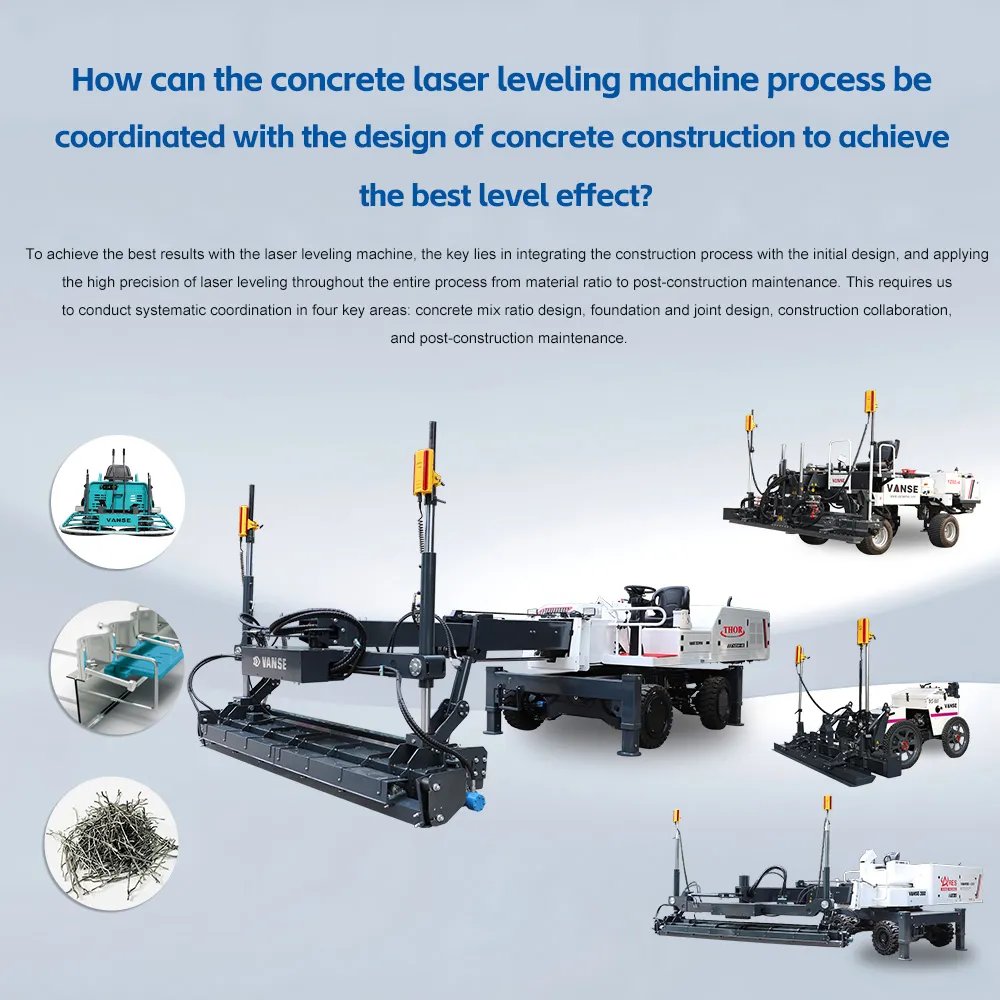
How can the concrete laser leveling machine process be coordinated with the design of concrete construction to achieve the best level effect?
To achieve the best results with the laser leveling machine, the key lies in integrating the construction process with the initial design, and applying the high precision of laser leveling throughout the entire process from material ratio to post-construction maintenance. This requires us to conduct systematic coordination in four key areas: concrete mix ratio design, foundation and joint design, construction collaboration, and post-construction maintenance. Objective: To prevent problems before they occur and promptly identify potential issues through daily observation. The high-frequency vibration and precise leveling of the laser leveling machine require that the concrete itself have good and stable working performance. Mix ratio design is the foundation. Design parameters Recommendation requirements: The influence on the laser leveling effect Water-cement ratio Not more than 0.5, no water addition allowed on site Controlling the water-cement ratio can ensure the strength and volume stability of the hardened concrete, preventing shrinkage cracks or insufficient strength due to excessive moisture. Adding water on-site will disrupt the mix ratio, causing segregation and bleeding, which seriously affects the leveling accuracy. Consistency 14 ± 2 cm (maximum 16 cm) This slump range can ensure that the concrete has good fluidity, facilitating the leveling by the laser leveling machine, while not being too thin to maintain the shape after leveling, which is the key to ensuring the stability of the leveling accuracy. Setting time Initial setting time controlled within 3-5 hours It provides sufficient operation windows for the spreading, vibrating and repeated leveling of the laser leveling machine, ensuring the continuity of large-scale construction and avoiding cold joints. Aggregate gradation Maximum particle size of coarse aggregate ≤ 25 mm; sand ratio controlled within 35% – 40% Good gradation can ensure the concrete is dense and uniform, avoiding surface defects (such as cracking and sanding) caused by aggregate segregation, creating a uniform working surface for laser leveling. Without a solid foundation and scientific joint design, the accuracy of laser leveling will be impossible to achieve. Foundation preparation: Before concrete pouring, it is necessary to ensure that the base has been leveled, compacted, and precisely controlled in terms of elevation. This is the fundamental measure to prevent ground settlement and deformation after completion, thereby ensuring the final levelness. Joint design: Construction joints: In design, efforts should be made to minimize the occurrence of construction joints. When they cannot be avoided, a force transmission system should be set up. This can effectively transfer the load between the slabs and prevent misalignment at the joint, thus avoiding damage to the overall flatness of the ground. Expansion joints/cutting joints: The design should clearly define the time and method for cutting the joints. To overcome concrete shrinkage and temperature stress, the cutting should be carried out as early as possible (usually within 24 hours), and the quality of the cutting should be strictly controlled to prevent the edges from cracking or the formation of irregular cracks. The laser leveling machine is the core, but it cannot function without the close collaboration between humans and the environment. Human-machine collaboration: The equipment operator is responsible for precise leveling, while 3-4 workers are needed to assist, responsible for quickly leveling the concrete, handling the formwork, the edges of columns, and the corner areas that the machine cannot cover. This "machine operator with human assistance" model is the key to ensuring overall flatness without any blind spots. Process control: Material supply stability: It is necessary to ensure continuous concrete supply (speed ≥ 40m³/h), and the slump and initial setting time of each truckload of concrete should be highly consistent to avoid affecting the construction quality and progress due to material fluctuations. Leveling verification: During the leveling process, the ground elevation should be regularly rechecked to ensure that the laser emitter is working properly. Once any problems are identified, they should be immediately adjusted to prevent large-scale rework. Environmental protection: The ground that has just been leveled must not be exposed to direct sunlight, strong winds, or rainwater. At the same time, the construction site should avoid electric welding operations and reflective objects to prevent interference with the reception of the laser signal. The later maintenance and surface treatment are the final procedures for protecting and enhancing the laser-levelled finished products. Timely maintenance: Use the maintenance agent compatible with the floor material for maintenance. This can form a high-density crystalline film, effectively locking in moisture and preventing concrete from developing dry shrinkage cracks or surface dusting due to rapid water loss, ensuring strength and flatness. Wear resistance and joint sealing: For floors with wear resistance requirements, apply high-performance floor hardener at the appropriate time (determined by the concrete setting time). After cutting the joints, use polyurethane joint sealing adhesive of the same color as the floor to handle the joints, to ensure the tear resistance, aging resistance and aesthetic performance of the joints. To achieve the best results with the laser leveler, it must be regarded as a systematic project. From the design stage, create the best conditions for this efficient and high-precision process, and strictly control the entire construction process. If you can provide more information about your project, such as whether it is a logistics warehouse with super-leveling or a basement with decoration requirements, I can provide you with more targeted design suggestions. Contact us NOW Note: The parameters provided in this document are for reference only and are not mandatory. Due to differences in technical characteristics between different brands and models of laser levelers, please consult the manufacturer for a suitable solution before actual operation. This reference document assumes no responsibility for any issues arising from failure to follow the manufacturer's instructions.