Technical Knowledge
How to monitor the status of concrete laser leveling machine in real time through vibration sensor?
To monitor the status of the concrete laser leveling in real time through a vibration sensor, the following steps can be taken:
1. Install vibration sensors:
Install vibration sensors on key parts of the concrete laser leveling machine, such as the scraper or leveling beam.
2. Connect the sensor and control system:
Connect the vibration sensor to the control system of the concrete laser leveling.
3. Set the alarm value:
Set the alarm value of the vibration sensor as needed. When the vibration of the leveling machine exceeds the preset alarm value, the system will automatically sound an alarm and notify the operator to take appropriate action.
4. Real-time monitoring:
The control system will monitor the data of the vibration sensor in real time and display the data to the operator through the control interface. The operator can check the vibration status of the leveler at any time and understand the operation of the leveler.
5. Abnormal handling:
When the vibration sensor detects abnormal vibration, the control system will immediately issue an alarm and automatically take corresponding measures, such as shutting down or adjusting working parameters, etc., to protect the leveling machine from damage.
6. Recording and data analysis:
The control system will also automatically record vibration data, and process and analyze the data through data analysis software. Through these data, the operator can fully understand the status of the leveling machine and provide a basis for equipment maintenance and upkeep.
In summary, real-time monitoring of the status of the concrete laser leveling through vibration sensors requires steps such as connecting the vibration sensor to the control system, setting alarm values, real-time monitoring, recording and data analysis. In this way, abnormal conditions of the leveling machine can be discovered in time, ensuring the normal operation of the equipment, and improving construction efficiency and construction quality.


Thanks to All the Friends Who Support and Trust Shandong Vanse Machinery Technology Co., Ltd.
If you want to know more about Shandong Vanse Machinery Technology Co., Ltd. or have any questions, please feel free to contact us:
Our Factory
Shandong Vanse Machinery Technology Co., Ltd.








Share this article

About the Author: Shandong Vanse Machinery Technology Co., Ltd.
Shandong Vanse Machinery Technology Co., Ltd. is a high-tech manufacturer specializing in concrete construction machinery, including laser screeds and related equipment. The company integrates R&D, production, and global sales, with products exported to over 60 countries and widely used in infrastructure projects worldwide.
Previous Post
Next Post
Related Articles
You Might Also Like
How to improve the construction accuracy of concrete laser leveling machine?
▪▪▪▷▷▷ Introduction With the continuous development of the modern construction industry, the requirements for ground construction accuracy are becoming higher and higher. As an advanced ground construction equipment, the concrete laser leveling plays an important role in improving construction accuracy. However, during the actual construction process, the construction accuracy of the concrete laser leveling may be affected by various factors. Therefore, how to improve the construction accuracy of concrete laser leveling machines has become the focus of current research. ▪▪▪▷▷▷ Factors affecting the construction accuracy of concrete laser leveling machine 1. Equipment factors: Factors such as the manufacturing accuracy, installation accuracy of the equipment itself, and wear and tear during use will all affect the construction accuracy of the leveler. 2. Environmental factors: Environmental factors such as temperature, humidity, and wind speed at the construction site will affect the working results of the leveler. 3. Operational factors: Factors such as the operator's skill level and operating habits will also affect the construction accuracy of the leveler. ▪▪▪▷▷▷ Specific measures to improve the construction accuracy of concrete laser leveling machines 1. Equipment selection and configuration Choosing high-precision, high-quality concrete laser leveling equipment is the key to improving construction accuracy. When purchasing equipment, you should fully consider the manufacturing accuracy, stability, durability and other factors of the equipment, and choose brands and models with good after-sales service and technical support. In addition, the accessories and tools of the snow leveling machine should be properly matched according to the specific construction needs and site conditions to ensure that the equipment can perform optimally during the construction process. 2. Equipment installation and debugging Correct equipment installation and debugging are crucial to improving the construction accuracy of the leveling. During the installation process, you should carefully follow the installation guidelines and specifications provided by the equipment manufacturer to ensure that the installation position and accuracy of each component of the equipment meet the requirements. During the debugging process, all functions of the leveling machine should be comprehensively inspected and tested to ensure that the equipment can operate stably and accurately during the operation. 3. Environmental factor control Corresponding measures should be taken to control environmental factors at the construction site. For example, when operating in high or low temperature environments, the operating time should be adjusted according to the requirements of the equipment or insulation measures should be taken to prevent the equipment from affecting the construction accuracy due to changes in ambient temperature. When operating under conditions of high wind speed, wind blocking facilities should be installed or the operation strategy should be adjusted to reduce the impact of wind speed on the operation effect of the leveler. 4. Improve operational skills Improving the skill level of operators is an effective way to improve the construction accuracy of concrete laser leveling machines. Regular training and assessment should be carried out to make operators familiar with the performance characteristics, operation essentials and maintenance knowledge of the equipment. At the same time, the safety awareness and responsibility awareness of operators should also be cultivated to ensure that they can operate in strict accordance with specifications and requirements during the construction process. 5.Construction process monitoring and adjustment During the construction process, the operating status of the leveling machine should be monitored and adjusted in real time. By using advanced monitoring equipment and technical means, the operating data and quality information of the leveling machine should be obtained in real time, so that problems can be discovered and solved in a timely manner. In the case of deviations or non-compliance with requirements, the parameters and operation strategies of the leveling machine should be adjusted in a timely manner to ensure that the construction accuracy meets the requirements. 6. Maintenance and troubleshooting Regular maintenance and troubleshooting of the concrete laser leveling is an important guarantee for improving construction accuracy. The equipment should be cleaned, lubricated, tightened and other maintenance work should be carried out regularly in accordance with the equipment manufacturer's requirements and maintenance plans to ensure that the equipment In good working order. At the same time, a complete troubleshooting mechanism should be established to analyze and deal with faults and problems in a timely manner to avoid equipment failure that affects construction accuracy. ▪▪▪▷▷▷ Case analysis Taking a large commercial complex as an example, this project requires high ground construction accuracy during the construction process. To ensure construction accuracy and quality, the project team took the following measures: 1. Select high-precision, high-quality concrete laser leveling equipment and carry out strict installation and debugging work. 2. Take corresponding control measures for environmental factors at the construction site, such as high temperature, wind speed, etc., to ensure that the equipment operates in a suitable environment. 3. Conduct systematic training and assessment of operators to improve their skill level and safety awareness. 4. Implement real-time monitoring and adjustment strategies during the construction process to ensure that the working status of the leveling is always at its best. Through the application of the above measures, the project successfully improved the construction accuracy of the concrete laser leveling and ensured the safety of ground construction. quality and efficiency ▪▪▪▷▷▷ Conclusion and outlook Improving the construction accuracy of warm concrete laser levelings requires starting from many aspects, including equipment selection and configuration, equipment installation and debugging, environmental factor control, operating skill improvement, construction process monitoring and adjustment, and maintenance and troubleshooting. wait. By taking comprehensive measures, the construction accuracy and operating performance of the leveling can be effectively improved to meet the modern construction industry's requirements for ground construction accuracy. Looking to the future, with the continuous advancement and innovation of science and technology, the construction accuracy of concrete laser leveling machines will be further improved. For example, by introducing more advanced control systems and sensor technologies, more precise control of the leveling machine's operating process can be achieved; by developing new materials and technical means, the wear resistance, stability and service life of the leveling machine can be further improved. wait. At the same time, it is also necessary to strengthen the training and education of operators to improve their skill level and safety awareness to adapt to the higher requirements for ground construction accuracy in the future construction industry.What are the possible development directions of concrete laser leveling machine in the future?
What are the possible development directions of concrete laser leveling machine in the future development? With the continuous advancement of science and technology and the increasing complexity of engineering construction, as an important equipment for modern engineering construction, concrete laser leveling machine has broad development prospects and is full of challenges. This article will explore the possible development directions of concrete laser leveling machine in the future development from the aspects of technological innovation and optimization, intelligent and automated improvement, multifunctional integrated design, green environmental protection technology application, industry standardization and standardization, market expansion and diversified application, and after-sales service and training system improvement. 1. Technological innovation and optimization Technological innovation is the core driving force for the future development of concrete laser leveling machine. In the future, the equipment will be committed to improving construction efficiency, reducing energy consumption and improving construction quality. First, in terms of materials, we can explore the use of lighter and more durable new materials to reduce the weight of equipment and increase service life. Secondly, in terms of laser emission and reception technology, more accurate and stable laser control systems should be studied to meet the needs of complex terrain and high-precision construction. In addition, the transmission system and hydraulic system of the equipment can be optimized to reduce energy consumption and improve operating efficiency. 2. Intelligent and automated improvement Intelligence and automation are important trends in the future development of concrete laser leveling machine. With the continuous development of artificial intelligence and Internet of Things technology, concrete laser leveling machines will achieve a higher level of intelligence and automation. By integrating intelligent components such as sensors, controllers and actuators, the equipment can realize real-time perception and autonomous decision-making of the construction environment, thereby improving construction efficiency and construction quality. In addition, through remote monitoring and control systems, operators can realize remote control and monitoring of the equipment, reducing the difficulty and risk of on-site operations. 3. Multifunctional integrated design Multifunctional integrated design is another important direction for the future development of concrete laser leveling machines. By integrating multiple functions into one device, construction costs can be reduced and construction efficiency can be improved. For example, the laser leveling function can be combined with the concrete spreading function to achieve integrated construction of concrete spreading and leveling. In addition, other auxiliary functions such as automatic lifting and automatic adjustment can also be considered to meet the needs of different construction scenarios. 4. Application of green and environmentally friendly technology With the increasing attention of society to environmental protection issues, green and environmentally friendly technology will become an important direction for the future development of concrete laser leveling machines. First of all, in the process of equipment manufacturing and use, environmentally friendly materials and processes should be used preferentially to reduce the emission of harmful substances. Secondly, energy consumption and noise pollution can be reduced by optimizing the equipment structure and working principle. In addition, we can also explore the use of renewable energy such as solar energy and wind energy to power the equipment and achieve green construction. 5. Industry standardization and normalization Industry standardization and normalization are important guarantees for the healthy development of concrete laser leveling machines in the future. By formulating unified technical standards, operating specifications and inspection methods, the performance and quality of the equipment can be improved and fair competition in the market can be promoted. At the same time, standardization and normalization also help reduce the maintenance and operating costs of the equipment and improve the user experience. Therefore, in the future, we should strengthen cooperation with industry associations, scientific research institutions, etc. to jointly promote the standardization and normalization process of the concrete laser leveling machine industry. 6. Market expansion and diversified applications Market expansion and diversified applications are another important direction for the future development of concrete laser leveling machines. At present, concrete laser leveling machines are mainly used in the construction of flat concrete such as roads, bridges, and squares, but with the continuous advancement of technology and the expansion of application scenarios, its application field will continue to expand. For example, we can explore the application of concrete laser leveling machines in water conservancy projects, tunnel projects and other fields to achieve wider applications. At the same time, through international cooperation and market development, concrete laser leveling machines can be promoted to the international market to improve international competitiveness. 7. Perfect after-sales service and training system A perfect after-sales service and training system is crucial to the long-term development of concrete laser leveling machines. With the continuous upgrading and replacement of equipment, users' demand for after-sales service and training is also growing. Therefore, in the future, the training and management of after-sales service personnel should be strengthened to improve their professional skills and service level. At the same time, a perfect training system should be established to provide users with comprehensive technical support and training services to help them better use and maintain equipment. In summary, in the future development of concrete laser leveling machines, there will be diversified development directions such as technological innovation and optimization, intelligent and automated improvement, multi-functional integrated design, green environmental protection technology application, industry standardization and normalization. Market expansion and diversified application, and improvement of after-sales service and training system. These development directions will help improve the performance and quality of concrete laser leveling machines, reduce construction costs, improve construction efficiency, and meet users' needs for efficient, environmentally friendly and intelligent construction. At the same time, it will also help promote the progress and development of the entire engineering construction industry. It should be noted that these development directions do not exist in isolation, but are interrelated and mutually reinforcing. In the future development, we should consider all factors comprehensively, strengthen technology research and development and market research, and promote the concrete laser leveling machine to achieve comprehensive breakthroughs and development in technology innovation, intelligence, environmental protection, standardization, market expansion and after-sales service. Only in this way can we be invincible in the fierce market competition and make greater contributions to the modern engineering construction industry.Can a concrete laser leveling machine handle slopes? Which settings work best?
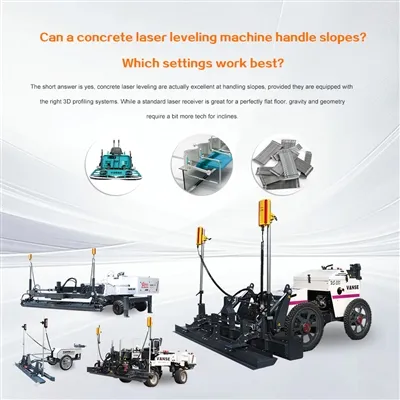
The short answer is yes, concrete laser leveling are actually excellent at handling slopes, provided they are equipped with the right 3D profiling systems. While a standard laser receiver is great for a perfectly flat floor, gravity and geometry require a bit more tech for inclines. Standard laser leveling uses a rotating laser transmitter on a tripod and receivers on the machine. This creates a flat "plane" of light. Single/Dual Slopes (2D): If you are doing a simple parking lot ramp or a consistent drainage slope, you can physically tilt the laser transmitter on its tripod to a specific percentage (e.g., a 1% grade). The machine will then follow that tilted plane.Complex Contours (3D): For complex curbs, valleys, or multi-directional slopes, the machine uses 3D Profiling Systems (often involving a Total Station or GPS). This allows the leveling to automatically adjust the head height based on its exact coordinate position on a digital map. To get the best finish on a slope, you can't just "set it and forget it." You need to account for the way wet concrete behaves under gravity. On a slope, concrete tends to "slump" or migrate downward. Setting: Keep the auger speed high enough to move excess material but not so fast that it creates a "wave" of concrete that pulls away from the high side. The vibrator is what settles the aggregate and brings the "cream" to the top. Setting: On steep slopes, lower the vibration frequency slightly. Over-vibrating on an incline can cause the concrete to fluidize too much, leading it to slide down the hill before it sets (slumping). Best Practice: Generally, you want to pull the machine up the slope or work across the fall. Pulling downhill can lead to "shingling," where the leveling head pushes too much material in front of it, resulting in an uneven thickness. If your machine has slope compensation software, ensure it is toggled on. This adjusts the hydraulic response time to ensure the leveling head reacts instantly to changes in elevation without "hunting" or bouncing, which happens more often on uneven grades. Factor Standard Flat Setting Slope Setting Laser Mode Horizontal / Level Grade / Manual Slope Vibration High / Normal Reduced (to prevent slump) Travel Speed Faster Slower & More Consistent Concrete Slump 4" – 5" 3" – 4" (Lower is better for slopes) Note: The parameters provided in this document are for reference only and are not mandatory. Due to differences in technical characteristics between different brands and models of laser levelers, please consult the manufacturer for a suitable solution before actual operation. This reference document assumes no responsibility for any issues arising from failure to follow the manufacturer's instructions.