Technical Knowledge
Detailed explanation of application scope of laser leveling machine

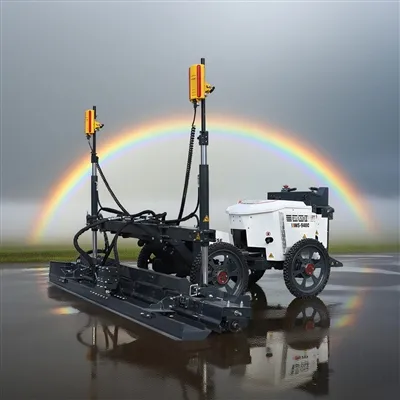
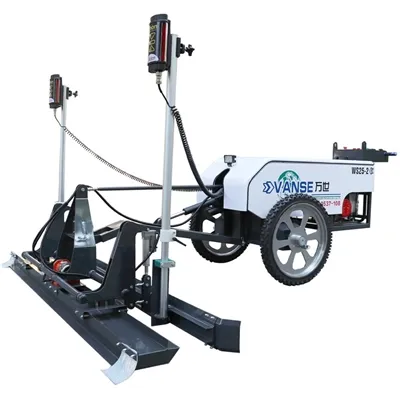
Concrete laser leveling machine is widely used. It is an advanced machine used to super-flatten and level concrete floors. Its application range can be roughly divided into two categories: indoor floor engineering and outdoor floor engineering. These two categories are further subdivided. The following is a detailed introduction to the use of concrete laser leveling machine and the projects of this type that Vanse Machinery's products have done.
Nowadays, concrete laser leveling machines are being used more and more widely. The specific scope of application can be divided into two categories:
1. Indoor floor
①. Industrial plants, workshops, and automated warehouses:
Vanse Machinery has done such projects as Harbin Haier workshop, Beijing Benz workshop, Baoding Great Wall Motors No. 5 spraying workshop, Shandong Classic Group steel structure production line workshop and other projects.
②. Clean workshops for electronic appliances, food materials, medicine, etc.:
Vanse Machinery has done such projects as: Suzhou Samsung Electronics Factory, Shandong Xingda Ecological Winery, Shandong Parkson Biological Workshop, Shandong Yuda Medical Workshop and other projects.
③. Large warehouse-style supermarkets, logistics centers, exhibition centers, etc.:
Such projects that Vanse Machinery has done include: Xi'an Fuju Home Plaza, Shenzhen Walmart Supermarket, Wuhan Vipshop Logistics Park, Guangxi Convention and Exhibition Center, Tianjin Yupei Logistics Park and other projects.
2. Outdoor floor
①. Wharf, container yard, cargo yard:
Such projects that Vanse Machinery has done include: Hubei Xiangzhou Industrial Park, Shanxi Shenlong Energy Coking and other projects.
②. Airport runway, apron, parking lot:
Such projects that Vanse Machinery has done include: Shandong Xinbaihui underground parking plant, Changchun FAW-Volkswagen parking lot, Hebei Hualian Supermarket large underground parking lot, Sichuan Wanda Plaza large underground parking lot, Hubei Xiangyang Dongjin Century City underground parking lot and other projects
③. Plaza, residential ground, municipal pavement, etc.:
Such projects that Vanse Machinery has done include: Nanjing Huawei Electronics Company floor, Shenyang Electronics Factory floor integration, Sichuan Hualian Plaza, Hubei Xiangyang Dongjin Century City and other projects.
Shandong Yanzhou Vanse Machinery Technology Co., Ltd. is the only high-tech enterprise in China that integrates R&D, manufacturing, sales, and technical services, specializing in concrete laser leveling machines. The use of "" brand concrete laser leveling machines can reduce about 60% of high-intensity labor, save about 50% of construction costs, shorten about 50% of construction period, and increase the strength and density of the floor by about 25%. The company has always been based on the tenet of "people-oriented, leading technology, honest management, and creating a well-known brand". We will provide customers with reliable products and perfect services, develop together, and create good results.
Thanks to All the Friends Who Support and Trust Shandong Vanse Machinery Technology Co., Ltd.
If you want to know more about Shandong Vanse Machinery Technology Co., Ltd. or have any questions, please feel free to contact us:
Our Factory
Shandong Vanse Machinery Technology Co., Ltd.








Share this article

About the Author: Shandong Vanse Machinery Technology Co., Ltd.
Shandong Vanse Machinery Technology Co., Ltd. is a high-tech manufacturer specializing in concrete construction machinery, including laser screeds and related equipment. The company integrates R&D, production, and global sales, with products exported to over 60 countries and widely used in infrastructure projects worldwide.
Previous Post
Next Post
Related Articles
You Might Also Like
Regarding environmental awareness education, how can the environmental awareness of workers using a concrete laser leveling machine be raised?
To enhance environmental awareness among concrete laser leveling operators during environmental awareness education, it's necessary to consider the specific construction scenarios, the cognitive patterns of operators, and the operational characteristics of the equipment. A comprehensive education program encompassing "cognition – skills – habits – supervision" should be designed to ensure that environmental protection concepts are translated into concrete construction behaviors. The following are possible optimization directions: First, identify the core issues directly related to environmental protection in concrete laser leveling construction to ensure that educational content is relevant and targeted, avoiding generalities. Three key pain points should be addressed: easily seep into the soil and contaminate groundwater); exhaust emissions from the equipment's engine (including NOx and particulate matter); and the indiscriminate discharge of wastewater from post-operation equipment cleaning (which contains cement residue and can cause soil compaction). Consumables and resource waste include: improper operation leading to misaligned concrete levels, resulting in rework and waste of raw materials; and the careless disposal of waste oil during equipment oil and hydraulic oil changes (which can contaminate soil). Environmental impacts include: noise from equipment operation (especially disturbing in residential areas) and dust from operation (dust spread due to failure to cover or water the surface). The first step in education: Use "case studies + data" to help construction workers intuitively understand the hazards. For example, show real-life cases such as "A project was fined 50,000 yuan by the environmental protection department for excessive wastewater discharge from a laser leveling machine" and "Waste oil seeping into the soil caused the withering of surrounding vegetation." Or calculate, "If a laser leveling machine reduces concrete rework by 10% per operation, it can save approximately 20 tons of cement per year (equivalent to reducing CO₂ emissions by 18 tons)." Use concrete consequences and benefits to build environmental awareness. Differentiated educational content is designed based on the differences in responsibilities of different positions (operators, auxiliary workers, and on-site managers) to avoid a "one-size-fits-all" approach and ensure that the content is directly related to the work of the personnel. Positions Core Educational Content Educational Objectives Laser leveling Operator 1. Environmentally Friendly Equipment Operation: such as precisely controlling concrete paving thickness (to reduce rework and waste) and promptly shutting down the engine after work (to reduce idling exhaust emissions); Master environmental protection skills in all aspects of "operation – maintenance – emergency" 2. Environmentally Friendly Equipment Maintenance: such as standardized waste oil recovery (designated containers and transfer to qualified personnel) and recycling equipment cleaning wastewater (e.g., connecting to a sedimentation tank); 3. Emergency Response: such as quickly sealing slurry leaks (covering with impermeable cloth) and absorbing oil spills (using absorbent cotton); Field Assistant 1. Consumables Management: such as recycling concrete residue (to avoid careless disposal) and dustproof covering (covering unhardened surfaces with geotextiles promptly after work); Clarify environmental protection responsibilities in auxiliary work and reduce hidden pollution 2. Waste Separation: such as separating equipment packaging materials (plastic, cardboard) from construction waste. Field Manager 1. Implementation of Environmental Protection Systems: such as establishing environmental standards for equipment operations (e.g., exhaust emission standards and wastewater discharge locations); Possess overall management capabilities to control environmental risks from the source 2. Risk Assessment: such as proactively identifying sensitive groundwater areas in the work area to prevent slurry infiltration. Construction workers tend to prefer hands-on learning and are averse to purely theoretical indoctrination. Therefore, environmental education should be more accessible through scenarios, practical exercises, and engaging content. ① Scenario-Based Practical Training: "Learning by Doing" on the construction site Environmental Protection Operation Demonstration Post: Experienced operators are selected to demonstrate environmentally friendly practices during laser leveling operations, such as "How to adjust equipment parameters to reduce concrete waste" and "How to properly clean equipment after operation (connecting a wastewater bucket to prevent turbulence)." Other personnel observe and practice on-site, while administrators simultaneously explain the environmental significance of each action (e.g., "Recycling one bucket of wastewater can reduce soil pollution by one square meter"). Environmental Protection Emergency Drill: Simulating scenarios such as "laser leveling hydraulic oil leak" and "concrete slurry flowing into green belts," construction personnel practice on-site techniques such as "contain oil stains with absorbent cotton" and "intercept slurry with sandbags and recycle it." They are evaluated on "handling speed and environmental effectiveness" to strengthen their emergency environmental protection skills. ② Visual Promotion: Making Environmental Protection Knowledge Visible and Remembrance-Friendly On-site "Environmental Warning Walls": Near the laser leveling machine operating area, use images and brief text to illustrate "wrong versus correct operation"-for example, the image on the left shows "Waste oil spilled on the ground withers vegetation" and the image on the right shows "Waste oil poured into a dedicated bucket and handed over to a recycling truck." Below, it's labeled "1 liter of waste oil = 1,000 liters of water contaminated." Equipment "Environmental Reminder Stickers": Stickers are placed on the laser leveling machine's operating panel, fuel tank cap, and other locations, such as "Check exhaust filter before starting (operate only if it meets standards)" and "Pour waste oil into the red bucket after oil change" to constantly remind operators to pay attention to environmental details. ③ Interactive Incentives: Reinforce Environmental Habits with Positive Feedback Environmental Points System: Create an environmental points account for construction workers-for example, "5 points for recycling a barrel of waste oil in a proper manner," "10 points for no concrete rework," and "3 points for notifying others of environmental violations." Points can be redeemed for daily necessities (such as laundry detergent and hard hats) or priority access to skills training, using incentives to drive proactive environmental protection. Environmental Complaints: Regularly organize gatherings for construction workers to share environmental issues they've encountered (e.g., "There was no place to drain wastewater during previous operations, so it just flowed randomly") and discuss solutions (e.g., "Requesting a temporary sedimentation tank in the work area"). This helps workers move from passive acceptance to active participation in environmental improvements. Education must be accompanied by supervision to prevent the "learned and forgotten" approach. Through a combination of "institutional constraints and positive guidance," environmental protection can become a conscious behavior of construction workers. Clarify environmental responsibility lists: Environmental requirements for laser leveling operations are included in job responsibilities, such as "Operators must ensure the concrete rework rate is ≤3% for each operation" and "Managers must inspect equipment exhaust emissions daily." This assigns responsibilities to specific individuals to prevent "no one in charge." Daily Inspections + Regular Assessments: During daily inspections, on-site managers will focus on environmental aspects of laser leveling operations (e.g., "Is there any wastewater discharge?" and "Is waste oil recycled?") and record environmental compliance. Environmental performance will be included in monthly performance appraisals. Those who maintain compliance for three consecutive months will be awarded the title of "Environmental Model" and receive rewards. Those who violate regulations will receive retraining and a deadline for rectification. Introduce "Environmental Supervisors": One or two "Environmental Supervisors" (optional) will be selected from construction personnel (part-time positions available) to regularly remind colleagues to adhere to proper operation procedures and collect feedback on environmental issues to management, fostering a culture of mutual monitoring and shared participation. Leveraging external expertise, we can help construction workers understand that environmental protection isn't a burden, but a long-term benefit, thereby increasing their willingness to proactively practice environmental protection. Invite environmental protection officials to provide on-site presentations: Environmental enforcement officers will use local case studies (e.g., "A construction site was penalized for pollution caused by a laser leveling") to explain environmental regulations (e.g., construction-related provisions in the Air Pollution Prevention and Control Law and the Soil Pollution Prevention and Control Law) and clarify the consequences of violations (fines, work suspension, and impact on corporate credit). Introduce green construction case studies: Invite project teams implementing "environmentally friendly construction" to share their experiences. For example, "A project used precise laser levelinging and waste material recycling to save 30 tons of concrete, reduce costs by 20,000 yuan, and even earn the local "Green Construction Site" designation." This allows construction workers to see that "environmental protection equals cost reduction and honor," dispelling the misconception that "environmental protection increases costs." Through the above methods, environmental awareness can be transformed from a "slogan" into the "daily operation" of concrete laser leveling machine construction workers, which not only reduces the impact of construction on the environment, but also reduces the environmental risks of the project, and achieves a dual improvement in "project quality + environmental benefits". Note: The parameters provided in this document are for reference only and are not mandatory. Due to differences in technical characteristics between different brands and models of laser levelers, please consult the manufacturer for a suitable solution before actual operation. This reference document assumes no responsibility for any issues arising from failure to follow the manufacturer's instructions.The impact of concrete fiber type (steel fiber VS synthetic fiber) on laser leveling operation and surface performance
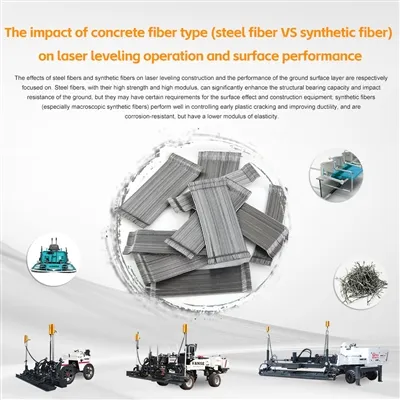
The effects of steel fibers and synthetic fibers on laser leveling construction and the performance of the ground surface layer are respectively focused on. Steel fibers, with their high strength and high modulus, can significantly enhance the structural bearing capacity and impact resistance of the ground, but they may have certain requirements for the surface effect and construction equipment; synthetic fibers (especially macroscopic synthetic fibers) perform well in controlling early plastic cracking and improving ductility, and are corrosion-resistant, but have a lower modulus of elasticity. In order to more clearly contrast the core differences between the two, I have compiled the following table: Comparison dimension Steel fiber Synthetic fibers The influence on the laser leveling construction operation It has a significant impact on the mixture and workability: The concrete appears drier and requires adjustments to the mix ratio (such as increasing the amount of cement or using water reducers) to ensure construction performance. Better workability: Has a smaller impact on the fluidity of concrete, making it easier to pump and spread. It causes severe wear on machinery: It causes more severe wear on mixers and laser leveling machines. More friendly to equipment: Causes less wear on construction equipment, and the machine operation is smoother. The influence on the performance of the ground surface layer (mechanical properties) Excellent tensile, shear and impact resistance: It can significantly improve the toughness of concrete, effectively transfer and withstand high loads, and prevent crack propagation. Improves toughness and post-crack bearing capacity: Can provide three-dimensional constraints after the concrete cracks, absorbing energy and preventing crack expansion. High elastic modulus: It has good coordination with the concrete matrix and can effectively prevent long-term creep of the concrete. Lower elastic modulus: Approximately 1/10 to 1/40 of that of steel fibers, and its contribution to structural stiffness is less than that of steel fibers under high loads. The influence on the performance of the ground surface layer (crack resistance and durability) Excellent crack resistance: It effectively limits micro-cracks in concrete caused by temperature and shrinkage. Excellent effect in controlling early plastic shrinkage and cracking: Especially suitable for suppressing early cracks within 12 hours after concrete pouring. Corrosion risk exists: Rust stains on the surface may affect the appearance, but usually do not cause the concrete to peel off. Fully corrosion-resistant: Stable performance in acidic and alkaline environments, no need for protective layer. Malleability: According to a study, at a specific dosage, the wear rate of steel fiber concrete may be higher than that of synthetic fiber concrete. Fire resistance: Microscopic synthetic fibers (such as polypropylene microfibers) have a low melting point and can form channels at high temperatures to release steam pressure, effectively preventing concrete from cracking. The influence on the final surface effect and post-processing May affect surface appearance: The surface treatment method is limited and is not suitable for creating decorative effects such as pattern embossing or exposed aggregate. If the fibers are exposed, it may cause harm to the human body or the waterproof layer. Compatible with various surface treatments: It is applicable to almost all surface treatment methods, including embossing, sandblasting, polishing, etc. No pressure during cutting: All sawing equipment can be used normally for steel fiber concrete. Cleaner surface effect: There is no risk of exposed metal fibers, resulting in a better appearance. The key factor in choosing which type of fiber to use depends on your ground application and performance requirements: Super heavy industrial workshops, warehouses, and aprons: They need to withstand huge dynamic loads and impacts, and have extremely high requirements for the structural bearing capacity of the ground. At this time, steel fibers are a more reliable choice. Large commercial floors, underground garages, and floors requiring good surface decoration: The main contradiction is to control early cracking, and there are requirements for surface appearance and corrosion resistance. Then, synthetic fibers (especially macro synthetic fibers) are a more economical and efficient choice. High-rise buildings or tunnels with special fire protection requirements: The risk of concrete cracking under high temperatures must be considered. At this time, fine polypropylene synthetic fibers must be added. In actual engineering projects, there are also many projects that choose to use a combination of the two (for example, using steel fibers to ensure structural strength and using fine synthetic fibers to control early plastic cracking) to complement each other and achieve the best performance and cost balance. What scenarios does your project mainly apply to? If you can provide more information about the ground design load or requirements for crack resistance, I can help you do a more specific analysis. Contact us NOW Note: The parameters provided in this document are for reference only and are not mandatory. Due to differences in technical characteristics between different brands and models of laser levelers, please consult the manufacturer for a suitable solution before actual operation. This reference document assumes no responsibility for any issues arising from failure to follow the manufacturer's instructions.What special attention should be paid to the maintenance and care of concrete laser leveling machines under different climatic conditions?
– Under high temperature environment, the engine (if it is a fuel laser leveler) and hydraulic system are prone to overheating. For the engine, make sure that the coolant in the radiator is sufficient and clean. The coolant level should be checked regularly, generally every 8-10 hours of work, and the coolant should be replaced regularly according to the requirements of the equipment manual. It is usually recommended to replace it once a year. – Clean the dust and debris on the surface of the radiator, as these will affect the heat dissipation effect. You can use a compressed air can or a soft brush to gently clean it to avoid damaging the radiator fins. – For the hydraulic system, some laser levelers are equipped with a hydraulic oil cooler. Also ensure that its surface is clean and pay attention to the temperature of the hydraulic oil. If the hydraulic oil temperature is too high, it may cause the performance of the hydraulic system to decline or even damage. – Try to avoid using the equipment for a long time when the temperature is highest during the day (usually 12 noon-3 pm). Because during the high temperature period, the operating temperature of each component of the equipment is already high, and long-term continuous operation will further aggravate heat accumulation and increase the risk of equipment failure. – The working time can be adjusted to the early morning or evening, when the ambient temperature is relatively low, which is conducive to the normal operation of the equipment. If it is unavoidable to work during high temperature periods, the rest frequency of the equipment should be increased. After every 1-2 hours of work, the equipment should be allowed to rest for 15-20 minutes to allow the various parts of the equipment to fully dissipate heat. – High temperature will accelerate the evaporation and aging of lubricating oil (grease), so the lubrication of the equipment should be checked more frequently. For example, for the bearings, chains and other parts of the equipment, lubrication may be performed once every 50-100 hours of work. In a high temperature environment, it is necessary to check and add grease every 30-50 hours of work. – At the same time, check the seals of the equipment, such as the seals at the joints of the hydraulic pipes and the engine oil seals. High temperature may cause the seals to age and deform, resulting in leakage. If the seals show signs of damage, they should be replaced in time to avoid leakage of hydraulic oil or coolant, which will affect the normal operation of the equipment. – For fuel-type laser levelers, use fuel suitable for low temperature environments. In cold weather, diesel may wax, which will affect the start and normal operation of the engine. You can add anticoagulants or use low-grade winter diesel to solve this problem. – Battery performance will decrease at low temperatures, so make sure the battery is fully charged. When the equipment is not in use, the battery can be removed and placed in a warm room for charging and storage. In addition, before starting the equipment, the battery can be preheated, such as using a battery heater, which can improve the battery's starting ability. – The engine should be fully preheated before starting. According to the requirements of the equipment manual, use a preheating device to preheat the engine. The preheating time is generally determined by the ambient temperature. For example, in an environment of about minus 10℃, the preheating time may take 10-15 minutes. – For the hydraulic system and working parts, do not let the equipment work at full load immediately after starting. Let the equipment run at no load for 5-10 minutes to gradually heat up the hydraulic oil and various components. After reaching the normal working temperature, start construction. – If the equipment is not used for a long time, it should be stored indoors or in a place with insulation measures to avoid exposure to cold outdoor environments. If it can only be stored outdoors, the equipment should be properly covered to prevent damage to the equipment caused by snow and ice. – Antifreeze can be added to the water tank and hydraulic oil tank of the equipment to prevent the water tank and oil tank from freezing and cracking at low temperatures. The amount of antifreeze added should be in accordance with the requirements of the equipment manual. Generally, the concentration of antifreeze should be ensured to effectively prevent freezing at the expected minimum temperature. – Check the electrical system of the equipment to ensure that all electrical components (such as motors, controllers, sensors, etc.) have good waterproof seals. For wire connectors exposed to the outside, waterproof tape or sealant can be used to wrap them to prevent moisture from entering and causing short circuits. – The laser transmitter and receiver of the laser leveling machine should also be waterproof. In humid weather, if these precision components are damp, it may affect the transmission and reception of laser signals, thereby affecting the construction accuracy. You can use a special waterproof cover to protect it. When the equipment is not in use, store these parts in a dry place. – Humid air can easily cause equipment to rust, especially the metal parts of the equipment. Anti-rust oil or anti-rust paint can be applied to the surface of the equipment, and the parts that are prone to rust (such as chassis, scrapers, screws, etc.) should be protected. – Regularly check whether the equipment has signs of rust. For rusted parts, rust removal should be carried out in time. You can use sandpaper or rust remover to remove the rust, and then apply anti-rust oil or touch-up paint. – After working in humid weather, the equipment should be cleaned and dried in time. Use a clean rag to wipe off the moisture on the surface of the equipment. For parts inside the equipment that may be damp (such as the cab, electrical control cabinet, etc.), a hair dryer or dehumidifier can be used to dry them. – At the same time, the working parts of the equipment (such as scrapers, spiral distributors, etc.) should be cleaned to prevent concrete residues and moisture from mixing and solidifying on the parts, affecting the next use of the equipment.