Technical Knowledge
Can a push power trowel be used in small indoor scenes?

Hand-push trowels can be used for small indoor scenes, but the following aspects need to be considered before use:
1. Applicability
Site area and shape
– Hand-push trowels are suitable for indoor scenes with relatively small areas. If the indoor space is relatively open and regular in shape, such as warehouses, large exhibition halls, etc., hand-push trowels can play a good role. It can be easily pushed on the flat ground to smooth the concrete and other floor materials.
– However, if the indoor space is narrow and there are many obstacles or corners, the use of hand-push trowels may be restricted. Because its size and operation method determine that it is difficult to turn and operate in a small space.
Floor materials and conditions
– For common indoor concrete, cement mortar and other floor materials, hand-push trowels can effectively smooth and compact the surface to make the floor smoother and smoother. It can handle newly poured floors and help remove surface defects such as bubbles and protruding pebbles.
– However, if the floor material is special, such as wooden floors, epoxy floors, etc., which are relatively fragile or require extremely high surface accuracy, the hand-push trowel may not be suitable. Because its working principle is to operate through a rotating trowel blade, it may cause damage to these special floors.
2. Convenience of operation
Operation difficulty
– The hand-push trowel is relatively simple to operate, and general operators can get started after simple training. It is pushed forward by manpower, and the direction and speed can be adjusted at any time according to the ground conditions during operation. For example, near the wall or pillar, you can slow down and operate carefully to avoid collision.
– However, long-term use of the hand-push trowel requires certain arm and waist strength, and the operator may be more tired.
Mobile flexibility
– The hand-push trowel is small in size and is easier to move in indoor scenes. In indoor areas without large equipment access channels, it can be transported to the work site through small doorways or elevators.
– However, compared with large driving trowels, its movement speed is slower, and work efficiency will be affected to a certain extent.
3. Safety and environmental factors
Safety risks
– The hand-push trowel has a high speed. If the operator is not careful during operation, clothing, hair, etc. may be drawn into the machine, causing safety accidents. Therefore, the operator needs to wear appropriate work clothes and protective equipment, such as safety helmets, gloves, etc.
– In addition, since the operation is indoors, the ground may be slippery, so be careful to prevent slipping when pushing the trowel.
Noise and dust
– The hand-push trowel will generate certain noise and dust when working. In small indoor scenes, the noise may interfere with the surrounding environment, so try to choose the right time to operate to avoid affecting others.
– For dust problems, you can reduce its impact on indoor air quality by equipping a dust collection device or strengthening ventilation.
Thanks to All the Friends Who Support and Trust Shandong Vanse Machinery Technology Co., Ltd.
If you want to know more about Shandong Vanse Machinery Technology Co., Ltd. or have any questions, please feel free to contact us:
Our Factory
Shandong Vanse Machinery Technology Co., Ltd.








Share this article

About the Author: Shandong Vanse Machinery Technology Co., Ltd.
Shandong Vanse Machinery Technology Co., Ltd. is a high-tech manufacturer specializing in concrete construction machinery, including laser screeds and related equipment. The company integrates R&D, production, and global sales, with products exported to over 60 countries and widely used in infrastructure projects worldwide.
Previous Post
Next Post
Related Articles
You Might Also Like
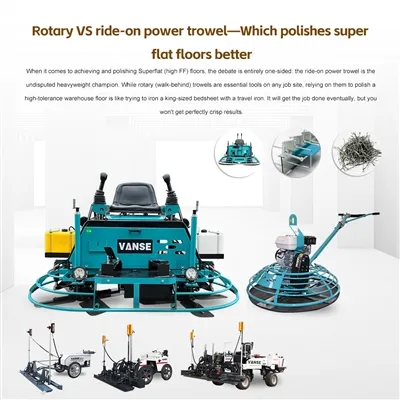
Rotary VS ride-on power trowel—Which polishes super flat floors better
When it comes to achieving and polishing Superflat (high FF) floors, the debate is entirely one-sided: the ride-on power trowel is the undisputed heavyweight champion. While rotary (walk-behind) trowels are essential tools on any job site, relying on them to polish a high-tolerance warehouse floor is like trying to iron a king-sized bedsheet with a travel iron. It will get the job done eventually, but you won't get perfectly crisp results. Here is the technical breakdown of why ride-on trowels dominate the Superflat and polishing arenas. The primary goal of a Superflat floor is high FF (Flatness), which means eliminating the microscopic "waves" in the concrete. Ride-On Trowels: Because they feature dual (or triple) overlapping rotors and a wide, rigid wheelbase, they act like a massive carpenter's plane. When equipped with float pans, a ride-on trowel "bridges" the low spots and violently shaves off the high peaks. Walk-Behind Trowels: A walk-behind has a single, small rotor. Instead of bridging the waves, it tends to ride up and down them. If you aren't careful, a walk-behind can actually create dips and dishing, ruining your FF numbers. Polishing and densifying the surface (creating that hard, dark "burnished" look) requires extreme friction and pressure. Ride-On Trowels: These machines weigh anywhere from 800 lbs to over 2,500 lbs. That massive downward force, combined with high-speed rotors and a steep blade pitch, generates the heat and friction necessary to melt the surface paste into a glass-like finish. Walk-Behind Trowels: Weighing in at only 150 to 300 lbs, they simply do not have the mass to forcefully close the pores of the concrete to the same density as a ride-on. This is the most critical factor for Superflat floors. Walk-Behind Trowels: The operator must physically walk backward on the curing concrete. Even when the concrete is firm enough to support a machine, work boots can still leave millimeter-deep micro-depressions. Every footprint is a localized failure in flatness. Ride-On Trowels: The operator sits on the machine. The weight is entirely distributed across the massive surface area of the rotors or float pans, leaving zero footprints and maintaining the pristine levelness established by the laser Leveling. Feature Ride-On Power Trowel Walk-Behind (Rotary) Trowel Superflat Capability Exceptional (Bridges waves) Poor (Follows contours) Burnishing/Polishing Superior (High downward pressure) Moderate (Lacks weight) Surface Disruption Zero (Operator rides) High (Operator footprints) Best Used For The main floor (the "runway") Edges, tight corners, around pipes It is worth noting that you still need both machines on a Superflat project. A massive ride-on trowel cannot get within a few inches of a wall or a structural column without risking damage to the concrete or the machine. The standard Superflat workflow uses ride-on trowels for 95% of the floor area to establish the density and flatness, while a skilled operator uses a walk-behind trowel equipped with a rotating edge ring to manually polish the remaining 5% along the perimeter. Would you like me to outline a specific overlapping pass pattern for a ride-on trowel to ensure you don't create ridges while pushing for maximum FF numbers? Contact us NOW Note: The parameters provided in this document are for reference only and are not mandatory. Due to differences in technical characteristics between different brands and models of laser levelers, please consult the manufacturer for a suitable solution before actual operation. This reference document assumes no responsibility for any issues arising from failure to follow the manufacturer's instructions.How to improve the safety of concrete laser leveling machine?
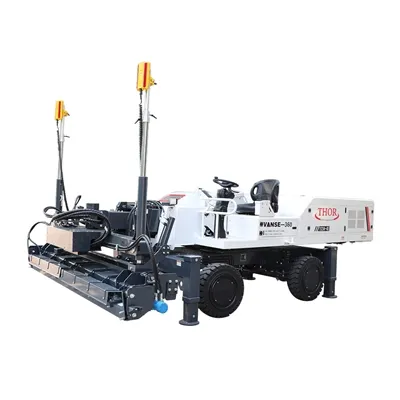
Operator safety training and qualification management 1. Professional training requirements Certification required: Operators must pass the training of manufacturers or professional institutions, master the equipment principles, operation procedures and emergency shutdown methods, and hold valid certificates to work after passing the assessment. Regular refresher training: Safety operation refresher training is carried out every six months, focusing on strengthening practical skills such as coping with new working conditions (such as slope operation, night construction), emergency handling of equipment abnormalities, etc. Case warning education: Analyze typical accident cases in the industry (such as leveling beam falling, laser system misjudgment leading to collision), and clarify the hazards of illegal operations. 2. Safety awareness training It is strictly forbidden to work after drinking or fatigue, stay focused during operation, and it is forbidden to make phone calls or distracted operations during operation. Establish a "double confirmation" system: key actions (such as equipment displacement, parameter modification) require two people to check and confirm to avoid single-person misoperation. Equipment safety protection device upgrade and maintenance 1. Mechanical safety protection Emergency stop button The machine body and operating handle are equipped with red emergency stop buttons. When pressed, the power system is immediately cut off, and the response time is ≤0.5 seconds. Anti-fall protection The leveling beam lifting system is equipped with a double brake device (hydraulic lock + mechanical lock). When the hydraulic system fails, the mechanical lock automatically locks to prevent the beam from falling. Overload protection The hydraulic system is equipped with a relief valve, which automatically relieves the pressure when the pressure exceeds 110% of the rated value; the motor is equipped with an overload protector to prevent the motor from being burned by excessive current. Protective cover for moving parts Metal protective covers are installed on rotating parts such as chains and pulleys. The protective covers must pass the 100N force test without deformation to prevent people from contacting and getting injured. 2. Electrical and laser system safety Leakage protection: The electrical system is equipped with a leakage circuit breaker (operating current ≤30mA, operating time ≤0.1 second), and the cable joints are waterproof and sealed to prevent rainwater from seeping in and causing electric shock. Laser safety level: Use Class 3B or lower laser transmitters (wavelength 630-670nm, power ≤50mW), avoid direct exposure to human eyes, and set up "Laser Danger" warning signs in the operating area. Anti-electromagnetic interference: The control system line uses shielded cables, away from interference sources such as electric welders and high-frequency equipment, to prevent laser signal misjudgment from causing equipment out of control. Safety management specifications for the working environment 1. Site pretreatment Survey the site before construction, remove hidden dangers such as underground pipelines, steel bar heads, and water pits, and lay steel plates (thickness ≥ 20mm) on soft ground to prevent the equipment from sinking and rolling over. Define the working area, set up cordons and warning signs, and keep non-operating personnel at least 5 meters away from the equipment to avoid collision when the leveling beam rotates. 2. Safety measures for special working conditions Night/low-light operation: Install LED work lights (brightness ≥ 200lux) to ensure that there is no shadow in the operating area; add reflective signs to the laser receiver to assist manual observation of the equipment position. Slope operation: When the slope exceeds 5°, the stability of the equipment must be tested first (run without load for 10 minutes), and the walking speed must be controlled to ≤1.5km/h during operation to avoid sudden stops and sudden turns. Rainy days/humid environment: Stop open-air operations. If construction is necessary, check the waterproof performance of electrical components, and operators must wear insulating shoes and gloves. The grounding resistance of the equipment must be ≤4Ω. Operation process safety control 1. "Three-step inspection" before operation Mechanical inspection: Test the lifting and traveling system of the leveling beam to confirm that there is no jamming in each action and the pressure of the hydraulic system is normal (the pressure gauge shows within the rated value ±0.5MPa). Electrical inspection: Test the calibration accuracy of the laser system (target ruler measurement error ≤3mm), check whether the sensor signal transmission is stable, and the backup battery power is ≥80%. Safety device test: Press the emergency stop button to confirm that the equipment stops immediately; simulate the loss of pressure in the hydraulic system to verify whether the mechanical lock starts automatically. 2. Key points for safe operation during operation It is forbidden to climb the fuselage or adjust the components when the equipment is running. When maintenance is required, the equipment must be shut down and the power must be cut off. When transferring the site, the leveling beam must be raised to the lowest position and locked, the driving speed must be ≤5km/h, and the height and weight limit must be confirmed before passing through the bridge and tunnel (equipment height + 0.5m safety margin). When multiple people work together, a dedicated person should be assigned to direct, and an intercom (fixed channel) or hand signals (such as the "stop" gesture is to extend the arm horizontally forward) should be used to avoid communication errors. V. Safety regulations in maintenance 1. Power-off and sign-out system Before maintenance, turn off the main power switch and hang a "no closing" warning sign. The key is kept by the maintenance personnel to prevent accidental start-up. Hydraulic system pressure relief: Loosen the cylinder exhaust valve and confirm that the pressure drops to 0MPa before disassembling the pipeline to avoid high-pressure oil spray and injury. 2. High-altitude work protection When inspecting the laser transmitter (height ≥ 2 meters), use an anti-slip ladder (load bearing ≥ 150kg) or a lifting platform, and the operator wears a safety belt (hook fixed to an independent anchor point). It is forbidden to stand or walk on the leveling beam. When the beam needs to be inspected, it needs to be supported by a safety bracket (support point load bearing ≥ 1.5 times the weight of the equipment). Emergency response and safety plan 1. Emergency response process for sudden failures Fault type Emergency measures Laser system failure Immediately switch to manual mode, stop operation, evacuate personnel, and notify technicians to calibrate or replace the receiver. Hydraulic system oil leakage Turn off the engine, surround the oil leak area with sandbags to prevent spread, use oil-absorbing cotton to clean, and strictly prohibit open flames from approaching (hydraulic oil ignition point ≥ 180℃). Risk of equipment tipping over Operators immediately evacuate to a safe area, slowly reset with a jack (the support point must be at the specified position of the frame), and it is strictly forbidden to force the equipment to start. 2. Safety plan and drills Formulate the "Laser Leveler Safety Accident Emergency Plan", clarify the handling procedures for electric shock, mechanical injury, laser burns, etc., and equip first aid kits (including tourniquets, burn ointments, etc.). Organize emergency drills every quarter to simulate scenarios such as equipment out of control and personnel injuries, improve the team's response speed, and archive the drill records for future reference. Strengthening the safety management system Daily inspection form: Formulate an "Equipment Safety Inspection Form", which includes 20 inspection items such as braking system, lighting, safety devices, etc., and the operator signs and confirms before daily operation. Responsibility traceability mechanism: Incorporate safety indicators into the performance appraisal of operators. For those who violate the regulations and cause accidents, deduct bonuses or pursue legal liability according to the degree of responsibility. Technology upgrade investment: Regularly update equipment safety modules (such as installing GPS positioning anti-crossing system and blind spot camera), and use intelligent monitoring system to warn abnormal data in real time (such as alarm when hydraulic oil temperature exceeds 90℃). Through the above measures, the operation risk of concrete laser leveling machine can be systematically reduced. It is recommended to combine the equipment instruction manual and industry safety standards (such as GB 2894-2008 "Safety Signs and Guidelines for Their Use"), formulate a personalized safety manual, and continuously track the application of new technologies (such as AI visual anti-collision system) to dynamically improve the level of safety protection.Can concrete polishing machines replace power trowels for achieving mirror-finish super flat floors?
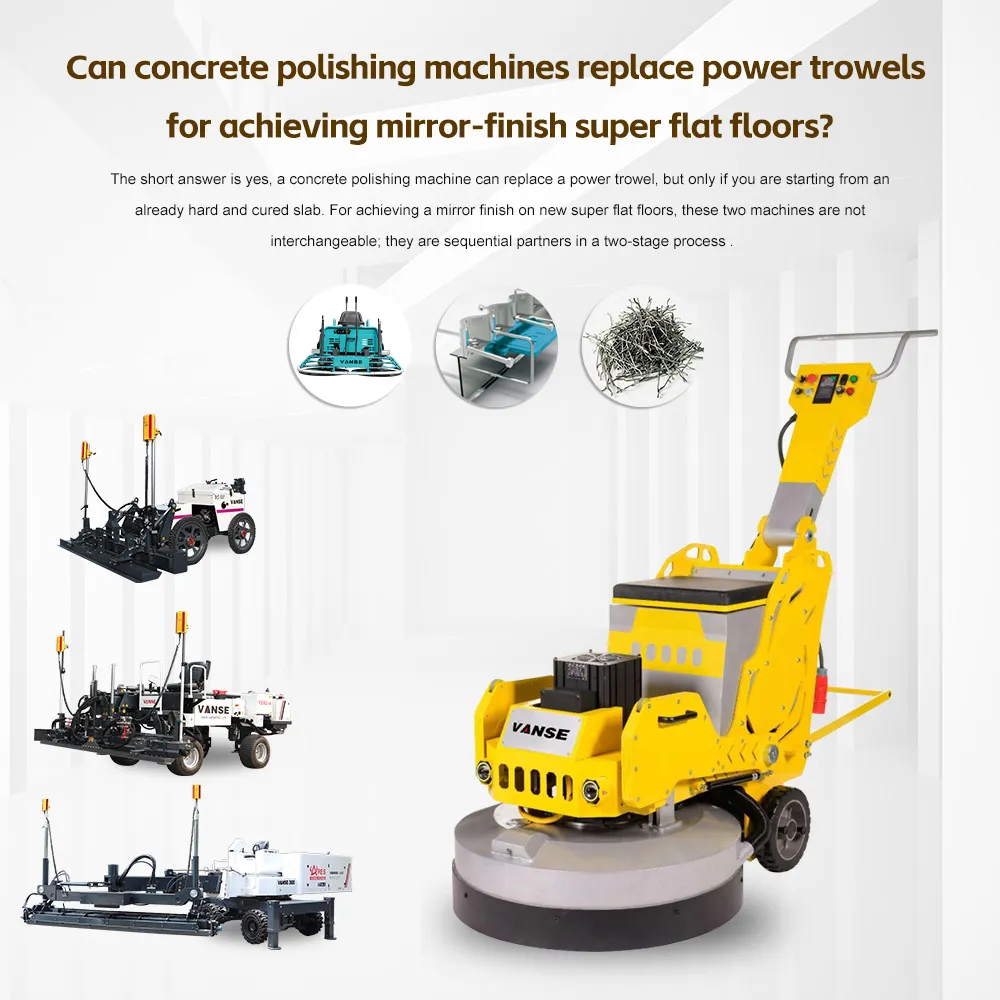
The short answer is yes, a concrete polishing machine can replace a power trowel, but only if you are starting from an already hard and cured slab. For achieving a mirror finish on new super flat floors, these two machines are not interchangeable; they are sequential partners in a two-stage process . To understand why, you have to look at when in the concrete's life cycle each machine operates. A power trowel works on wet, setting concrete, while a polishing machine works on hard, cured concrete. Feature Power Trowel (Finishing Stage) Concrete Polisher (Hardening Stage) When to Use During the concrete's initial set (while still plastic/hardening) . After the concrete has fully cured (typically 28+ days) . How it Works Uses steel blades to float, compact, and "burnish" the surface paste, creating a temporary mechanical shine . Uses abrasive diamond pads to physically grind down the surface, exposing the aggregate and creating a permanent structural shine . Result Creates the initial dense, smooth surface required before any polishing can happen. This is the foundation. Removes the top layer to achieve the final desired gloss level (from satin to mirror). This is the final art. Goal Densification & Profile Creation. To prepare a flat, cured slab ready for polishing. Aesthetics & Durability. To reveal the aggregate and create a long-lasting, high-gloss finish . Think of it like building a piece of fine furniture. You cannot start with a rough log and immediately apply varnish. You need a plane to make it flat first. The power trowel's job is to create a perfectly flat and dense foundation. As we discussed in your previous question about operation time, the trowel burnishes the surface. If you try to use a polishing machine on a floor that hasn't been properly power-troweled, the slab will be too rough and uneven. The polisher would have to remove far too much material to achieve flatness, which is inefficient and costly . Once the concrete is cured, the polishing machine takes over. You attach diamond abrasive pads (starting coarse and moving to very fine, like 3,000 grit) . This process physically cuts the surface, revealing the inner beauty of the stone and creating a shine that is part of the material itself, not just a surface effect . Technically, yes, a power trowel can be converted into a high-speed polishing machine, but this is for the polishing phase only. The Conversion: You can buy a conversion kit (planetary grinding heads) that attaches to the bottom of a power trowel, allowing it to hold diamond polishing pads . The Advantage: This is incredibly fast. A converted ride-on power trowel can polish over 10,000 square feet a day, making it ideal for massive warehouses . The Trade-off: A converted trowel is less precise than a dedicated planetary grinder and cannot get close to walls or into corners. You would still need a smaller, walk-behind grinder for the edges . Regardless of which machine you use for polishing, you must apply a chemical hardener called a densifier (usually lithium silicate) after the initial grinding passes . This chemical reacts with the concrete to make it rock-hard, allowing it to accept a high-gloss polish. Without it, the surface will remain chalky and dull. In short: Use the power trowel to build the perfect canvas. Then, bring in the polisher to create the artwork. If you are planning a project, knowing the desired final gloss level (e.g., matte, satin, or high-gloss mirror) will help determine exactly which grit progression you need for the polishing phase. Let me know if you'd like more details on that. Contact us NOW Note: The parameters provided in this document are for reference only and are not mandatory. Due to differences in technical characteristics between different brands and models of laser levelers, please consult the manufacturer for a suitable solution before actual operation. This reference document assumes no responsibility for any issues arising from failure to follow the manufacturer's instructions.