Technical Knowledge
What’s the impact of the laying direction of the steel mesh on the building structure?

The influence of the laying direction of the steel mesh on the building structure is mainly reflected in the following aspects
Stress performance
Relationship with the direction of principal stress:
The main function of the steel mesh is to bear the tensile force in the concrete structure. When the structure is stressed, the principal stress will be generated inside the concrete. The laying direction of the steel mesh should be consistent with the principal stress direction as much as possible, so that the tensile strength of the steel bars can be fully exerted and the bearing capacity of the structure can be effectively improved. For example, in a one-way slab, the load is mainly transmitted along the short span direction, and the direction of the principal tensile stress is also roughly along the short span direction. Therefore, the bottom steel mesh is usually arranged along the short span direction to resist the tensile force.
Two-way stress situation:
For a two-way slab, the spans in both directions are similar, and both bear a large load. The steel mesh in both directions must bear tensile force. At this time, the steel mesh should be arranged in a certain proportion according to the force size in the two directions, and is generally laid perpendicular to each other, so that the structure can have sufficient bearing capacity and good deformation performance in both directions.
Crack resistance
Control of crack direction:
A reasonable laying direction of the steel mesh can guide the development direction of the crack, so that it develops in the direction with less influence on the structural force. For example, in concrete pavement, transverse reinforcement can limit the development of longitudinal cracks, while longitudinal reinforcement can restrain transverse cracks, thereby improving the integrity and durability of the pavement.
Improving crack resistance:
When the steel mesh is laid along the direction where cracks may occur, it can play a "bridge" role after the concrete cracks, withstand the tension on both sides of the cracks, and prevent the cracks from further expanding. For example, in the wall of a hydraulic structure, the horizontal and vertical steel meshes work together to effectively improve the wall's ability to resist cracks caused by factors such as temperature changes and concrete shrinkage.
Structural durability
Protecting steel bars:
The correct laying direction of the steel mesh helps to ensure the protective effect of concrete on the steel bars. The steel bars are wrapped in concrete to prevent them from rusting and corroding when exposed to the external environment. If the steel mesh is laid improperly, resulting in deviation in the position of the steel bars or uneven thickness of the protective layer, the steel bars are prone to rust under the action of external corrosive media, thereby reducing the durability of the structure. For example, in the basement structure of a building, the laying of the steel mesh should ensure that there is a sufficient and uniform concrete protective layer to prevent groundwater from corroding the steel bars.
Uniform stress:
Reasonable laying direction makes the steel mesh evenly stressed in the structure, avoiding premature destruction of concrete due to local stress concentration, thereby providing a stable protective environment for the steel bars and extending the service life of the structure.
In short, the laying direction of the steel mesh is an important factor affecting the performance of the building structure. During the construction process, the laying direction of the steel mesh must be reasonably determined according to the stress characteristics and design requirements of the structure to ensure the safety, applicability and durability of the building structure.
Thanks to All the Friends Who Support and Trust Shandong Vanse Machinery Technology Co., Ltd.
If you want to know more about Shandong Vanse Machinery Technology Co., Ltd. or have any questions, please feel free to contact us:
Our Factory
Shandong Vanse Machinery Technology Co., Ltd.








Share this article

About the Author: Shandong Vanse Machinery Technology Co., Ltd.
Shandong Vanse Machinery Technology Co., Ltd. is a high-tech manufacturer specializing in concrete construction machinery, including laser screeds and related equipment. The company integrates R&D, production, and global sales, with products exported to over 60 countries and widely used in infrastructure projects worldwide.
Previous Post
Next Post
Related Articles
You Might Also Like
How to evaluate the economic benefits of laser leveling machines in municipal engineering?
– Laser leveling machines have a high degree of automation and can greatly reduce manpower input compared to traditional manual leveling methods. In municipal engineering, such as concrete leveling operations on roads and squares, the use of laser leveling machines can complete large-scale construction tasks with fewer operators. For example, traditional manual leveling may require 10-15 workers, while the use of laser leveling machines may only require 3-5 operators, including machine operators, auxiliary personnel, etc. Calculated based on the labor cost per person per day, a large amount of labor costs can be saved in projects with longer construction periods. – Moreover, the operation of laser leveling machines is relatively simple, and personnel who have undergone short-term training can start working, reducing dependence on senior technical workers and indirectly saving labor costs. Because the wages of senior technical workers are usually much higher than those of ordinary workers. – Laser leveling machines can accurately control the paving thickness and flatness of concrete. In municipal road construction, it can accurately lay concrete according to design requirements to avoid excessive laying or uneven thickness of concrete due to imprecise manual operation. For example, manual leveling may cause the concrete thickness error to reach ±10 – 15mm due to lack of experience or improper operation, while the laser leveling machine can control the error within ±3 – 5mm. Such precise control can effectively reduce the waste of concrete, because concrete materials are more expensive in municipal engineering, and reducing waste means reducing material costs. – At the same time, due to the high flatness of the ground leveled by the laser leveling machine, the amount of materials required for subsequent construction (such as paving asphalt, installing curbstones, etc.) is also more accurate, and there will be no additional material consumption due to uneven ground, thereby further reducing material costs. – The laser leveling machine has high working efficiency and can quickly complete large-area leveling tasks. Taking the construction of the municipal square as an example, traditional manual leveling may take several days or even weeks to complete the leveling of a large square, while the laser leveling machine can complete the same workload in a shorter time. For example, a 1,000-square-meter square may take 5 to 7 days to be leveled manually, while a laser leveler may only take 2 to 3 days. – Shortening the construction period can bring many economic benefits. On the one hand, it can enable the project to be put into use ahead of schedule. For example, the early opening of municipal roads can relieve traffic pressure, bring social benefits, and may also obtain additional economic benefits due to early operation; on the other hand, shortening the construction period can reduce the indirect costs of the project, such as construction site management costs, equipment rental costs, etc., which will increase accordingly when the construction period is extended. – The laser leveler is relatively less affected by external factors such as weather, and can maintain stable working efficiency as long as it is under suitable construction conditions. In municipal engineering, especially some key projects with construction period requirements, stable project progress is very important. For example, in areas with more rainy seasons, laser levelers can quickly resume construction in a short time after the rain stops, while manual leveling may delay construction due to factors such as wet ground, thus affecting the progress of the entire project. Stable project progress helps to arrange subsequent construction procedures reasonably, avoid the chain reaction of the entire project caused by the delay of a certain process, and reduce the economic losses that may be caused by project delays. – The ground leveled by the laser leveler has high flatness and good quality. In municipal road projects, a flat road surface can reduce the bumps when vehicles are driving and reduce the probability of cracks, potholes and other diseases caused by uneven force on the road surface. For example, under normal use, the time when road diseases appear on roads treated by laser levelers may be 2-3 years later than that on roads leveled by traditional manual leveling. – Reducing later maintenance can not only save maintenance materials and labor costs, but also avoid indirect economic losses such as traffic congestion caused by road maintenance. For municipal engineering, some lanes may need to be closed during road maintenance, which will affect traffic flow, reduce vehicle traffic efficiency, and generate economic costs. – High-quality leveling effects enhance the overall stability of municipal engineering structures (such as roads, squares, etc.), allowing them to withstand greater loads and longer use. Taking the concrete bridge deck construction of municipal bridges as an example, the use of laser leveling machines can make the bridge deck flatness reach a higher standard. Within the design service life of the bridge, it can better resist the impact of repeated vehicle loads and reduce damage to the bridge deck structure caused by poor flatness, thereby extending the service life of the bridge. In the long run, this will undoubtedly bring huge economic benefits.Super Flat Floor Joint Design and Construction Equipment Coordination Plan
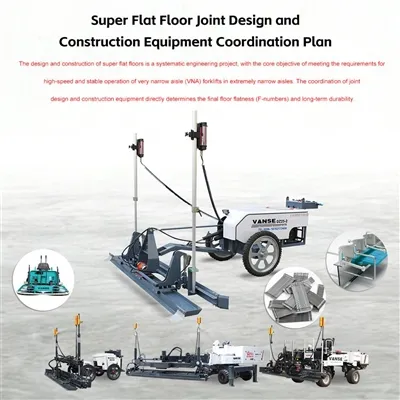
The design and construction of super flat floors is a systematic engineering project, with the core objective of meeting the requirements for high-speed and stable operation of very narrow aisle (VNA) forklifts in extremely narrow aisles. The coordination of joint design and construction equipment directly determines the final floor flatness (F-numbers) and long-term durability. The following is a professional plan for super flat floor joint design and equipment coordination: Ultra-flat floor slabs typically follow the principle of "large slab spans and fewer joints" to reduce the impact of forklift wheels on the joints. Load Transfer Bar Design: Square load transfer bars or armored joints must be used. Armored joints consist of two cold-drawn flat steel bars, which effectively protect the concrete edges from being crushed by the hard wheels of forklifts. Placement: Avoid placing joints in the main forklift traffic areas as much as possible. In VNA (Very Narrow Aisle) areas, construction joints should be parallel to the aisles and ideally located under the racking rather than in the center of the aisle. Timing of cutting the joints: The joints should be cut after the concrete has initially set and reached a strength of 5-10 MPa, usually 6-12 hours after pouring. Spacing control: It is recommended to keep the spacing within 6m x 6m to prevent the formation of irregular, random cracks. The joints must be filled with **high-hardness polyurea** or semi-rigid epoxy resin to support the edges of the joint. The filler should slightly overflow during application, and after curing, the excess should be trimmed flush with a blade to ensure the joint is perfectly level with the floor surface. Achieving a super-flat floor relies not only on manual work but also on high-precision automated equipment. This is the core of super-flat floor construction. Equipment Selection: A telescopic-arm laser leveling machine with automatic leveling function is used. Coordination Key Points: The laser transmitter should be installed at a high location unaffected by vibrations. The leveling machine automatically adjusts the height of the leveling head at a frequency of 10 times per second to ensure the accuracy of the initial floor elevation. In some special tunnels requiring a flatness level of F min, the laser leveling process still needs to be supplemented with a side form guide rail system. Process: Precision channel steel or I-beams are used as guide rails, combined with manual verification using a Leveling bar, to ensure extremely high accuracy in both the transverse and longitudinal directions. Double-drive ride-on power trowel: Used for large-area concrete finishing and compaction. Recommended procedure: Must be used in conjunction with a **long-handled straightedge** for repeated leveling. After each pass with the power trowel, use a 3-4 meter long straightedge to level the surface in both longitudinal and transverse directions, eliminating any waves left by the trowel. Stages Core Equipment Key points for implementation Spreading and leveling Laser leveling machine + laser control system Ensure continuous material supply to prevent machine stoppages that could cause indentations. Initial leveling Long-handled aluminum-magnesium alloy Leveling (Check Rod) Before the concrete begins to set, manually smooth out any minor unevenness left by the leveling machine through repeated scraping. Grouting and finishing Ride-on power trowel + floating disc Strictly control the finishing time, adjusting the blade angle according to the concrete's hardening degree. Joint treatment Automatic self-propelled concrete saw + polyurea joint filling machine The cutting depth is typically 1/3 to 1/4 of the slab thickness. After construction is complete, the floor must be inspected using a professional **floor flatness testing instrument (such as Dipstick or FloorPro)**. FF (Floor Flatness): Reflects the flatness of the floor (small-scale undulations). FL (Floor Levelness): Reflects the levelness of the floor (large-scale inclination). Key reminder: The success of a super-flat floor depends 50% on equipment precision and 50% on controlling the concrete mix design (slump variation needs to be controlled within ± 20 mm). Note: The parameters provided in this document are for reference only and are not mandatory. Due to differences in technical characteristics between different brands and models of laser levelers, please consult the manufacturer for a suitable solution before actual operation. This reference document assumes no responsibility for any issues arising from failure to follow the manufacturer's instructions.THE Concrete laser leveling machine are not only widely used in municipal engineering, but also have outstanding performance in the following fields:
1. **Industrial plants and warehouses**: Laser levelers are used for ground construction in industrial plants and large warehouses to meet the flatness and strength requirements of large-area concrete floors. 2. **Commercial facilities**: In the ground construction of large shopping malls, shopping centers, supermarkets and other commercial facilities, laser levelers can provide high-quality ground flatness and enhance customer experience. 3. **Logistics and warehousing**: Logistics centers, warehouse-style supermarkets and exhibition centers require large-area flat and durable floors, and laser levelers can meet these needs. 4. **Transportation infrastructure**: In the construction of transportation infrastructure such as airport runways, aprons, port terminals and container yards, laser levelers ensure the flatness and bearing capacity of the ground. 5. **Clean room environment**: In clean workshops with special requirements for environmental cleanliness such as electronic appliances, food materials, and medicines, the application of laser levelers improves the overall quality and performance of the ground. 6. **Outdoor floor**: Laser leveling machine is also suitable for the construction of outdoor floors such as outdoor parking lots and municipal pavements, providing high-quality concrete surfaces. 7. **Special ground engineering**: Such as aerospace manufacturing centers, aircraft manufacturing and maintenance workshops, and other places with special requirements for ground flatness and bearing capacity. 8. **Overall super-flat floor system**: In this modern floor construction process, the laser leveling machine ensures that the flatness of the ground exceeds the Chinese architectural design and construction standards. 9. **Large-area concrete floor construction**: Laser leveling machine is suitable for the construction of large-area concrete floors such as various industrial plants, warehouses, parking lots, airport runways, etc., whether it is flat, sloping or even with potholes. 10. **Floor construction**: Laser leveling machines are used in floor construction, especially for environments that require high cleanliness, beauty, dust-free, sterile and anti-static environments, such as electronics, microelectronics, communications products, computer production industries, large precision instrument factory floors, and warehouses, workshops, and garage floors that require wear resistance, heavy pressure resistance, impact resistance, and chemical corrosion resistance. The versatility and high adaptability of laser leveling machines enable them to play an important role in a variety of construction environments, improve construction efficiency and quality, and reduce labor costs and later maintenance costs. With the continuous advancement of technology, the application scope of laser leveling machines will continue to expand to meet the construction needs of more fields.