Technical Knowledge
How should maintenance standards for equipment used in concrete construction be established?
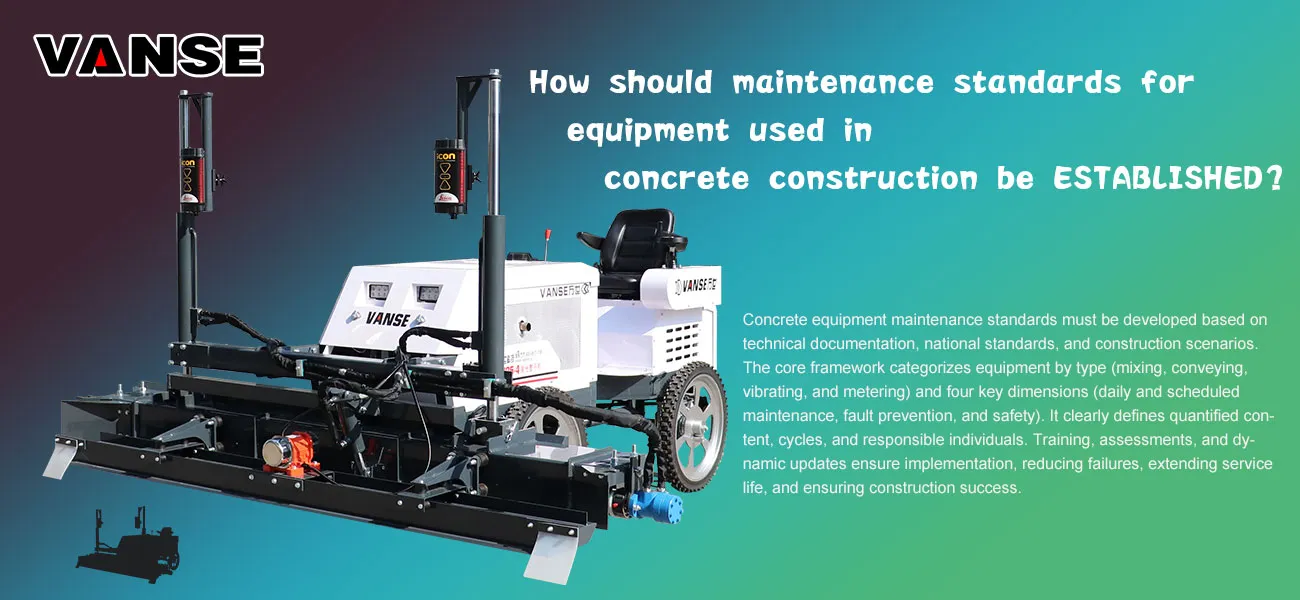
When developing maintenance standards for concrete construction equipment, it's necessary to consider the technical characteristics of each equipment type (such as mixing equipment, conveying equipment, pouring equipment, and vibrating equipment), construction scenario requirements, and industry standards. This approach aims to create a systematic standard that covers the entire lifecycle, is quantifiable and implementable, and assigns specific responsibilities. The following is the specific framework and core content:
Ⅰ. Core Basis Before Development: Clarifying the "Benchmark Anchor"
Before developing standards, it's important to first clarify the underlying foundations to ensure they are legally compliant, practical, and avoid being divorced from equipment characteristics or industry requirements.
Equipment Technical Documentation
Based on the manufacturer's operating and maintenance manuals, key parameters (such as lubrication cycles, replacement thresholds for wearing parts, and maintenance tool models) are extracted. For example, for a mixer, "mixing blades should be replaced if wear is ≤3mm" and "gear oil should be changed every 500 hours for the reducer" are standard "technical baselines."
Industry and national standards
Reference mandatory or recommended specifications, such as:
Technical Regulations for Safety in the Use of Construction Machinery (JGJ33-2012): Clarifies safety requirements for equipment maintenance (such as powering off before maintenance and posting warning signs);
Technical Specifications for Concrete Mixing Plants (Buildings) (GB/T 10171-2021): Specifies maintenance cycles and performance testing indicators for mixing equipment;
Technical Specifications for Concrete Pumps (GB/T 13333-2014): Clarifies maintenance requirements for the hydraulic system and piping of concrete pumps.
Construction scenarios and equipment load
Based on project specific adjustments (e.g., high temperature, high humidity, or high-frequency construction scenarios require shortened maintenance intervals):
For example, for concrete mixer trucks in tropical regions, the hydraulic oil filter replacement interval needs to be shortened from the standard 1,000 hours to 800 hours.
For example, when continuously pouring large volumes of concrete, the insulation layer of the vibrator needs to be inspected every 8 hours instead of every 8-hour shift.
II. Core Framework of the Standard: Breakdown by "Equipment Type + Maintenance Dimension"
Concrete construction equipment varies greatly. Based on the principle of "classification and standardization," the standard should be broken down into "equipment classification modules." Each module covers four dimensions: daily maintenance, scheduled maintenance, fault prevention, and safety requirements, ensuring coverage of the entire equipment lifecycle.
Module 1: Core Equipment Maintenance Detailed Rules (Example)
Using the four most critical types of equipment in concrete construction as examples, this standard specifies specific maintenance content, cycles, standards, and responsible individuals:
| Device Type | Maintenance Dimension | Maintenance cycle | Core maintenance content (quantifiable standards) |
| 1. Mixing equipment (mixing machine, batching machine, cement silo) | Daily Maintenance | Daily before/after construction | 1. Mixer: Clean any remaining concrete in the drum (no lumps or adhesion), and check the blade/liner fastening bolts (no looseness, torque ≥ 80 N·m). |
| 2. Batching machine: Clean any debris from the hopper, and check the conveyor belt for deviation (≤ 50 mm/10 m). | |||
| 3. Cement silo: Check the sensitivity of the level gauge (analog signal response time ≤ 2 seconds), and the safety valve for leaks. | |||
| Periodic Maintenance (Medium Repair) | Every 300-500 man-hours | 1. Replace the mixer liner (if wear ≥ 5 mm). | |
| 2. Change the gear oil in the reducer (oil quality test: viscosity ≥ 220 cSt, no metal debris). | |||
| 3. Adjust the tension of the batching machine conveyor belt (deflection ≤ 15 mm/1 m span). | |||
| Periodic Maintenance (Major Repair) | Every 2000-3000 man-hours | 1. Disassemble the mixer shaft and check the bearing clearance (≤ 0.05 mm). | |
| 2. Calibrate the batching scale for accuracy (error ≤ ±1%). | |||
| 3. Repair the anti-corrosion coating on the cement silo interior (no rust on ≥ 0.1 m2). | |||
| 2. Conveying equipment (concrete pump trucks, trailer pumps, mixer trucks) | Daily Maintenance | Daily after construction | 1. Pump Truck: Flush the delivery pipeline (no concrete residue, smooth water flow), check the outrigger cylinder seals (no oil leakage, no scratches on the piston rod); |
| 2. Mixer Truck: Clean the tank (no hardening on the tank wall), check the tire pressure (±0.2 bar). | |||
| Periodic Maintenance | Every 1000 km / 500 man-hours | 1. Pump Truck: Replace the hydraulic oil filter (pressure differential ≥ 0.3 MPa), inspect the boom welds (no cracks, weld height ≥ 8 mm); | |
| 2. Mixer Truck: Replace the tank liner (wear ≥ 10 mm), and maintain the drive system (bearing temperature ≤ 60°C). | |||
| 3. Vibrating equipment (insertion vibrator, flat plate vibrator) | Daily Maintenance | Every 8-hour shift | 1. Check the cable insulation (no damage, ground resistance ≤ 4Ω); |
| 2. Vibrator: Test run (amplitude ≥ 0.8 mm, no abnormal noise), and check the connectors for looseness. | |||
| Periodic Maintenance | Every 50 shifts | 1. Replace the vibrator bearing (clearance ≥ 0.1 mm); | |
| 2. Clean the motor cooling vents (no dust blockage, temperature rise ≤ 40°C). | |||
| 4. Measuring equipment (sand and gravel scales, cement scales, admixture scales) | Daily Maintenance | Daily | 1. Clear the scale hopper of any accumulated material (no material hanging, no skew); |
| 2. Calibrate the zero point (error ≤ ±0.5kg) and check the sensor wiring (no looseness). | |||
| Periodic Maintenance | Every 30 days | 1. Perform dynamic calibration (load 100% of the rated weight, error ≤ ±1%); | |
| 2. Check the sensor protection (no moisture, no deformation due to impact). |
Module 2: General Maintenance Requirements (Applicable to All Equipment)
Lubrication Management Standards
Follow the "Equipment Lubrication Chart" (specify the lubricant type, filling point, cycle, and amount). For example, use 3# lithium-based grease for the mixer bearings, refilling every 100 working hours at a rate of 50g each time.
After lubrication, record the "lubrication time, person performing the lubrication, and oil quality" to avoid over-lubrication or under-lubrication.
Consumable Parts Management Standards
Maintain a "consumable parts ledger" (including model, inventory threshold, and replacement cycle), such as for agitator blades, conveyor belts, vibrators, and cables, with a minimum inventory of three sets.
When replacing consumable parts, "model matching" is required. Substitution with non-genuine parts is prohibited (exceptional circumstances require approval from the technical director). After replacement, a test run is required to confirm compliance.
Safety Maintenance Standards
Before maintenance, power and gas must be turned off, and a warning sign must be posted (e.g., "Equipment under maintenance, do not start"). Safety belts must be worn and a warning area must be set up for overhead work (e.g., pump truck boom maintenance).
Electrical equipment maintenance requires a "certified operator" (electrician's license). Hydraulic system maintenance must be depressurized (reduced to 0 MPa) to prevent hydraulic fluid spray and injury.
Record and traceability standards
Establish an "Equipment Maintenance Record Form" (electronic or paper) that includes: equipment number, maintenance date, maintenance items, test data, abnormalities, person responsible, and inspector.
Record retention period should be ≥ the equipment's service life to facilitate tracing the cause of a malfunction (e.g., if a mixer blade breaks, the record can be used to verify whether it has not been replaced beyond the specified time limit).
III. Ensuring Standard Implementation: Responsibility, Supervision, and Improvement
Clarify the responsibility system
Responsibilities are divided into different levels: Operators are responsible for "daily maintenance" (cleaning, inspection, and simple tightening); repair workers are responsible for "regular maintenance" (disassembly, replacement, and calibration); technical leaders are responsible for "standard review and exception handling"; and project managers are responsible for "resource support (spare parts, tools, and funding)."
A "Equipment Maintenance Responsibility Letter" is signed, linking maintenance effectiveness to performance appraisals (e.g., if equipment failure occurs due to inadequate maintenance, the responsible individual's performance will be deducted).
Supervision and Inspection Mechanism
Daily Inspections: Technicians will spot-check the Maintenance Record Form daily and verify maintenance effectiveness on-site (e.g., randomly checking the wear of the mixer blades to see if it matches the records).
Regular Assessments: Monthly "Equipment Maintenance Evaluations" are conducted, rewarding teams/individuals with a maintenance compliance rate ≥95%. Those failing to meet the standards will be given a deadline to rectify the situation.
Fault Review: After equipment failure, analysis will be conducted to determine whether the cause was maintenance failure, and standards will be updated (e.g., if a crack on a pump truck boom was caused by untimely weld inspection, the weld inspection cycle will be shortened).
Personnel Training Standards
New employees must pass "equipment maintenance training + practical assessment" (e.g., identifying wearing parts of the mixing unit and completing maintenance records) before they can begin work.
Maintenance skills training is organized quarterly (manufacturer technicians are invited to explain key maintenance points and common troubleshooting for new equipment) to ensure personnel skills meet standard requirements.
IV. Dynamic Standard Update Mechanism
Concrete construction equipment technology evolves rapidly (e.g., new intelligent mixing plants and electric pump trucks), necessitating regular standard updates:
Update Cycle: A comprehensive review is conducted annually. Revisions are required immediately if equipment upgrades, construction scenarios change, or industry standards are updated.
Update Process: The technical department collects equipment failure data, maintenance feedback, and new regulatory requirements. Discussions are held with maintenance workers, operators, and manufacturer representatives. After revisions are made public, training sessions are held to ensure full awareness.
The standards established through the above framework can not only cover the technical requirements of equipment, but also be implemented in specific positions and operations, avoiding "empty" concepts and ultimately achieving the goal of "reducing equipment failures, extending service life, and ensuring construction continuity."
Note:
The parameters provided in this document are for reference only and are not mandatory. Due to differences in technical characteristics between different brands and models of laser levelers, please consult the manufacturer for a suitable solution before actual operation. This reference document assumes no responsibility for any issues arising from failure to follow the manufacturer's instructions.
Thanks to All the Friends Who Support and Trust Shandong Vanse Machinery Technology Co., Ltd.
If you want to know more about Shandong Vanse Machinery Technology Co., Ltd. or have any questions, please feel free to contact us:
Our Factory
Shandong Vanse Machinery Technology Co., Ltd.








Share this article

About the Author: Shandong Vanse Machinery Technology Co., Ltd.
Shandong Vanse Machinery Technology Co., Ltd. is a high-tech manufacturer specializing in concrete construction machinery, including laser screeds and related equipment. The company integrates R&D, production, and global sales, with products exported to over 60 countries and widely used in infrastructure projects worldwide.
Previous Post
Next Post
Related Articles
You Might Also Like
Common sources of errors & solutions in the construction of concrete laser leveling machines
Although the concrete laser leveling machine is a highly precise device, it is not a "fully automatic wonder". The final leveling accuracy (FF/FL value) of it is highly dependent on the perfect coordination of "human-machine-material-method". Often, the machine itself is not faulty, but the ground it produces has unevenness or wave patterns. Here are the four main sources of common errors and their specific solutions. This is a "guide to avoiding pitfalls" derived from countless construction sites. This is the most common but also the most easily overlooked source of error. The laser system serves as the benchmark for the leveling machine. If the benchmark is incorrect, everything will be ruined. Source of error Description of the phenomenon Solution Reference drift of the transmitter Over time, the overall elevation of the entire area has shifted or there has been a large-scale inclination. Root control: The launcher tripod must be set up on a completely stationary base (strictly prohibited from being placed on soil prone to subsidence or on vibrating floor slabs). Root control: The launcher tripod must be set up on a completely stationary base (strictly prohibited from being placed on soil prone to subsidence or on vibrating floor slabs). Laser signal dead zone / interference The machine suddenly started to move erratically, or the leveling head began to shake up and down. Clean up the site: Ensure there is no obstruction (workers moving, pillars) between the transmitter and the receiver. Light shielding reflection: Remove large areas of glass and stainless steel plates at the scene to prevent multi-path laser reflection that could cause false signals. Adjusting the Dead Band: Based on the requirements for flatness, appropriately set the sensitivity (width of the dead band) of the receiver. Strong wind vibration During outdoor construction, strong winds blew the transmitter, causing the base surface to shake up and down. Physical Wind Protection: Build a wind shield around the transmitter, or use a heavy tripod with added weights. 💡 Expert tip: Never allow the power cords of the concrete pump pipe or the vibration rod to come into contact with the frame of the laser emitter! This is the most embarrassing error that can occur on-site. The mechanical condition of the machine directly determines whether it can accurately execute the instructions of the laser system. Question: If there is a significant difference in tire pressure between the left and right wheels, the machine will shake while moving, causing the leveling head to sway left and right and resulting in wave patterns. Solution: Before construction, the tire pressure of all four wheels must be measured to ensure they are exactly the same. Question: The laser caused the scraper to rise, but the hydraulic cylinder responded half a second later, resulting in a "pit" on the ground. Solution: Check if the hydraulic oil temperature is too high and if the solenoid valve is clogged. Problem: The bottom of the scraper is worn unevenly, resulting in scratches or stripes on the polished surface. Solution: Daily inspect the wear plate at the bottom of the scraper. Replace it immediately if it is severely worn. This is the factor that the machine "cannot control" but is the most affected one. The inconsistency in slump (cohesion) is the number one killer of flatness. Too dry (<100mm): The machine cannot scrape, or the leveling head is "pushed up" by the counterforce, resulting in an overly high ground elevation. Too dry (<100mm): The machine cannot scrape, or the leveling head is "pushed up" by the counterforce, resulting in an overly high ground elevation. Solution: Strict control must be exercised over the material distribution at the concrete mixing station! Designate a dedicated person to test the slump before the tanker unloads the material. Those with Unqualified slumps must be immediately withdrawn or adjusted on-site. The optimal slump for the laser leveling machine is typically 140mm ± 20mm (depending on the model). Question: The interval between the first batch of materials and the second batch is too long, resulting in "cold joints" or hardness differences at the junction. The machine will vibrate when passing through. Solution: Ensure continuous supply of materials and avoid any interruptions. A good machine requires a good operator. The operator's experience determines 30% of the final outcome. Error principle: If the concrete in front of the scraper is piled up too high (for example, more than half the height of the feeding screw), the machine resistance becomes too large, the tires slip or the machine head is lifted. If it is piled up too little, it will result in the pit not being filled. Solution: The operator needs to work in coordination with the general workers to ensure that there is always only 2-3 cm of excess concrete remaining on the scraper during the rolling process. Make more corrections when necessary and avoid excessive adjustments. Solution: The recommended standard overlap width is usually between 15cm and 30cm, and the marking lines should be used to assist with walking. Solution: The recommended standard overlap width is usually between 15cm and 30cm, and the marking lines should be used to assist with walking. Question: It's like driving over a speed bump. If you go too fast, the suspension system doesn't have enough time to react. Solution: Maintain a constant speed. It is generally recommended to keep the speed within the range of 3 – 5 meters per minute, allowing sufficient reaction time for the hydraulic system. Check 1 (Test): Before starting each day's work, calibrate the laser transmitter and check the tire pressure. Check 2 (Control): Strictly control the slump of the first batch of concrete, and set the standard for the day. Check 3 (and): At a distance of 2 meters behind the leveling machine, arrange workers to hold a 3-meter scraper to perform fine adjustment (remember: it's fine adjustment, not re-scraping), to eliminate any minor defects that may remain at the turning points or seams of the machine. Note: The parameters provided in this document are for reference only and are not mandatory. Due to differences in technical characteristics between different brands and models of laser levelers, please consult the manufacturer for a suitable solution before actual operation. This reference document assumes no responsibility for any issues arising from failure to follow the manufacturer's instructions.What blade type fits different concrete hardness for power trowel?
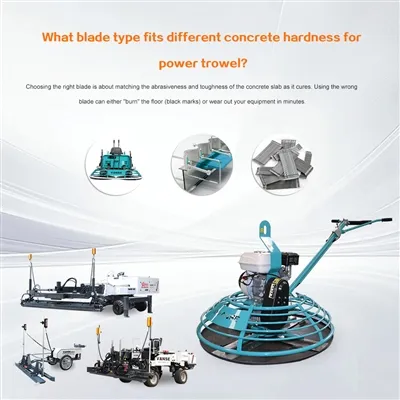
Choosing the right blade is about matching the abrasiveness and toughness of the concrete slab as it cures. Using the wrong blade can either "burn" the floor (black marks) or wear out your equipment in minutes. Here is the breakdown of blade types and when to swap them: Strictly speaking, these are large steel disks that clip onto the blades, but they are the first "type" you'll use. Concrete State: Wet/Plastic. You can leave a 1/4" to 1/2" footprint. Hardness Profile: Soft/Fresh. Use Case: To break down high spots and fill low spots left by the laser leveling. Pans provide the highest Floor Flatness (FF) because they have a massive surface area. The workhorse of the industry. Concrete State: Damp to Firm. Footprint is roughly 1/8". Hardness Profile: Standard setting concrete. Use Case: These are used as the concrete begins to harden. They are stiff enough to apply pressure but flexible enough to "flick" the cream back into the pores. The Catch: If the concrete is very "hard" or has high silica content, these blades will wear down quickly and can leave dark burnish marks if you aren't careful. The "Insurance Policy" for colored or decorative concrete. Concrete State: Firm to Hard. Hardness Profile: High-performance mixes or light-colored slabs. Use Case: If you are working on a white or light-gray floor where burn marks (black streaks from steel friction) would be a disaster. Plastic blades give a smooth finish without the metallic discoloration. A hybrid between a float blade and a finish blade. Concrete State: Medium-Firm. Hardness Profile: Versatile. Use Case: Designed for operators who don't want to swap blades mid-job. One side is wide (for floating) and the other is pitched for finishing. They are great for small-to-medium residential jobs but usually aren't precise enough for ultra-flat industrial floors. Concrete Hardness / Type Recommended Blade Primary Benefit Fresh / Soft Float Pans Maximum flatness; high "cream" Standard / Mid-Day Carbon Steel Finish High durability; classic shine Ultra-Hard / Fast-Set Blue Steel Blades Extra flexibility; prevents "chatter" Light Colored / Dyed Plastic (Poly) Blades Prevents black burnish streaks Epoxy / Specialty Stainless Steel Prevents rust contamination If you are dealing with High-Early strength concrete (which gets hard very fast), look for Blue Steel blades. Blue Steel is thinner and more flexible than standard gold or silver steel. This flexibility allows the blade to "give" a little when it hits a hard aggregate stone, preventing the machine from "chattering" or bouncing, which is common on hard-set slabs. Would you like me to explain how to tell if your blades are "spent" and actually damaging your floor flatness? Contact us NOW Note: The parameters provided in this document are for reference only and are not mandatory. Due to differences in technical characteristics between different brands and models of laser levelers, please consult the manufacturer for a suitable solution before actual operation. This reference document assumes no responsibility for any issues arising from failure to follow the manufacturer's instructions.How to Achieve ±1mm/3m Flatness Control with Concrete Laser Leveling Machine?
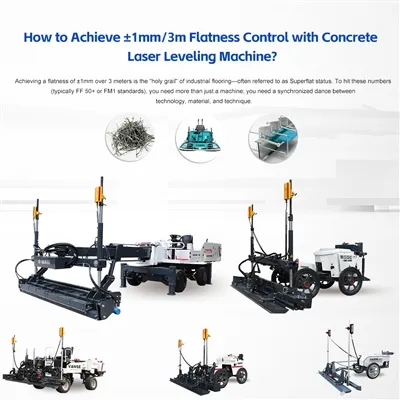
Achieving a flatness of ±1mm over 3 meters is the "holy grail" of industrial flooring-often referred to as Superflat status. To hit these numbers (typically FF 50+ or FM1 standards), you need more than just a machine; you need a synchronized dance between technology, material, and technique. If you're a contractor aiming for that level of precision, here is a professional breakdown of how to master it using a Concrete Laser Leveling Machine, with some insider tips on the Vanse technology that makes it possible. You can't hit ±1mm if your reference point is off by 2mm. Global buyers know that the laser system is the most critical component. The Pro Tip: Use a high-quality transmitter (like Leica or Trimble) and set it up on a stable, vibration-free tripod. The Vanse Edge: Most Vanse laser leveling machines, such as the WS940C or the telescopic YZ40-4E, are designed to integrate seamlessly with world-class laser systems. The machine's receivers pick up the signal at a frequency of 10 times per second, making real-time micro-adjustments to the hydraulic leveling head before the concrete even has a chance to settle. You can have the best laser leveling in the world, but if your concrete slump varies from truck to truck, your floor will be a "rollercoaster." The Pro Tip: Keep your slump consistent (ideally 120mm–160mm depending on the mix). If the concrete is too wet, it will sink after the machine passes; too dry, and the vibrator won't consolidate it properly. The Vanse Edge: Vanse machinery is built with high-frequency vibrators (up to 4000rpm). This ensures that even with a slightly lower slump (which is better for long-term durability), the machine can still liquefy the surface just enough to get that perfect, glassy finish in a single pass. In the old days, you'd leveling, then check, then leveling again. Every time you touch the concrete, you risk making it worse. The Pro Tip: Look for an integrated leveling head that performs leveling, leveling, and vibrating simultaneously. The Vanse Edge: If you look at the Vanse YZ series, the leveling head is a masterpiece of engineering. It's a 3-in-1 system. As the machine moves, the auger removes excess concrete, the vibrator consolidates the slab, and the scraper plate leaves a level surface-all controlled by the laser system. This "one-pass" efficiency is exactly how you maintain that ±1mm tolerance over 3 meters without over-working the material. Even with full automation, the operator's path matters. The Pro Tip: Maintain a consistent travel speed and ensure a 20cm–30cm overlap between passes. This "blends" the cold joints and prevents "ridges" between lanes. The Vanse Edge: For large-scale projects, the Vanse Telescopic Boomed Laser leveling (like the YZ30-4E) is a game-changer. The 6-meter boom means the machine stays stationary while the head does the work. This eliminates tire tracks and weight-shifting issues, which are the #1 enemies of superflat floor precision. Hitting ±1mm/3m isn't magic-it's physics. By combining the automated precision of a Vanse Concrete Laser Leveling Machine with consistent material and a smart operator, you don't just meet the specs; you set the standard for the industry. For more technical specs and to see these machines in action, visit the experts at Vanse Machinery ( www.vansemac.com ). Note: The parameters provided in this document are for reference only and are not mandatory. Due to differences in technical characteristics between different brands and models of laser levelers, please consult the manufacturer for a suitable solution before actual operation. This reference document assumes no responsibility for any issues arising from failure to follow the manufacturer's instructions.