Technical Knowledge
Technical measures to ensure construction quality of concrete laser leveling machines under extreme weather conditions such as high and low temperatures
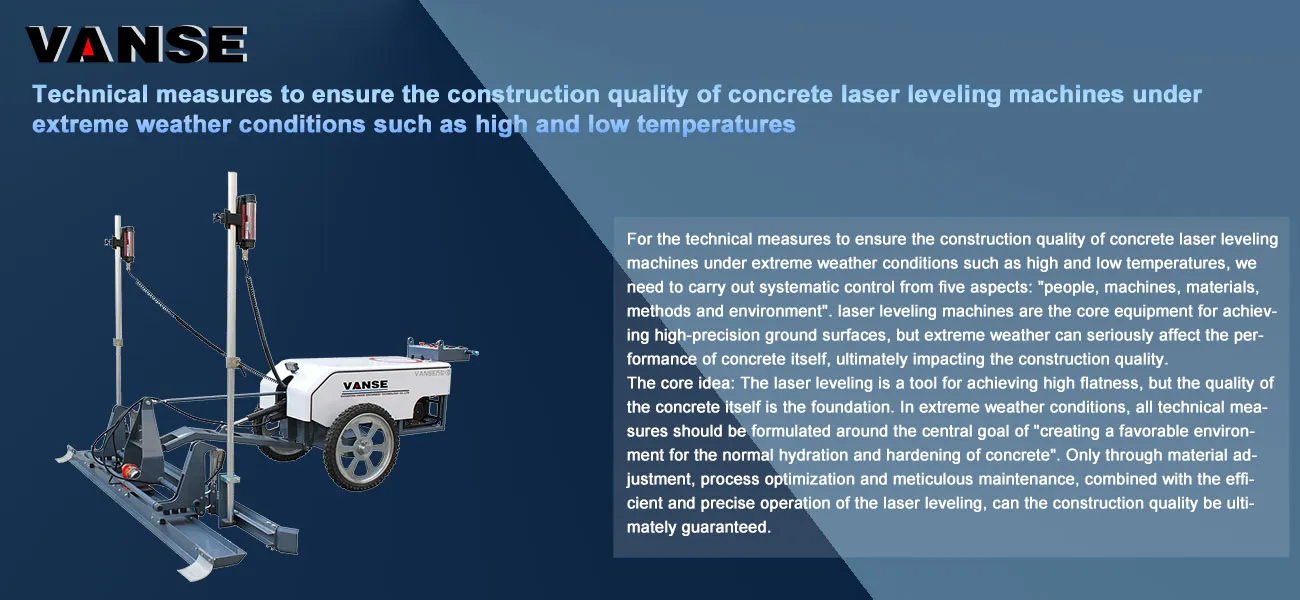
For the technical measures to ensure the construction quality of concrete laser leveling machines under extreme weather conditions such as high and low temperatures, we need to carry out systematic control from five aspects: "people, machines, materials, methods and environment". laser leveling machines are the core equipment for achieving high-precision ground surfaces, but extreme weather can seriously affect the performance of concrete itself, ultimately impacting the construction quality.
The following is a detailed technical measure plan
I. Technical Measures for Construction in High-temperature Weather
High temperatures can cause rapid evaporation of concrete moisture, significant loss of slump, shortened setting time, and easily lead to problems such as plastic shrinkage cracks and surface powdering, posing challenges to the construction efficiency of laser levelings and the quality of the ground.
1. Concrete mix proportion and material control
Adjust the mix ratio: Communicate with the mixing plant in advance to use retarding water-reducing agents or high-efficiency retarders to delay the setting time of the concrete and create a longer operation window for leveling.
Reduce the mold entry temperature
Shade and cover the aggregates (sand, stone) or spray water to cool them down to avoid direct sunlight.
Mix with cold water or ice to lower the temperature of the mixing water.
When necessary, sprinkle water on the surface of the cement tanker to cool it down.
Control slump: Strictly monitor the slump of the concrete arriving at the site to avoid it being too large (prone to bleeding and significant shrinkage) or too small (difficult to level). Slump loss is rapid at high temperatures, so it is necessary to ensure that the concrete has good workability.
2. Construction process control
Arrange the operation time reasonably: Try to avoid pouring operations during the hottest period of the day (such as from 10 a.m. to 4 p.m.), and choose to carry out construction in the morning and evening when the temperature is lower.
Accelerate transportation and pouring: Plan the transportation route well to ensure that the time from the concrete leaving the machine to the completion of pouring is the shortest. On-site dispatching should be efficient, ensuring that "vehicles wait for jobs" rather than "jobs wait for vehicles".
Adequate preparation and rapid construction: Before pouring the concrete, ensure that everything such as formwork, steel bars, and laser leveling machines is in place. After the concrete arrives, immediately organize pouring, spreading and leveling to shorten the exposure time.
3. Key points for Operating a laser leveling
Improving leveling efficiency: The laser leveling should maintain continuous and uniform operation, taking advantage of its high efficiency to complete the leveling work before the initial setting of the concrete.
Prevent rapid evaporation of moisture: After the scraper of the leveling machine is applied, personnel can be immediately arranged to spray curing agent or cover it with plastic film for "covering as needed". This is a very effective measure to prevent surface plastic cracks.
4. Early maintenance
Timely maintenance: After the leveling is completed, maintenance should be carried out immediately. Do not wait until the concrete has completely hardened before curing.
Moisture retention curing: Cover with wet gunny bags or straw curtains and continuously sprinkle water, or use water retention curing, covering with curing film and other methods to ensure that the concrete surface remains moist for at least 7 days.
Ⅱ. Technical Measures for Construction in Low-temperature Weather
Low temperatures can delay the hydration of cement. When the temperature drops below 0℃, the free water inside the concrete freezes, generating ice expansion stress, which damages the concrete structure and leads to permanent loss of strength. When using a laser leveling for construction at low temperatures, the key is to ensure that the concrete is not damaged by freezing and to create a normal environment for its strength growth.
1. Concrete mix proportion and material control
Adjust the mix ratio: Use early-strength cement or add early-strength agents and antifreeze agents to accelerate the early strength development of concrete and enhance its frost resistance.
Increase the mold entry temperature
Heat the aggregates (sand, stone) to prevent caking and the presence of ice chips.
Heat the mixing water (generally not exceeding 60℃).
Ensure that the temperature of the concrete leaving the machine and entering the mold comply with the specification requirements (generally, the temperature leaving the machine should not be lower than 10℃ and the temperature entering the mold should not be lower than 5℃).
2. Construction Environment and Maintenance Control (Heat Storage Method and External Heating Method)
Build an insulated greenhouse: Set up a temporary insulated greenhouse in the construction area, and use heating methods such as warm air fans and steam pipes inside to maintain the environmental temperature above 5℃. This is the most reliable method.
Heat storage maintenance method: This method can be adopted when the average outdoor temperature is not lower than -5℃. After the pouring is completed, immediately cover the concrete surface closely with insulation materials (such as rock wool quilts, plastic films with straw curtains, etc.), and utilize the heat of hydration of cement and the initial heat of the concrete to make it reach the critical strength in a positive temperature environment.
Heating maintenance method: When the temperature is extremely low, an external heat source should be used.
Warm air blower hot air method: Blowing hot air in a closed space.
Electric blanket covering method: Cover the concrete surface with a special electric heating curing blanket.
Note: It is strictly prohibited to directly bake the concrete surface with an open flame, as this will cause rapid water loss and carbonization.
3. Operation and construction management of laser leveling machines
Base layer and preparation: Before pouring, it is necessary to remove ice, snow and frozen blocks from the formwork and base layer. It is strictly prohibited to pour concrete on the frozen base.
Rapid construction: Similar to high-temperature weather, it is necessary to organize tightly to reduce heat loss during the transportation and pouring of concrete. The leveling machine should operate efficiently and be immediately covered and insulated after completion.
Temperature monitoring: Temperature measurement points are set up at different parts within the concrete structure to monitor temperature changes at regular intervals, ensuring that the internal temperature of the concrete reaches the "critical strength for freezing" (typically 30% of the designed strength or 5MPa) before dropping to 0℃.
Ⅲ. Special Precautions for the laser leveling Machine Itself (General but Crucial
No matter what extreme weather conditions it is, the stability and accuracy of the equipment itself are the prerequisites for ensuring quality.
Equipment calibration and inspection
Before starting work every day, the accuracy of the laser transmitter and the receiver of the leveling machine must be checked and calibrated.
Inspect key components such as the hydraulic system, engine, and scraper base plate to ensure there are no faults.
At extreme temperatures, the viscosity of hydraulic oil will change, and the corresponding grade of hydraulic oil should be used.
Equipment adaptability
High temperature: Pay attention to the heat dissipation of the equipment and prevent the hydraulic system from overheating. It is advisable to consider installing sunshade devices at key parts of the equipment.
Low temperature: Equipment (especially diesel engines) may have difficulty starting. Low-temperature grade diesel should be used, and the engine should be preheated if necessary. At low temperatures, the brittleness of metal parts in the equipment increases. Operation should be smooth and avoid severe impacts.
Power supply guarantee: Ensure the power supply of the laser emitter is stable to prevent the leveling from being interrupted due to power failure, which may cause cold joints during construction.
Summary
| Control dimension | Core measures for high-temperature weather | Core measures for low-temperature weather |
| Concrete material | Retarder, reducing mold entry temperature | Early strength agent/antifreeze, increase mold entry temperature |
| Construction process | Avoid high-temperature periods and carry out rapid and continuous construction | Rapid construction and ice and snow removal |
| Leveling operation | High-efficiency leveling and immediate application | High-efficiency leveling and immediate insulation |
| Maintenance measures | Moisturizing is key (watering, covering) | Insulation is key (covering, heating) |
| Environmental control | Shading and wind protection | Build an insulated shed and heat it up |
The core idea: The laser leveling is a tool for achieving high flatness, but the quality of the concrete itself is the foundation. In extreme weather conditions, all technical measures should be formulated around the central goal of "creating a favorable environment for the normal hydration and hardening of concrete". Only through material adjustment, process optimization and meticulous maintenance, combined with the efficient and precise operation of the laser leveling, can the construction quality be ultimately guaranteed.
Note: The parameters provided in this document are for reference only and are not mandatory. Due to differences in technical characteristics between different brands and models of laser levelers, please consult the manufacturer for a suitable solution before actual operation. This reference document assumes no responsibility for any issues arising from failure to follow the manufacturer's instructions.
Thanks to All the Friends Who Support and Trust Shandong Vanse Machinery Technology Co., Ltd.
If you want to know more about Shandong Vanse Machinery Technology Co., Ltd. or have any questions, please feel free to contact us:
Our Factory
Shandong Vanse Machinery Technology Co., Ltd.








Share this article

About the Author: Shandong Vanse Machinery Technology Co., Ltd.
Shandong Vanse Machinery Technology Co., Ltd. is a high-tech manufacturer specializing in concrete construction machinery, including laser screeds and related equipment. The company integrates R&D, production, and global sales, with products exported to over 60 countries and widely used in infrastructure projects worldwide.
Previous Post
Next Post
Related Articles
You Might Also Like
What are the safety operating procedures for concrete laser leveling machines?
Safety operating procedures for concrete laser leveling machines ◆◆◆◆Preparation before operation◆◆◆◆ 1. Operators should be familiar with the performance, principles and operating methods of the machine, and operate it correctly in accordance with the requirements of the instruction manual. 2. Check whether all parts of the machine are intact, without damage or missing, and ensure that the machine is in normal working condition. 3. Ensure the safety and cleanliness of the construction site, clean up the surrounding debris and obstacles, and ensure the smooth progress of the construction. ◆◆◆◆Work environment inspection◆◆◆◆ 1. Check whether the work area is safe and free of potential safety hazards. 2. Confirm that there are no oil stains, water stains or other impurities on the concrete surface, so as not to affect the normal operation and leveling effect of the machine. 3. Check whether the laser measurement and control system is working properly to ensure the accuracy and stability of the machine. ◆◆◆◆Equipment startup and shutdown◆◆◆◆ 1. Turn on the power switch, start the machine, and check whether the machine is working normally. 2. After the leveling work is completed, the laser measurement and control system should be turned off first, and then the power switch is turned off to ensure the normal service life of the machine. 3. When the machine fails, it should be stopped immediately for inspection, and the work should be carried out after troubleshooting. ◆◆◆◆Machine debugging◆◆◆◆ 1. According to work needs, adjust the height, angle and other parameters of the machine to ensure the leveling effect and quality: 2. During the debugging process, attention should be paid to the surrounding environment and personnel safety to avoid accidents. ◆◆◆◆Calibration of laser measurement and control system◆◆◆◆ 1. The laser measurement and control system should be calibrated regularly before and after use to ensure the accuracy and stability of the machine. 2. During the calibration process, attention should be paid to the surrounding environment and personnel safety to avoid accidents. ◆◆◆◆Leveling operation◆◆◆◆ 1. According to the work needs, select appropriate leveling tools and parameters to perform leveling work. 2. During the leveling process, attention should be paid to the surrounding environment and personnel safety to avoid accidents. 3. After leveling is completed, the leveling effect and quality should be checked and any problems found should be dealt with in a timely manner. ◆◆◆◆Exception handling◆◆◆◆ During use, if any abnormality or malfunction is found in the machine, it should be stopped immediately for inspection and the fault should be eliminated before starting work.The importance of after-sales service when purchasing a laser leveling machine
Today's building floor construction uses laser leveling machines, and the quality of the floor paved is much better than that of traditional methods – first, the flatness and levelness of the floor are improved by more than 3 times, and the density and strength of the floor are increased by more than 20%. At the same time, it can also shorten the construction period by 40% and save about 49% of labor. It can also greatly save costs in later maintenance, because laser leveling machine construction can more easily lay high-strength concrete, low-slump concrete and fiber mud concrete. The construction effect of the laser leveling machine is good, and it is a step for laser leveling machine manufacturers to gain praise from users, but if they want to gain a long-term foothold, they still need solid after-sales service to support them. As a laser leveling machine manufacturer, Shandong Vanse Machinery has been working hard to provide services to all customers, no matter where you are in the world. But words are not enough. You can only understand our services when you need help. Here are 4 reasons why after-sales support is particularly important when purchasing a laser leveling machine. 1. Time is money When you encounter problems during the construction of your equipment and need assistance, you can immediately contact the after-sales service engineer. You don't have to wait a few days to call. This is why you need excellent after-sales support. It will be critical when you need it, especially when you invest in a laser leveling machine. We know that all contractors are located in different time zones and work at different times. This is why we provide support services for our products. 2. Get solutions immediately when you need them When you encounter problems, our services are always available to help you identify the root cause of the problem and find solutions. The value of our products is that on the job site, you only need to take care of your own affairs. Our excellent products can help you complete most of the work. 3. Make your equipment available anytime, anywhere Before construction, you need to ensure that the machine is properly maintained and in good condition. Whether you are an experienced operator or a novice operator, or your machine has been idle for a long time, we can provide corresponding services. Our service agreement can ensure that you will not encounter any problems when you are ready to work and need to run the machine. 4. Understand how to maintain your laser leveler For every product we manufacture, we will provide after-sales support at any time, and at the same time we hope that our customers will know some knowledge about how to maintain the product. In addition to providing maintenance plans for each customer, customer service will also follow your every step of maintenance. The service life of a leveler is generally very long, and it is inevitable to encounter after-sales maintenance services in the middle, so when purchasing, you must understand the importance of laser leveling after-sales service, and examine the company's after-sales service capabilities.What are the advantages of laser leveling machine?
What are the advantages of laser leveling machine? The laser leveling machine is developed according to the increasing demand for ground quality such as strength, flatness, levelness, etc. of modern industrial plants, large shopping malls, warehouses and other large-area cement concrete floors. Not only is it fast and compact, it saves labor input to a great extent and saves economic costs in disguise. Advantages of laser leveling technology: 01 Higher construction quality – the ground elevation and flatness of laser-level precision can be achieved. The floor elevation is automatically controlled by laser and computer, and the leveling unit is adjusted in real time through a two-way hydraulic cylinder (10 times per second), ensuring Precise leveling. 02 The density of concrete is increased by more than 20%, and the strength of concrete is improved, and it is suitable for dry hard concrete, fiber concrete and large aggregate concrete. 03 The laser emitter is arranged independently. The floor construction can be paved in a large area and can ensure the consistency of the ground elevation. The elevation is not controlled by the formwork, and there will be no cumulative error. 04 Compared with the traditional method, the construction joints of the floor can be greatly reduced, and the construction without separate warehouse joints can be achieved. The post-maintenance cost of the ground and the use of templates are also greatly reduced. Due to maintenance and formwork support, the sub-storage joints on the large-area concrete floor will have defects such as damage along the joints. These problems can be avoided by using laser leveling and joint cutting technology. 05 The integrity of the ground is better – it is very easy to achieve large-area overall paving. On the one hand, this overall paving technology can avoid problems such as easy hollowing and cracking caused by layered pouring of the floor, and on the other hand, it can reduce A large number of construction joints make the integrity of the ground better. This is not easy to do with other construction techniques. 06 The vibrating system of the laser leveling machine has a vibrating frequency of 3000 times per minute, which can avoid irregular cracking and other ills caused by uneven stress caused by uneven vibrating. 07 The construction speed is faster – the work efficiency is increased by 100-300% (200-400 square meters of paving work can be completed per hour, and an average of 1500-4000 square meters can be completed per day), and labor is reduced by more than 30%, especially suitable for Projects with tight construction schedule, large paving area and high quality requirements. 08 Save the cost of formwork and support formwork. The leveled cement concrete floor paved by the laser leveling machine is much better than the ground paved by conventional methods-the ground flatness and levelness are increased by more than 3 times, and the compactness and strength are increased by more than 20%. At the same time, it can also improve work efficiency by more than 50%, and save about 35% of labor. In addition, it can easily place high-strength concrete, low-slump concrete and fiber cement. Its laser system is equipped with a variety of automatic control components to monitor the elevation of the leveling head at a frequency of 10 times per second in real time to ensure that the levelness and levelness of the ground being paved are effectively controlled. At the same time, the vibrating frequency of its powerful vibrator reaches 3000 times/min, which ensures that the concrete is vibrated and compacted, so that the entire paved concrete matrix is homogeneous and dense.