Technical Knowledge
Lifecycle management and replacement records for wear parts of power trowels (such as filters, oil seals, and bearings).
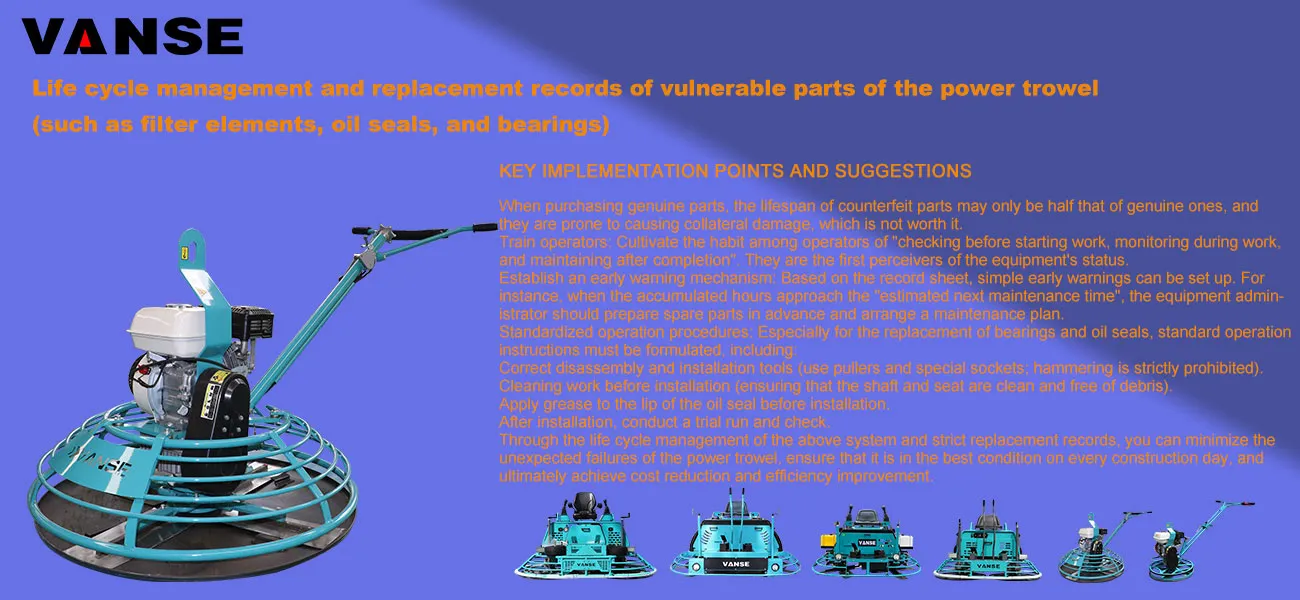
Effective management of the vulnerable parts of the power trowel not only ensures the continuity and quality of construction but also significantly extends the overall service life of the machine and reduces long-term operating costs.
The following is a detailed elaboration on the establishment and implementation of the life cycle management and replacement record system for the vulnerable parts (filter elements, oil seals, bearings) of the power trowel.
Ⅰ. Life Cycle Management of Vulnerable Parts
Life cycle management aims to prevent unexpected downtime and chain damage to other components by replacing parts before they fail through preventive maintenance.
1. Air filter element
Life cycle influencing factors
Environmental dust concentration: This is the most crucial factor. During the polishing stage of the cement floor, the dust is extremely high and the working load on the filter element is very heavy.
Working hours: Cumulative working hours are the basic reference.
Filter element type: The paper filter element is disposable, while the polyurethane foam pre-filter element can be cleaned and reused.
Life Cycle and Management strategies
Paper main filter element
Standard cycle: Usually 50 to 100 working hours. In an environment with extremely high levels of dust, it may be necessary to inspect and clean the area every shift (8-10 hours) and replace it every 25-50 hours.
Management method
Daily inspection: After each shift's work, remove the filter element and illuminate it from the inside with a light to observe if there are any light-transmitting points on the outside. If so, it indicates that it is damaged and must be replaced.
Non-oily cleaning: For minor blockages, low-pressure air (pressure < 0.5MPa) can be used to blow from the inside out. Do not strike.
Forced replacement: Even if there is no obvious damage, replacement must be carried out when the recommended working time is reached or significant resistance is still found after cleaning.
Polyurethane foam pre-filter core
Cleaning cycle: Per shift or every 4 to 8 working hours.
Management method: Clean with neutral detergent (such as soapy water), squeeze out the water by hand, dry and then install. Do not clean with gasoline, as it will damage the foam. Replace immediately in case of damage or loss of elasticity.
2. Oil seal
Life cycle influencing factors
Operating temperature: High temperatures in the engine and transmission will accelerate the aging of the oil seal rubber.
The quality of lubricating grease: Using substandard grease or grease mixed with impurities will wear out the lip of the oil seal.
The surface condition of the journal: If the output shaft is rusted or scratched, it will directly cut the oil seal, causing oil leakage.
Installation quality: Improper installation is the main cause of early failure of oil seals.
Life Cycle and Management strategies
There is no fixed time period, and it belongs to the type of vulnerable parts that are subject to condition monitoring and regular inspection.
Management method
Daily observation: During each maintenance or use, check whether there is any grease leakage at the transmission case, engine crankshaft end, blade drive shaft, etc.
Regular inspection: Every 100 to 200 working hours, or every quarter, conduct a detailed inspection of the oil seals at key parts to check for any flanging, hardening or cracks at the lip.
Preventive replacement: When overhauling equipment (such as replacing bearings and clutches), all associated oil seals must be replaced at the same time. Do not take the risk of secondary disassembly and assembly just to save a little money.
3. Bearing
Life cycle influencing factors
Load: When the trowel is under eccentric load or overload (such as when attempting to grind overly high protrusions), the bearings are subjected to impact loads.
Lubrication: Insufficient lubrication is the primary cause of bearing damage. This includes incorrect grease type, untimely addition, and excessive addition leading to high temperatures.
Sealing performance: The failure of the oil seal causes cement dust and moisture to invade the bearing, forming abrasives and causing rapid wear.
Alignment accuracy: Improper installation (such as directly hitting with a hammer) or shaft bending can cause uneven wear of the bearing.
Life Cycle and Management strategies
As a core transmission component, the goal is to extend its service life infinitely through good maintenance before the end of its natural lifespan.
Management method
Regular lubrication: Strictly follow the instructions and add the specified lithium-based grease through the grease nipple every 8 to 10 working hours. Add until new grease overflows from the seal and squeeze out the old impurities.
Abnormal noise and vibration monitoring: Operators and mechanics must be sensitive. If you hear a "clattering" noise, a strong granular friction sound or abnormal vibration of the entire machine at the bearing part during operation, stop the machine immediately for inspection.
Temperature monitoring: After working for a period of time, touch the outer shell of the bearing housing with your hand. If it is abnormally hot and cannot be touched, it indicates that there may be poor lubrication or wear inside.
Ⅱ. Establishment of a record system for replacement
Establishing a record system is the core of achieving scientific management. It is recommended to use the tabular management of "one file per machine".
Record Form for Replacement and Maintenance of Vulnerable Parts of the power trowel
Equipment number: ______ Equipment model: ______ Person in charge: ______
| Date | Cumulative working hours | Name of vulnerable parts | Specification and model | Reasons for replacement/maintenance | Operator | The estimated maintenance time for the next time is per hour | Remarks |
| 2023/10/26 | 1250 | Air filter element (paper) | ABC-123 | Replace periodically/Dust blockage | A | 1350 | |
| 2023/10/26 | 1250 | Polyurethane pre-filter element | XYZ-456 | Clean | B | 1258 | |
| 2023/11/15 | 1380 | Drive shaft oil seal | OIL-789 | When replacing bearings, replace them prevatively | C | – | Accompanied by bearing replacement |
| 2023/11/15 | 1380 | Main shaft bearing | BEAR-001 | There is an abnormal noise during operation and it is damaged after disassembly and inspection | D | – | Replace the oil seals on both sides simultaneously |
| 2023/12/1 | 1450 | Air filter element (paper) | ABC-123 | Replace on a periodic basis | E | 1550 | |
| … | … | … | … | … | … | … | … |
Ⅲ. Key Implementation Points and Suggestions
When purchasing genuine parts, the lifespan of counterfeit parts may only be half that of genuine ones, and they are prone to causing collateral damage, which is not worth it.
Train operators: Cultivate the habit among operators of "checking before starting work, monitoring during work, and maintaining after completion". They are the first perceivers of the equipment's status.
Establish an early warning mechanism: Based on the record sheet, simple early warnings can be set up. For instance, when the accumulated hours approach the "estimated next maintenance time", the equipment administrator should prepare spare parts in advance and arrange a maintenance plan.
Standardized operation procedures: Especially for the replacement of bearings and oil seals, standard operation instructions must be formulated, including:
Correct disassembly and installation tools (use pullers and special sockets; hammering is strictly prohibited).
Cleaning work before installation (ensuring that the shaft and seat are clean and free of debris).
Apply grease to the lip of the oil seal before installation.
After installation, conduct a trial run and check.
Through the life cycle management of the above system and strict replacement records, you can minimize the unexpected failures of the power trowel, ensure that it is in the best condition on every construction day, and ultimately achieve cost reduction and efficiency improvement.
Note: The parameters provided in this document are for reference only and are not mandatory. Due to differences in technical characteristics between different brands and models of laser levelers, please consult the manufacturer for a suitable solution before actual operation. This reference document assumes no responsibility for any issues arising from failure to follow the manufacturer's instructions.
Thanks to All the Friends Who Support and Trust Shandong Vanse Machinery Technology Co., Ltd.
If you want to know more about Shandong Vanse Machinery Technology Co., Ltd. or have any questions, please feel free to contact us:
Our Factory
Shandong Vanse Machinery Technology Co., Ltd.








Share this article

About the Author: Shandong Vanse Machinery Technology Co., Ltd.
Shandong Vanse Machinery Technology Co., Ltd. is a high-tech manufacturer specializing in concrete construction machinery, including laser screeds and related equipment. The company integrates R&D, production, and global sales, with products exported to over 60 countries and widely used in infrastructure projects worldwide.
Previous Post
Next Post
Related Articles
You Might Also Like
How to effectively avoid safety hazards during the operation of concrete laser leveling machine?
1. Comprehensive training: – All operators should receive formal training and be familiar with the operating manual of the equipment. – Understand the basic structure, function, working principle and emergency response methods of the equipment. 2. Equipment inspection: – Before starting work every day, conduct a thorough equipment inspection, including mechanical parts, electrical system, hydraulic system, laser system, etc. – Make sure all safety devices (such as emergency stop switches) are in working condition. 3. Personal protective equipment: – Provide and enforce the wearing of appropriate personal protective equipment, including hard hats, protective glasses, earmuffs, reflective vests, protective gloves and non-slip shoes. 1. Site layout: – Clean the construction site, remove all obstacles, and ensure sufficient operating space. – Set up clear warning signs and fences to separate the work area and pedestrian area. 2. Communication is smooth: – Ensure that there are enough communication equipment on site so that the operator can communicate effectively with other personnel on site. – If necessary, wireless walkie-talkies and other equipment can be equipped. 1. Smooth operation: – Operate smoothly and slowly, avoid sudden acceleration, sudden braking or sharp turns. – Maintain the correct standing position and avoid getting close to rotating or moving parts. 2. Laser safety: – Understand the safety level of lasers and take appropriate safety measures. – Avoid looking directly into the laser beam and use laser protective glasses. – Ensure that the laser transmitter is placed firmly to prevent accidental tipping. 3. Pay attention: – Keep an eye on the surrounding environment during operation, especially when the machine is close to edges or obstacles. – Pay attention to wires, pipes and other underground facilities on the ground. 4. Emergency handling: – Familiarize yourself with the emergency shutdown procedures and ensure that all operators know how to execute them quickly. – Prepare fire extinguishers and other fire-fighting equipment and ensure that operators know how to use them. 1. Regular Maintenance: – Perform regular maintenance according to the manufacturer's recommendations, including changing oil, filters, grease, etc. – Regularly check tires, chains, belts and other easily worn parts. 2. Records and Reports: – Maintain complete maintenance and inspection records. – Any abnormal conditions or failures should be reported to the supervisor or maintenance department in a timely manner. 3. Professional Repair: – When encountering equipment failure, it should be repaired by professional technicians. – Do not try to repair problems beyond your ability by yourself. – Establish Safety Awareness: Cultivate a strong safety culture and encourage employees to proactively report potential safety hazards. – Regular Drills: Conduct regular safety drills to simulate evacuation and first aid procedures in emergency situations. Through these comprehensive safety measures, safety hazards during the operation of concrete laser leveling machines can be effectively reduced, thereby creating a safer working environment.What is the precaution for daily maintenance and care of the hydraulic system of the concrete laser leveling machine?
– Check the hydraulic oil level regularly, park the เครื่องปรับระดับคอนกรีตด้วยเลเซอร์ on a level surface, turn off the engine and check to ensure that the oil level is within the normal scale range. If the oil level is found to be too low, add hydraulic oil that meets the equipment requirements in time. Different models of concrete laser leveling machines, such as vanse concrete laser leveling machine or mini concrete paver leveling machine, may have different requirements for hydraulic oil, and must be selected strictly according to the instructions. – Pay attention to the quality of the oil. Hydraulic oil will age and deteriorate after long-term use. If the oil is found to be black, has a pungent smell, is turbid or has precipitation, it should be replaced immediately even if the specified replacement cycle has not been reached. When replacing, drain the old oil thoroughly, clean the oil tank and filter, and then add new oil. At the same time, pay attention to the equipment with higher vanse laser leveling price, and use high-quality hydraulic oil to ensure the performance and life of the hydraulic system. – The filter in the hydraulic system plays a key role and should be replaced regularly. Generally speaking, the filter needs to be replaced every certain number of working hours or every few months. The specific interval can be referred to the equipment manual. For places with harsh working environment and large dust, the replacement cycle should be appropriately shortened to ensure the cleanliness of the hydraulic oil and protect the precision parts of the hydraulic system. – When replacing the filter, carefully check whether there are impurities such as metal particles and fibers on the filter. If a large amount of impurities are found, it may mean that there are worn parts inside the hydraulic system, which requires further inspection and repair to avoid the expansion of the fault and affect the normal use of the เครื่องปรับระดับคอนกรีตด้วยเลเซอร์ or Extendedoras de hormigón. – Check the working status of the hydraulic pump and hydraulic motor, listen to whether the running sound is normal, and whether there is abnormal vibration and noise. Observe whether its working pressure is stable and whether it is within the specified range. If the pressure is unstable or there is an abnormal sound, it may be due to wear of the internal parts of the pump or motor, damage to the seal, etc., which needs to be repaired or replaced in time to ensure the stable power output of the Máy cán sàn bê tông bằng Laser hydraulic system. – Check whether there is oil leakage in the oil pipe and joints, and whether the oil pipe is damaged, aged, cracked, etc. If the oil pipe is found to be damaged, it should be replaced in time; loose joints should be tightened in time to prevent oil leakage from causing the pressure of the hydraulic system to drop and affect the normal operation of the equipment. At the same time, keep the surface of the system clean, clean up oil and dust in time to prevent them from entering the hydraulic system. In short, doing a good job of daily maintenance and maintenance of the hydraulic system of the concrete laser leveling machine can effectively extend the service life of the equipment, improve work efficiency, reduce maintenance costs, and ensure that the equipment can operate stably and reliably under various working conditions.With the advent of laser leveling machines, are you still using the old vibrating leveler to vibrate the beam?
With the advent of laser leveling machines, are you still using the old vibrating leveler to vibrate the beam? When it comes to construction, everyone knows that only with a short construction period and high quality can we save costs, improve efficiency and increase profits. If you want to save costs quickly during construction, construction tools are a very important choice. An efficient, convenient and fast tool will make construction work more effective with half the effort! On the contrary, choosing inappropriate tools will extend the construction period, increase costs, and reduce profits. Take the floor construction under construction as an example! The flatness of the floor is more difficult to grasp. Leveling is usually done manually. Even if you use an old-fashioned floor machine, the effect and cost are not particularly ideal. The emergence of a laser leveling machine has greatly solved many problems that arise during construction. During the construction process, it can solve the problems of hollowing, shelling, cracking, and uneven ground after general construction. It can make the final effect exceed Party A's floor quality requirements, reduce costs, and Improved work efficiency. Many industries require factories, as well as shopping malls, large warehouses and other construction sites that require large areas of ground, to have much higher standards. Attention has been greatly increased to the strength, flatness and level of the ground quality. It is difficult to meet the requirements using old-fashioned flooring methods, and labor costs will increase exponentially. The construction principle of the laser leveler is very simple and clear. It can perform several construction processes such as leveling and vibration at the same time, further ensuring the quality of the construction and completely saving labor costs. The advantage of construction is that the construction speed is fast and the quality is high, ensuring that the overall integrity of the ground is good and cracks are not prone to occur. The amount of support and disassembly is reduced compared with the traditional method. Moreover, the reduction in the number of workers ensures an increase in final profits.