Technical Knowledge
Construction of concrete cutting machine
1, rack
The main role is to make horizontal cutting vehicles in the orbit for horizontal movement and cross-cutting mechanism in its orbit for vertical movements.
2, cross-cutting mechanism
By the cross-frame, transmission and across the device, guide wheel, swing device, cutting wire and other components. The drive and the spanning device drive the cross section to cut the blanks vertically and cut the wires simultaneously for both directions.
3, the level of cutting cars
By the frame, scraper device, trimming device, transmission device, hanging column, wheel group, Ping group and other components. Horizontal cutting car on both sides were equipped with two sets of sheaves and two sets of flat wheels, driven by the horizontal cutting machine in the spikes and flat track on the walk back and forth, to achieve horizontal cutting and "bread head" cutting.
4, flip table
By the flip frame, carts, cars, flip the main cylinder and walking cylinder and other components, its role is to use the horizontal placed in the flip table on the body of the body turned 90 ° forward and moved to the cutting position, the horizontal, vertical cutting And six-sided cutting, complete cutting and then flip back to the starting position.
5, hydraulic system
By the petrol station, motor, pump, all kinds of valves, pipe joints and other components. The main role is to flip the table smooth and accurate flip 90 °, cart, car synchronized to move to the appropriate location. [1]
6, electrical control system
Follow the instructions to achieve manual and automatic control of all actions.
Thanks to All the Friends Who Support and Trust Shandong Vanse Machinery Technology Co., Ltd.
If you want to know more about Shandong Vanse Machinery Technology Co., Ltd. or have any questions, please feel free to contact us:
Our Factory
Shandong Vanse Machinery Technology Co., Ltd.








Share this article

About the Author: Shandong Vanse Machinery Technology Co., Ltd.
Shandong Vanse Machinery Technology Co., Ltd. is a high-tech manufacturer specializing in concrete construction machinery, including laser screeds and related equipment. The company integrates R&D, production, and global sales, with products exported to over 60 countries and widely used in infrastructure projects worldwide.
Previous Post
Next Post
Related Articles
You Might Also Like
Can you recommend some operating tips to improve the working efficiency of concrete laser leveling machine?
The working efficiency of the concrete laser leveling machine is affected by many factors such as equipment debugging, operating specifications, and construction planning. The following are some operating tips and precautions that can improve its working efficiency: – Survey the construction site in advance, clarify the elevation benchmark (such as building elevation, design slope), and ensure that the installation position of the laser transmitter can cover the entire construction area to avoid blind spots. – Divide the construction blocks according to the size of the site (such as 500-1000㎡ per block), and plan the route of the leveling machine (it is recommended to use a "U-shaped" or "S-shaped" route to reduce round trips). – After starting up, calibrate the height consistency between the laser receiver and the leveling machine scraper, and ensure that the error is ≤2mm through manual fine-tuning (the scraper can be raised and lowered multiple times on the open ground for testing). – Check the hydraulic system pressure (usually 12-15MPa) and motor speed (scraper motor speed needs to be stable at 2000-2500 rpm) to avoid affecting the leveling accuracy due to insufficient power. – Adopt the method of "segmented spreading, leveling as you spread": When the concrete tank truck unloads, first pile the material at the edge of the block, and then use the loader or manual to spread the material to a thickness of 20-30cm (slightly higher than the design elevation by 5-10mm, leaving room for vibration settlement). – The spreading speed matches the travel speed of the leveler (it is recommended that the speed of the leveler be controlled at 1-2 meters/minute) to avoid spreading too slowly to cause initial setting of the concrete, or spreading too quickly to cause accumulation and rolling. – Starting stage: Start the laser receiver first, wait for the equipment to identify the reference elevation, slowly lower the scraper, cut into the concrete at an angle of 10-15° (reduce initial resistance), and turn on the vibration function at the same time (vibration frequency is recommended to be 50-60Hz). – Travel process: Keep the machine body stable, avoid sudden acceleration or sudden braking (speed fluctuations will cause elevation deviation); if there are local bulges or depressions, the scraper height can be adjusted in real time through the control panel (each adjustment amount ≤3mm), and repeat the rolling 2-3 times. – Edge and corner treatment: For edges that the leveling machine cannot cover (such as wall edges and column bases), use steel chisels or small vibrators to assist in leveling in advance, or install baffles (the height is consistent with the design elevation) before construction to reduce the amount of manual repairs in the later stage. – When the leveler is vibrating, it can be matched with manual auxiliary finishing: 2-3 meters behind the leveler, use an aluminum alloy scraper to scrape again along the scraper track to eliminate local ripples and promote slurry on the concrete surface (the slurry thickness should be 2-3mm). – If the slump of concrete is low (≤120mm), you can spray cement slurry (water-cement ratio 0.4-0.5) in the leveling process to avoid leveling difficulties due to dry surface. – Regularly clean the concrete lumps at the bottom of the scraper (clean once every 1 hour of construction) to avoid lumps affecting elevation control; check the tire pressure (recommended 2.5-3.0bar) to ensure the level of the machine body. – If the laser signal is interrupted during construction (such as the transmitter is blocked), stop the machine immediately and manually mark the current position. After the signal is restored, recalibrate from the mark to avoid blind operation and error accumulation. – 2-4 hours after leveling is completed (depending on the temperature), cover with plastic film or spray curing agent to prevent the concrete surface from dehydrating and cracking; personnel or machinery are prohibited from entering the construction area too early during the maintenance period (at least 7 days of maintenance). – Record the construction time, equipment fuel consumption, labor input and other data of each block, analyze efficiency bottlenecks (such as slow material spreading speed, equipment failure and shutdown), and optimize the next construction process. – Large slope site: Adjust the slope parameters of the laser transmitter (such as 1% slope), and use the "low speed + multiple round trips" mode when the leveling machine is moving. The scraper inclination angle is increased to 20° to ensure uniform slope. – Large-area continuous construction: Equip 2 leveling machines for alternating operations, one for rough leveling and one for fine leveling, and arrange special personnel to track laser signals to improve construction continuity. The above techniques can significantly improve the construction efficiency of the concrete laser leveling machine (the average daily construction volume of a single device in a conventional site can reach 2000-3000㎡), while ensuring that the flatness error is ≤3mm (3-meter ruler detection). When operating, it is necessary to flexibly adjust the equipment model and concrete characteristics, and participate in manufacturer training when necessary to master the optimal parameters of the equipment. Click the below to jump immediately!!! ARMOUR JOINT CONCRETE LEVELING MACHINE LIGHT TOWER POWER TROWEL SLIPFORM MACHINE STEEL FIBER TOPPING SPREADER TRACKED MINI DUMPERThe promotion and application of concrete laser leveling in agricultural modernization
The promotion and application of concrete laser leveling in agricultural modernization is a highly forward-looking and valuable topic. It is not merely an upgrade of construction tools, but a crucial link in promoting the advancement of agricultural production infrastructure towards high standards and intelligence. The following will be elaborated from several aspects, including promotion value, specific application scenarios, challenges faced, and countermeasures and suggestions. Ultra-high flatness: The leveling accuracy under laser control can reach the millimeter level, providing an absolutely flat foundation for subsequent high-standard farmland construction and large-scale precise irrigation (such as drip irrigation and sprinkler irrigation). It avoids the common problem of "unevenness" after traditional land leveling, which leads to water accumulation or uneven irrigation. Extremely high density and strength: The combination of high-frequency machine vibration and hydraulic leveling makes the concrete dense and uniform, greatly reducing problems such as ground dusting, sanding and cracking, and its durability far exceeds that of manual construction. Supporting intelligent agricultural machinery operations: It provides an ideal working surface like a "highway" for unmanned tractors, intelligent harvesters, automated seeders, etc., reducing bumps and path correction, and improving operation accuracy, speed and equipment lifespan. Adapting to large-scale breeding: In the ground construction of modern breeding farms (dairy farms, pig farms, etc.), a smooth, seamless, easy-to-clean and disinfect, and durable concrete ground is a prerequisite for biosecurity and efficient collection and treatment of manure and sewage. The laser leveling is the best tool to achieve this goal. Water conservation: Combined with precise irrigation systems, it completely eliminates the waste of water resources caused by uneven ground. Material conservation: Through precise elevation control, unnecessary waste of concrete raw materials can be reduced. Energy conservation: Leveling the ground reduces the resistance of agricultural machinery during operation and lowers fuel/electricity consumption. Environmental protection: Hardened and sealed ground effectively prevents soil dust from flying and reduces the pollution of soil and groundwater caused by the seepage of manure and sewage from livestock farms. Although the initial investment is relatively high, the ground it builds has a long service life and extremely low maintenance requirements. It avoids the long-term costs and agricultural interruption losses that require repeated leveling and repair of traditional land or low-quality ground, and has significant economic benefits throughout the entire life cycle. Large-scale drying ground/grain drying center floor: Achieve rapid and uniform drying, facilitating mechanical collection. The ground of the agricultural machinery warehouse and the warehousing and logistics center: meets the storage and transfer requirements of heavy machinery. Hardening of field roads and ditches: Enhancing transportation efficiency and irrigation/drainage accuracy. The ground inside large multi-span greenhouses and glass greenhouses: It provides a foundation for automated seedling raising, transportation robots, and soilless cultivation systems. The floor of the agricultural product grading, packaging and processing workshop: meets the requirements of food-grade cleanliness and efficient logistics. Cattle sheds, milking parlors and passageways in dairy and beef cattle farms: conducive to the scraping and sweeping of manure, animal welfare and hoof health. The floors of modern pigsties and poultry houses: easy to clean, dry and control diseases. Processing sites for special crops such as Chinese medicinal materials and edible fungi. The floor of the industrialized recirculating aquaculture (RAS) workshop and the seedling workshop must be absolutely flat to match the installation of the water pool and the drainage design. High initial investment cost: The cost of purchasing and leasing equipment is relatively high, and the threshold for individual farmers or small cooperatives is high. Shortage of technology and talent: Operating and maintaining laser screeners requires certain professional skills, and there is a lack of corresponding technical talents in rural areas. Application scenario cognitive limitations: Many agricultural operators still regard it as a "large construction tool" and have not fully recognized its huge value in the agricultural production end. The particularity of agricultural projects: Agricultural ground construction may encounter challenges such as scattered operation areas, small single area, and complex terrain, which require flexible equipment scheduling and construction plans. Lack of policies and standards: In the agricultural sector, there is a lack of specialized subsidy policies and clear design and construction standards for such high-standard ground construction. Incorporate high-performance concrete laser leveling construction into the subsidy or recommendation standards for projects such as high-standard farmland construction, modern agricultural industrial parks, and resource utilization of livestock and poultry manure. Encourage the reduction of the initial usage cost for users through measures such as government procurement of services, setting up special subsidies for agricultural machinery, and providing loan interest subsidies. Vigorously develop "professional construction service teams" or equipment rental companies to enable small and medium-sized agricultural business entities to enjoy high-quality services without purchasing equipment. Promote the contract model of "charging by area". Equipment manufacturers can develop more flexible and suitable small and medium-sized models for agricultural scenarios. Strengthen technical training and demonstration guidance Add relevant courses in agricultural colleges and universities and the agricultural machinery extension system. Build a number of high-quality application demonstration zones (such as super farms and national-level industrial parks), and through on-site meetings, effect comparisons and other means, visually display their long-term benefits and change concepts. Promote the in-depth integration of "agricultural machinery and agronomy" with "engineering construction". Agricultural experts, agricultural machinery engineers and the construction party jointly designed to ensure that the ground standards truly meet the needs of future agricultural production. Encourage laser levelings to be integrated with concrete mixer trucks, trowels, etc. to form an integrated construction solution to enhance overall efficiency. Industry associations or government departments should take the lead in formulating the "Technical Specifications for Laser Leveling of Concrete Floors for Agricultural Use", which should put forward clear requirements for the flatness, strength, wear resistance and anti-slip properties of floors for different uses (such as breeding, storage, greenhouses, etc.), and regulate the market. The promotion of concrete laser leveling machines in agricultural modernization essentially involves introducing industrial-grade precision construction technology into agriculture, providing a solid and accurate physical load-bearing foundation for digital agriculture and smart agriculture. It is not only a "revolution of tools", but also a "revolution of production thinking". With the in-depth transformation of China's agriculture towards intensification, intelligence and greenness, its application prospects are bound to become increasingly broad. By breaking through the initial cost and cognitive barriers and taking a three-pronged approach of policy, model and innovation, this technology will become a powerful "infrastructure shaper" that helps build a strong agricultural country. Note: The parameters provided in this document are for reference only and are not mandatory. Due to differences in technical characteristics between different brands and models of laser levelers, please consult the manufacturer for a suitable solution before actual operation. This reference document assumes no responsibility for any issues arising from failure to follow the manufacturer's instructions.What are the common mistakes in concrete laser leveling operations, and how can faults be quickly resolved?
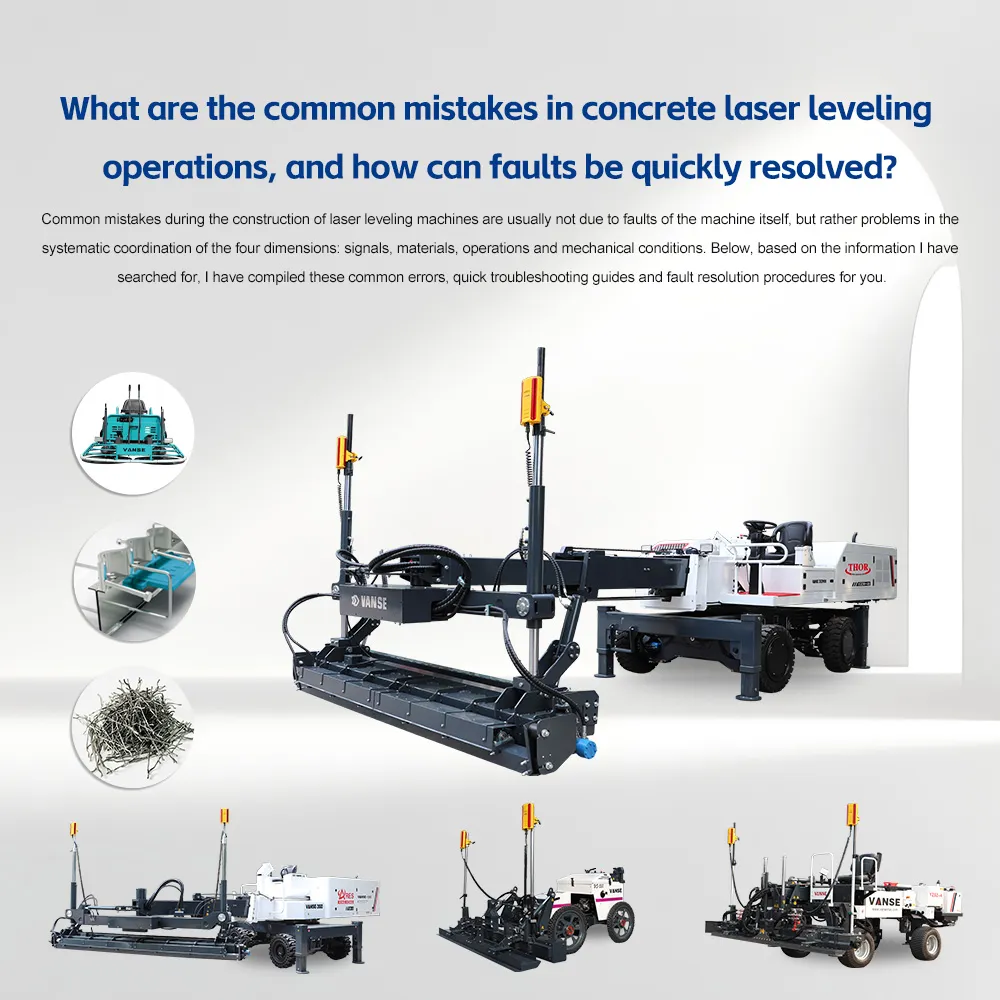
Common mistakes during the construction of laser leveling machines are usually not due to faults of the machine itself, but rather problems in the systematic coordination of the four dimensions: signals, materials, operations and mechanical conditions. Below, based on the information I have searched for, I have compiled these common errors, quick troubleshooting guides and fault resolution procedures for you. Error Categories Typical phenomenon The root cause Quick solution 1. Signal and System Error The overall ground elevation has shifted, wave-like patterns have appeared, or the machine operation has been irregular. The laser transmitter is installed on unstable foundations (such as soft soil, vibrating floor slabs); the signal is blocked or interfered with by strong light or reflective objects (glass, stainless steel); strong winds cause the transmitter to shake. Check immediately: Ensure that the tripod of the transmitter is firmly fixed on a solid base. Physical isolation: Remove any obstacles between the receiver and the transmitter, and install a windproof cover or counterweight on the transmitter. Avoid interference: Keep the cable of the concrete pump truck away from the transmitter support. 2. Concrete material error The slump variation is significant, resulting in some areas of the ground being too high (too dry) or too low (too soft); "cold joints" or inconsistent hardness occur at the seams. The slump of the concrete does not match the laser leveling machine. The optimal range is usually 140mm ± 20mm. If it is too dry (< 100mm), the machine cannot move; if it is too thin (> 200mm), it is prone to segregation. Source control: At the mixing station, the mix ratio is strictly controlled. The slump of each truckload of concrete upon arrival is measured, and if it fails to meet the standards, it will be rejected or the mix will be adjusted. The supply of concrete was discontinuous, and there was a significant difference in the performance of the concrete between the front and rear vehicles. Ensure continuous pouring: The feeding rhythm is reasonably arranged to avoid long intervals. 3. Operator's mistake After leveling, the ground has knife marks, waves, or edges that have collapsed. Improper control of the working head: If too much material is piled up before leveling the head (exceeding half the height of the spiral working head), it causes excessive resistance and the machine body lifts up; if there is too little material, it cannot level the low areas. Control the uniform speed and material quantity: The operator and the discharging workers closely cooperate, maintaining an excess of approximately 2-3 centimeters of material before reaching the leveling head. Using marking lines for assistance: Draw lines on the ground and ensure that the overlap width is consistent each time. Excessive speed: The hydraulic system cannot respond in time. Generally, it is recommended to maintain a speed of 3-5 meters per minute. Incorrect overlap width: If the overlap between adjacent processes is too wide or too narrow, the standard overlap width is usually 15-30 centimeters. 4. Mechanical state error Regular stripes appear on the ground, or the machine operates with sluggishness and tremors. Inconsistent tire pressure: A large pressure difference between the left and right wheels causes the leveling head to sway left and right, resulting in wave patterns. Daily start-up inspection: Measure and standardize the tire pressure of all four wheels. Wear of vulnerable parts: Uneven wear of the scraper plate and base plate will cause "grooves" to appear, and wear of the spiral feeder affects the uniformity of the material distribution. Daily maintenance: Clean thoroughly after each use, especially paying attention to the concrete on the screws and scrapers to prevent damage to the components after hardening. Check all bolts and tighten them. Hydraulic system response lag: High hydraulic oil temperature or blocked valve groups cause delayed execution of instructions. Critical gap inspection: Ensure that the installation gaps of components such as scrapers and augers meet the standards (for example, the scraper is 1/4 inch higher than the auger). When problems occur during construction, follow the principle of "from outside to inside, from simple to complex" to conduct a rapid diagnosis. Immediately stop the machine, turn off the laser transmitter, and ensure safety. Check if the "eyes" are clean: Clean the sensing panel of the laser receiver and the window of the laser transmitter to ensure there is no cement slurry or dust covering. Check if the "energy" is sufficient: Confirm that the laser transmitter, receiver, and remote control batteries are fully charged, and all cable plugs are securely connected. Situation A: No signal or weak signal from the receiver Confirm the transmitter status: Is it turned on and in rotation mode? Is the horizontal bubble centered? Check height and position: Is the receiver within the effective working height range of the laser transmitter? Move the movable receiver closer to the transmitter for testing. Exclude interference: Is there strong sunlight direct exposure? Try installing a shading cover. Situation B: Unstable signal, machine shakes up and down Check the foundation: Is the tripod of the transmitter stable? Is the ground vibrating? Check mechanical connections: Are the connections between the receiver and the mast, and the mast and the vehicle body firm? Is the gap at the leveling head too large? Check electromagnetic interference: Are the laser system cables bundled with power lines and hydraulic pipes? They should be arranged separately. Situation C: Continuous deviation in leveling accuracy (inaccurate elevation) Calibrate the laser transmitter: This is the most critical step! Use the random accompanying calibration tools to check and calibrate the horizontal accuracy of the transmitter. Check reference points: Reconfirm the absolute elevation of the construction benchmark points (marks) to see if it is correct. Check mechanical linkage: Manually operate the hydraulic lifting, check if the cylinder movements are smooth and powerful, and if there is any jamming or internal leakage. Situation D: Abnormal walking system (unable to walk, one side weak, walking deviates) Check emergency stop and mode: Has the emergency stop button been pressed? Is the working mode correct? Check mechanical jamming: Are the walking wheels or tracks stuck by concrete blocks? Check hydraulic system: Is the hydraulic oil level normal? For single-sided faults, try swapping the hydraulic pipes on both sides. If the fault phenomenon shifts, it can be determined to be a problem with the motor or valve group. Establish a standard procedure to minimize the impact of faults on construction: Fault reporting: The operator discovers a fault and immediately reports it, describing the phenomenon and the time. Quick analysis: The maintenance team quickly locates the cause based on the phenomenon and the above troubleshooting steps, and formulates a plan. Supplies and tools: On-site should always have spare parts (such as sensors, sealing rings, filter elements, etc.) and specialized tools readily available. Fault repair: Carry out the repair according to the plan. Record and analysis: Record the type of fault, the cause, and the solution method. Regularly analyze to avoid recurrence. Three checks every day: Before starting work, check the installation point of the laser transmitter, tire pressure, and the slump of the first batch of concrete. Dual insurance: 2 meters behind the leveling machine, arrange workers to use a 3-meter scraper for fine adjustment to eliminate small defects at the machine's turning or joint. Technical upgrade: Consider introducing equipment with remote monitoring and fault diagnosis systems. Such systems can monitor key parameters in real time, achieve preventive maintenance, and issue warnings before faults occur, turning "unexpected shutdowns" into "planned maintenance", greatly ensuring the construction schedule. If you encounter specific abnormal phenomena during the construction (such as specific patterns of ripples on the ground, or a complete failure of a certain action), please tell me more detailed information, and I can help you conduct more targeted analysis. Contact us NOW Note: The parameters provided in this document are for reference only and are not mandatory. Due to differences in technical characteristics between different brands and models of laser levelers, please consult the manufacturer for a suitable solution before actual operation. This reference document assumes no responsibility for any issues arising from failure to follow the manufacturer's instructions.