Technical Knowledge
After-sale maintenance and notice of concrete laser leveling machine
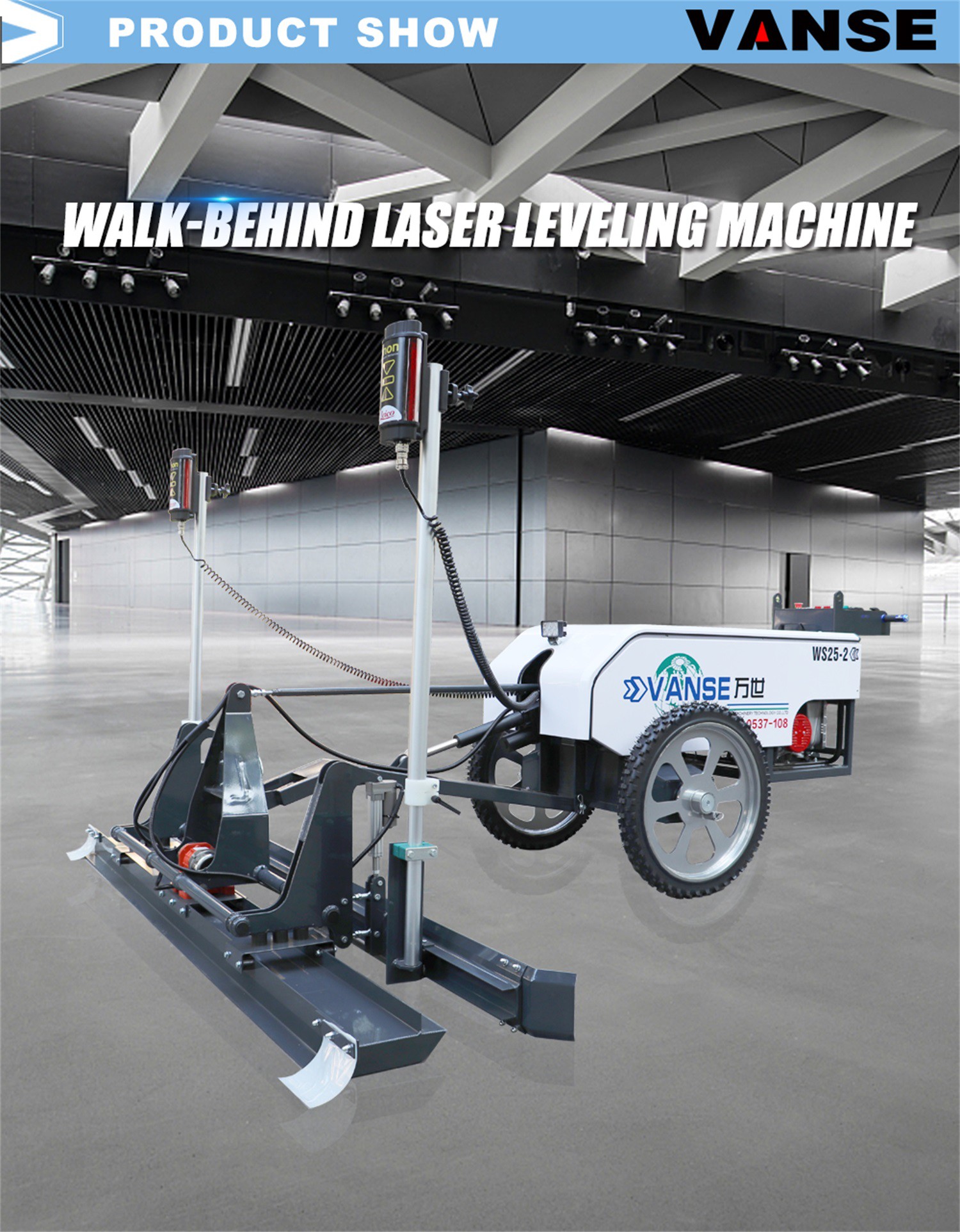
1.The time interval of each start-up should not be less than 10s.
2. In the process of equipment shutdown and transfer, the pulling ring of hub center plug should be pulled out before the tire can be rotated.
3. In the process of equipment transfer, the arm can be lifted manually to control the height of the leveling head.
4. After completion of construction, please lift the nose manually by using the lifting button, and then withdraw from the construction site. It is forbidden to push the machine in the vibration and leveling parts and the ground contact state, so as to prevent damage to the vibration plate.
5. It is strictly forbidden to insert air plugs in operation, to rotate the fixed part of laser receiver by force, and to rotate the fixed part of metal air plug.
6. It is strictly forbidden for those who are not familiar with the performance of the machine to start the machine. They need to receive training before operation.
7. It is strictly forbidden to aim the eyes at the laser beam for a long time.
8. Machines shall not be used under construction in thunderstorm weather.
9. In the process of stopping leveling or turning, the vibration motor must be shut down first.
10. In the process of turning, the speed knob must be adjusted to the position below 3.
11. Check the fastening bolts of vibration motor every 100 hours.
12. The joint head of the lifting frame is refueled once a day.
13. Calcium-based butter is added to the axle head of the wheel every 50 hours.
14. The scraper coupling shaft is filled with oil once a day.
15. It is strictly forbidden to move the laser transmitter when it is turned on.
16. Do not use high-pressure water gun to clean the control box and operation screen and plug the power line of the control box at will.
17. Laser transmitters should be placed in open, non-interference and vibration places, and avoid electromagnetic interference places as far as possible, such as distribution boxes.
18.Handheld receivers snap must be perpendicular scrapers and laser receivers must be in a vertical state.
Welcome for asking if you had any needs on concrete laser leveling equipment, choose Vanse, choose quality.
Thanks to All the Friends Who Support and Trust Shandong Vanse Machinery Technology Co., Ltd.
If you want to know more about Shandong Vanse Machinery Technology Co., Ltd. or have any questions, please feel free to contact us:
Our Factory
Shandong Vanse Machinery Technology Co., Ltd.








Share this article

About the Author: Shandong Vanse Machinery Technology Co., Ltd.
Shandong Vanse Machinery Technology Co., Ltd. is a high-tech manufacturer specializing in concrete construction machinery, including laser screeds and related equipment. The company integrates R&D, production, and global sales, with products exported to over 60 countries and widely used in infrastructure projects worldwide.
Previous Post
Next Post
Related Articles
You Might Also Like
What are the common failures & solutions of concrete trowel machines?
Common faults and solutions of concrete trowel machine ●1. The engine cannot start Cause of issue: 1. The battery power is low; 2. The engine oil circuit is not smooth; 3. Starter failure; 4. The engine air filter is clogged. Solution: 1. Charge or replace the battery; 2. Check the oil line to ensure it is smooth; 3. Check the starter and replace it if necessary; 4. Clean the air filter. If you need to replace it, please contact professional technicians. ●2. Insufficient engine power Cause of issue: 1. Engine fuel system failure; 2. Improper engine valve clearance; 3. Engine air intake system failure. Solution: 1. Check the fuel system to ensure smooth fuel supply; 2. Adjust the valve clearance. If you need to replace the valve, please contact professional technicians; 3. Check the air intake system and clean or replace the air filter. ●3. The operation of the trowel machine is unstable Cause of issue: 1. The trowel blade is worn or loose; 2. The bearings of the trowel are worn or loose; 3. Improper operation of the trowel or poor road conditions. Solution: 1. Replace or tighten the blade; 2. Replace or tighten the bearings; 3. Adjust the operating method and select the appropriate operating speed and pressure according to the road conditions. ●4. The trowel machine makes a lot of noise when working Cause of issue: 1. The bearings of the trowel are damaged or loose; 2. The trowel blade is loose or worn; 3. There are foreign objects in the running parts of the trowel. Solution 1. Replace or tighten the bearing; 2. Fasten or replace the blade; 3. Check the running parts and clean up foreign objects. ●5. The smoothing effect of the trowel is not ideal Cause of issue: 1. The trowel blade is worn or improperly installed; 2. The smoothed concrete surface is uneven or blocked by hard objects; 3. Improper operation of the trowel or poor road conditions. Solution: 1. Replace or reinstall the blade; 2. Check the flatness of the concrete surface and clean up hard objects; 3. Adjust the operating method and select the appropriate operating speed and pressure according to the road conditions.How to ensure safety when operating a concrete laser leveling machine?
It is very important to ensure safety during the operation of the concrete laser leveling machine, because it is not only related to the personal safety of the operator, but also affects the construction quality and the smooth progress of the project. The following are some key safety measures: 1. Training and qualification: Ensure that all operators have received appropriate professional training and hold the corresponding operating certificates. Understand all functions, safety features and emergency response measures of the equipment. 2. Equipment inspection: Perform a comprehensive inspection of the leveling machine before each use, including but not limited to tires, fuel, hydraulic system, electrical system, laser transmitter, etc. Ensure that all parts are intact and functioning properly. 3. Personal protective equipment: Operators must wear appropriate personal protective equipment, such as hard hats, goggles, non-slip shoes, gloves, etc. 4. Site assessment: Conduct a comprehensive safety assessment of the construction site, identify potential risks, and formulate corresponding preventive measures. 1. Clear identification: Set up obvious warning signs and fences in the work area to prevent non-staff from entering the danger zone. 2. Communication is smooth: Ensure that there is a reliable way of communication between all relevant personnel to facilitate coordination of work and handling of emergencies. 3. Observe operating procedures: Strictly follow the operating manual provided by the manufacturer, and do not change or ignore any safety steps without authorization. 4. Smooth operation: Keep the machine moving smoothly during operation, avoid sudden acceleration or sharp turns, and reduce the chance of accidents. 5. Pay attention to the surrounding environment: Always pay attention to changes in the surrounding environment, especially when working at night or in poor visibility. 6. Emergency stop button: Be familiar with and know how to quickly use the location of the emergency stop button, and stop the machine immediately if any abnormality is found. 1. Regular maintenance: Perform equipment maintenance and inspection regularly according to the manufacturer's recommendations, and replace worn or damaged parts in a timely manner. 2. Record maintenance history: Keep detailed maintenance records to help track the status of the equipment and predict future maintenance needs. 3. Professional maintenance: For complex maintenance work, it should be carried out by professional technicians, and do not disassemble or repair the equipment privately. – Avoid fatigue work: Arrange working hours reasonably to avoid distraction of operators due to fatigue. – Comply with laws and regulations: Comply with national and local laws, regulations and standards on production safety. By strictly implementing the above safety measures, the safety hazards when operating the concrete laser leveling machine can be greatly reduced, ensuring the safety of the construction site.Safety & environmental protection measures for fine stone concrete floor construction
Construction of fine aggregate concrete floor: Safety protection and environmental protection measures To ensure the smooth progress of the fine aggregate concrete floor construction process, safeguard the safety and health of the workers, and minimize the negative impact on the environment, the following measures are specially formulated. Safe construction should follow the principle of "safety first, prevention foremost, and comprehensive governance". Head protection: All personnel entering the construction site must wear qualified safety helmets correctly. Foot protection: Construction workers should wear safety shoes that are resistant to impact, puncture and slip. Concrete operators are advised to wear rubber boots to prevent cement slurry corrosion. Respiratory protection: When handling, mixing and dry spreading cement and sand and gravel, especially in poorly ventilated environments, dust masks must be worn to prevent inhalation of cement dust. Hand protection: Operators should wear rubber or plastic gloves to prevent skin burns from cement and alkaline substances. Eye protection : When mixing, pumping or using power tools for cutting and grinding, protective glasses should be worn to prevent concrete slurry or debris from splashing into the eyes. High-altitude work protection: When working near edges or openings, safety belts must be fastened. Before use, check the electrical circuits, insulation conditions and whether the protective covers are in good condition. When in operation, it is strictly forbidden to insert hands or tools into the mixing drum. When cleaning or conducting maintenance, the power supply must be cut off, and a dedicated person should be assigned for supervision. A warning sign reading "Do Not Close the Switch" should be hung. Before operation, check whether the cable, switch, blade/grinding disc are in good condition and securely fastened. Operators need to be familiar with the equipment operation procedures, hold the control lever tightly with both hands to prevent the machine from getting out of control. The cable should be suspended to prevent it from being caught or dragged by the machine. The support of the pump pipe must be firm, especially at the elbows and joints. When pumping, it is strictly prohibited for anyone to stand at the outlet of the pump pipe. When cleaning the pipeline, there must be no personnel in front of the outlet. All electric tools must be powered by a power supply equipped with a leakage protection device. Cables must not be dragged on the ground, rolled over or immersed in water. They should be installed overhead or buried underground. Non-professional electricians are strictly prohibited from privately connecting wires or repairing electrical equipment. Openings and edge protection: The reserved openings on the floor, staircase entrances, and elevator shaft openings must be covered with solid covers or guardrails, and safety warning signs must be hung. Material stacking safety: Materials such as cement and sand and gravel should be stacked neatly, and the height should not be too high to prevent collapse. The stacking area should be kept away from slopes and pits. Safety of cross-operation: Arrange the construction sequence reasonably and reduce vertical cross-operation. When it is unavoidable, a safety isolation layer should be set up, and a dedicated person should be assigned to direct and communicate between the upper and lower floors. Fire prevention measures: Smoking is strictly prohibited at the construction site, and sufficient fire-fighting equipment (such as fire extinguishers) should be provided as required. When conducting thermal construction (such as using a furnace for heating in winter construction), there must be a dedicated person to supervise and keep away from flammable materials. Lighting and ventilation: When conducting construction in the basement or at night, there must be sufficient lighting. When working in a closed space, good ventilation should be ensured. Environmental protection should follow the principle of "source control, process management and end-of-pipe treatment". Cement and sand: Cement should be stored in a dedicated warehouse or tightly covered with tarpaulin. Sand and gravel storage sites should be appropriately watered to reduce dust or covered. Mixing operation: Pre-mixed commercial fine aggregate concrete is preferred. If on-site stirring is carried out, it should be set up in a closed or semi-closed stirring shed and equipped with dust suppression devices. Transportation and paving: Transport vehicles should be protected from spillage. When laying manually, avoid raising dust. Cutting and grinding: When performing ground cutting and grinding, it is necessary to use dedicated equipment with dust collection devices or carry out wet water spraying operations to effectively suppress dust. Equipment selection: Give priority to using construction machinery with low noise and high efficiency. Work time: Reasonably arrange the time for high-noise operations (such as cutting and grinding), and try to avoid construction at night or during lunch breaks. If continuous operation is required, it should be reported to the environmental protection department in advance and the surrounding residents should be informed. Sound insulation measures: For fixed high-noise equipment (such as fixed mixers), sound insulation sheds can be set up. Mobile device operators should wear earplugs. Classified collection: Separate construction waste from household waste. Discarded concrete blocks, mortar, packaging bags, etc. should be sorted and stacked. Recycling: Discarded concrete blocks, bricks, etc. can be crushed and used as backfill materials or roadbed materials. Timely removal: Assign dedicated personnel to be responsible for transporting the waste to the designated construction waste storage area in a centralized manner. It is strictly prohibited to dump or landfill it at will. Cleaning of mixing equipment: The wastewater from cleaning mixers and transport vehicles should be discharged into a dedicated sedimentation tank. After sedimentation treatment, the supernatant can be recycled for water spraying and dust suppression. It is strictly prohibited to directly discharge it into the municipal water network or natural water bodies. Curing wastewater: The wastewater generated during the curing stage (such as watering and covering with a wet cloth) is basically clean water, but the flow rate should be controlled to avoid surface runoff, which could lead to water resource waste and site mud. Material conservation: Accurately calculate the amount of concrete used, adopt advanced construction techniques, and reduce unnecessary waste and loss. Water conservation: It is recommended to use spray moisture retention during maintenance and avoid flooding with water. Promote the use of water-saving curing agents (film curing liquid) to replace traditional watering curing. Energy conservation: Select construction equipment with high energy efficiency, rationally arrange the process, and reduce the idling time of equipment. The safety and environmental protection management of fine aggregate concrete floor and ground construction is a dynamic and full-process management. All construction personnel must receive detailed safety and technical briefings before taking up their posts, clearly defining all risks and response measures. Only through strict on-site management and continuous education can safety accidents be effectively prevented and the goal of green and civilized construction be achieved. Note: The parameters provided in this document are for reference only and are not mandatory. Due to differences in technical characteristics between different brands and models of laser levelers, please consult the manufacturer for a suitable solution before actual operation. This reference document assumes no responsibility for any issues arising from failure to follow the manufacturer's instructions.