Technical Knowledge
Know- how about laser leveling technology
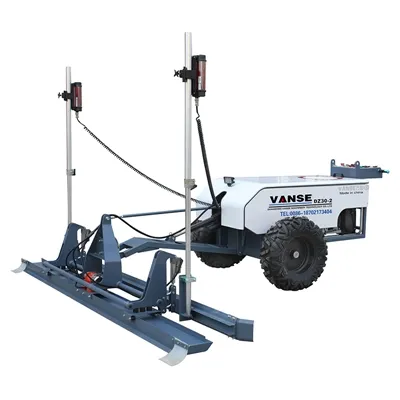
Intellectual property assets such as patents are the core of many organizations and transactions related to technology.
Patents that contribute to products with a wide market appeal or that represent a considerable improvement to an existing product in an established market may be likely to generate significant economic returns.Thus, the commercial value of a patent may be, in part, a function of the size and nature of the market for the product to which the patent pertains.
Vanse passionate about being the premier manufacturer of placing . A patent provides a right to a technology holder to exclude others from exploiting the patented invention.There fore, other than the inventor cannot use, make or sell the patented invention without permission from the inventor.
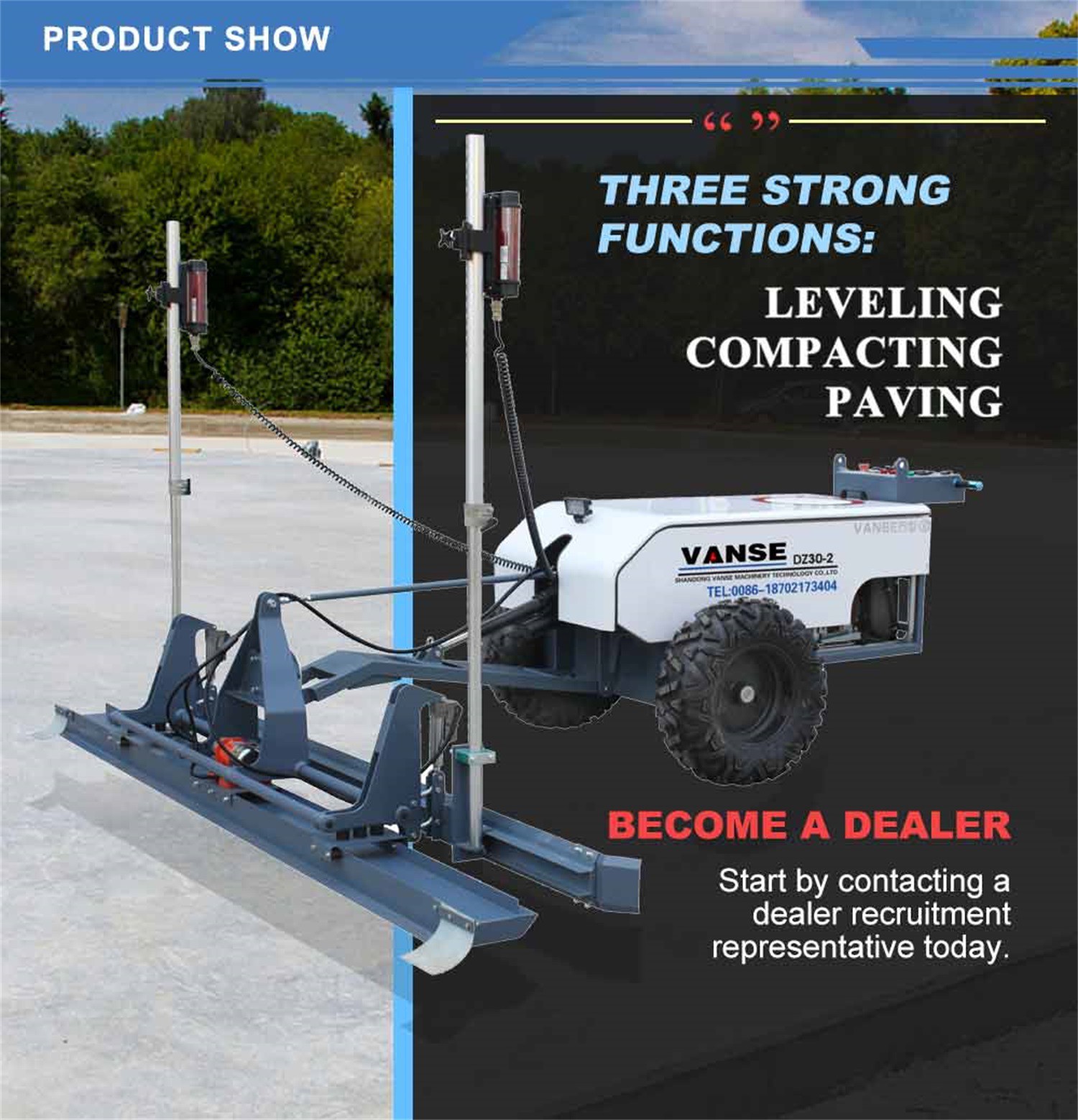
This is often referred to as the exclusive right of the invention. Vanse Concrete Laser leveling technology enables faster and flatter floors going for patented vanse laser leveling technology allows you to increase productivity, efficiency, and quality of each and every job.
Thanks to All the Friends Who Support and Trust Shandong Vanse Machinery Technology Co., Ltd.
If you want to know more about Shandong Vanse Machinery Technology Co., Ltd. or have any questions, please feel free to contact us:
Our Factory
Shandong Vanse Machinery Technology Co., Ltd.








Share this article

About the Author: Shandong Vanse Machinery Technology Co., Ltd.
Shandong Vanse Machinery Technology Co., Ltd. is a high-tech manufacturer specializing in concrete construction machinery, including laser screeds and related equipment. The company integrates R&D, production, and global sales, with products exported to over 60 countries and widely used in infrastructure projects worldwide.
Previous Post
Next Post
Related Articles
You Might Also Like
How to maximize the leveling efficiency of the laser leveler while ensuring flatness?
In concrete construction, the use of laser leveling machines has greatly improved construction efficiency and ground flatness. However, while ensuring flatness, how to maximize the leveling efficiency of the laser leveling machine is a challenge that the construction team needs to face. The following is a detailed analysis of this issue. Introduction As an advanced construction equipment, the high efficiency and high precision of the laser leveling machine have brought revolutionary changes to building construction. This article will explore how to maximize the working efficiency of the laser leveling machine while ensuring construction quality. 1. Preparation before construction Sufficient pre-construction preparation is the basis for improving the efficiency of the laser leveling machine: – **Equipment inspection**: Ensure that all components of the laser leveling machine are in good condition, especially the laser system and control system. – **Construction plan**: Develop a detailed construction plan according to the project requirements, including concrete mix ratio, pouring thickness and leveling process. – **Operator training**: Ensure that the operator is familiar with the equipment operation and construction process, and understands how to balance efficiency and flatness. 2. Quality control of construction materials The quality of construction materials directly affects the leveling efficiency of the laser leveler: – **Concrete ratio**: Strictly control the ratio of concrete to ensure its fluidity and plasticity, and reduce the working pressure of the laser leveler. – **Raw material quality**: Select high-quality cement, aggregates and additives to avoid affecting construction efficiency due to material problems. 3. Quality monitoring during construction Quality monitoring during construction is the key to ensuring flatness and improving efficiency: – **Laser system monitoring**: Real-time monitoring of the stability of the laser system to ensure the accuracy of the laser plane. – **Flatness detection**: Regularly use professional equipment to detect the flatness of the concrete surface and adjust the working parameters of the laser leveler in time. 4. Laser leveler operating skills Skilled operating skills can improve the leveling efficiency of the laser leveler: – **Equipment adjustment**: Adjust the height and speed of the leveler according to the actual situation of the concrete to achieve the best leveling effect. – **Operation continuity**: Maintain the continuity of operation to avoid inconsistent flatness or reduced efficiency due to operation interruptions. 5. Control of construction environment A good construction environment helps improve the leveling efficiency of the laser leveling machine: – **Environmental factor control**: Control the temperature, humidity and light conditions of the construction site to ensure a suitable construction environment for concrete. – **Construction site layout**: Rationally plan the construction site layout to reduce the time for equipment movement and material transportation. 6. Post-construction maintenance management Reasonable maintenance management is crucial to ensure construction results and improve efficiency: – **Timely covering**: Cover the concrete surface in time after construction to prevent moisture from evaporating too quickly. – **Curing time**: Ensure sufficient curing time to fully harden the concrete and avoid affecting the flatness due to improper curing. 7. Recording and analysis of construction data Detailed recording and analysis of construction data helps to continuously improve construction efficiency: – **Data recording**: Record various parameters during the construction process, such as concrete temperature, pouring speed, leveling speed, etc. – **Data analysis**: Analyze the data, find out the factors that affect construction efficiency, and formulate improvement measures. 8. Maintenance and upgrading of construction machinery Regular maintenance and timely upgrading of construction machinery are the guarantee for maintaining construction efficiency: – **Regular maintenance**: Develop equipment maintenance plans to ensure that the equipment is in good condition. – **Technology upgrade**: Pay attention to the development of industry technology, upgrade the equipment technology in a timely manner, and improve its work efficiency. 9. Prevention and control of construction risks Preventing and controlling construction risks can reduce construction interruptions and improve efficiency: – **Risk assessment**: Conduct construction risk assessments regularly to identify potential risk factors. – **Emergency plan**: Develop emergency plans to ensure that risks can be responded to quickly when they occur. 10. Technological innovation and application Technological innovation is an important way to improve the leveling efficiency of laser leveling machines: – **New process exploration**: Continuously explore and experiment with new construction processes to improve construction efficiency. – **Technology integration**: Integrate the latest technologies, such as intelligent control systems, to improve the level of construction intelligence. 11. Conclusion To maximize the leveling efficiency of the laser leveler while ensuring flatness requires comprehensive consideration of multiple aspects, including preparation before construction, quality control of construction materials, quality monitoring during construction, operation skills of the laser leveler, control of the construction environment, maintenance management after construction, recording and analysis of construction data, maintenance and upgrading of construction machinery, prevention and control of construction risks, and technological innovation and application. Through the implementation of these measures, construction efficiency can be effectively improved while ensuring construction quality.When using the gasoline power trowel, what types of blades should be selected based on the different hardness levels of the concrete?
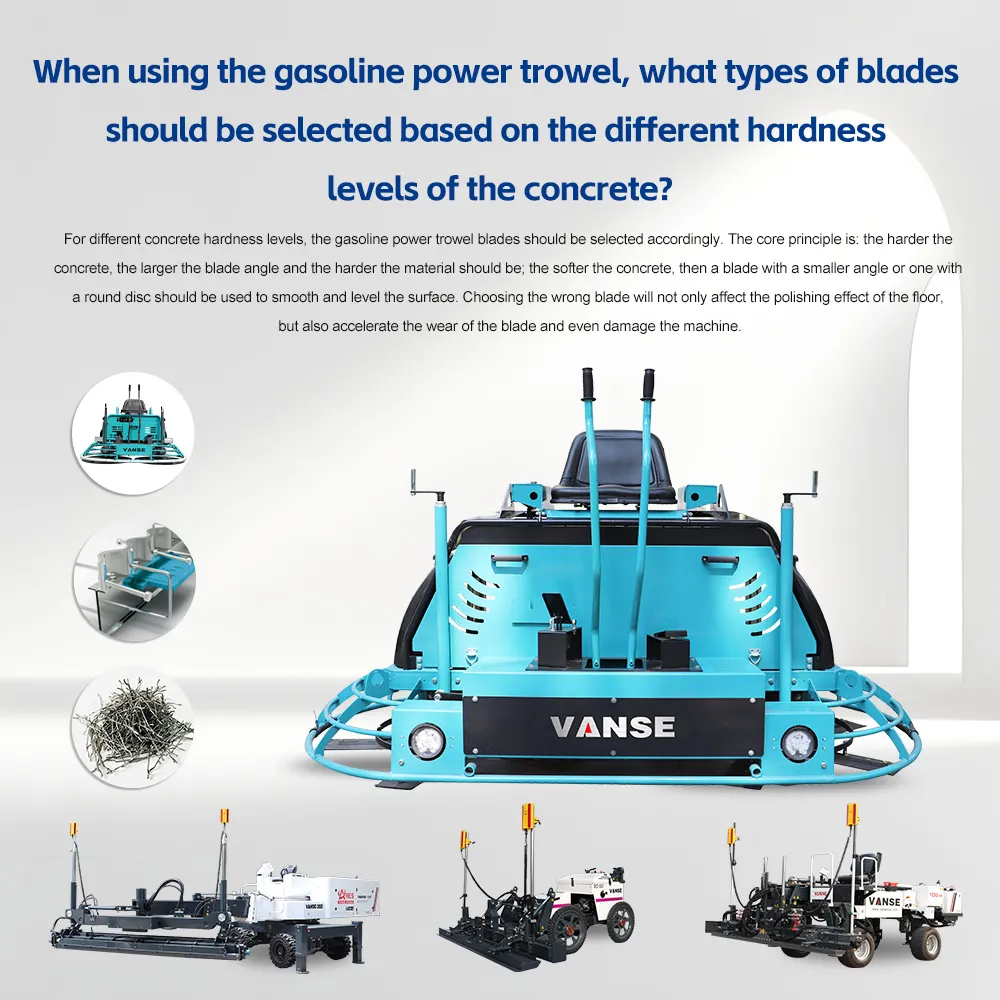
For different concrete hardness levels, the gasoline power trowel blades should be selected accordingly. The core principle is: the harder the concrete, the larger the blade angle and the harder the material should be; the softer the concrete, then a blade with a smaller angle or one with a round disc should be used to smooth and level the surface. Choosing the wrong blade will not only affect the polishing effect of the floor, but also accelerate the wear of the blade and even damage the machine. According to the hardening process of concrete from initial setting to final setting, it is generally divided into three stages, and different types of blades need to be selected for each stage: Construction stage Concrete hardness state Recommended blade types Key parameters/materials Functions and Effects First stage: Mixing and leveling Immediately after pouring, the concrete is soft and has high fluidity. Disc-shaped polishing blade (requires installing the disc onto the blade) The diameter of the disc is usually greater than the length of the blade. Compaction, levelling and initial leveling. The disc can prevent the blade from cutting too deeply, lift the surface slurry and provide an initial levelness for the ground. Second stage: Smoothing After the concrete begins to set, the surface starts to harden. When stepping on it, there are slight footprints (about 1-3mm deep). Regular polishing blade Material: 65 manganese steel or high manganese steel; thickness: approximately 2mm; blade size: common lengths such as 345mm, 355mm, etc. Level the ground and remove the disc marks. At this point, the disc should be removed and the blade used for the operation. The blade angle should be adjusted to be smaller (about 0 – 10 degrees), mainly for leveling purposes. Third stage: Finishing Before the concrete fully sets, the surface becomes hard. When stepping on it, there are almost no footprints. Fine-tuning/finishing blade Alloy steel with a harder material and a smoother surface; or used old blades (because the edges have been smoothed out more smoothly). Make the ground smooth, wear-resistant and dense. The blade angle should be increased (about 10 – 15 degrees) to increase the pressure on the ground and repeatedly press to create a smooth surface. The material of the blade determines its lifespan: The search results repeatedly mention that high-quality blades are usually made of 46# high manganese steel or 65 manganese steel, with a thickness of approximately 2mm. This material combines hardness and toughness, being able to withstand intense friction with concrete while also being less prone to breaking. Poor-quality blades, on the other hand, are prone to uneven polishing due to insufficient strength. The blade angle can be adjusted: The tilt angle of the blade on an gasoline power trowel is usually adjustable between 0 and 15 degrees. The greater the angle, the deeper the blade cuts into the concrete, exerting greater pressure on the ground, and is suitable for the harder polishing stage; the smaller the angle, the softer it is, and is suitable for the initial smoothing stage. This is a key mechanical parameter for controlling the polishing effect. Replace worn-out blades in time: When the blade wears down to 30mm on one side, it can be considered to switch to the other side to achieve the effect of two blades. If the wear is severe and causes imbalance, a new blade must be replaced; otherwise, it will cause the machine to shake and affect the flatness of the ground. Soft ground requires hard tools, while hard ground needs soft tools is a misconception: Please remember, the softer the concrete, the more you should use round discs or small-angle blades (to avoid cutting); the harder the concrete, the more you should use large-angle sharp blades (to increase friction). Combination of new and old blades: Experienced workers will keep a pair of worn-out but still suitable old blades specifically for the final polishing process, because their edges are smoother and rounder, and are less likely to leave marks. Safety and maintenance: When replacing blades or cleaning residual concrete, make sure the machine has been turned off and the blades have completely stopped rotating. After each use, clean the cement slurry on the blades promptly and apply grease for rust prevention. I hope this guide can help you choose the right blades at different construction stages. If you can tell me approximately which stage of hardening your current concrete is in, or if you encounter specific ground effect problems (such as knife marks, lack of shine), I can help you further analyze and adjust the plan. Contact us NOW Note: The parameters provided in this document are for reference only and are not mandatory. Due to differences in technical characteristics between different brands and models of laser levelers, please consult the manufacturer for a suitable solution before actual operation. This reference document assumes no responsibility for any issues arising from failure to follow the manufacturer's instructions.Laser leveling VS manual leveling for Superflat floors
If you are bidding on high-spec projects like Amazon fulfillment centers or automated cold storage, the "Manual vs. Laser" debate is already over. To hit Superflat (FM1/FM2) standards consistently, the human eye and a hand-held straightedge simply cannot compete with light-speed technology. But why exactly is the shift happening globally? If you're a contractor weighing the investment, here is the professional breakdown of Laser leveling vs. Manual leveling and why the "Vanse System" is the modern industry standard. Manual leveling relies on the physical stamina of the crew. By the 4th hour of a pour, fatigue sets in, and those "tight" tolerances begin to slip. Manual: Even the best crew will struggle to hit FF 30 consistently across a 1,000sqm slab. The Vanse Edge: A Vanse Concrete Laser Leveling Machine receives signals 10 times per second. It makes micro-adjustments to the hydraulic head in real-time. This automated precision is how you hit FF 50+ (Superflat) without breaking a sweat. It removes human error from the most critical stage of the pour. A Superflat floor isn't just about the leveling; it's about the entire "Value Chain." Manual crews often struggle with the sheer logistics of a large pour. Placement: Instead of 6 guys with shovels struggling to move wet concrete, pros use a Vanse Concrete Distributor or a Mini Dumper. These tools place the concrete exactly where it needs to be, preventing the "mounds" that make leveling difficult. Leveling: While the Laser Leveling Machine strikes off the floor, the Vanse Automatic Topping Spreader can follow behind to apply wear-resistant hardener with mechanical uniformity-something a manual thrower can never achieve. Finishing: To turn that level slab into a mirror, you need torque. A Vanse Ride-on Power Trowel provides the heavy compaction needed to "burnish" the floor, closing the pores that manual floating leaves open In the international market, labor isn't just expensive; it's hard to find. The Math: A manual Superflat pour requires a "dream team" of 10–15 highly skilled laborers. The Vanse Reality: With the right equipment, you can cut your specialized crew by 60%. One operator on the laser leveling, one on the Mini Dumper, and two on the Power Trowels. You produce 3x the square meters with half the people. The machine doesn't get tired, doesn't call in sick, and produces the same quality at 4 PM as it did at 8 AM. If a manual floor fails the FF/FL test, your profits vanish into "rework" (grinding and patching). Long-term Quality: Once the floor is set, a Vanse Concrete Cutting Machine (Floor Saw) ensures the joints are crisp and straight. This prevents the "spalling" and cracking that often plagues manually-leveled floors where the concrete wasn't consolidated uniformly. Feature Manual leveling Vanse Laser leveling System Precision (FF/FL) Variable (Human Error) High/Superflat (Automated) Production Speed 400 – 600 m²/day 2,500 – 3,500 m²/day Labor Requirement High (12+ people) Low (4-6 people) Surface Hardness Uneven Superior (Uniform Compaction) Physical Strain Extreme Low (Machine-driven) ROI Low (High Labor + Rework Risk) High (Speed + Guaranteed Spec) Manual leveling belongs to the past. If you want to bid on the world's most demanding logistics and industrial projects, you need the precision of a Vanse fleet. From the initial transport with a Mini Dumper to the final pass of the Power Trowel, Vanse (www.vansemac.com) provides the technology to turn a simple concrete pour into a world-class asset. Ready to upgrade your production? Explore the full range of Superflat solutions at Vanse Machinery and start hitting those high FF numbers today. Note: The parameters provided in this document are for reference only and are not mandatory. Due to differences in technical characteristics between different brands and models of laser levelers, please consult the manufacturer for a suitable solution before actual operation. This reference document assumes no responsibility for any issues arising from failure to follow the manufacturer's instructions.