Technical Knowledge
Laser leveling machine for concrete paving
November 2, 2022

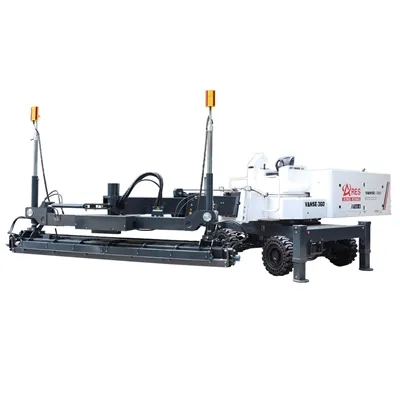
WS740 concrete laser leveling machine: the apparatus guide by laser for concrete leveling.
Laser leveling leveling machine could greatly improve the concrete smoothness and compaction. as well as prolong the service life of concrete floor.
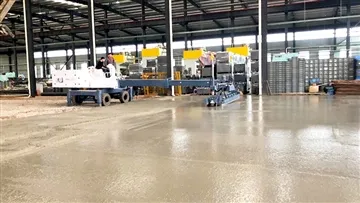
Walk-behind two wheels concrete laser leveling machine, mainly used in large area concrete construction, such as workshop, supermarket, warehouse, airport, playground and so on. This laser leveling can satisfy the construction requirement of large area and high flatness and levelness.
As for laser leveling: A new concrete construction,while construct a large area of concrete floor,use laser leveling machine to vibrate new concrete,leveling and control the standard elevation from ground.
Technical Description:First,set a fixed laser transmitter,the transmitter emits a laser beam rotation forming a laser control plane,using handheld receivers lever floor elevation guide to the leveling head of Tank concrete laser leveling machine,the automatic control system of leveling machine receiver laser signal (10 times/sec frequency) based on the laser leveling head sensed,then adjust the elevation automatic in real-time,because the laser emitter after the set is fixed,so it can make sure does not produce a cumulative error while a large area of ground construction.
Thanks to All the Friends Who Support and Trust Shandong Vanse Machinery Technology Co., Ltd.
If you want to know more about Shandong Vanse Machinery Technology Co., Ltd. or have any questions, please feel free to contact us:
Our Factory
Shandong Vanse Machinery Technology Co., Ltd.


About the Author: Shandong Vanse Machinery Technology Co., Ltd.

Shandong Vanse Machinery Technology Co., Ltd. is a high-tech manufacturer specializing in concrete construction machinery, including laser screeds and related equipment. The company integrates R&D, production, and global sales, with products exported to over 60 countries and widely used in infrastructure projects worldwide.

Previous Post
Shandong Vanse Machinery
Leading manufacturer specializing in high-performance concrete laser screeds, telescopic arm flatwork handlers, and mechanical ride-on power trowels.
Post overview
Main PRODUCT Categories
Need Machine Guidance?
Speak directly with Shandong Vanse field specialists for tailored equipment quotes and site planning.
Contact Us TodayRelated Articles
You Might Also Like
February 12, 2026
How to match power trowel with concrete laser leveling machine for warehouse floors
In warehouse construction, the laser leveling sets the floor's flatness (FF), but the Power Trowel determines its levelness (FL) and surface durability. If these two aren't "in sync," you risk a floor that is flat but wavy, or a surface that delaminates under forklift traffic. Here is the strategy to match these machines for a high-tolerance warehouse floor. The most critical "match" isn't speed-it's chemistry. You must time the trowel start based on the leveling's progress. The Footprint Test: In a warehouse setting, the ride-on trowel should enter the slab when a worker's boot leaves an indentation of roughly 3mm to 5mm. The "Pass" Offset: Typically, the first power trowel should be starting its "panning" pass exactly 2 to 4 hours (depending on temperature and mix) after the laser leveling finished that specific section. Rate Matching: If your laser leveling is placing 500 m² per hour, you need enough trowel capacity to finish 500 m² per hour. Usually, this requires one 8ft or 10ft ride-on trowel for every 400–600 m² of daily pour to stay ahead of the "set." The laser leveling is excellent at striking off concrete, but it can leave minor "micro-ridges" from the vibration. The Large-Diameter Advantage: To match a laser-levelinged floor, use large-diameter ride-on trowels (10ft or 12ft) equipped with float pans. Why Pans? Unlike blades, pans act like giant flat-edges. They "cut" the high spots left by the leveling and "fill" the low spots, effectively magnifying the accuracy of the laser leveling. Cross-Troweling: Always run the power trowel perpendicular to the direction the laser leveling traveled. This eliminates any rhythmic undulations caused by the leveling head. As the warehouse floor hardens, you must transition from floating to finishing. Stage Tooling Matching the leveling Result Break-in Float Pans Levels the ridges left by the laser leveling head. Second Pass Combo Blades Begins to "close" the surface pores. Final Pass Finish Blades High-pitch "burnishing" for that mirror-like warehouse shine. To ensure the machines work as a team, verify these specs: Non-leveling Zones: For areas near docks or pits where the laser leveling can't reach, ensure your trowel operators have handheld vibratory leveling to maintain the same consolidation density as the main slab. Weight Ratio: Use heavy-duty ride-on trowels (e.g., 1000KG + machines) for warehouse floors. The weight is necessary to densify the surface that the laser leveling has already flattened. Fuel/Power: Ensure your trowels are running clean-burning engines (or have scrubbers) if the laser leveling is working in an enclosed warehouse space to prevent carbon monoxide buildup. In modern warehouses, "burnished" floors are the standard. This requires the power trowel to "burn" the surface at high RPMs. If the laser leveling didn't do its job, high-speed troweling will actually highlight the defects. Rule of thumb: If the trowel is "chattering" (jumping), the laser leveling pass was likely too fast or the mix was too stiff. Would you like me to create a labor-to-machine ratio table based on your typical daily pour size (in square feet or meters)? Contact us NOW Note: The parameters provided in this document are for reference only and are not mandatory. Due to differences in technical characteristics between different brands and models of laser levelers, please consult the manufacturer for a suitable solution before actual operation. This reference document assumes no responsibility for any issues arising from failure to follow the manufacturer's instructions.Read More
November 27, 2025
Analysis of the Causes of Unstable Laser Signals in Concrete Laser Leveling and Treatment Measures
The following is a detailed answer to the analysis of the causes of unstable laser signals in Concrete Laser Leveling and the corresponding treatment measures. Unstable laser signals are one of the common faults in the construction of Concrete Laser Leveling, which will directly lead to a decrease in the leveling accuracy and affect the flatness and quality of the floor. It is of vital importance to quickly locate and solve problems. The main causes of unstable laser signals come from four aspects: the laser emitter, the signal receiver, the external environment and the machinery itself. Power supply issue: Insufficient battery power or poor contact of the power adapter leads to unstable power supply to the laser and fluctuations in output power. Laser itself malfunction: Aging, damage of the laser module or loosening or contamination of internal optical components (such as lenses) can cause the beam to diverge or drift. Unstable reference point: The tripod of the laser emitter is not stably set up and may slightly move or sink under the influence of wind or human touch. Automatic calibration failure: The calibration system of the transmitter with self-leveling function (such as pendulum, magnetic damping or electronic sensor) malfunctions and cannot maintain a stable level reference. Power connection issue: The connection cable between the receiver and the main body of the leveler is loose, poorly connected or damaged. Sensor failure: The photoelectric sensor on the receiver is aged, its sensitivity has decreased, or it is covered with dirt (dust, cement slurry), making it impossible to accurately identify the laser signal. Improper installation: The receiver is not correctly installed on the mast, or there is severe vibration at the installation position, which affects signal reception. Strong light interference: The intense sunlight at noon, especially its infrared spectrum, can interfere with the receiver's recognition of laser signals. Obstruction: Temporary obstructions such as scaffolding, personnel, and equipment at the construction site block the laser beam, causing signal discontinuity. Vibration interference: There are large equipment (such as excavators, heavy trucks) operating nearby, or the laser emitter is set up on a platform with obvious vibration, causing the reference optical path to jitter. Atmospheric disturbance: At super-large construction sites, heat waves caused by high ground temperatures can lead to uneven air density, resulting in slight refraction and jitter of laser beams. Mechanical vibration: If the engine of the Leveling machine operates unsmoothly or the hydraulic system vibrates excessively, the vibration will be transmitted to the receiver, introducing signal noise. Electrical system interference: The generator, frequency converter or high-current circuit of the leveling machine itself generates electromagnetic interference, affecting the sensitive receiver circuit. Follow the principle of "from simple to complex and from outside to inside" in the investigation. Check the power supply: Ensure that the laser emitter is fully charged and all power connections are firm and reliable. Clean and inspect optical components: Use dedicated lens cleaning paper to clean the output lens of the laser emitter and the sensor window of the receiver. Stable reference: Confirm that the laser emitter tripod is firmly set up on a solid floor and kept away from vibration sources. Use counterweights to stabilize the tripod when necessary. Eliminate environmental interference Shading: Install a sunshade on the receiver to prevent direct exposure to strong light. Obstacle clearance: Inspect and clear all possible obstacles along the laser propagation path. Vibration avoidance: Suspend operations that generate strong vibrations nearby or move the position of the laser emitter. 5. Restart the system: Turn off the power of the laser emitter and the leveler, wait for one minute, and then restart to reset the electronic system. 6. Calibration check Manually rotate the transmitter to check if it can provide a stable signal throughout the entire 360-degree range. Use professional tools to check whether the automatic leveling function of the laser emitter is normal. If necessary, send it for repair and calibration. 7. Substitution method test Install the receiver on another confirmed normal level machine for testing. If the problem persists, it indicates that the receiver is faulty. Replace it with a confirmed normal laser emitter. If the problem is solved, the original emitter needs to be repaired. 8. Inspect the cables and connections: Carefully check all the cables from the receiver to the main controller for any signs of compression, wear or breakage, and reinsert all the connectors. 9. Seek professional support: If none of the above steps can solve the problem, it is very likely that there is a hard fault with the electronic components inside the laser or the receiver. At this point, you should immediately contact the after-sales service department of the equipment manufacturer (such as Shandong Wansai Technology) for diagnosis and repair by professional technicians. Do not disassemble the core components by yourself. Regular maintenance: Clean and calibrate the laser transmitter and receiver regularly in accordance with the operation manual. Standard operation: Set up and move the equipment correctly to avoid violent impacts. On-site investigation: Observe the on-site environment before construction, plan the installation position of the laser emitter in advance, and avoid potential interference sources. Backup equipment: For critical projects, it is recommended to prepare backup laser transmitters or receivers to deal with sudden malfunctions. Through systematic analysis and step-by-step investigation, the problem of unstable laser signals of concrete Laser Leveling machines can be efficiently solved, ensuring the quality and efficiency of construction. Note: The parameters provided in this document are for reference only and are not mandatory. Due to differences in technical characteristics between different brands and models of laser levelers, please consult the manufacturer for a suitable solution before actual operation. This reference document assumes no responsibility for any issues arising from failure to follow the manufacturer's instructions.Read More
February 25, 2026
Which types of concrete admixtures can improve the plasticity of the concrete used for laser leveling construction?
For laser leveling construction, the "plasticity" of concrete not only relates to its fluidity, but also to the stability, uniformity and plasticity exhibited by the concrete during the brief process of vibration, compaction and leveling carried out by the laser leveling machine. To ensure that the laser leveling machine can create a flat, dense and non-cracked ground, the following several admixtures are key to improving the performance of concrete construction: Type of admixture The core role of laser leveling in plasticity Applicable Scenarios and Advantages Key points to note Water reducer / High-efficiency water reducer Core role: While maintaining fluidity, significantly reduces the water-cement ratio, making the concrete slurry denser, more uniform, and more stable. It is the preferred choice for almost all laser-leveling of floors, especially for industrial floors that require high wear resistance and high strength. The dosage must be strictly controlled. Excessive dosage may cause the concrete to become too thick, thereby increasing the load on the leveling machine. Impact on construction: Reduces bleeding and segregation, allowing the surface of the laser leveling machine to immediately set concrete after vibration, facilitating surface finishing; at the same time, prevents "edge collapse" due to excessive softness after spreading, ensuring flatness. Retarding agent Core role: Delays the cement hydration reaction, prolonging the plastic state of the concrete. Large-scale and large-volume flooring construction, or construction under hot weather conditions. The dosage must be precisely adjusted according to the temperature and the construction speed. Excessive retardation will seriously affect the construction schedule. Impact on construction: Provides sufficient operating window periods for the laser leveling machine's spreading, vibrating, and repeated leveling, ensuring that the joints of large-area flooring can be perfectly integrated and eliminating cold joints. Air-entraining agent Core role: Introduces a large number of stable, tiny closed air bubbles into the concrete. For ground that requires freeze-thaw cycles (such as outdoor parking lots), or to address the construction challenges posed by high clay content in sand and gravel. It will slightly reduce the strength of the concrete. Special equipment is required to measure the air content and keep it within a reasonable range (usually 4% – 6%). Impact on construction: These bubbles are like "micro-rollers", significantly improving the cohesion and plasticity of the concrete, making the mixture softer and easier to level, and reducing bleeding and segregation. Adhesive agent / Viscosity regulator Core role: Increases the viscosity of the cement slurry and enhances its ability to encapsulate the aggregate. Used for preparing self-compacting concrete or pumped concrete, it prevents segregation during the vibration of the laser leveling machine, ensuring the uniformity of the concrete. It is often used in combination with high-efficiency water reducing agents to balance fluidity and anti-dewatering properties. In actual engineering projects, to achieve the best plastic effect, these additives are usually used in combination. A typical "golden combination" is: high-efficiency water reducer + retarder. This combination can ensure that the concrete has the excellent fluidity required for laser leveling (facilitating spreading), provide sufficient construction time (facilitating leveling), and ensure the strength and stability after hardening. If your construction environment is complex, such as during hot summer construction, or if the aggregate gradation you use is not ideal, you can consider adding air-entraining agent or tackifier to further optimize the workability of the concrete. Which additives are currently used in your concrete mix ratio? Or did you encounter specific plasticity problems during construction (such as poor fluidity, rapid setting, or easy bleeding)? Please tell me these details, and I can help you analyze how to optimize the combination of additives. Contact us NOW Note: The parameters provided in this document are for reference only and are not mandatory. Due to differences in technical characteristics between different brands and models of laser levelers, please consult the manufacturer for a suitable solution before actual operation. This reference document assumes no responsibility for any issues arising from failure to follow the manufacturer's instructions.Read More