Technical Knowledge
Precision Setting Techniques for Concrete Laser Leveling Machines in Super-Flat Floor Construction
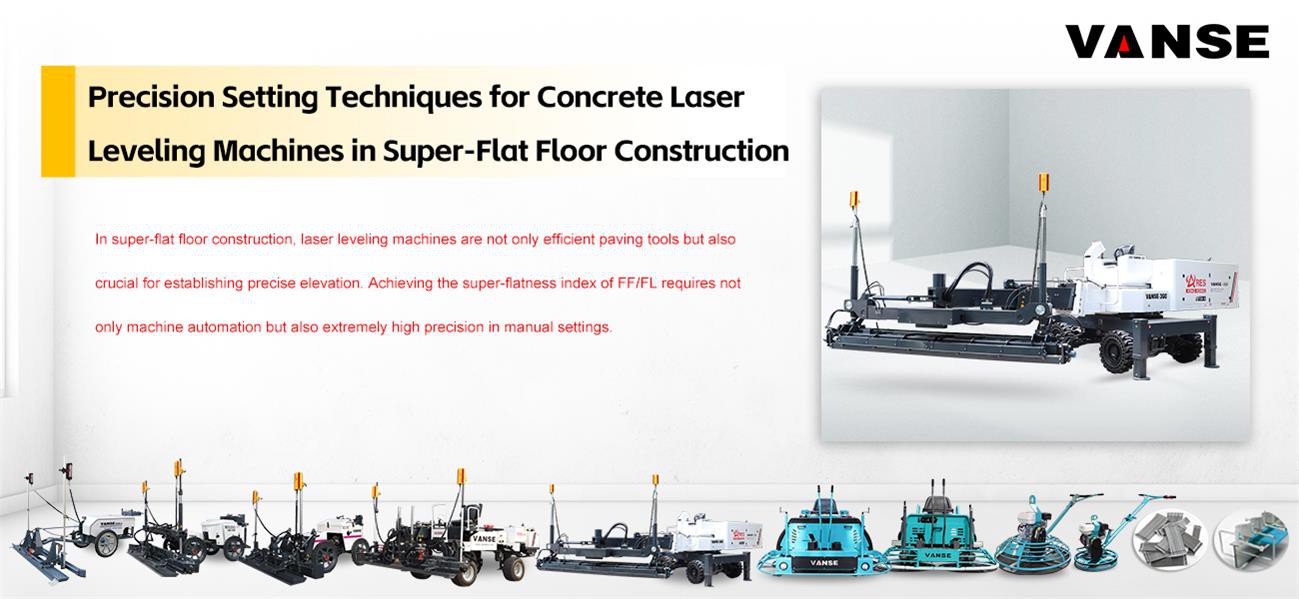
In super-flat floor construction, laser leveling machines are not only efficient paving tools but also crucial for establishing precise elevation. Achieving the super-flatness index of FF/FL requires not only machine automation but also extremely high precision in manual settings.
The following are precision setting and operation techniques for laser leveling machines to achieve super-flatness:
I. Baseline Settings of the Laser System (Core Accuracy Control)
1. Laser Transmitter Placement and Setup
Avoid interference sources: The transmitter must be installed outside the concrete paving area and away from crane vibrations, passing vehicles, and airflow interference (the support structure needs to be reinforced in windy conditions).
Height coverage: Ensure that the transmitter's signal plane covers the entire work area and is not obstructed by on-site columns or equipment.
Dual transmitter verification: For extra-large areas, it is recommended to set up two transmitters for mutual verification to ensure that signal attenuation or drift during long-distance transmission is detected in a timely manner.
2. Calibration of the Handheld Receiver (Grade Rod)
Before the start of each shift, the physical elevation of the top of the formwork must be compared with the signal elevation of the laser transmitter using the same handheld laser receiver rod.
Error limit: The error between the measured elevation of the formwork and the laser signal elevation must be controlled within ±1 mm.
II. Fine-Tuning Techniques for Mechanical Performance
1. Automatic Response Rate
Technique: Adjust the sensitivity of the hydraulic sensor based on the concrete slump.
If the concrete is stiffer, the sensitivity should be appropriately reduced to prevent the leveling head from frequently bouncing due to resistance; if the concrete is thinner, increase the sensitivity to ensure immediate correction of small height differences.
2. Depth Control of the Scraper (Auger/Plow)
Screw Feeder Setting: The lower edge of the screw feeder should be slightly higher than the design elevation (approximately 3-5 mm), using the rear vibrating beam to compact the material to the design position.
Material Excess: Always maintain a suitable amount (approximately 2-5 cm) of concrete accumulation in front of the leveling head. Too little material will result in "empty scraping," and too much material will create pushing waves.
III. Path Planning and Operating Procedures
1. Overlap Paving Method
Operation: Each paving pass should overlap the previously completed pass by 200-300 mm.
Technique: Set the hydraulic control on the overlapping side to "manual" and the non-overlapping side to "automatic". This allows the screed to use the completed pavement as a reference, ensuring consistent elevation at the joint and eliminating noticeable "joint ridges".
2. Landing Control
At the end of each paving pass (when the machine retracts its arm), the travel speed should be slightly reduced to prevent the suction created when the screed lifts from pulling up the concrete and causing low spots at the edges.
IV. Monitoring of environmental factors affecting accuracy
| Factors | Factors affecting accuracy | Troubleshooting Techniques: |
| Wind speed | Wind can cause the laser beam to shake. | Use windproof supports or add a filtering function to the laser receiver. |
| Concrete slump | The consistency (dryness/wetness) of each batch of material varies. | Assign a dedicated person to monitor at the discharge point and strictly prohibit spreading material with a slump error exceeding ±20 mm. |
| Tire pressure | The amount of tire deflection changes. | Check the tire pressure of the leveling machine before starting work each day to ensure symmetry and consistent pressure on both sides. |
V. The "Human-Machine Integration" Composite Control Scheme
The **first pass with a long-handled straightedge (Highway Straightedge)** after the laser Leveling is completed is crucial:
Operation: While the concrete is still plastic, the operator should use an aluminum alloy straightedge of more than 3 meters in length, following the Leveling machine and performing reciprocating leveling perpendicular to the paving direction.
Purpose: To eliminate the small marks left by the laser Leveling when changing lines or turning.
Note: The parameters provided in this document are for reference only and are not mandatory. Due to differences in technical characteristics between different brands and models of laser levelers, please consult the manufacturer for a suitable solution before actual operation. This reference document assumes no responsibility for any issues arising from failure to follow the manufacturer's instructions.
Thanks to All the Friends Who Support and Trust Shandong Vanse Machinery Technology Co., Ltd.
If you want to know more about Shandong Vanse Machinery Technology Co., Ltd. or have any questions, please feel free to contact us:
Our Factory
Shandong Vanse Machinery Technology Co., Ltd.








Share this article

About the Author: Shandong Vanse Machinery Technology Co., Ltd.
Shandong Vanse Machinery Technology Co., Ltd. is a high-tech manufacturer specializing in concrete construction machinery, including laser screeds and related equipment. The company integrates R&D, production, and global sales, with products exported to over 60 countries and widely used in infrastructure projects worldwide.
Previous Post
Next Post
Related Articles
You Might Also Like
What are the construction options for a concrete laser leveling machine?
The construction plan for a concrete laser leveling machine must be tailored to the project type (e.g., industrial plant, underground garage, large plaza, etc.), concrete grade, and site conditions. The core design principle is "standardized processes and controllable precision." The following is a general plan framework and examples of typical scenarios: Floor Flatness Error: ≤3mm/2m (core indicator for laser leveling); Concrete Density: ≥98% (avoiding sanding and hollowing); Construction Schedule: Planned based on a "500-800㎡/shift" (per machine). Stages Key Work Areas Core Requirements 1. Construction Preparation ① Base Preparation: Compaction (compaction degree ≥ 95%), debris removal, and watering (no water accumulation); Base leveling error ≤ 5mm/2m; Laser signal unobstructed (avoid metal and strong light). ② Laser System Commissioning: Transmitter calibration (horizontal error ≤ 0.1mm/m), receiver sensitivity test; ③ Material Preparation: Concrete (slump 120-160mm, initial setting ≥ 4h), geotextile/plastic film curing 2. Concrete Pouring ① Spreading: Use a tanker or concrete spreader to spread the material evenly, 30-50mm above the design elevation (allowing for leveling margin); Material spreading speed matches leveling speed (no accumulation or material shortages); Bin seams align with subsequent expansion joints. ② Combination Casting: For large areas, divide the concrete into 6-8m wide compartments (with temporary dividers) to prevent cracking after initial setting. 3. Laser Leveling ① Equipment Movement: Drive at a constant speed (0.8-1.2m/min), following a "horizontal back-and-forth" pattern with staggered overlaps; Real-time monitoring of the laser receiver (steady green indicates normal operation); immediate shutdown and calibration if deviation exceeds 2mm. ② Vibration Control: Insert the vibrator ≥ 50mm (penetrating the current paving layer) to ensure the connection between the upper and lower layers. 4. Finishing ① Rough Finishing: After the leveling passes, manually use a scraper to assist with leveling (to address any minor vibration leaks or unevenness). Timing of fine cutting is critical: premature cutting can lead to sanding, while delayed cutting may prevent surface air bubbles. ② Fine Finishing: After the concrete surface has cleared of water seepage (no noticeable indentations when pressed with a finger), use a trowel (with a disc) to smooth the surface 2-3 times. 5. Curing ① Covering: Cover with geotextile/plastic film within 1-2 hours of completion (before initial setting). No personnel or material stacking is permitted during the curing period; avoid freeze-thaw cycles in winter. ② Moisturizing: Water the surface every 2 hours in summer (to keep the film moist), and cover with a thermal blanket in winter (curing temperature ≥ 5°C). ③ Curing Time: ≥ 7 days (≥ 14 days for C30 and above concrete). 6. Expansion Joint Cutting ① Timing: 24-48 hours after pouring (surface hardness reaches 1.2 MPa, and no visible marks are visible when scratched with a fingernail). Clean the seams after cutting and apply sealant later to prevent water seepage. ② Specifications: Joint depth = 1/3-1/4 of the floor thickness, spacing ≤ 6 meters (required for areas over 36 square meters), joint width 5-8 mm. Key Differentiations: Concrete Grade: C35/C40 (one grade higher than standard flooring) is used, with polypropylene anti-cracking fiber (0.9 kg/m³) added to reduce thermal cracking. Laser System: Due to obstruction by pillars in the garage, a "multi-transmitter zoned coverage" system (one transmitter every 15-20 meters) is used to avoid signal blind spots. Surface Optimization: After finishing, diamond wear-resistant aggregate (5-6 kg/m²) is applied, followed by finishing with a high-speed trowel to improve surface hardness (Mohs hardness ≥ 6). Key Differentiators: Base Reinforcement: 300mm thick graded sand and gravel with a 150mm thick C25 cushion layer (50% thicker than standard flooring) ensures a load capacity of ≥5t/m2; Leveling Parameters: Vibration frequency is adjusted to 60-70Hz (compared to 50Hz for standard flooring) and travel speed is reduced to 0.6-0.8m/min to enhance concrete density; Post-treatment: After curing, a sealant and curing agent treatment (penetration depth ≥5mm) is applied to improve the floor's compressive strength (≥80MPa) and impermeability. Key Differentiations: Optimized Compartmentalization: Compartments are divided into 10m x 10m squares (common flooring requires 6-8m). Expansion joints (filled with foam board) are provided to relieve thermal stress. Concrete Control: Low-heat cement (heat of hydration ≤ 270kJ/kg) is used, and a retarder is added in summer (extending the initial setting time to 6-8 hours) to prevent cracking due to temperature differences. Laser Calibration: Transmitter levelness is rechecked every 2 hours (common flooring requires 4 hours). Because the plaza is unobstructed, a wind shield is required to prevent strong winds from interfering with the signal. Staffing: Each machine is equipped with one operator (certified) + two fabricators + two finishers + one laser monitor. Equipment Inspection Checklist: Before starting the machine, check the laser transmitter battery, vibrator wear, and tire pressure (tolerance ≤ 0.1 MPa). Emergency Plan: If the initial setting of the concrete is too rapid, immediately activate the backup leveling. If the laser signal is lost, switch to manual mode (using the adjacent leveled surface as a reference). Note: The parameters provided in this document are for reference only and are not mandatory. Due to differences in technical characteristics between different brands and models of laser levelers, please consult the manufacturer for a suitable solution before actual operation. This reference document assumes no responsibility for any issues arising from failure to follow the manufacturer's instructions.How to ensure safety during the construction process of concrete laser leveling machine?
••◆◆◆•• Introduction As an indispensable construction equipment in the modern construction industry, the safe operation of the concrete laser leveling is crucial to ensuring the safety of personnel, the integrity of the equipment and the quality of the project at the construction site. This document aims to explain how to ensure safety during the construction process of concrete laser leveling machines, including compliance with safe operating procedures, equipment inspection and maintenance, wearing protective equipment, on-site safety warnings, construction personnel training, environmental risk assessment, and emergency plan preparation As well as construction progress and quality control. ••◆◆◆•• Comply with safe operating procedures 1. Before using the concrete laser leveling, you must read and understand the safe operating procedures of the equipment in detail to ensure that every operator is familiar with the safety requirements. 2. Operators must hold a certificate to work. Unlicensed or illegal operations are prohibited. 3. During the construction process, operators should always pay attention to the surrounding environment and avoid collisions with people, other equipment or obstacles. ••◆◆◆•• Equipment inspection and maintenance 1. Before starting the equipment, a comprehensive inspection should be carried out, including electrical systems, mechanical components, laser systems, etc., to ensure that the equipment is in good working condition. 2. During the use of the equipment, regular maintenance should be carried out and worn parts should be replaced in time to ensure stable performance of the equipment. 3. If there is a malfunction or abnormality in the equipment, stop it immediately for inspection and contact professionals for repair. ••◆◆◆•• Wear protective equipment 1. Operators should wear standard protective equipment, including safety helmets, work clothes, non-slip shoes, gloves, etc., to prevent accidents. 2. At the construction site, special protective equipment such as protective glasses and dustproof mouthpieces should also be worn as needed. ••◆◆◆•• On-site safety warning 1. Obvious safety warning signs, such as safety warning signs, warning lights, etc., should be set up at the construction site to remind personnel to pay attention to safety. 2. During the construction process, cordons or warning areas should be set up according to the actual situation, and non-construction personnel are prohibited from entering. ••◆◆◆•• Construction personnel training 1. Operators should receive comprehensive construction safety technical training and be familiar with equipment operation methods, safety requirements and emergency response measures. 2. Conduct safety education and training for construction personnel on a regular basis to improve their safety awareness and self-protection capabilities. ••◆◆◆•• Environmental risk assessment 1. Before construction, an environmental risk assessment should be conducted on the construction site to identify potential safety risks. 2. Develop corresponding risk control measures and emergency plans for the identified safety risks. ••◆◆◆•• Emergency plan preparation 1. Develop a detailed emergency plan, including accident reporting procedures, personnel evacuation and rescue measures, etc. 2. Conduct regular emergency drills to improve the ability to respond to emergencies. ••◆◆◆•• Construction progress and quality control 1. Develop a reasonable construction progress plan to ensure that the construction progress meets the design requirements and avoid safety risks caused by blind rush to work. 2. Strengthen construction quality control to ensure that the construction quality of concrete laser leveling machines meets relevant standards and specifications. ••◆◆◆•• Conclusion The safety assurance of the construction process of the concrete laser leveling is a systematic project that requires the joint efforts of all construction personnel. Safety risks during the construction process can be effectively reduced by complying with safe operating procedures, equipment inspection and maintenance, wearing protective equipment, on-site safety warnings, construction personnel training, environmental risk assessment, emergency plan preparation, and construction progress and quality control. , protect the life safety of construction personnel and ensure the quality and progress of the project.How to ensure safety during operation of concrete laser leveling machine?
As an important equipment in modern building construction, the safety of concrete laser leveling machine operation is directly related to the life safety of construction workers and the quality of the entire project. In order to ensure safety during the operation, it is necessary to comprehensively consider multiple aspects and take practical and effective measures: • ◤Personnel training and certified operation◢ • 1. Professional training: Personnel operating concrete laser levelings must undergo professional operating training and understand the working principles, operating procedures, safety regulations, etc. of the equipment. During the training process, attention should be paid to the combination of theory and practice to ensure that operators can master operating skills proficiently. 2. Work with a certificate: Operators who have been trained and qualified should hold corresponding operating certificates to ensure that they have legal operating qualifications. Unlicensed personnel are not allowed to operate equipment without authorization to reduce safety accidents caused by improper operation. . • ◤Equipment inspection and maintenance◢ • 1. Equipment inspection: Before each operation, the mixed soil laser leveling machine should be comprehensively inspected, including mechanical components, electrical systems, laser systems, etc. Ensure equipment is in good working order and identify and deal with potential safety hazards in a timely manner. 2. Regular maintenance: According to the usage of the equipment, formulate a reasonable maintenance plan and perform regular maintenance and repair of the equipment. This includes replacing worn parts, cleaning dust, checking oil levels, etc. to ensure proper operation and extended service life of the equipment. • ◤Develop and follow safe operating procedures◢ • 1. Preparation and removal procedures: According to the characteristics of the concrete laser leveling machine and the actual conditions of the construction site, detailed safety operating procedures are formulated. Procedures should include equipment start-up and shutdown, operating procedures, emergency measures in emergency situations, etc. 2. Comply with procedures: Operators should strictly abide by safe operating procedures and shall not change or ignore any terms in the procedures without authorization. At the same time, on-site managers should strengthen the supervision and management of operators to ensure the effective implementation of procedures. • ◤Strengthen safety protection measures◢ • 1. Set up safety warning signs: Set up obvious safety warning signs at the construction site and around the equipment to remind operators and other personnel to pay attention to safety. Signs should be clearly visible and comply with relevant standards and regulations. 2. Use personal protective equipment: Operators should wear personal protective equipment that meets the requirements, such as hard hats, protective glasses, protective shoes, etc. These equipment can effectively reduce injuries caused by splashes or other factors. 3. Install protective devices: Install protective devices on key parts of the equipment, such as protective devices, guardrails, etc. These devices can effectively prevent operators from contacting dangerous parts of the equipment and reduce the possibility of accidents. • ◤Pay attention to the working environment and weather conditions◢ • 1. Evaluate the operating environment: Before operation, the operating environment should be comprehensively assessed to ensure that there are no obstacles, potholes and other factors that may affect the stable operation of the equipment. If necessary, it should be cleaned and leveled in advance. 2. Pay attention to weather changes: In severe weather conditions such as strong winds, rain, snow, and high temperatures, the operation of the concrete laser leveling should be suspended. These weather conditions may affect the normal operation of equipment and operator visibility, increasing the risk of accidents. • ◤Strengthen on-site safety management◢ • 1. Establish a safety management system: Develop a complete safety management system to clarify the safety responsibilities and authorities of personnel at all levels. At the same time, we will strengthen the supervision and assessment of the implementation of the system to ensure that various safety measures are effectively implemented. 2. Carry out safety education and training: Organize safety education and training activities regularly to improve the safety awareness and skill level of operators. The training content should include safe operating procedures, equipment maintenance, accident case analysis, etc. 3. Establish an emergency plan: Develop detailed emergency plans for possible emergencies and accidents. The plan should include emergency response procedures, rescue measures, resource allocation, etc., and regular drills and evaluations should be organized to ensure the feasibility and effectiveness of the plan. • ◤Strengthen coordination and communication with other types of work◢ • 1. Clear division of responsibilities: At the construction site, the division of responsibilities and work areas of each type of work should be clearly defined to avoid overlapping operations and mutual interference. At the same time, an effective communication mechanism should be established to ensure that all parties can understand the construction progress and safety status in a timely manner. 2. Strengthen communication and collaboration: Operators should maintain good communication and collaboration relationships with other types of work to jointly maintain the safety and order of the construction site. During the operation, if any safety hazards or violations are discovered in other types of work, they should be promptly reminded and coordinated to resolve them. In summary, ensuring the safety of concrete laser leveling machines during operation requires personnel training, equipment inspection and maintenance, formulating and complying with safe operating procedures, strengthening safety protection measures, paying attention to the operating environment and weather conditions, and strengthening on-site This includes safety management and strengthening coordination and communication with other types of work. Only by adopting comprehensive policies and taking a multi-pronged approach can we effectively reduce the risk of accidents and ensure the safety of construction workers and the quality of the entire project.