Technical Knowledge
Vanse Laser Leveling Machine – Strive To Create High-End Ultra-Flat Ground
Vanse Laser Leveling Machine – Strive To Create High-End Ultra-Flat Ground
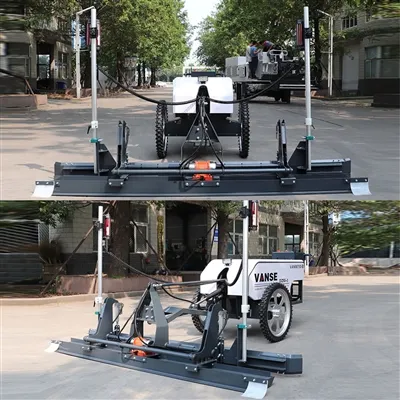
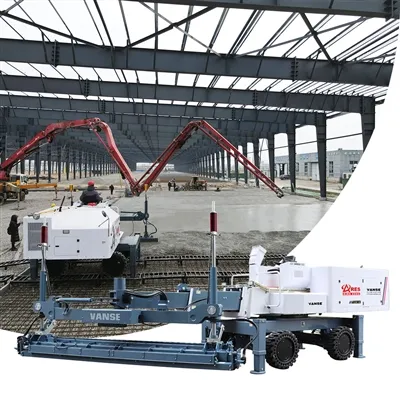
With the continuous advancement of science and technology, in the construction of modern building floors, more and more things are not manually operated, but replaced by more efficient machines. For example, the laser leveling machine produced by our VANSE Machinery is a Such a machine is an excellent product to replace labor. The concrete floor poured out by VANSE Concrete Laser Leveling Machine is smooth, compact and time-saving. It can more than double the efficiency of manual laying and pouring the ground, but it greatly saves manpower. The solidity is three times that of artificial paving, making the cement floor more solid and dense. Therefore, this machine is regarded as the first choice for ground paving by many construction teams.
Today, VANSE Machinery will summarize the construction advantages of concrete laser leveling machines. The biggest feature of our concrete laser leveling machines is to save labor and improve efficiency. Let's take a look at the specific and more detailed aspects:
1. High construction quality
The laser leveling machine can level the ground, which can significantly improve the flatness of the ground. For the ground constructed by the laser leveling machine and the traditional method, 22 points are detected (one point every 5mx4m), and the average flatness is 1.3mm and 4.1mm respectively. Laser leveling The leveling quality of equipment such as leveling machines is more than three times higher than that of traditional methods.
The laser leveling machine can realize large-scale construction, reduce a large number of construction joints, reduce the slump of concrete, and ensure the strength of concrete, so that the ground has good integrity and is not prone to cracks.
2. Fast construction speed
Using laser leveling machine and other equipment to construct large concrete slabs can improve the work efficiency by 3 times compared with the traditional beam vibrator method, save 30%, and can complete 3,000 square meters per day on average. It is especially suitable for concrete surfaces with simple shapes and large surface areas. construction.
3. Reduce the amount of side formwork support and dismantling
Based on the statistics of 20,000 square meters of concrete pavement, the traditional method needs to dismantle 5800m of side formwork, but with advanced equipment such as laser leveling machine, the dismantling is only 2500m, reducing the support modulus by more than 74%
4. High degree of automation and low labor intensity
The use of laser leveling machines and other equipment turns heavy manual labor into mechanical paving, vibrating, leveling, slurry extraction, and surface plastering, reducing the number of operators by 30% and reducing labor intensity.
5. High economic benefit
The application of laser leveling machine and other equipment saves the cost of 2-3 yuan/㎡ compared with the traditional process, with fewer seams and lower maintenance costs in the later period, so that the economic benefits are significantly improved. Advanced equipment such as laser leveling machines are especially suitable for projects such as docks, storage yards, expressways, airports, large squares, parking lots, and municipal roads that have relatively simple shapes, large amounts of action, and high construction quality requirements.
Now our laser leveling machine is very mature. Customers who have bought it have used it for a period of time. During the return visit, our sales staff all said that it has been used very well. We are honored and very happy. The user's feedback that the concrete laser leveling machine is easy to use comes from their own heartfelt words. Only after using a good product can they have the most personal experience. VANSE laser leveling machine – strive to create high-end ultra-flat ground!

Thanks to All the Friends Who Support and Trust Shandong Vanse Machinery Technology Co., Ltd.
If you want to know more about Shandong Vanse Machinery Technology Co., Ltd. or have any questions, please feel free to contact us:
Our Factory
Shandong Vanse Machinery Technology Co., Ltd.








Share this article

About the Author: Shandong Vanse Machinery Technology Co., Ltd.
Shandong Vanse Machinery Technology Co., Ltd. is a high-tech manufacturer specializing in concrete construction machinery, including laser screeds and related equipment. The company integrates R&D, production, and global sales, with products exported to over 60 countries and widely used in infrastructure projects worldwide.
Previous Post
Next Post
Related Articles
You Might Also Like
How Is The Frequency Of Maintenance Of Concrete Laser Leveling Machine Determined?
How is the frequency of maintenance of concrete laser leveling machine determined? As an important equipment in modern building construction, the frequency of maintenance of concrete laser leveling machine is of great significance to ensure the normal operation of the equipment, extend its service life and ensure the quality of construction. Determining a reasonable maintenance frequency is a complex process that requires consideration of the combined effects of multiple factors. This article will delve into how to determine the maintenance frequency of concrete laser levelings, and cover frequency of use and working environment, equipment performance evaluation, manufacturer recommendations and maintenance manuals, regular inspections and preventive maintenance, fault and exception handling, maintenance records and tracking and professional technical support and services. 1. Frequency of use and working environment The frequency of use and working environment of the concrete laser leveling are the basic factors that determine the frequency of maintenance. Generally speaking, equipment that is heavily used is more prone to wear and failure and therefore requires more frequent maintenance. At the same time, the complexity of the working environment will also affect the frequency of maintenance. If the equipment often operates in harsh environments, such as dusty, watery, high or low temperatures, the frequency of maintenance will also need to increase accordingly. When determining the frequency of maintenance, a preliminary assessment can be made based on the actual use of the equipment and the working environment. For example, if the equipment needs to work for a long time every day and the working environment is harsh, then it is recommended to perform comprehensive maintenance once a week or every two weeks. 2. Equipment performance evaluation Equipment performance evaluation is an important basis for determining maintenance frequency. By evaluating the performance of the equipment, you can understand the operating status and wear of the equipment and determine when maintenance is needed. Performance evaluation includes but is not limited to the flatness, flatness deviation, compactness, operational flexibility and stability of the equipment. During the evaluation process, if it is found that the performance of the equipment has declined or an abnormality occurs, maintenance should be carried out in a timely manner. At the same time, based on the results of equipment performance evaluation, the frequency of maintenance can be adjusted to ensure that the equipment is always maintained in optimal condition. 3. Manufacturer's recommendations and maintenance manual Manufacturer's recommendations and maintenance manuals are important references for determining the frequency of maintenance on concrete laser levelings. Manufacturers usually provide a detailed set of maintenance recommendations based on equipment design, manufacturing and testing experience. These recommendations usually include specific requirements and cycles for equipment cleaning, lubrication, tightening, inspection, and replacement of wear parts. The maintenance manual is a detailed guide for equipment maintenance, which contains maintenance requirements and specific operating steps for each component of the equipment. . By reading and maintaining the manual, we can have a more comprehensive understanding of the structure, performance and maintenance methods of the equipment, thereby more accurately determining the frequency of maintenance. Therefore, when determining the maintenance frequency of the concrete laser leveling, we should carefully read the recommendations and maintenance manuals provided by the manufacturer, and comprehensively consider the actual situation of the equipment. 4.Regular inspection and preventive maintenance Regular inspection and preventive maintenance are important measures to ensure the stable operation of the concrete laser leveling. Through regular inspections, potential problems and hidden dangers of the equipment can be discovered in time to prevent the occurrence or expansion of faults. Preventive maintenance is to delay the wear and aging process of equipment through a series of maintenance measures before equipment failure occurs. Regular inspections usually include visual inspection, electrical system inspection, hydraulic system inspection and transmission component inspection. During the inspection process, attention should be paid to the wear and tear of the equipment, the lubrication condition, the tightening of fasteners, and the contact of electrical components. Preventive maintenance includes regularly changing lubricants, cleaning filters, adjusting transmission component clearances, and tightening loose components. These measures can effectively extend the service life of the equipment and improve the stability of the equipment. The frequency of regular inspections and preventive maintenance should be determined based on the actual use of the equipment and the working environment. For equipment with high frequency of use or harsh working environment, the frequency of inspection and maintenance should be appropriately increased. 5. Fault and exception handling Fault and exception handling are important links in the maintenance process. When equipment fails or an abnormal situation occurs, it should be dealt with in time to prevent the failure from expanding or affecting the construction progress. When dealing with a fault, you should first determine the cause and location of the fault. Through observation, testing and analysis, the root cause of the fault is found, and then appropriate measures are taken to repair or replace it. At the same time, faults should be summarized and recorded to avoid the recurrence of similar problems during subsequent maintenance. In addition to handling faults, attention should also be paid to abnormal conditions of the equipment. For example, abnormal sounds, vibrations or temperature increases during the operation of the equipment may be symptoms of potential problems with the equipment. When these abnormalities are discovered, timely inspection and repair should be carried out to ensure the normal operation of the equipment. Therefore, when determining the maintenance frequency of concrete laser levelings, the need for fault and abnormal handling should also be taken into consideration. If your equipment frequently malfunctions or behaves abnormally, it may require more frequent maintenance. 6. Maintenance records and tracking Maintenance records and tracking are important means to ensure that maintenance work is carried out in an orderly manner. By recording the maintenance status of the equipment, the maintenance history and status of the equipment can be understood in a timely manner, providing reference for subsequent maintenance work. Maintenance records should include information such as the time, content, and methods of each maintenance, as well as problems found and treatment results. At the same time, records should be organized and analyzed regularly to evaluate the maintenance effect of the equipment and determine the next maintenance plan. Through the tracking and analysis of maintenance records, the actual operation status and maintenance needs of the equipment can be more accurately understood, thereby providing a more reliable basis for determining the frequency of maintenance. 7. Professional technical support and services Professional technical support and services are important guarantees to ensure the smooth progress of concrete laser leveling maintenance work. Manufacturers or professional maintenance teams usually have rich technical experience and professional knowledge and can provide timely and accurate technical support and services. During the maintenance process, if you encounter problems that are difficult to solve or need professional technical support, you can seek help from the manufacturer or a professional maintenance team. They can provide targeted solutions and technical guidance based on the actual situation and specific needs of the equipment. At the same time, professional technical support and services can also provide equipment upgrades and improvement suggestions to help users make better use of the equipment and improve its performance and efficiency. Through cooperation with the professional technical team, we can have a more comprehensive understanding of the characteristics and maintenance of the equipment. Maintenance requirements to more accurately determine the frequency of maintenance. To sum up, determining the frequency of concrete laser leveling maintenance is a process that takes multiple factors into consideration. Through comprehensive consideration of frequency of use and working environment, equipment performance evaluation, manufacturer recommendations and maintenance manuals, regular inspections and preventive maintenance, fault and exception handling, maintenance records and tracking, and professional technical support and services, we can provide equipment with Develop a scientific and reasonable maintenance plan. In actual operations, we need to flexibly adjust the frequency and content of maintenance based on the specific conditions and actual needs of the equipment. At the same time, we will strengthen the training and technical improvement of maintenance personnel to ensure that they are proficient in equipment maintenance skills and provide a strong guarantee for the stable operation of the equipment. In addition, with the continuous advancement of science and technology and the upgrading of equipment, we also need to pay attention to new maintenance technologies and methods and apply them to actual work in a timely manner to improve the effectiveness and efficiency of maintenance. During the maintenance process, we should also pay attention to the following points: First, we must strengthen the daily cleaning and maintenance of the equipment, regularly clean up dust and debris on the surface of the equipment, and keep the equipment clean and hygienic. This can not only extend the service life of the equipment, but also improve the construction efficiency of the equipment. Secondly, pay attention to the lubrication of the equipment, regularly replace the lubricating oil and clean the filter to ensure that the lubrication system of the equipment is smooth. Good lubrication conditions can reduce equipment wear and failure and improve equipment stability and reliability. In addition, attention should be paid to the inspection and maintenance of the equipment's electrical system and hydraulic system. Regularly check the contact of electrical components and the connection of the lines to ensure the normal operation of the electrical system: Regularly check the cleanliness of the wave pressure oil and the stability of the oil level to ensure the stable operation of the hydraulic system. Finally, it is necessary to establish a sound maintenance record and file management system, and conduct detailed records and analysis of each maintenance situation to provide reference and basis for subsequent maintenance work. At the same time, through the management of maintenance records and files, potential problems and hidden dangers of the equipment can be discovered in time, providing a basis for preventive maintenance. In short, determining the frequency of concrete laser leveling maintenance is a comprehensive and complex process that requires comprehensive consideration of multiple factors. Through the implementation of scientific and reasonable maintenance plans and measures, we can ensure the stable operation of the equipment and extend its service life, and provide efficient and high-quality services for concrete construction. However, it is worth noting that although we have discussed multiple factors to determine the frequency of maintenance, each specific concrete laser leveling may vary depending on its model, specifications, usage conditions and other factors. different. Therefore, in actual operation, we also need to flexibly adjust the frequency and method of maintenance according to specific conditions. At the same time, with the advancement of science and technology and the upgrading of equipment, new maintenance concepts and technologies will continue to emerge. We should actively pay attention to the latest developments and technological developments in the industry, and promptly apply new maintenance concepts and technologies to actual work to improve the maintenance level and efficiency of equipment. In addition, it is also very important to strengthen communication and cooperation with other peers and professional and technical personnel. By sharing experiences, exchanging ideas and jointly discussing ways to solve problems, we can continuously improve our professional skills and levels and provide better support and services for the maintenance of concrete laser leveling machines. Finally, we need to emphasize the continuity and stability of maintenance work. Maintenance work should not be just an occasional temporary task, but should become a long-term, stable job. Only consistent maintenance can ensure the stable operation of the equipment and extend its service life. To sum up, determining the frequency of concrete laser leveling maintenance is a complex and important process. We need to comprehensively consider multiple factors, formulate a scientific and reasonable maintenance plan, and strengthen the continuity and stability of maintenance work. Only in this way can we ensure the stable operation and efficient construction of the equipment and contribute to the development of the concrete industry. The above content is only a relatively comprehensive overview of the maintenance frequency of concrete laser leveling machines. In actual operation, we still need to conduct more in-depth research and discussion based on specific circumstances. I hope this article can provide some reference and inspiration for readers, and inspire more thinking and research on the maintenance of concrete laser leveling machines.How should the slump of concrete pavement construction be adjusted in different construction scenarios?
Reason: The increase in temperature will accelerate the cement hydration rate and the water evaporation rate, resulting in faster loss of concrete slump and reduced fluidity. Adjustment method: Appropriately increase the slump. It is generally recommended to increase it by 2040mm compared with normal temperature construction. For example, the slump is controlled at 80100mm at normal temperature, and it can be adjusted to 100140mm at high temperature. At the same time, measures can be taken to reduce the temperature of raw materials, such as shading aggregates, spraying water to cool down, using underground cold water to mix concrete, and adding ice cubes to the mixing water to control the concrete outlet temperature ≤30℃. Reason: Low temperature will prolong the setting time of concrete and deteriorate the construction performance. If the slump is too small, the concrete may be difficult to vibrate and compact. Adjustment method: The slump should not be too large, usually controlled at 3060mm. Warm water can be used to mix concrete to increase the temperature of the concrete out of the machine, and the amount of admixture can be appropriately reduced to avoid too long setting time of the concrete. In addition, attention should be paid to the insulation and maintenance of the concrete to prevent freezing. Reason: Long transportation time will cause the slump of concrete to be lost. If the initial slump is small, it may be difficult to meet the construction requirements when arriving at the construction site. Adjustment method: Appropriately increase the slump when setting off, such as increasing it by 2030mm compared to normal construction. For example, the normal construction slump is 80100mm, and it can be set to 100130mm during longdistance transportation. At the same time, on the basis of the continuous lowspeed rotation of the mixer tank (24 rpm), a transport retarder can be added to ensure that the slump loss rate is ≤30% within 2 hours. Reason: Pumping requires concrete to have good fluidity and pumpability to pass through the pipeline smoothly and reach the pouring location. Adjustment method: The slump is usually controlled at 120180mm. It is necessary to select a suitable pumping agent and adjust its dosage according to the pumping distance, height and pipeline layout. At the same time, optimize the concrete mix ratio and control the sand ratio at around 35%45% to improve the fluidity and water retention of the concrete. Reason: If manual paving or small mechanical paving is used, the concrete does not need to have high fluidity like pumping, but it still needs to have a certain workability to facilitate paving and vibration. Adjustment method: The slump is generally controlled at 3080mm. If the slump is increased by one level (i.e., by 20 30 mm), in addition to increasing the sand content by more than 1% to ensure stability and workability, the amount of water (5 10 kg/m3) and cement (10 kg per cubic meter) must be increased accordingly. In actual construction, the optimal slump and mix ratio should be determined through tests according to specific conditions, and inspection and adjustment should be carried out strictly in accordance with relevant standards and specifications to ensure the construction quality of the concrete pavement.The impact of power trowel operation time on the final glossiness of concrete floors
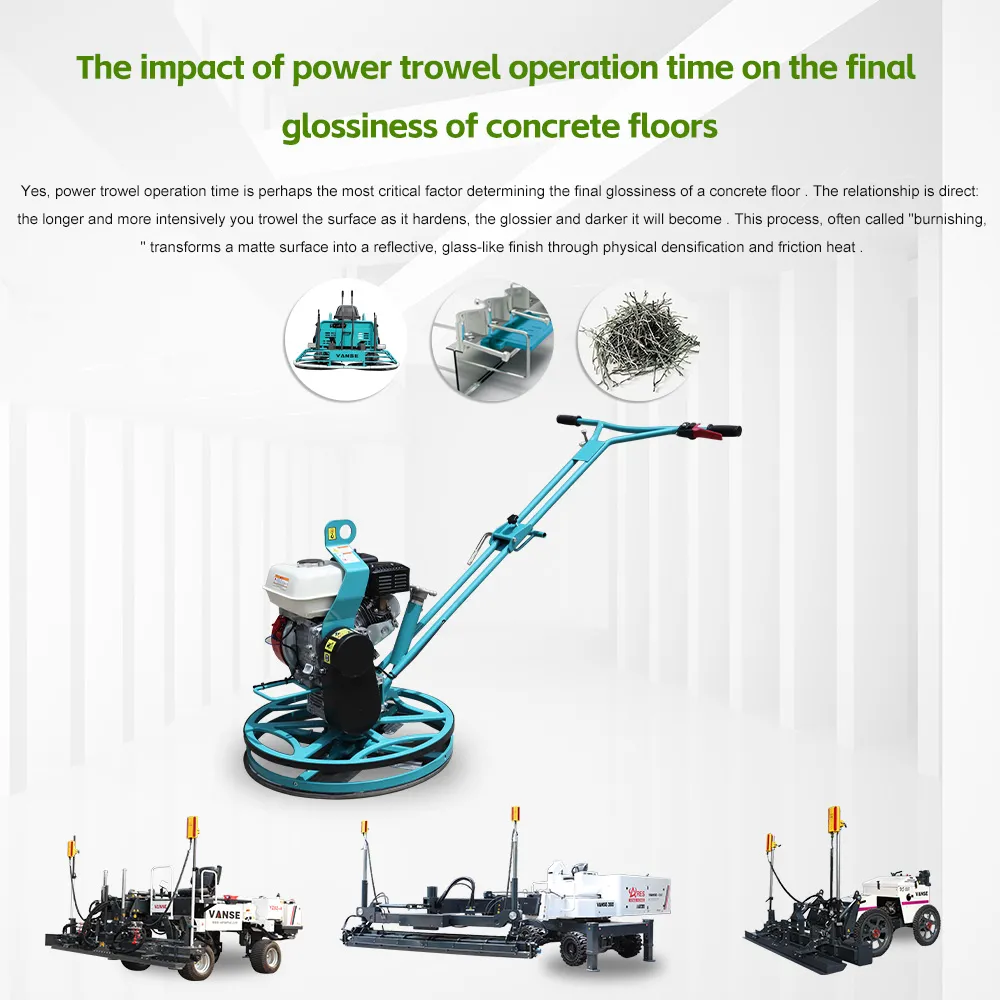
Yes, power trowel operation time is perhaps the most critical factor determining the final glossiness of a concrete floor . The relationship is direct: the longer and more intensively you trowel the surface as it hardens, the glossier and darker it will become . This process, often called "burnishing," transforms a matte surface into a reflective, glass-like finish through physical densification and friction heat . The following table outlines how the timing and technique of each pass build towards the final gloss level: Stage Timing (Approx.) Concrete State Action & Settings Resulting Gloss Key Goal 1. Initial Float 1–2 hours after pour Initial set, footprint depth ~5mm Use float pans at low speed, blades flat . Matte / Dull Press in aggregate, bring up "cream," eliminate waviness . 2. Intermediate 3–4 hours after pour Surface moisture disappears, becomes firmer Switch to finish blades at slight pitch (5-10°) . Low Sheen (Satin) Compact the surface, close capillaries. Repeat passes every 30-60 mins . 3. Burnishing "The Window" Hard, walkable with almost no imprint Max blade pitch (20-30°) & high RPM . Continue even when surface looks "done" . High Gloss (Mirror) Generate friction heat to physically densify and "melt" the surface into a reflective layer . Glossiness isn't just a visual effect; it's a physical change in the surface. As you make repeated passes with steel blades, you are physically forcing the fine cement particles closer together, closing up microscopic pores . This is densification. In the final "burnishing" stage, high-speed troweling generates significant friction heat . This heat slightly "buff" the surface paste, creating a reflective, burnished finish . You will often observe the surface instantly transform from a dull matte to a dark, almost metallic sheen during this phase . While chasing a high gloss, it's crucial to respect the concrete's setting process. Over-troweling or poor timing can cause significant problems: Surface Burning: Excessive troweling at the very end, especially with too high an angle or speed, can leave dark, blackish "burn" marks on the surface . Sealing in Moisture: If you achieve a high-gloss finish too quickly, you can "seal" the surface. This traps residual water inside the slab, which can later lead to delamination (the top layer peeling off) or surface blisters . Loss of Breathability: A highly burnished surface is nearly waterproof. While great for spill resistance, this can make it difficult for the slab to dry out if you plan to install certain types of flooring, like glue-down vinyl or carpet, soon after . You have direct control over the outcome by managing the machine and your passes: To Increase Gloss: Increase the blade pitch, increase the rotor speed (RPM), and continue making passes even after the surface looks "done" . Ensure you are using brand-new or minimally worn high-quality steel blades; damaged blades will create scratches that ruin the mirror effect . To Decrease Gloss (Maintain Matte): Keep the blade pitch low, use lower RPMs, and stop troweling once the surface is flat and the pores are closed . Your question perfectly captures the essence of high-end concrete finishing. Would you like to know how using a concrete densifier during the troweling process can make that gloss even more durable and intense? Contact us NOW Note: The parameters provided in this document are for reference only and are not mandatory. Due to differences in technical characteristics between different brands and models of laser levelers, please consult the manufacturer for a suitable solution before actual operation. This reference document assumes no responsibility for any issues arising from failure to follow the manufacturer's instructions.