Technical Knowledge
Tips to extend laser leveling laser emitter life? Let’s share!
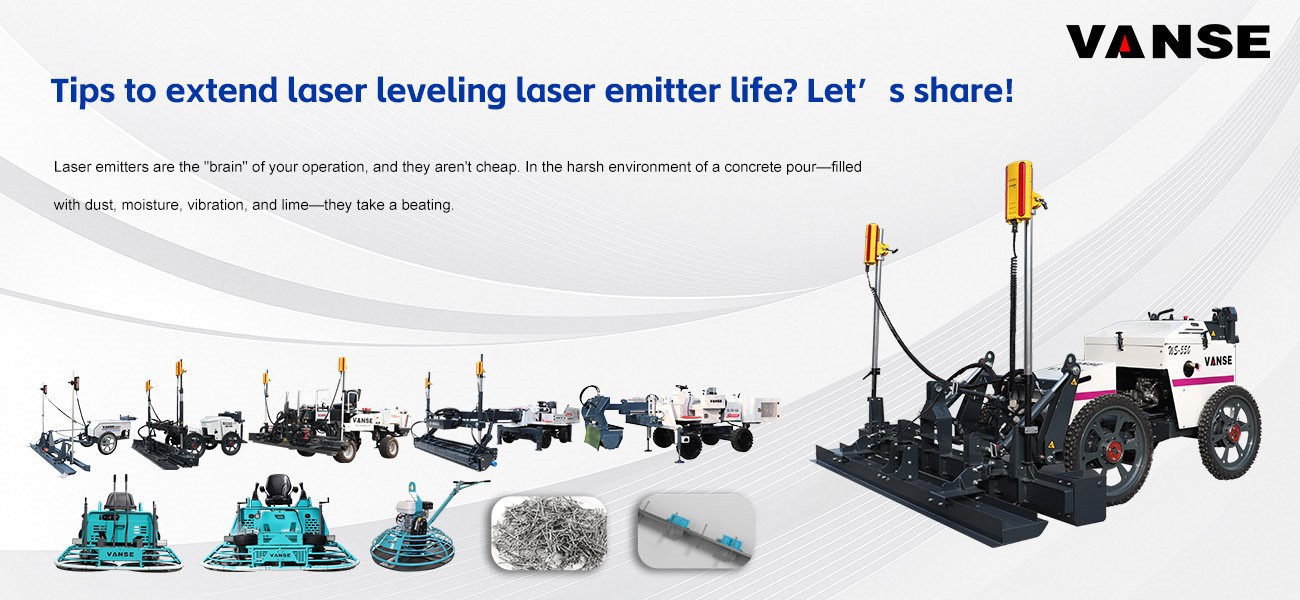
Laser emitters are the "brain" of your operation, and they aren't cheap. In the harsh environment of a concrete pour-filled with dust, moisture, vibration, and lime-they take a beating.
Here are the best ways to keep your transmitter running with ±3mm accuracy for years instead of months:
1. The "Golden Rule": Buffer the Vibration
Vibration is the #1 killer of internal self-leveling pendulums and spinning diodes.
Tripod Placement: Never set your tripod directly on a slab where the laser leveling or a vibrating truss is running. The micro-vibrations can wear out the internal motor bearings.
Subgrade Stability: If you must set up on dirt, use a "tripod stabilizer" or sink three rebar pins into the ground and set the tripod legs on those to prevent settling during the pour.
2. Manage the "Lime Dust" Film
Concrete dust is highly abrasive and slightly alkaline. It eats through lens coatings.
The Microfiber Only Rule: Never wipe a dry laser lens with your shirt or a paper towel. It’s like using sandpaper.
Cleaning Routine: Use compressed air (canned air is best) to blow off grit, then use a specialized camera lens cleaner and a fresh microfiber cloth.
Shielding: If you are working in a windy, dusty warehouse, consider a "wind shield" (a clear acrylic housing) for the transmitter, provided it’s optically rated so it doesn't refract the beam.
3. Thermal Shock Prevention
Laser diodes are sensitive to temperature shifts.
Acclimatization: If you transport your laser in a heated truck cab and then set it up in a 2℃(35℉) warehouse, the internal components will contract, and you might get "fogging" inside the glass.
The "Slow Warm-up": Let the laser sit in its (closed) case in the work environment for 15 minutes before turning it on.
4. Battery Hygiene
Most modern emitters use Li-ion or NiMH packs.
Don't "Cook" the Battery: Avoid leaving the transmitter on a charger for days at a time once it's full.
Storage: If the machine is going to sit for more than two weeks, remove the batteries. Leaking alkaline batteries are a common cause of "totaled" transmitters.
5. Proper Transport (The "Vertical" Rule)
The internal leveling gimbals are designed to be upright.
Case Orientation: Always store and transport the laser in its hardshell case, and ensure the case is secured upright in the vehicle.
The "Seatbelt" Treatment: Don't let the laser case bounce around in the bed of a pickup truck. Put it in the cab, strapped down.
Comparison: Daily vs. Monthly Maintenance
| Task | Daily | Monthly |
| Lens Cleaning | Blow off dust | Use optical-grade solution |
| Calibration | Quick benchmark check | Full "Two-Peg" field test |
| Connections | Check for moisture | Clean battery contacts with ISO |
| Storage | Dry off any condensation | Inspect case seals/latches |
Pro Tip: Keep a logbook in the laser case. Note the date of the last calibration and who did it. If your FF/FL numbers start to dip, you'll have a paper trail to see if the laser is drifting over time.
Would you like a Step-by-Step Field Calibration Guide (the "Two-Peg Test") to help your crew verify the emitter's accuracy on-site? Contact us NOW
Note: The parameters provided in this document are for reference only and are not mandatory. Due to differences in technical characteristics between different brands and models of laser levelers, please consult the manufacturer for a suitable solution before actual operation. This reference document assumes no responsibility for any issues arising from failure to follow the manufacturer's instructions.
Thanks to All the Friends Who Support and Trust Shandong Vanse Machinery Technology Co., Ltd.
If you want to know more about Shandong Vanse Machinery Technology Co., Ltd. or have any questions, please feel free to contact us:
Our Factory
Shandong Vanse Machinery Technology Co., Ltd.








Share this article

About the Author: Shandong Vanse Machinery Technology Co., Ltd.
Shandong Vanse Machinery Technology Co., Ltd. is a high-tech manufacturer specializing in concrete construction machinery, including laser screeds and related equipment. The company integrates R&D, production, and global sales, with products exported to over 60 countries and widely used in infrastructure projects worldwide.
Previous Post
Next Post
Related Articles
You Might Also Like
How To Determine The Consumables Of Concrete Laser Leveling Machine?
How to determine the consumables of concrete laser leveling machine ✔☀Introduction With the continuous advancement of science and technology, laser leveling machines are increasingly used in the field of concrete paving. This advanced equipment not only improves construction efficiency, but also greatly improves the flatness of the concrete surface. However, with the widespread use of equipment, the problem of consumables has become increasingly prominent. How to reasonably determine and manage the consumables of concrete laser leveling machines has become a key issue for construction companies to reduce costs and improve efficiency. ✔☀Working principle of leveling machine Concrete laser leveling machines mainly rely on laser technology and hydraulic systems to achieve precise leveling of concrete. The laser transmitter emits a precise laser beam and transmits the signal to the leveling machine through the receiver to guide the leveling machine's scraper to perform precise scraping operations. The hydraulic system provides power to drive the walking and scraper movements of the leveling machine. In this work process, the use of consumables is inevitable. ✔☀Overview of consumable types The consumables of the concrete laser leveling mainly include the following: 1. Scraper blade: The scraper blade is one of the fastest-wearing parts of the leveling machine. It is in direct contact with the concrete during work and is responsible for scraping the concrete surface. The material and wear resistance of the blade directly determine its service life. 2. Hydraulic oil: The normal operation of the hydraulic system is inseparable from the support of hydraulic oil. Hydraulic oil plays the role of lubrication, cooling and power transmission during equipment operation. As the use time increases, the hydraulic oil will gradually age and become contaminated, and needs to be replaced regularly. 3. Filter: In order to prevent impurities and particles from entering the hydraulic system, the leveler is equipped with various filters. After working for a long time, these filters will lose their effectiveness due to blockage and need to be replaced regularly. 4. Seals: Seals in hydraulic systems, such as O-rings, gaskets, etc., are subject to long-term pressure and wear and need to be replaced regularly. ✔☀Analysis of consumable consumption factors The consumption of consumables is affected by many factors, including the following: 1. Construction quality requirements: The higher the construction quality requirements, the higher the accuracy and performance requirements for the leveling machine, and the consumption of consumables will also increase accordingly. 2. Frequency of equipment use: The higher the frequency of equipment use, the faster the wear and tear of various components, and the consumption of consumables will naturally increase. 3. Working environment: The environment at the construction site, such as temperature, humidity, dust, etc., will have an impact on the performance and service life of the equipment, which will in turn affect the consumption of consumables. 4. Maintenance: Regular maintenance of equipment is crucial to reducing consumable consumption. If maintenance is not done properly, the wear and tear of the equipment will increase and the consumption of consumables will also increase. ✔☀Improved consumable usage efficiency In order to reduce consumable consumption and improve usage efficiency, the following measures can be taken: 1. Choose appropriate consumables: According to the equipment model and construction requirements, choose consumables with stable quality and reliable performance, and avoid using inferior or unsuitable consumables. 2. Regular maintenance: According to the recommendations of the equipment manufacturer, perform regular maintenance on the equipment, including replacing hydraulic oil, cleaning filters, checking seals, etc., to ensure that the equipment is in optimal working condition. 3. Standardize operation: Provide professional training to operators to ensure that they are proficient in equipment operation skills and avoid equipment damage and consumable waste caused by improper operation. 4. Construction site management: Strengthen construction site management, keep the construction site clean and dry, and reduce the impact of dust and other impurities on equipment. ✔☀Actual case analysis Taking a large construction company as an example, by introducing an advanced consumable management system and taking the above measures, the consumable consumption of its thermal soil laser leveling machine has been significantly reduced. Specifically, by choosing high-quality supplies. Through measures such as strengthening maintenance and standardizing operations, the company's consumable consumption has dropped by about 30%, and the construction quality has also been improved. This case shows that through scientific management and technological innovation, the consumable consumption of concrete laser leveling machines can be effectively reduced. ✔☀Consumables cost management and control In order to effectively manage and control consumable costs, construction companies can take the following measures: 1. Establish a consumables management system: Develop a detailed consumables management system, including the procurement, storage, use, replacement and other aspects of consumables to ensure that the management and use of consumables are governed by rules. 2. Introduce an information management system: Use the information management system to track and manage consumables in real time to ensure that the consumption and usage of consumables can be grasped and adjusted in a timely manner. 3. Carry out cost analysis: regularly analyze and evaluate consumable costs, identify weak links in cost control, and formulate corresponding improvement measures. 4. Establish long-term cooperative relationships with suppliers: Establish long-term cooperative relationships with high-quality consumable suppliers to ensure the quality and supply stability of consumables. At the same time, procurement costs can also be reduced through centralized procurement and other methods. ✔☀Conclusion The management of consumables for concrete laser leveling machines is an important step for construction companies to reduce costs and improve efficiency. Through in-depth understanding of the working principle of the equipment, reasonable selection of consumables, strengthening maintenance and standardized operations, we can effectively reduce consumable consumption and improve usage efficiency. At the same time, through the introduction of information management systems and cost analysis, the consumable cost management and control process can be further optimized. In the future, with the continuous advancement of technology and the continuous improvement of construction requirements, the consumable management of thermolysis soil laser leveling machines will face greater challenges and opportunities. Therefore, construction companies need to continue to innovate and explore more scientific and effective management methods and technologies. Means to adapt to changing market demands and construction environment.How to improve construction efficiency of concrete laser leveling machine?
Improving the construction efficiency of concrete laser leveling machines is of great significance for reducing construction costs and shortening project cycles. The following is a comprehensive analysis of how to improve the construction efficiency of concrete laser leveling machines. Introduction As a highly efficient construction machine, concrete laser leveling machines are increasingly widely used in the field of construction. However, the improvement of construction efficiency not only depends on the performance of the equipment itself, but also requires comprehensive consideration of construction preparation, operating skills, construction management and other factors. 1. Preparation before construction Sufficient pre-construction preparation is the prerequisite for improving construction efficiency: – **Equipment inspection and maintenance: Ensure that the laser leveling machine is in the best working condition to avoid failures during construction. – **Construction plan optimization: Develop a reasonable construction plan based on the characteristics of the project, including construction process, equipment layout, etc. – **Material preparation: Prepare the required concrete materials in advance to ensure the continuity of material supply during construction. 2. Professional training of construction personnel Professional construction personnel are the key to improving construction efficiency: – **Operation skills training: Regularly conduct skill training for operators to improve their proficiency in operating laser leveling machines. – **Safety education: Strengthen safety education to ensure that construction workers comply with safety regulations while working efficiently. 3. Fine management during the construction process Fine construction process management can effectively improve construction efficiency: – **Construction scheduling: Rationally dispatch construction resources to avoid construction delays caused by waiting for materials or equipment. – **Real-time monitoring: Real-time monitoring of construction progress and equipment status, and quick response to possible problems. 4. Optimal use of construction equipment Optimizing the use of construction equipment can improve construction efficiency: – **Equipment configuration: Rationally configure the laser leveler according to construction needs to avoid excess or insufficient equipment capacity. – **Equipment automation: Use equipment automation functions to reduce manual intervention and increase construction speed. 5. Innovation and improvement of construction technology Innovation and improvement of construction technology is an important way to improve construction efficiency: – **Technology innovation: Explore new construction technologies, such as using premixed concrete, to reduce on-site mixing time. – **Technology integration: Integrate advanced technologies, such as GPS positioning, intelligent control systems, etc., to improve construction accuracy and speed. 6. Optimization of construction environment A good construction environment helps improve construction efficiency: – **Environmental control: Control the temperature, humidity and other conditions of the construction site to ensure a suitable construction environment for concrete. – **Construction site layout: Rationally plan the construction site layout to reduce the time for equipment movement and material transportation. 7. Quality and supply of construction materials High-quality construction materials and stable supply are crucial to improving construction efficiency: – **Material quality control: Ensure the quality of concrete materials and avoid construction interruptions caused by material problems. – **Supply chain management: Optimize supply chain management to ensure the timeliness and stability of material supply. 8. Collection and analysis of construction data Collecting and analyzing construction data helps to find room for efficiency improvement: – **Data collection: Collect various data during the construction process, such as construction speed, equipment utilization, etc. – **Data analysis: Analyze the data, find out the factors that affect construction efficiency, and formulate improvement measures. 9. Maintenance and upgrading of construction machinery Regular maintenance and timely upgrading of construction machinery are the guarantee for maintaining construction efficiency: – **Regular maintenance: Formulate equipment maintenance plans to ensure that the equipment is in good condition. – **Technology upgrade: Pay attention to the development of industry technology and upgrade the technology of equipment in a timely manner. 10. Prevention and control of construction risks Preventing and controlling construction risks can reduce construction interruptions and improve efficiency: – **Risk assessment: Conduct construction risk assessment regularly to identify potential risk factors. – **Emergency plan: Develop an emergency plan to ensure that you can respond quickly when risks occur. 11. Conclusion Improving the construction efficiency of concrete laser leveling machines is a systematic project involving construction preparation, personnel training, process management, equipment use, process innovation, environmental optimization, material supply, data collection, machinery maintenance, risk control and other aspects. Through the comprehensive application of these measures, we can effectively improve construction efficiency, shorten the project cycle and reduce construction costs.How to effectively avoid safety hazards during the operation of concrete laser leveling machine?
1. Comprehensive training: – All operators should receive formal training and be familiar with the operating manual of the equipment. – Understand the basic structure, function, working principle and emergency response methods of the equipment. 2. Equipment inspection: – Before starting work every day, conduct a thorough equipment inspection, including mechanical parts, electrical system, hydraulic system, laser system, etc. – Make sure all safety devices (such as emergency stop switches) are in working condition. 3. Personal protective equipment: – Provide and enforce the wearing of appropriate personal protective equipment, including hard hats, protective glasses, earmuffs, reflective vests, protective gloves and non-slip shoes. 1. Site layout: – Clean the construction site, remove all obstacles, and ensure sufficient operating space. – Set up clear warning signs and fences to separate the work area and pedestrian area. 2. Communication is smooth: – Ensure that there are enough communication equipment on site so that the operator can communicate effectively with other personnel on site. – If necessary, wireless walkie-talkies and other equipment can be equipped. 1. Smooth operation: – Operate smoothly and slowly, avoid sudden acceleration, sudden braking or sharp turns. – Maintain the correct standing position and avoid getting close to rotating or moving parts. 2. Laser safety: – Understand the safety level of lasers and take appropriate safety measures. – Avoid looking directly into the laser beam and use laser protective glasses. – Ensure that the laser transmitter is placed firmly to prevent accidental tipping. 3. Pay attention: – Keep an eye on the surrounding environment during operation, especially when the machine is close to edges or obstacles. – Pay attention to wires, pipes and other underground facilities on the ground. 4. Emergency handling: – Familiarize yourself with the emergency shutdown procedures and ensure that all operators know how to execute them quickly. – Prepare fire extinguishers and other fire-fighting equipment and ensure that operators know how to use them. 1. Regular Maintenance: – Perform regular maintenance according to the manufacturer's recommendations, including changing oil, filters, grease, etc. – Regularly check tires, chains, belts and other easily worn parts. 2. Records and Reports: – Maintain complete maintenance and inspection records. – Any abnormal conditions or failures should be reported to the supervisor or maintenance department in a timely manner. 3. Professional Repair: – When encountering equipment failure, it should be repaired by professional technicians. – Do not try to repair problems beyond your ability by yourself. – Establish Safety Awareness: Cultivate a strong safety culture and encourage employees to proactively report potential safety hazards. – Regular Drills: Conduct regular safety drills to simulate evacuation and first aid procedures in emergency situations. Through these comprehensive safety measures, safety hazards during the operation of concrete laser leveling machines can be effectively reduced, thereby creating a safer working environment.