Technical Knowledge
How to control the power trowel speed and pressure to prevent surface cracking on super flat floors?
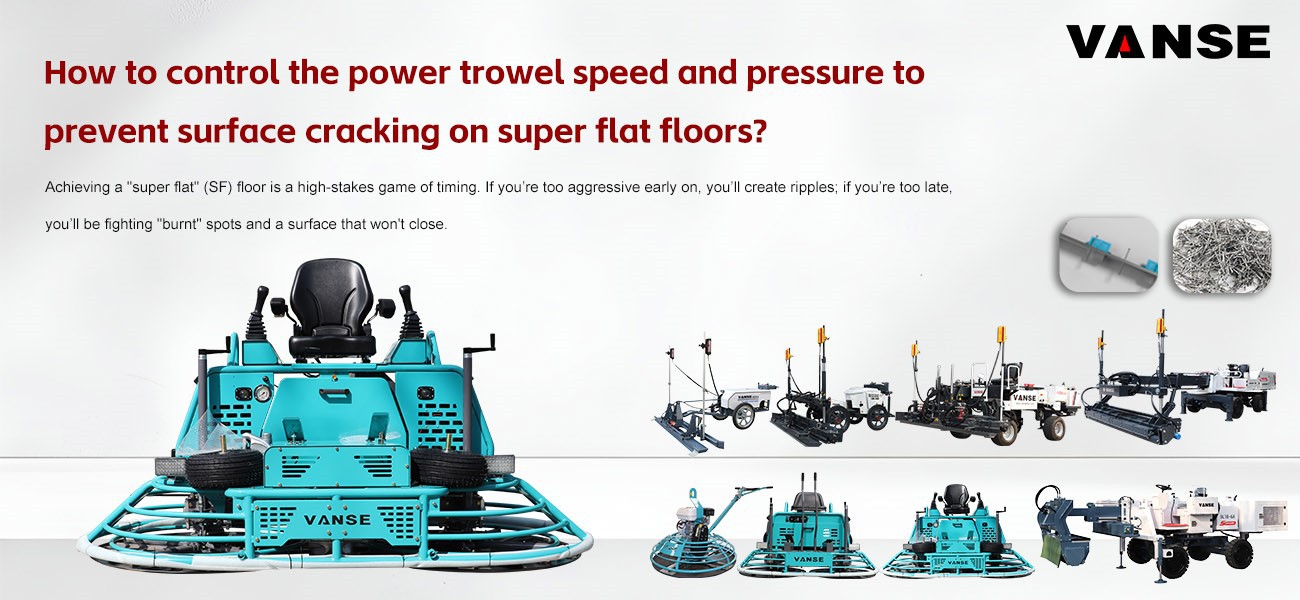
Achieving a "super flat" (SF) floor is a high-stakes game of timing. If you’re too aggressive early on, you’ll create ripples; if you’re too late, you’ll be fighting "burnt" spots and a surface that won't close.
To prevent surface cracking-specifically crazing (fine spiderweb cracks) or plastic shrinkage cracks-you need to manage the relationship between the machine’s RPM and the pitch of the blades.
1. Speed Control (RPM)
The general rule for super flat floors is: Slow and steady wins. High speeds create centrifugal force that can pull moisture to the surface prematurely or "tear" the paste.
Initial Passes: Keep the engine at a low-to-medium throttle. You want just enough speed to move the machine smoothly without "digging in."
Finishing Passes: Increase speed gradually as the slab hardens. However, on SF floors, avoid "redlining" the engine, as excessive vibration can interfere with the floor's levelness ($F_{L}$) and flatness ($F_{F}$) numbers.
Uniformity: Maintain a consistent walking or riding speed. Sudden accelerations create "waves" in the concrete paste that are nearly impossible to flatten out later.
2. Blade Pitch (Pressure)
Blade pitch is your primary tool for controlling how much pressure is exerted on the slab.
| Stage | Blade Pitch | Objective |
| Panning (Float) | Flat (0°) | Use float pans to break open the surface, bring up "cream," and knock down high spots. |
| First Power Trowel | Slight Tilt (1-2°) | Close the pores without tearing the surface. |
| Late Finishing | High Pitch (Increasing) | Increase pressure to "burnish" or densify the surface. |
Pro Tip: If you notice "chatter marks" (rhythmic ripples), your pitch is likely too steep for the current hardness of the slab. Flatten the blades immediately.
3. Preventing Surface Cracks
Cracking on super flat floors often happens because the surface dries faster than the base.
Avoid "Dusting": Never throw dry cement or "shake" on a floor that has already lost its bleed water. This is a recipe for delamination and crazing.
Watch the Wind: If you are working in an open bay, use windbreaks. Rapid evaporation is the #1 cause of plastic shrinkage cracks.
The "Touch" Test: Do not start troweling until you can step on the slab and leave a footprint no deeper than 1/8 to 1/4 inch.
Technical Summary for Super Flat Floors
For a high FF rating, your movement pattern is just as vital as your speed:
Overlap: Ensure a 50% overlap on every pass.
Direction: Always change your direction by 90 degrees on subsequent passes to "cross-cut" any minor ridges created by the previous pass.
The "Sweet Spot": If the concrete begins to turn dark (the "burn"), you have reached maximum density. Stop pitching the blades higher, or you risk brittle surface cracking.
Would you like me to create a checklist for the curing process to ensure those super flat specs hold up after the troweling is done? Contact us NOW
Note: The parameters provided in this document are for reference only and are not mandatory. Due to differences in technical characteristics between different brands and models of laser levelers, please consult the manufacturer for a suitable solution before actual operation. This reference document assumes no responsibility for any issues arising from failure to follow the manufacturer's instructions.
Thanks to All the Friends Who Support and Trust Shandong Vanse Machinery Technology Co., Ltd.
If you want to know more about Shandong Vanse Machinery Technology Co., Ltd. or have any questions, please feel free to contact us:
Our Factory
Shandong Vanse Machinery Technology Co., Ltd.








Share this article

About the Author: Shandong Vanse Machinery Technology Co., Ltd.
Shandong Vanse Machinery Technology Co., Ltd. is a high-tech manufacturer specializing in concrete construction machinery, including laser screeds and related equipment. The company integrates R&D, production, and global sales, with products exported to over 60 countries and widely used in infrastructure projects worldwide.
Previous Post
Next Post
Related Articles
You Might Also Like
What special measures or methods need to be taken to deal with special ground conditions?
For special ground conditions, in order to ensure the construction effect and flatness of the concrete laser leveling, some special measures or methods need to be taken. The following are some common special ground conditions and how to deal with them: 1. Soft soil foundation: For soft soil foundations, foundation reinforcement measures can be taken, such as using geotextiles, drainage materials, etc. to improve the bearing capacity and stability of the ground. In addition, an appropriate amount of early strength agent can be added to the concrete to shorten the initial strength. Set time and improve construction efficiency. 2. Uneven ground: For seriously uneven ground, it can be filled first. Use sand, gravel, filler and other materials to fill potholes and make the ground roughly flat. Then, when the leveler is operating, the pressure and angle of the scraper can be appropriately adjusted to adapt to changes in the ground. 3. Smooth floors: For smooth floors, thickeners, scrubs, etc. can be used to increase the friction coefficient of the concrete to make it better adhere to the ground. At the same time, it is necessary to appropriately adjust the pressure and angle of the scraper and control the slump of the concrete to ensure that the concrete can be spread evenly and reduce slippage. 4. Cross construction: In cross construction sites, the construction work of different professional teams may have a certain impact on the ground. In order to ensure the smoothness of the ground, appropriate plastering and calendering treatments can be carried out before the initial setting of the concrete to eliminate surface marks and uneven areas. 5. Temperature influence: When constructing in high or low temperature environments, attention needs to be paid to controlling the temperature and setting time of concrete. At high temperatures, measures such as sprinkling water to cool down and using retarders can be taken; at low temperatures, measures such as insulation and antifreeze can be taken to ensure the normal hardening of the concrete and the smoothness of the ground. 6. Drainage issues: For floors that are prone to water accumulation, special attention needs to be paid to drainage issues. Drainage materials and drainage ditches can be laid under the concrete cushion to prevent water accumulation from causing adverse effects on the ground. 7. Strengthen edge processing: In the edges or detailed areas, because the leveling machine is difficult to reach or it is difficult to scrape, manual auxiliary processing needs to be strengthened. Manual adjustments can be made using tools such as scrapers and knives to ensure smoothness of edges and detailed areas. To sum up, for special ground conditions, corresponding special measures or methods need to be taken. These methods can be selected and applied according to the actual situation to achieve the best construction effect and smoothness. It should be noted that in actual stinging, it is necessary to flexibly apply it according to specific conditions, comprehensively consider multiple factors, and formulate reasonable construction plans and quality control measures.Can the elevation control accuracy of the concrete laser leveling machine meet the construction requirements of pharmaceutical clean workshops?
Selecting high-precision concrete laser leveling machines and standardizing construction not only meets the elevation control accuracy requirements but also is the preferred key equipment for achieving the high-standard floor requirements of pharmaceutical clean workshops. Below, I will provide you with a detailed analysis from three aspects: standards, principles, and practical operations The core requirements for the floor in a pharmaceutical clean workshop are: extremely high flatness, levelness, integrity and dust-free property. Flatness: Generally, the straightedge inspection standard of "±3mm/2m" or "±2mm/2m" is adopted, that is, a 2-meter straightedge is used for inspection, and the height difference at any position should not exceed 3mm or 2mm. Some high-standard areas (such as the core process zone) even require ±1.5mm/2m. Levelness (elevation control) : The absolute elevation error of the entire ground needs to be strictly controlled, usually within ±5mm/ tens of meters, to ensure that water in the ground area can flow smoothly to the floor drain and there will be no local water accumulation. Integrity: The ground must be cast as a seamless whole to prevent bacteria from breeding in the gaps. Wear-resistant and resistant to chemical corrosion: Meets the requirements of cleaning and disinfection. The technical principle of the laser leveling machine determines that it is inherently suitable for such high-precision requirements. Laser reference: A rotating laser emitter is set up outside the construction area, which will establish an absolutely horizontal laser reference surface within the construction area, with an accuracy of ±1.0mm/100m or even higher (such as ±0.5mm/100m). This reference plane will not deform. Real-time monitoring and automatic adjustment: The laser receiver on the leveler captures the laser signal in real time and transmits the information to the on-board computer control system. Hydraulic system execution: The control system drives the hydraulic cylinders at the four corners of the flattening head several times per second to automatically adjust the height of the scraper, ensuring that it always precisely remains at the elevation set on the laser reference surface. Traditional craftsmanship (using a ruler to scrape the bar) : It relies on the manual skills and physical strength of workers, and is prone to problems such as fatigue, visual errors, and the accuracy of formwork support, resulting in large cumulative errors and making it difficult to stably reach the standard of ±3mm/2m. Laser leveling machine: Eliminates human factors and formwork errors. The machine is completely controlled by an invisible laser beam, featuring stable and reliable precision, and is formed as a whole in one go, with extremely high efficiency. Although the equipment itself is highly precise, to ensure that the final outcome meets the requirements of a pharmaceutical clean workshop, the following points still need to be noted: For large clean areas in pharmaceutical factories (such as core production areas and packaging areas), it is recommended to use large ride-on laser leveling machines. Its self-weight is sufficient to effectively press concrete, forming a highly dense surface with the best flatness. For areas such as the periphery of the equipment, walls, and column bases that large equipment cannot cover, it is necessary to use a handheld laser leveling machine in conjunction for auxiliary operations to ensure consistent accuracy throughout the entire area. The foundation and template accuracy are the prerequisites: laser leveling machines cannot correct significant undulations of the foundation (such as steel mesh sheets, crushed stone bedding layers). The flatness of the foundation must be done in advance; otherwise, concrete materials will be wasted. The top elevation of the formwork must also be precisely calibrated with a level, as the leveling machine sometimes takes the formwork as the initial reference. The mix proportion and slump of concrete must be uniform and stable. The slump is recommended to be controlled at around 140mm±20mm. If it is too high, it will easily lead to uneven settlement; if it is too low, it will be difficult to level. Operators must be trained and familiar with the equipment principles and operation procedures. This includes the installation and calibration of laser emitters, as well as the planning of the traveling path for the leveling machine, etc. The ground that has been precisely leveled must be immediately subjected to seamless and comprehensive maintenance (such as spraying maintenance agents or covering with plastic film) to prevent cracking due to uneven water loss, which could damage the flatness. The control accuracy of elevation and flatness of the concrete laser leveling machine is not only a core technical means to "meet", but also to "guarantee" the construction requirements of pharmaceutical clean workshops. It achieves construction accuracy and consistency far exceeding manual levels through non-contact laser measurement and automated hydraulic control. To ensure everything goes smoothly, we suggest that you: Choose a reputable equipment supplier (for lease or purchase). Hire a concrete team with experience in the construction of pharmaceutical clean workshops. Before construction, conduct a detailed technical briefing to clearly define the requirements for flatness and elevation. During the construction process, a 2-meter straightedge and a level are used for simultaneous inspection. The adoption of laser leveling technology is a mature, reliable and efficient choice for building high-standard floors in pharmaceutical clean workshops. Note: The parameters provided in this document are for reference only and are not mandatory. Due to differences in technical characteristics between different brands and models of laser levelers, please consult the manufacturer for a suitable solution before actual operation. This reference document assumes no responsibility for any issues arising from failure to follow the manufacturer's instructions.How to ensure that the parameters and performance of the concrete laser leveling machine meet the requirements
To ensure that the parameters and performance of the concrete laser leveling machine meet the standards, the core is to establish " Source selection → Preoperative calibration → Intraoperative verification → Postoperative maintenance "The whole process is closed-loop controlled, and each link is closely linked to "parameter standards" and "matching of actual working conditions", avoiding single reliance on debugging or calibration. The factory parameters of the equipment itself are the performance bottom line and must be strictly checked upon purchase and arrival to avoid "innate deficiencies". Selection and benchmarking parameter standards: Clarify core parameter requirements: Based on construction requirements (such as ground flatness grade and working area), benchmark against national standards (such as "Concrete Laser Leveling Machine" GB/T 37497-2019), and lock in key parameters – laser system accuracy (≤±0.1mm/m), maximum leveling thickness (such as 100-300mm), travel speed (0-6m/min adjustable), and flatness error (≤3mm/2m) to ensure that the selected parameters cover construction requirements. Give priority to brands with "parameter traceability": require manufacturers to provide calibration certificates for laser transmitters and receivers (such as those issued by a third-party metrology agency) to confirm that the parameters of core components are within the validity period, and avoid purchasing equipment with "three no's" or ambiguous parameters. After unpacking, check the "document compliance" first: check the product certificate and instruction manual, and confirm that the standard values of each parameter (such as the effective distance of the laser signal and the working pressure of the hydraulic system) are clearly marked in the manual. Simple core performance test: Use a high-precision level (0.02mm/m) to check the levelness of the laser transmitter. After powering on, observe the signal stability of the receiver within a range of 5 meters (uninterrupted flashing). Manually push the leveler to check that the travel wheels are not stuck and the blade rises and falls smoothly, preliminarily eliminating mechanical faults. Calibration before use is the key to "making the equipment work according to the standard". The core system needs to be calibrated item by item according to the instructions and standards. Transmitter calibration: Place it on a stable base and adjust the bottom feet so that the built-in level bubble is centered (or the electronic level displays "0±0.1mm"). Set the "elevation reference" according to the instructions and use a tape measure to measure the height from the center of the transmitter to the ground. The deviation from the designed elevation must be ≤1mm. Receiver and mechanical linkage: Fix the receiver to the "zero point scale" of the lifting rod and ensure that the receiver sensing surface is flush with the bottom surface of the leveling blade (verify by placing a ruler close to the blade); start the equipment and let the receiver sense the laser signal. If the display on the operation panel is not "0", adjust it to zero using the "zero point calibration" button to ensure that "signal deviation = mechanical action deviation". Travel system: Mark a 10-meter straight line on the ground, start the leveling machine and move it along the straight line. After the line is drawn, use a tape measure to measure the deviation of the machine body. The requirement is ≤5mm/10m. If it exceeds the standard, use the "travel speed fine-tuning" function on the operation panel to calibrate the speed difference of the motors on both sides. Level the blade: Use a spirit level to press against both ends of the blade. If the bubble is offset, adjust the hydraulic cylinders on both sides of the blade until the spirit level shows level (deviation ≤ 0.02mm/m) to prevent the blade from tilting and causing a height difference on the ground. After calibration, performance needs to be verified through actual operation, and parameters must be monitored in real time during construction to avoid "calibration passed but operation failed". Pour 2-3㎡ concrete test blocks according to the normal process. After completion, use a 2-meter ruler + feeler gauge to check the flatness. The deviation is required to be ≤3mm/2m (in accordance with the "Concrete Structure Engineering Construction Quality Acceptance Code" GB 50204); use a laser altimeter to check the ground elevation. The deviation from the design value is ≤2mm. If it does not meet the standard, return for calibration. Test performance stability: Operate continuously for 30 minutes to observe whether the laser signal is continuously stable (the receiver indicator light does not flicker) and whether the blade raises and lowers in a timely manner (the blade moves within 0.5 seconds after the signal offset) to avoid parameter drift caused by long-term operation. For every 100 square meters of work, stop the machine and randomly check 3-5 points with a ruler. If the flatness deviation exceeds 3mm, stop the machine immediately to check whether the laser transmitter is shifted or the receiver is blocked by dust, and recalibrate in time. Pay attention to abnormal signals: If the operation panel displays errors such as "weak laser signal" or "low hydraulic pressure", stop the machine immediately for investigation to avoid operating with faults that may cause parameters to lose control. Equipment parameters will decay with use, and long-term maintenance is required to prevent performance degradation. The core is "regular inspection + recalibration upon expiration." Daily maintenance: preventing parameter drift After each use: Clean the lenses of the laser transmitter and receiver (wipe with a dust-free cloth to avoid scratches), and check whether the travel wheel and blade connecting bolts are loose (tightening torque is in accordance with the instructions, such as M16 bolt torque 40-50N·m). Weekly inspection: Check the hydraulic oil level (must be between the oil mark "MIN-MAX") and the circuit terminals for oxidation to avoid delayed operation due to insufficient hydraulic pressure or poor circuit contact. Perform a "simple recalibration" once a month: focus on calibrating the laser transmitter level and the receiver zero point to ensure that the parameters are within the standard range. Perform a "full recalibration" every 3 months or after 500 hours of operation: contact the manufacturer or a third-party metrology agency to conduct professional testing of the laser system's accuracy, travel linearity, and blade levelness, and issue a calibration report. If any parameters are out of tolerance, immediately adjust or replace components (such as aging laser modules). Ensuring that equipment parameters and performance meet requirements is essentially "Don't let standards remain on paperFrom benchmarking during model selection to precise calibration before use, real-time verification during operation, and regular maintenance, every step is based on measurable parameters, avoiding empirical judgment. Only by establishing a "traceable and verifiable" control system throughout the entire process can we continuously ensure leveling accuracy.