Technical Knowledge
Can concrete topping spreaders handle different types of additives (e.g., color pigments, anti-slip agents) for floor projects
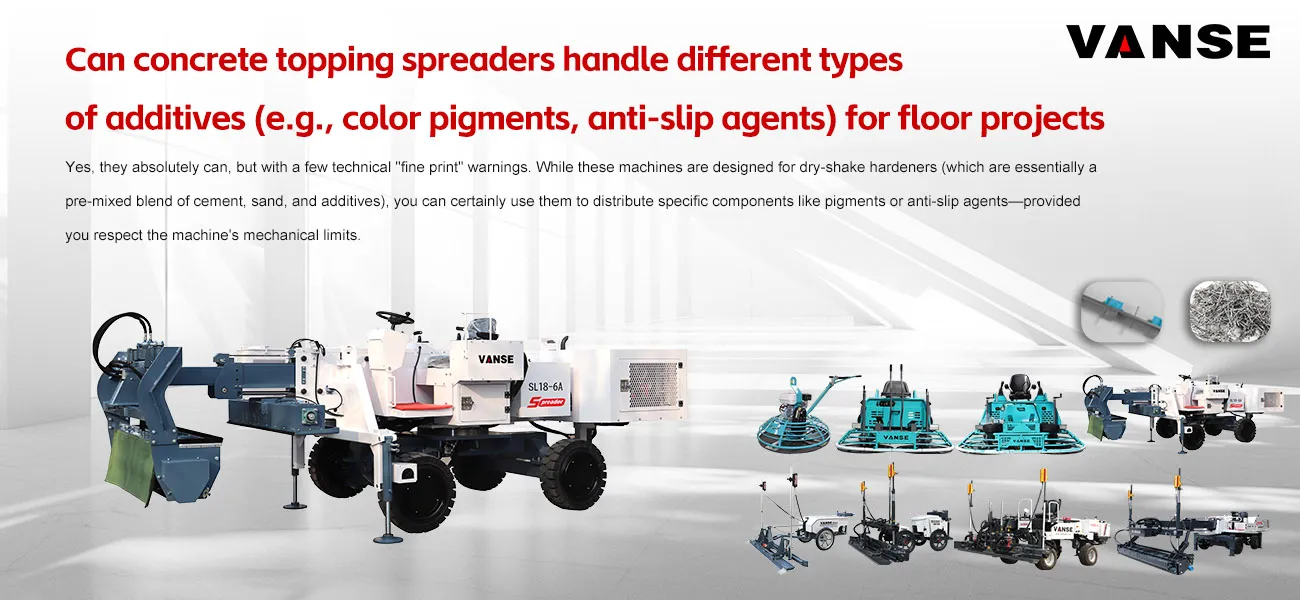
Yes, they absolutely can, but with a few technical "fine print" warnings. While these machines are designed for dry-shake hardeners (which are essentially a pre-mixed blend of cement, sand, and additives), you can certainly use them to distribute specific components like pigments or anti-slip agents-provided you respect the machine's mechanical limits.
Here is how concrete topping spreaders handle various additives and the adjustments you need to make.
1. Dry-Shake Color Hardeners (Pigments)
Most "color" in industrial floors isn't pure pigment; it’s a Color Hardener (pigment + cement + fine aggregate).
The Spreader's Role: It is the only way to get a perfectly uniform color. Hand-tossing color usually results in "leopard spots."
The Risk: Pure, raw pigment is often too fine (like flour). If you put pure pigment in a spreader, it may "bridge" (clump together) in the hopper and refuse to fall through the rotor.
The Fix: Ensure the pigment is part of a engineered dry-shake mix. If you must use pure pigment, it should be blended with a carrier (like fine sand) to give it enough "weight" to flow through the machine.
2. Anti-Slip Agents (Abrasives)
For loading docks or wet processing areas, you might spread Silicon Carbide or Aluminum Oxide.
Handling: These materials are much denser and "grittier" than standard hardeners.
Machine Wear: These are essentially sandpaper for your equipment. If you are running high volumes of anti-slip agents, you will notice accelerated wear on the rubber seals and the discharge rotor.
Distribution: Because these grains are heavy, they drop very fast. You usually need to tighten the discharge gap on the spreader to prevent "dumping" too much material in one spot.
3. Specialized Additives Comparison
| Additive Type | Material Examples | Spreader Compatibility | Key Challenge |
| Metallic Aggregates | Iron filings, steel grit | Excellent | High weight; requires heavy-duty motors. |
| Anti-Slip | Silicon Carbide, Quartz | Good | Highly abrasive; wears down internal parts. |
| Reflective | Glass beads, "Sparkle" grain | Moderate | Very fragile; can "crush" in the rotor. |
| Pure Pigment | Iron oxide powders | Difficult | Clumping and "dusting" (blown away by wind). |
4. Operational "Must-Dos" for Specialized Loads
The "Clean-Out" Protocol
If you are switching from a high-visibility color (like "Safety Red") to a standard grey hardener, a simple shake-out isn't enough.
The Danger: Residual pigment trapped in the rotor corners will "bleed" into the next project for the first 100 feet.
The Fix: Use a shop-vac and a stiff brush to clean the internal discharge vanes. Some operators run a "sacrificial" 25 kg bag of plain sand through the machine to scrub the pigment out before starting the next color.
Moisture Sensitivity
Additives like pure pigments are extremely hygroscopic (they suck moisture out of the air).
If you leave specialized additives in the hopper during a lunch break or a rain delay, they can "cake" onto the rotor.
The Rule: Only load what you are about to spread immediately.
Calibration for Density
Not all additives weigh the same.
1 Liter of Steel Aggregate weighs much more than 1 Liter of Glass Beads.
The Test: Before starting the actual floor, run a "10-foot test" on a piece of plastic or a dry section of the slab. Weigh the material dropped to ensure your kg/㎡ (or lb/ft^2) matches the project spec.
5. Summary: Can they handle it?
Integrated Blends: Yes, flawlessly. This is what they are built for.
Raw Abrasives: Yes, but expect higher maintenance on the machine.
Fine Powders: No, unless blended with a carrier to improve flow.
Pro Tip:
When spreading reflective beads or very fine anti-slip grains, lower the discharge height of the spreader head as much as possible. Even a light breeze in a warehouse can blow 20% of your expensive additives away before they even hit the wet concrete.
Would you like me to find the recommended "Drop Rates" (kg/㎡) for standard VS heavy-duty industrial wear layers? Contact us NOW
Note: The parameters provided in this document are for reference only and are not mandatory. Due to differences in technical characteristics between different brands and models of laser levelers, please consult the manufacturer for a suitable solution before actual operation. This reference document assumes no responsibility for any issues arising from failure to follow the manufacturer's instructions.
Thanks to All the Friends Who Support and Trust Shandong Vanse Machinery Technology Co., Ltd.
If you want to know more about Shandong Vanse Machinery Technology Co., Ltd. or have any questions, please feel free to contact us:
Our Factory
Shandong Vanse Machinery Technology Co., Ltd.








Share this article

About the Author: Shandong Vanse Machinery Technology Co., Ltd.
Shandong Vanse Machinery Technology Co., Ltd. is a high-tech manufacturer specializing in concrete construction machinery, including laser screeds and related equipment. The company integrates R&D, production, and global sales, with products exported to over 60 countries and widely used in infrastructure projects worldwide.
Previous Post
Next Post
Related Articles
You Might Also Like
How to ensure safety when operating a concrete laser leveling machine?
It is very important to ensure safety during the operation of the concrete laser leveling machine, because it is not only related to the personal safety of the operator, but also affects the construction quality and the smooth progress of the project. The following are some key safety measures: 1. Training and qualification: Ensure that all operators have received appropriate professional training and hold the corresponding operating certificates. Understand all functions, safety features and emergency response measures of the equipment. 2. Equipment inspection: Perform a comprehensive inspection of the leveling machine before each use, including but not limited to tires, fuel, hydraulic system, electrical system, laser transmitter, etc. Ensure that all parts are intact and functioning properly. 3. Personal protective equipment: Operators must wear appropriate personal protective equipment, such as hard hats, goggles, non-slip shoes, gloves, etc. 4. Site assessment: Conduct a comprehensive safety assessment of the construction site, identify potential risks, and formulate corresponding preventive measures. 1. Clear identification: Set up obvious warning signs and fences in the work area to prevent non-staff from entering the danger zone. 2. Communication is smooth: Ensure that there is a reliable way of communication between all relevant personnel to facilitate coordination of work and handling of emergencies. 3. Observe operating procedures: Strictly follow the operating manual provided by the manufacturer, and do not change or ignore any safety steps without authorization. 4. Smooth operation: Keep the machine moving smoothly during operation, avoid sudden acceleration or sharp turns, and reduce the chance of accidents. 5. Pay attention to the surrounding environment: Always pay attention to changes in the surrounding environment, especially when working at night or in poor visibility. 6. Emergency stop button: Be familiar with and know how to quickly use the location of the emergency stop button, and stop the machine immediately if any abnormality is found. 1. Regular maintenance: Perform equipment maintenance and inspection regularly according to the manufacturer's recommendations, and replace worn or damaged parts in a timely manner. 2. Record maintenance history: Keep detailed maintenance records to help track the status of the equipment and predict future maintenance needs. 3. Professional maintenance: For complex maintenance work, it should be carried out by professional technicians, and do not disassemble or repair the equipment privately. – Avoid fatigue work: Arrange working hours reasonably to avoid distraction of operators due to fatigue. – Comply with laws and regulations: Comply with national and local laws, regulations and standards on production safety. By strictly implementing the above safety measures, the safety hazards when operating the concrete laser leveling machine can be greatly reduced, ensuring the safety of the construction site.Safety tips for ride-on power trowels in tight indoor spaces
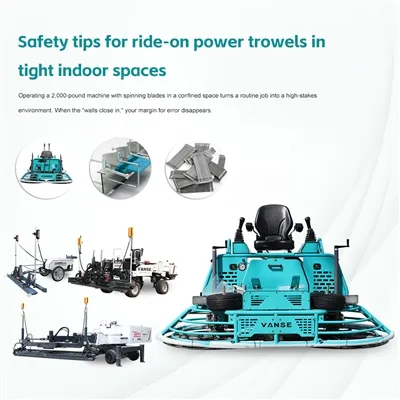
Operating a 2,000-pound machine with spinning blades in a confined space turns a routine job into a high-stakes environment. When the "walls close in," your margin for error disappears. Here is the safety protocol for maneuvering ride-on trowels in tight indoor quarters. This is the #1 danger for indoor ride-on use. Standard gas or diesel engines produce Carbon Monoxide (CO), which can reach lethal levels in minutes in a closed room. Active Ventilation: Do not rely on "open doors." You need high-volume axial fans (blowers) to create a "push-pull" airflow system. CO Monitors: The operator must wear a personal CO monitor clip. If it beeps, the site is evacuated immediately. Catalytic Converters: Ensure your machine is fitted with a "scrubber" (catalytic muffler) to reduce emissions, or better yet, use Propane-powered or Electric trowels for indoor work. In tight spaces, the machine's "tail swing" is your biggest enemy. No-Go Zones: Establish a rule that no ground crew (manual finishers) can be within 10 feet of the machine when it is near a wall or pillar. Pillar Strategy: When circling columns, always keep the machine moving in a direction where the operator has a clear line of sight to the gap between the machine and the obstruction. Avoid "Backing Into" Corners: Always try to nose into tight corners so you have the best visibility to back out into the open. If a spinning blade hits a protruding pipe, drain, or a structural steel column, the machine can jerk or spin violently. Mark Obstructions: Use bright spray paint or "flags" on any floor penetrations (pipes/conduit) that are shorter than the operator's seated eye level. Low Speed Near Edges: Reduce RPM when working within 2 feet of a wall. This gives you more reaction time if the machine "catches" an edge. Indoor spaces often have poor airflow for flammable vapors. Cool Down Before Fueling: Never refuel a hot engine inside. The "flash point" of spilled gas on a hot manifold in a room with no wind is a recipe for a fireball. Spill Kits: Keep a spill kit nearby. A hydraulic hose burst on fresh concrete is a slip hazard and a nightmare to clean. Danger Preventive Action CO Poisoning Use CO monitors + High-velocity fans Wall Impact Maintain "Slow-Zone" within 3ft of walls Tip-Over Watch for floor "drop-offs" or open elevator shafts Communication Use hand signals (it's too loud for shouting) Lighting Ensure 2,000+ lumens of temporary work lighting Before starting, test the kill switch. In a tight space, if you lose control or the throttle sticks, you have a fraction of a second to shut down before hitting a structural wall. If the seat-activated safety switch is bypassed or broken, do not operate the machine. Would you like me to look up the OSHA (or local) requirements for CFM airflow based on the square footage of your indoor project? Contact us NOW Note: The parameters provided in this document are for reference only and are not mandatory. Due to differences in technical characteristics between different brands and models of laser levelers, please consult the manufacturer for a suitable solution before actual operation. This reference document assumes no responsibility for any issues arising from failure to follow the manufacturer's instructions.What’s the importance of pre-sales and after-sales service of concrete laser leveling machine?
In the process of purchasing laser leveling machine equipment, manufacturing quality, market price, technical indicators, manufacturer strength, etc. are all important aspects that can be used to measure the performance of laser leveling machine equipment, but in addition to these more important reference factors , Product pre-sales and after-sales service should also be fully considered. So, what is the importance of guaranteeing the pre-sales and after-sales service of laser leveling machines? The specific analysis is detailed below. In modern society, pre-sales and after-sales services are undoubtedly an extremely important link in the process of enterprise development. However, there is a saying in the market: "Good equipment does not need after-sales service, and it will not break no matter how long it is used; and those with good after-sales service have to rely on after-sales to provide continuous supply because the equipment is always broken. Maintenance service." This sentence sounds quite right to a layman at first glance, but when you think about it carefully, it's not the case at all. For products like concrete laser leveling machines, no matter how good the equipment itself is, it is inevitable that certain parts will be lost during normal operation. What's more, how can good after-sales service just stop at "repairing" machines? After-sales service can be said to be a significant advantage of laser leveling machines. Most of the laser leveling machine equipment purchased by large-scale concrete floor construction companies is undoubtedly a "big piece" in terms of price and equipment volume. In addition, the installation, commissioning, and maintenance of laser leveling machine equipment require special personnel The operation makes the purchase of laser leveling machine equipment more cautious. However, floor construction companies have more doubts in purchasing laser leveling machine equipment products in terms of purchase, transportation distance, language communication, and after-sales communication. These doubts are exactly the advantages of VANSE laser leveling machine equipment. Compared with other equipment, VANSE laser leveling machine has its own independent production workshop, and R&D departments are located in one place, which is convenient for buyers to conduct on-site inspections of products and production workshops. It is more convenient to purchase VANSE laser leveling machine equipment, whether it is purchase procedures, transportation or later commissioning and maintenance. Our service team continues a complete set of solutions for customers, from the production of laser leveling machine equipment, arrival, equipment assembly, performance debugging, application training, production and maintenance guidance to delivery to customers as the goal, and later services also include laser Timely repair, maintenance, technical training and other work of leveling machine equipment, this kind of technical support is a good embodiment of after-sales service. Our after-sales service and product quality complement each other and fully reflect the strength of the enterprise. We not only have good quality machinery and equipment , better after-sales service.