Technical Knowledge
Automatic concrete spreader VS manual spreading Which ensures more uniform distribution of hardener for super flat floors
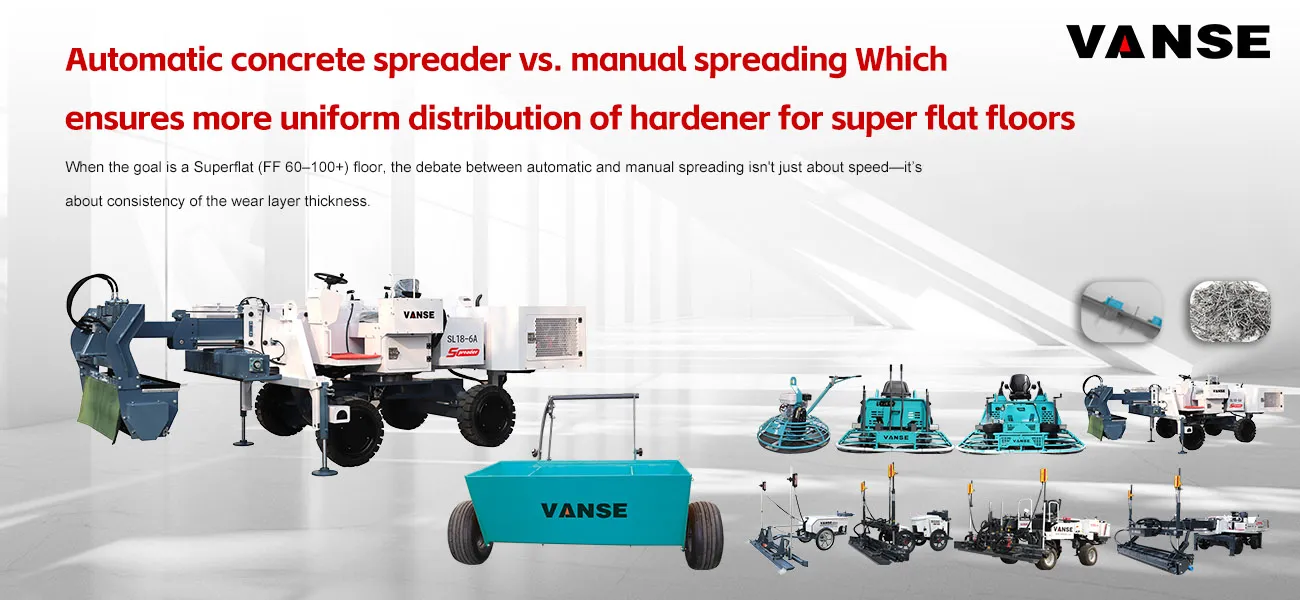
When the goal is a Superflat (FF 60–100+) floor, the debate between automatic and manual spreading isn't just about speed-it’s about consistency of the wear layer thickness.
For high-precision projects, Automatic Spreading wins decisively. Here is the technical breakdown of why manual spreading is often the "weak link" in achieving Superflat tolerances.
1. Uniformity of Application Rate (kg/㎡)
To maintain a Superflat surface, the concrete must hydrate and shrink at exactly the same rate across the entire slab.
Automatic Spreader: Uses a computer-controlled, fluted rotor (similar to an agricultural seed drill). It drops a metered amount of material (e.g., exactly 5.0 kg/㎡) regardless of travel speed. This ensures the "chemical demand" for water from the base slab is identical everywhere.
Manual Spreading: Relies on a worker tossing material from a bucket or bag. Even the most skilled worker will create "heavy" spots (where the pile is 8 mm thick) and "light" spots (where it is 2 mm thick).
The Superflat Consequence: Heavy spots suck more moisture out of the slab, causing localized "humps" or "blisters" that a power float cannot easily fix.
2. Impact on the "Levelness" Plane (FL)
A Superflat floor requires a perfectly level plane.
Automatic (Telescopic): Machines like use a telescopic boom to "fly" the spreader head over the concrete. The head never touches the wet slab, meaning it doesn't leave ruts or footprints that would disturb the FL established by the laser Leveling.
Manual: Requires workers to walk on the wet concrete (even with "snowshoes"). Every footstep is a displacement of aggregate and a micro-dip in the levelness that must be "re-floated." In Superflat construction, every time you touch the concrete, you risk degrading the F-number.
3. Comparative Performance for Superflat Projects
| Feature | Automatic Spreader | Manual Spreading |
| Precision | ± 2% variance | ± 20-30% variance |
| Surface Integrity | No contact with slab (Telescopic) | High contact (Footprints/Ruts) |
| Timing | Fast; covers large areas in minutes | Slow; can lead to "cold joints" |
| Dust Control | Integrated skirts (low dust) | High dust (affects laser receivers) |
| Bond Strength | Even hydration = uniform bond | Uneven hydration = delamination risk |
4. The "Laser Interference" Factor
In Superflat projects, the laser transmitter is the "Source of Truth."
Manual spreading often creates a cloud of cement dust as workers toss the hardener. This dust can refract or "scatter" the laser beam, causing the laser Leveling or the laser-guided power floats to receive false signals.
Automatic spreaders have enclosed hoppers and drop the material from a height of only a few centimeters, keeping the air clear and the laser signals accurate.
5. When Manual is (Rarely) Better
The only time manual spreading is preferred is in extremely tight corners or around complex "box-outs" where a large machine cannot reach. However, for the main "runway" of a VNA (Very Narrow Aisle) warehouse, manual spreading is generally prohibited by high-end specifications.
The Verdict for Superflat Floors
Automatic spreading is mandatory. Manual spreading introduces too much human error in volume distribution. On a Superflat project, an extra 2 mm of dry-shake in one spot can create a "peak" that fails the FF floor profiler test after the concrete cures.
Would you like me to provide a sample specification clause that contractors use to mandate automatic spreading for VNA warehouse projects? Contact us NOW
Note: The parameters provided in this document are for reference only and are not mandatory. Due to differences in technical characteristics between different brands and models of laser levelers, please consult the manufacturer for a suitable solution before actual operation. This reference document assumes no responsibility for any issues arising from failure to follow the manufacturer's instructions.
Thanks to All the Friends Who Support and Trust Shandong Vanse Machinery Technology Co., Ltd.
If you want to know more about Shandong Vanse Machinery Technology Co., Ltd. or have any questions, please feel free to contact us:
Our Factory
Shandong Vanse Machinery Technology Co., Ltd.








Share this article

About the Author: Shandong Vanse Machinery Technology Co., Ltd.
Shandong Vanse Machinery Technology Co., Ltd. is a high-tech manufacturer specializing in concrete construction machinery, including laser screeds and related equipment. The company integrates R&D, production, and global sales, with products exported to over 60 countries and widely used in infrastructure projects worldwide.
Previous Post
Next Post
Related Articles
You Might Also Like
Causes and treatment of ground cracks
Causes and treatment of concrete floor cracks 1. Introduction As an indispensable part of building structures, concrete floors are widely used in various construction sites. However, in actual use, cracks often occur in concrete floors, which not only affects the aesthetics of the floor, but also poses a potential threat to the integrity and safety of the structure. Therefore, it is particularly important to deeply study the causes of concrete floor cracks and take corresponding treatment measures. The formation of concrete floor cracks is a complex process involving many factors such as materials, design, construction, and environment. This paper aims to analyze the specific causes of concrete floor cracks, explore effective treatment methods and preventive measures, and provide theoretical support and practical guidance for crack control in actual projects. 2. Analysis of causes of concrete floor cracks ✔ Material factors The material selection of concrete floors is directly related to the generation of cracks. If the quality of raw materials such as cement, aggregates, and admixtures used is unqualified, or the mix ratio is improperly designed, it may lead to insufficient concrete strength and large shrinkage, thereby causing cracks. In addition, impurities, bubbles, and other defects added to concrete may also become the starting point of cracks. ✔ Design factors Improper design is also an important cause of concrete floor cracks. If the design load calculation is inaccurate, the structural layout is unreasonable, the ground thickness is insufficient or too thick, etc., the concrete floor may produce excessive stress concentration when subjected to force, resulting in cracks. ✔ Construction factors Improper operation during construction is also a common cause of cracks. For example, uneven vibration during concrete pouring leads to voids and stratification inside the concrete; failure to maintain in time after pouring causes shrinkage cracks due to excessive water loss during the hardening process; improper construction joint treatment forms weak links, etc. ✔ Environmental factors Environmental factors also have an important impact on the generation of cracks in concrete floors. For example, thermal expansion and contraction caused by temperature changes cause stress changes inside the concrete; humidity changes cause concrete to shrink or expand; foundation settlement, earthquakes and other natural disasters may also cause damage to the concrete floor and cause cracks. 3. Treatment measures for concrete floor cracks According to the different causes of concrete floor cracks, corresponding treatment measures need to be taken. The following are some common treatment methods: ✔ Surface repair method For cracks with smaller width and shallower depth, surface repair method can be used for treatment. Specific operations include cleaning the crack surface, applying repair materials such as ring gold resin to seal the cracks and restore the flatness and aesthetics of the ground. ✔ Filling method For cracks with larger width and deeper depth, the filling method can be used for treatment. First, clean the inside of the crack, and then use high-strength repair materials (such as epoxy mortar, polymer cement, etc.) to fill it to ensure that the filling is dense and tightly combined with the surrounding concrete. ✔ Pressure grouting method For cracks with larger width and deeper depth, the pressure grouting method can be used for treatment. The repair material is injected into the crack with a certain pressure through the grouting equipment, so that the material can be fully diffused and fill the crack space, thereby achieving the purpose of repair and reinforcement. ✔ Replacement method For cracks that are serious and affect structural safety, the replacement method may be required. That is, the damaged concrete part is excavated and new concrete is poured again to restore the integrity and structural safety of the ground. ✔ Structural reinforcement method While dealing with cracks, the overall structural performance of the concrete floor should also be considered. The crack resistance of the ground can be enhanced by adding steel mesh, increasing the thickness of the ground, and setting expansion joints. 4. Preventive measures In order to reduce the probability of cracks in concrete floors, preventive measures should also be taken from the aspects of design, materials, and construction: ✔ Rationally design the floor structure and thickness to ensure that the use requirements and load conditions are met. ✔ Select high-quality raw materials and strictly control the mix ratio to ensure the quality of concrete. ✔ Strengthen the management of the construction process to ensure the pouring, vibration, maintenance and other process operations are standardized. ✔ Fully consider the impact of environmental factors on the concrete floor and take corresponding measures to prevent it. 5. Case analysis In order to better illustrate the causes and treatment measures of cracks in concrete floors, this paper selects a real engineering case for analysis. During the construction process of this project, cracks appeared on the ground due to uneven vibration and untimely maintenance. After on-site investigation and cause analysis, the construction unit adopted the filling method and strengthened maintenance measures to deal with the cracks, and strengthened the management of the subsequent construction process, effectively preventing similar problems from happening again. 6. Technology development trend With the advancement of science and technology and the continuous accumulation of engineering practice, the technology for handling cracks in concrete floors is also developing. In the future, we can expect the emergence of more efficient, environmentally friendly and intelligent crack handling technologies. For example, using nondestructive testing technology to accurately identify and locate cracks; using new repair materials to improve the repair effect and durability; using intelligent monitoring systems to monitor and warn concrete floors in real time, etc. The application of these technologies will further improve the efficiency and accuracy of concrete floor crack treatment, and provide strong support for ensuring project safety and performance. 7. Conclusion The problem of concrete floor cracks is a complex and important engineering problem that requires us to analyze and deal with it from multiple angles. By deeply analyzing the causes of cracks, we can take targeted treatment measures and preventive measures to ensure the quality and safety of concrete floors. At the same time, we should also pay attention to the development trend of technology, continuously introduce and apply new technologies, new materials and new methods, and improve the level and effect of concrete floor crack treatment. In summary, the causes and treatment of concrete floor cracks are a highly comprehensive topic, involving both technical aspects and management and maintenance elements. In-depth research and discussion on the problem of concrete floor cracks will not only help improve the quality of the project, but also provide valuable experience and reference for future building design and construction. First of all, from the perspective of technology and materials, with the advancement of science and technology, new concrete materials and additives are constantly emerging, which have better strength, durability and crack resistance. At the same time, new construction processes and equipment have also improved the accuracy and efficiency of concrete construction and reduced the possibility of cracks. Therefore, we should actively pay attention to and apply these new technologies and new materials to improve the quality of concrete floors. Secondly, from the perspective of management and maintenance, establishing a sound construction management system and quality control system is an important means to prevent cracks in concrete floors. This includes training and supervision of construction personnel to ensure that they operate in accordance with specifications; strictly control the quality of raw materials to prevent unqualified materials from entering the construction site; monitor the construction process throughout the process, and promptly identify and deal with problems. At the same time, strengthening the post-maintenance and maintenance of concrete floors, and conducting regular inspections and repairs are also important measures to prevent the generation and expansion of cracks. In addition, we should also pay attention to the impact of environmental factors on cracks in concrete floors. By improving the construction environment, controlling temperature changes, and reducing humidity changes, the adverse effects of environmental factors on concrete floors can be reduced, thereby reducing the generation of cracks. Finally, we should also pay attention to the innovation and development of concrete floor crack treatment technology, and by introducing and developing new treatment technologies and equipment, improve the efficiency and effect of crack treatment and reduce damage to concrete floors during treatment. At the same time, strengthening the research and application of crack treatment technology and improving the professional level and skills of technicians are also important ways to promote the development of concrete floor crack treatment technology. In summary, the causes and treatment of concrete floor cracks are a complex and important issue. We need to take comprehensive measures from multiple perspectives to prevent and deal with crack problems. Through technological innovation, material upgrades, management optimization and environmental improvement, we can continuously improve the quality and durability of concrete floors and make greater contributions to the development of the construction industry. Of course, we should also realize that although we have achieved certain results, there are still many unknowns and challenges waiting for us to explore and solve the problem of concrete floor cracks. In the future, we need to continue to increase research efforts, deeply explore the mechanism and laws of crack generation, and find more effective treatment methods and preventive measures. At the same time, we should also strengthen international cooperation and exchanges, learn from and absorb international advanced experience and technology, and jointly promote the research and solution of concrete floor crack problems. In short, the problem of concrete floor cracks is an issue that requires long-term attention and continuous efforts. Through continuous exploration and practice, we believe that we will be able to find more effective solutions and make greater contributions to the sustainable development of the construction industry. Before concluding this article, I would like to emphasize that the prevention and treatment of concrete floor cracks cannot be achieved overnight, but requires us to constantly explore and improve in practice. We should always maintain our sensitivity to technology and pursuit of quality, and constantly improve our professional quality and practical ability to better cope with the challenges brought by the problem of concrete floor cracks. At the same time, we should also actively advocate and promote advanced concrete technology and concepts to promote the progress and development of the entire industry. In summary, the causes and treatment of concrete floor cracks is a topic that is both challenging and full of opportunities. Through in-depth research, technological innovation and practical exploration, we will definitely be able to find more effective solutions and make positive contributions to the prosperity and development of the construction industry.What are the common failures & solutions of concrete trowel machines?
Common faults and solutions of concrete trowel machine ●1. The engine cannot start Cause of issue: 1. The battery power is low; 2. The engine oil circuit is not smooth; 3. Starter failure; 4. The engine air filter is clogged. Solution: 1. Charge or replace the battery; 2. Check the oil line to ensure it is smooth; 3. Check the starter and replace it if necessary; 4. Clean the air filter. If you need to replace it, please contact professional technicians. ●2. Insufficient engine power Cause of issue: 1. Engine fuel system failure; 2. Improper engine valve clearance; 3. Engine air intake system failure. Solution: 1. Check the fuel system to ensure smooth fuel supply; 2. Adjust the valve clearance. If you need to replace the valve, please contact professional technicians; 3. Check the air intake system and clean or replace the air filter. ●3. The operation of the trowel machine is unstable Cause of issue: 1. The trowel blade is worn or loose; 2. The bearings of the trowel are worn or loose; 3. Improper operation of the trowel or poor road conditions. Solution: 1. Replace or tighten the blade; 2. Replace or tighten the bearings; 3. Adjust the operating method and select the appropriate operating speed and pressure according to the road conditions. ●4. The trowel machine makes a lot of noise when working Cause of issue: 1. The bearings of the trowel are damaged or loose; 2. The trowel blade is loose or worn; 3. There are foreign objects in the running parts of the trowel. Solution 1. Replace or tighten the bearing; 2. Fasten or replace the blade; 3. Check the running parts and clean up foreign objects. ●5. The smoothing effect of the trowel is not ideal Cause of issue: 1. The trowel blade is worn or improperly installed; 2. The smoothed concrete surface is uneven or blocked by hard objects; 3. Improper operation of the trowel or poor road conditions. Solution: 1. Replace or reinstall the blade; 2. Check the flatness of the concrete surface and clean up hard objects; 3. Adjust the operating method and select the appropriate operating speed and pressure according to the road conditions.How to use concrete curing blankets to protect super flat floors after laser leveling and power trowel
Using concrete curing blankets is a crucial step in protecting the ultra-flat floor and ensuring its long-term flatness and structural strength. Its main function is to maintain stable humidity and temperature during the hydration and hardening of the concrete, preventing shrinkage cracks and surface warping caused by excessive water evaporation. The following is a detailed operation guide based on industry standards and engineering practices. To achieve the best maintenance results, please follow the following steps: Steps Key operation Core purpose and precautions: 1. Timing for laying down After the surface is polished and leveled, proceed with the laying as soon as possible. Ideally, the covering should start within 10 to 15 minutes. Immediate moisturization: The moisture on freshly polished floors evaporates very quickly. Immediate coverage can lock in the surface moisture and prevent plastic shrinkage cracks. Note: If there is water on the floor, it should be carefully drained using a hose to prevent the surface from becoming too soft and being pressed into an indentation. 2. Laying method Complete wetting: Before laying, the contact surface (the gray side) of the ground and the maintenance blanket must be thoroughly sprayed with water to ensure the blanket is fully saturated. Front and back distinction: Lay the blanket with the white reflective side facing up and the gray wet side facing down, ensuring it closely adheres to the concrete. The white side can reflect sunlight and prevent the blanket from overheating. Close contact: Ensure that the blanket is in 100% tight contact with the concrete surface, without any air bubbles or wrinkles. Otherwise, the areas with poor contact will form dry spots. Overlap and fixation: Adjacent blankets need to overlap at least 15-30 centimeters (12 inches) and use sandbags or heavy objects to compact the edges and seams to prevent them from being blown away and ensure sealing. Covering the edges: The edges of the concrete slab and exposed formwork should also be covered with the blanket and kept moist. These areas are most prone to losing moisture. 3. Maintenance period management Continuous Moisture Retention: During the maintenance period, it is necessary to regularly check and re-wet the blanket to ensure it remains in a saturated state. Especially in hot, dry, or windy weather, it may be necessary to spray water multiple times a day. Maintenance Duration: At least 7 consecutive days of maintenance are required. For super smooth floors with high requirements or using high-performance concrete, it is recommended to extend the maintenance period to 14 days for better performance. Avoid Disturbance: During the maintenance period, it is strictly prohibited to walk on the blanket or stack any items on it to avoid damaging the floor. Whether to use the maintenance blanket and how to use it mainly depend on the ambient temperature during the construction process: Environmental conditions Why is a curing blanket needed? Specific approach: Cold weather (< 10°C) The hydration reaction is extremely slow and there is a risk of freezing. Ice crystals can damage the internal structure of the concrete, resulting in loss of strength. Use a thermal insulation blanket (typically a thick blanket filled with insulation material). Cover it immediately after the surface is polished, and keep it covered for 5-7 days. Remove it when the temperature is higher during the day (such as at noon) to prevent "thermal shock". Normal/Hot weather (10°C – 30°C +) The core is to prevent excessive evaporation of water. High temperatures, direct sunlight, and strong winds will quickly remove the water, causing shrinkage cracks. Strictly follow the above "three-step method", with the focus being on thoroughly pre-wetting the blanket and maintaining saturation. Facing the white reflective side upwards can lower the blanket temperature and reduce water evaporation. Strong wind and dry weather Wind is the primary factor that accelerates water evaporation. Even if the temperature is not high, it can easily cause rapid cracking on the surface. The blanket must be immediately covered and the edges must be tightly fixed to prevent wind from entering the bottom of the blanket and forming a "wind tunnel", which accelerates local water loss. Fast: Cover immediately after sanding. Wet: The blanket and the floor must be fully moistened. Tight: Ensure the blanket is tightly attached to the floor and the edges are sealed. Long: At least maintain for 7 days, preferably 14 days. What is the current environmental temperature and weather conditions of your project? Please tell me the specific conditions so that I can help you further confirm if the maintenance plan needs to be adjusted. Contact us NOW Note: The parameters provided in this document are for reference only and are not mandatory. Due to differences in technical characteristics between different brands and models of laser levelers, please consult the manufacturer for a suitable solution before actual operation. This reference document assumes no responsibility for any issues arising from failure to follow the manufacturer's instructions.