Technical Knowledge
How to Verify Laser Leveling Effect through F-number (FF/FL) System?
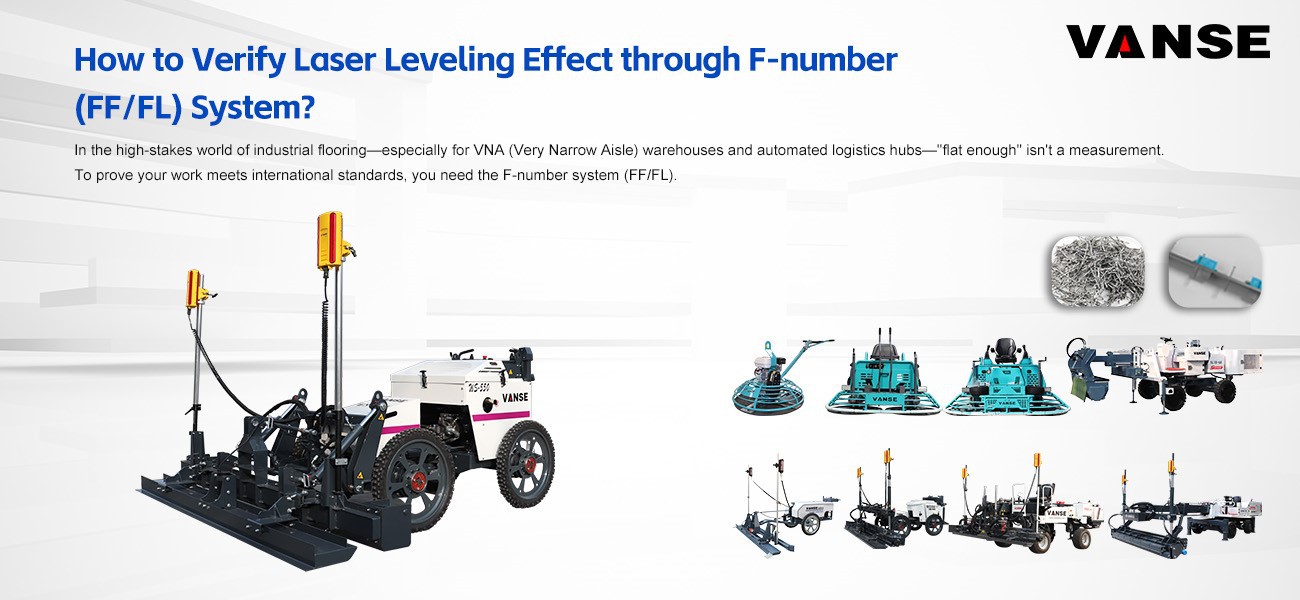
In the high-stakes world of industrial flooring-especially for VNA (Very Narrow Aisle) warehouses and automated logistics hubs-"flat enough" isn't a measurement. To prove your work meets international standards, you need the F-number system (FF/FL).
If you’re using a Concrete Laser Leveling Machine and need to verify your results for a client, here is the professional's guide to understanding, measuring, and hitting those high scores.
1. What Exactly are You Measuring? (FF VS FL)
Before you pull out the testing equipment, you need to know what the numbers represent. Global buyers and engineers follow the ACI 117 standard, which breaks down into two parts:
FF (Floor Flatness): This measures the "waviness" of the surface. Think of it as the small bumps and dips. High FF numbers mean a smoother ride for forklifts.
FL (Floor Levelness): This measures the overall tilt or slope of the slab. It’s about how close the floor is to the actual horizontal plane.
2. The "Golden Window" for Measurement
Timing is everything. To get an accurate reading that reflects the machine's performance, measurements should be taken within 24 to 72 hours after placement. If you wait too long, concrete curling (due to drying) can throw off your FL numbers, even if your laser leveling did a perfect job.
3. The Role of Equipment in Hitting the Specs
You can’t verify a high F-number if the machine didn't produce it in the first place. This is where the engineering of your Concrete Laser Leveling Machine comes into play.
Vanse Insight: To achieve FF numbers in the 50s or 60s (Superflat), the machine’s hydraulic response must be instantaneous. Vanse’s YZ series, uses high-speed laser receivers that talk to the leveling head 10 times per second. This constant, automatic correction is what eliminates the "waves" that tank your FF scores.
4. How to Conduct the Test
Most international contractors use an F-Meter or a Dipstick® Profiler.
Walk the Lines: You don't measure the whole floor randomly. You walk the device in straight lines across the slab.
Data Collection: The device records the elevation changes every 12 inches (30cm).
The Result: The software calculates a statistical average. If your goal was FF 50 and you hit FF 52, you’ve verified that your laser leveling machine and your crew executed the plan perfectly.
How Vanse Helps You Guarantee FF/FL Results
When a buyer asks, "Can your machine hit FM1 standards?" they are asking about reliability. Here’s how Vanse Machinery ( www.vansemac.com ) supports those high-spec requirements:
Integrated Vibration: A major enemy of FF numbers is uneven concrete density. Vanse machines feature high-frequency vibration integrated directly into the leveling head, ensuring the slab is consolidated uniformly before the final pass.
Telescopic Precision: For the highest FL accuracy, the Vanse YZ30-4E telescopic boom allows the machine to stay in one spot while the head extends. This removes the variable of machine weight shifting on the wet concrete, which is a common cause of "dips" in the F-number report.
Dual-System Control: By combining top-tier laser transmitters (Leica/Trimble) with Vanse’s proprietary hydraulic control, the margin for error is reduced to nearly zero.
Note: The parameters provided in this document are for reference only and are not mandatory. Due to differences in technical characteristics between different brands and models of laser levelers, please consult the manufacturer for a suitable solution before actual operation. This reference document assumes no responsibility for any issues arising from failure to follow the manufacturer's instructions.
Thanks to All the Friends Who Support and Trust Shandong Vanse Machinery Technology Co., Ltd.
If you want to know more about Shandong Vanse Machinery Technology Co., Ltd. or have any questions, please feel free to contact us:
Our Factory
Shandong Vanse Machinery Technology Co., Ltd.








Share this article

About the Author: Shandong Vanse Machinery Technology Co., Ltd.
Shandong Vanse Machinery Technology Co., Ltd. is a high-tech manufacturer specializing in concrete construction machinery, including laser screeds and related equipment. The company integrates R&D, production, and global sales, with products exported to over 60 countries and widely used in infrastructure projects worldwide.
Previous Post
Next Post
Related Articles
You Might Also Like
Rapid calibration and repair of sudden deviation in the leveling accuracy of Concrete Laser Leveling
The problem of sudden deviation in the leveling accuracy of the concrete Laser Leveling during the construction process is an extremely urgent situation. The following is a systematic guide for troubleshooting, calibration and repair aimed at helping you resume construction quickly. When there is a sudden deviation in accuracy, please follow the principle of "from the outside to the inside and from the easy to the difficult" to conduct a systematic investigation. Check the laser signal source Stability: Immediately check whether the tripod of the laser emitter has been knocked over or settled by personnel or equipment. Battery power: Make sure the laser is fully charged. Low battery power may cause unstable beam. Cleanliness: Quickly check if there are any mud spots or dust on the light-emitting lens of the laser emitter, and clean it with special lens cleaning paper. Inspect the body of the leveling machine Receiver rod: Check whether the mast on which the receiver is installed has been bent or loosened. Receiver cleaning: Check if the surface of the receiver sensor is contaminated by cement slurry or dust, and clean it immediately. Scraper and flattening head: Check whether the bottom plate of the flattening head and the scraper have severe wear or concrete accumulation, as this can cause physical scratches and affect the perception accuracy. If the initial inspection does not solve the problem, please perform the following in-depth operations. 1. Calibration verification of the laser system Manual rotation test: Manually and slowly rotate the laser emitter 360 degrees to observe whether the signals of the leveler receiver are consistent and stable in all directions. If there is a continuous deviation in a certain direction, it might be that the transmitter's reference is inaccurate. Check the reference height: Use a tower ruler or steel tape measure to measure whether the reference height set by the laser emitter is consistent with the actual height of the ground control point, and eliminate errors in the reference setting. 2. Mechanical inspection of the leveling machine body Hydraulic system pressure: Check whether the hydraulic pressure of the lifting mechanism is normal and stable. Insufficient pressure can cause the flat head to "sink" in the concrete, resulting in overly deep scratches. Sensor and actuator connection: Check whether the mechanical or electrical connection between the receiver signal and the hydraulic valve is loose or damaged. Try to conduct a "manual/automatic" switching test. In the automatic mode, slightly cover the receiver manually and observe whether the flat head responds quickly to rise and fall. If there is no response or the response is slow, it indicates a fault in the signal transmission or hydraulic control system. 3. Perform rapid on-site calibration (key step) Most modern laser screeners are equipped with "quick calibration" or "learning" functions. Please refer to the manual of your equipment (such as YZ30-4E from Shandong Vanse Technology) for operation. The general process is as follows: Enter calibration mode: Go to the calibration menu on the control panel. Locate the high and low points: Turn on the Leveling to a known reference plane (or have the laser emitter sweep out a plane), and move the receivers to a known "high point" (with the display bar at the top) and a "low point" (with the display bar at the bottom) respectively. Data collection: Confirm the position at each point and let the machine record the corresponding relationship between the Angle of the laser signal received at this time and the height of the flattening head. Complete and test: Save the calibration data and exit the menu. Move the machine on the reference plane and observe whether it can be stably maintained at the "zero position" (with the green light constantly on). If obvious mechanical faults such as mast bending or hydraulic cylinder leakage are found, use should be stopped immediately and maintenance personnel should be contacted. Electronic system failure: If it is highly suspected after investigation that the fault lies within the control mainboard, receiver or laser transmitter, the "replacement method" should be adopted. Replacing the spare laser transmitter or receiver for testing is the fastest way to locate the source of the fault. Activate the backup plan: When the fault cannot be immediately eliminated and the construction task is urgent, it can be used as a temporary measure to switch to manual mode. Relying on the experience of skilled operators, the current section construction can be completed, and the equipment can be moved aside for maintenance to avoid prolonged downtime. Stop: Immediately shut down the machine to prevent the defect from expanding. Look: Conduct a quick visual inspection of the laser, receiver, and flattening head for any obvious abnormalities. Clean: Clean all optical and mechanical components. Check: Verify the laser reference and the response of the leveling machine. Calibration: Carry out on-site rapid calibration procedures. Replace: Conduct replacement tests using spare parts. If the above steps are ineffective, contact the technical support of the equipment supplier immediately. Following this process quickly and calmly can minimize downtime to the greatest extent and ensure the quality and efficiency of construction. Regular preventive maintenance of equipment is the best way to avoid such unexpected problems. Note: The parameters provided in this document are for reference only and are not mandatory. Due to differences in technical characteristics between different brands and models of laser levelers, please consult the manufacturer for a suitable solution before actual operation. This reference document assumes no responsibility for any issues arising from failure to follow the manufacturer's instructions.From Ground Up: Your Complete Guide to Professional Concrete Slab Preparation & Pouring
Whether you're planning a sturdy new patio, a warehouse floor, or any concrete project, success is truly built from the ground up. A flawless finish begins long before the concrete truck arrives. At Vanse Machinery, with over a decade of expertise in concrete equipment, we understand that proper ground preparation is the most critical, yet often overlooked, step. This comprehensive guide will walk you through the essential stages of prepping for a concrete slab and introduce how modern robotic concrete pumps and laser-guided equipment can elevate your project's quality and efficiency. A concrete slab is only as strong and stable as the base it rests on. Skipping or rushing through preparation is a direct path to future cracks, sinking, and expensive repairs. Here is your essential checklist for how to prep ground for concrete slab: Site Clearing & Excavation: Remove all vegetation, topsoil, rocks, and debris. Excavate to the required depth, accounting for the slab thickness and the sub-base material. Sub-Grade Compaction: Compact the native soil thoroughly. A well-compacted sub-grade prevents settling. For optimal support, consider using a laser leveling machine to ensure a perfectly flat and uniform base before adding gravel. Installing the Sub-Base: Add a 4-6 inch layer of compactible gravel or crushed stone. This layer provides drainage, prevents frost heave, and offers a stable platform. Use a plate compactor in layers to achieve maximum density. Formwork & Reinforcement: Build sturdy wooden or metal forms to define the slab's edges. Install any necessary reinforcement, such as rebar or welded wire mesh, and support it with chairs to keep it centered in the slab. Final Checks & Moisture Barrier: Verify all dimensions, levels, and slopes. On indoor projects or where moisture is a concern, lay a vapor barrier over the sub-base before pouring. While meticulous manual preparation is vital, the actual pouring and finishing phases are where modern concrete pouring equipment makes a transformative difference. This is the core of Vanse's expertise. For Unmatched Flatness: Laser Leveling Technology After the concrete is placed, achieving a perfectly level surface is paramount. Vanse's Boom Laser Leveling Machines (like the YZ30-4E) automate this process. They use a rotating laser transmitter and a mobile receiver to automatically control the Leveling head's height, producing a super-flat floor with far greater speed and accuracy than manual methods. This technology is essential for large-scale industrial floors, warehouses, and commercial spaces. Beyond Basic Pumps: The Power of Robotic Placement The keyword robotic concrete pump points to the future of placement. Vanse's advanced machinery embodies this concept. Our truck-mounted concrete boom pumps allow for precise, remote-controlled placement of concrete directly into the forms, even in hard-to-reach areas. This minimizes labor, reduces material segregation, and significantly speeds up the concrete pouring process for patios, foundations, and elevated slabs. From Pour to Polish: The Complete Equipment Ecosystem A perfect slab requires more than just pouring. Vanse provides the full suite of equipment: Spreaders & Distributors: For evenly placing and roughly leveling the concrete mass. Power Trowels: Ride-on and walk-behind models (like the VS836) for creating a dense, smooth, professional-grade finish. Cutting Machines: To create precise control joints (like those made with the VS-HM500), which guide where the concrete should crack as it cures, preventing unsightly random cracks When you research cement slab preparation, you're seeking reliable, proven solutions. This aligns perfectly with Google's E-E-A-T (Experience, Expertise, Authoritativeness, Trustworthiness) framework, which Vanse exemplifies: Experience & Expertise: Founded in 2013, Vanse is a national high-tech enterprise with deep, specialized knowledge in concrete equipment R&D and manufacturing. Our solutions are born from real-world application. Authoritativeness: We have successfully partnered with major global firms like JD Logistics, CATL, and China State Construction Engineering Corporation (CSCEC), a testament to the reliability and performance of our equipment on demanding projects. Trustworthiness: Our global reach-exporting to over 80 countries including the USA, Germany, Australia, and Saudi Arabia-and established overseas branches demonstrate a commitment to quality and international standards that contractors worldwide trust. Preparing for a concrete slab is a systematic process that blends fundamental best practices with cutting-edge technology. By following a thorough concrete pre pour checklist for ground preparation and leveraging precision equipment like laser Levelings and advanced pumps for the pour, you ensure a result that is structurally sound, aesthetically pleasing, and built to last. For contractors and project managers looking to invest in efficiency and quality, exploring Vanse's range of concrete pouring equipment is the logical next step. Our team is ready to help you select the right machinery to make your next patio, floor, or slab project your most successful one yet. Note: The parameters provided in this document are for reference only and are not mandatory. Due to differences in technical characteristics between different brands and models of laser levelers, please consult the manufacturer for a suitable solution before actual operation. This reference document assumes no responsibility for any issues arising from failure to follow the manufacturer's instructions.How can we promote market expansion and diversified applications of concrete laser leveling machines?
To promote market expansion and diversified applications of concrete laser leveling, we must focus on the three core principles of "technology adapting to specific scenarios, demand-driven market development, and ecosystem-lowering barriers to entry." We must build a path forward from four dimensions: technological iteration, deep application development, market cultivation, and ecosystem collaboration. This can be implemented through the following strategies: The core bottleneck of concrete laser leveling is that general-purpose models are difficult to adapt to specific application scenarios. Technical customization and functional expansion are necessary to cover more construction scenarios: For small/special-shaped applications: Develop lightweight, splittable models (such as portable devices that can be disassembled into 2-3 modules) suitable for construction in small spaces such as indoor floors, villa courtyards, and narrow alleyways. This addresses the limitations of traditional large equipment, which often require limited access and maneuverability. This also reduces unit costs (targeting 1/3-1/2 of those of large equipment), attracting small and medium-sized construction teams. For special material applications: Develop specialized models suitable for steel fiber reinforced concrete, permeable concrete, and lightweight concrete. For example, by adjusting the vibration frequency (for steel fiber reinforced concrete, reducing the frequency to avoid aggregate breakage) and optimizing the distribution structure (for permeable concrete, reducing aggregate compression), these machines address the pain points of low leveling accuracy and material segregation in special material construction, allowing them to enter niche markets such as municipal permeable pavement and industrial wear-resistant flooring. Targeting extreme environments: Developing models suitable for high temperatures (above 50°C), low temperatures (below -20°C), and high altitudes (above 3,000 meters). By optimizing the hydraulic system's heat resistance, upgrading the battery's low-temperature endurance (e.g., using a low-temperature battery capable of starting at -40°C), and adjusting the laser sensor's anti-interference algorithm (to adapt to strong ultraviolet rays at high altitudes), we aim to expand into markets such as western infrastructure and northern winter construction. Integrated "leveling + inspection + repair" functionality: A real-time flatness detection module (e.g., laser rangefinder + data analyzer) is installed on the equipment to directly generate a flatness report after construction. For small defects, a small repair nozzle (capable of spraying concrete repair agent) is provided to achieve a closed loop of "construction – quality inspection – micro-repair," enhancing competitiveness in high-precision applications such as electronics factories and laboratory floors. Linking upstream and downstream process equipment: Developing intelligent interfaces that connect with concrete pumps and automatic finishing machines. Using the Internet of Things, coordinated control of "delivery volume – leveling speed – finishing timing" is achieved (e.g., the pump automatically adjusts feed rate based on the progress of the finishing machine). This creates a "fully automated production line" and attracts large construction groups (e.g., China Construction and China Railway). Currently, laser leveling machines are primarily used in industrial plants and large plazas. Through "demand exploration and case studies," they need to penetrate more industries. Target industries Core Demand Pain Points Targeted Solutions Municipal engineering Tight construction schedules (e.g., road reconstruction), complex environments (e.g., numerous underground pipelines) Developed "quick assembly and disassembly + narrow-width operation" models (such as the 1.2m narrow-width leveling head), suitable for municipal roadside and sidewalk construction; equipped with an underground pipeline positioning module (integrated with municipal BIM models) to avoid pipeline damage. Agricultural facilities Low cost and corrosion resistance (e.g., greenhouse floors) Introduced an economical carbon steel model (reducing material costs by 30%) with an anti-corrosion coating; optimized leveling accuracy (meeting the needs of agricultural machinery, with an error of ≤5mm/3m), entering the construction of modern agricultural parks. Transportation hubs High loads (e.g., airport runways, high-speed rail stations), high precision Developed a "heavy-duty" model (with a 50% increase in vibrating force to ensure concrete density); and utilized a dual laser system (primary laser + backup laser) to prevent single failures from impacting construction, meeting the high reliability requirements of transportation projects. Prefabricated buildings High precision requirements for the connection between prefabricated components and on-site floors Developed an integrated "precast component leveling + on-site leveling" model. Laser scanning of precast component elevations automatically adjusts leveling parameters to ensure an error of ≤2mm at joints, making it suitable for floor construction in prefabricated factories and residential buildings. First-tier Cities/Eastern Coastal Areas: Focusing on "high precision and intelligence" needs, promote high-end models equipped with 5G remote control and digital twins, focusing on "efficiency + quality" (e.g., electronics factories and high-end commercial buildings), and build brand awareness through case studies (e.g., the Shanghai Disneyland floor and Shenzhen Airport T3 Terminal). Central and Western Regions/Third- and Fourth-tier Cities: Focusing on "cost-effectiveness and practicality," launch economical models (with a 20%-30% price reduction), simplify non-core functions (e.g., retaining foundation leveling and vibration, eliminating cloud management), and offer "rent-to-buy" services (lowering the initial investment threshold) to meet the needs of infrastructure construction in the central and western regions (e.g., county-level industrial parks and rural road paving). Users (especially small and medium-sized construction teams) face challenges with high procurement costs, difficult operation, and expensive maintenance. They need to lower barriers to entry through "financial support + training services + after-sales optimization": Financial Instrument Innovation: We collaborate with banks and leasing platforms to launch solutions such as "financial leasing" (30% down payment, 2-3 year installments), "rent-to-buy" (monthly rental as low as 1.5% of the total equipment price), and "old equipment replacement" (discounts on old traditional leveling equipment) to alleviate funding pressures for small and medium-sized teams. Bulk Purchase Discounts: For large clients such as construction groups and local municipal investment companies, we offer "bulk purchase + customized services" (such as adjusting machine parameters according to project requirements), offering a 10%-15% bulk discount and bundled maintenance services (such as two years of free maintenance) to increase repeat purchase rates among large clients. Intelligent Operation: Developed a "foolproof" control system, presetting core parameters (such as leveling thickness and vibration frequency) for scenario modes like "Municipal Road" and "Factory Floor." Operators simply select the scenario and start the equipment, requiring no specialized skills (reducing training time from 7 days to 1 day). Established a training system: Collaborated with local housing and construction departments and vocational colleges to offer "free operator training + certification" services (such as issuing a "Laser leveling Operator Certificate"). Furthermore, short video tutorials (such as the "One-Minute Startup Guide" on Douyin and Kuaishou) and an online simulation app were developed to reduce learning costs. Localized Service Network: Regional Service Centers will be established in key regions (such as the Yangtze River Delta, Pearl River Delta, and Chengdu-Chongqing), staffed with maintenance engineers and spare parts warehouses. We promise a "2-hour response and 24-hour on-site service" (within 48 hours in remote areas), addressing the pain points of slow after-sales service and spare parts shortages. Intelligent Operation and Maintenance Services: Equipment will be equipped with a "remote diagnostic module" that uses AI algorithms to monitor the status of key components (such as hydraulic pumps and laser sensors) in real time, providing early warning of faults (e.g., "Hydraulic oil temperature is too high, recommended replacement within 3 days") and automatically sending notifications of nearby repair locations to minimize downtime. A single company cannot drive market adoption. It is necessary to collaborate with industry chain partners, leverage policy initiatives, and establish industry standards to create synergistic effects: Upstream: Collaborate with concrete admixture companies (such as water-reducing agent manufacturers) and sensor companies (such as lidar manufacturers) to jointly develop "equipment + material" adaptation solutions (e.g., matching specific water-reducing agent formulas with equipment vibration frequency to improve leveling results), thereby reducing user trial-and-error costs. Downstream: Collaborate with architectural design firms and supervisory agencies to incorporate laser leveling construction techniques into design specifications (e.g., specifying in construction drawings that "laser leveling technology is used, with a flatness error of ≤3mm/3m"), guiding construction adoption through design. Simultaneously, collaborate with real estate developers and municipal engineering general contractors to create "demonstration projects" (e.g., using laser leveling in a residential community to demonstrate the advantages of "no sanding and cracking"), fostering word-of-mouth communication. Industry Exhibition Promotion: Dedicated zones will be set up at major exhibitions such as Bauma China and the China Construction Expo, offering live demonstrations of various construction scenarios (e.g., narrow-width models operating in simulated tunnels, heavy-duty models operating on simulated airport runways) to visually showcase the equipment's advantages. Customer Case Studies: "Customer Story" content will be produced and disseminated in industry media (such as Construction Machinery Magazine) and on short video platforms (Facebook, YouTube, Instagram, Douyin, and Video Accounts) to enhance the trust of potential users. Through these strategies, we will achieve "technology adaptation to specific scenarios, lowering service barriers, and expanding the ecosystem's impact," transforming concrete laser leveling from a niche device to a standard feature in floor construction across all industries, ultimately achieving breakthroughs in both market size and application scenarios. Note: The parameters provided in this document are for reference only and are not mandatory. Due to differences in technical characteristics between different brands and models of laser levelers, please consult the manufacturer for a suitable solution before actual operation. This reference document assumes no responsibility for any issues arising from failure to follow the manufacturer's instructions.