Technical Knowledge
Establishment and sharing of a troubleshooting manual for common faults of concrete laser leveling
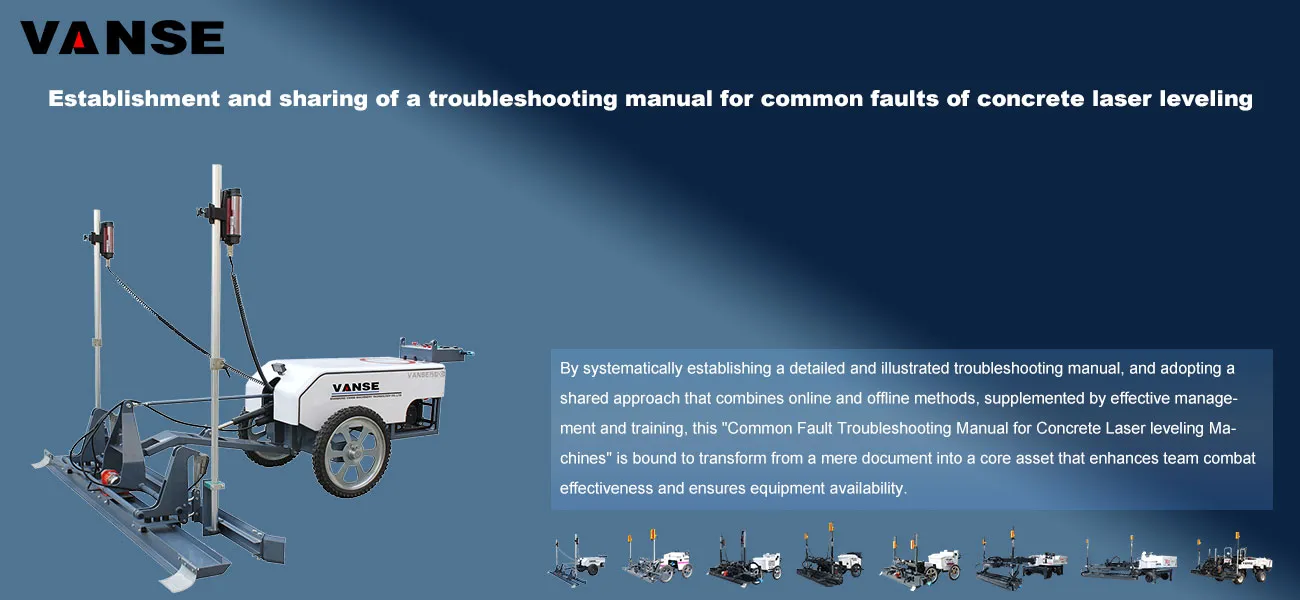
This is a detailed plan on how to establish and share the "Common Fault Troubleshooting Manual for concrete laser leveling". It not only contains the core content framework of the manual, but also provides a full-process approach for establishing, maintaining and sharing this knowledge system.
Establishment and sharing plan for the "Common Fault Troubleshooting Manual for concrete laser leveling"
Ⅰ. Preface: Why was this manual established?
Concrete laser leveling machines are core equipment in modern floor construction, and their operational status directly affects the construction efficiency and floor quality. The establishment of a standardized troubleshooting manual aims to:
Enhance efficiency: Quickly locate and resolve faults to minimize downtime.
Cost reduction: Avoid major repairs due to minor malfunctions and reduce reliance on senior technicians.
Unified standards: Provide a unified troubleshooting process and solutions for both new and experienced operators as well as mechanics to reduce operational errors.
Knowledge inheritance: Transform the experience of master craftsmen into replicable and shareable organizational assets.
Ensure safety: Standardize operations to prevent safety accidents caused by improper maintenance.
Ⅱ. Establishment of the Manual: Content Framework and Writing Process
(1) Core Content Framework of the manual
The manual should adopt a clear, concise and easy-to-query structure. The suggested list is as follows:
Cover
Equipment name and model
Manual version number, formulation/revision date
Establish departments/personnel
Part One: Safety First
General Safety Regulations: All maintenance and inspection work must be carried out after power failure and pressure relief.
Personal protective equipment (PPE) requirements: safety helmets, protective glasses, gloves, steel-toed shoes, etc.
Safety checklist before operation: such as checking the surrounding environment of the equipment, the effectiveness of the emergency stop button, etc.
Part Two: Introduction to Equipment Foundation and Working Principle
Diagram of the main components of the entire machine (chassis, scraper, vibrator, laser receiver, hydraulic system, control system, etc.).
A brief description of the working principle of the laser elevation control system.
A brief description of the principle of hydraulic transmission.
Part Three: Quick Troubleshooting Table for Common Faults (Core Part)
It is recommended to use a table format, which is clear at a glance.
| Fault phenomenon | Possible reasons | Troubleshooting steps | Solution | Risk Warning/Remarks |
| 1. The leveling accuracy is inaccurate | ||||
| The elevation remains persistently high or low | 1. The elevation setting of the laser emitter is incorrect | 1. Recheck the elevation of the laser emitter | 1. Reset the laser elevation | Before calibration, ensure that the ground is stable and the laser signal is unobstructed |
| 2. The initial height of the laser receiver was not calibrated | 2. Execute the "centering" calibration procedure for the receiver | 2. Re-calibrate the receiver | ||
| 3. Wear of the machine's reference surface | 3. Check the wear condition of the scraper base plate | 3. Replace or adjust the scraper base plate | ||
| The ground shows waves or unevenness | 1. The machine's walking speed is unstable | 1. Check the walking motor and control system | 1. Adjust to a uniform walking speed | |
| 2. Pressure fluctuations in the hydraulic system | 2. Check the hydraulic oil level, filter element and pump valve | 2. Replace the hydraulic oil or filter element and inspect the hydraulic components | ||
| 3. The ground base is soft and uneven | 3. Assess the compaction degree of the base layer | 3. Handle the grassroots level | ||
| 2. Vibration system failure | ||||
| The vibrator is not working or is weak | 1. Power supply/circuit failure of the vibrator | Check the fuses, circuits and switches | 1. Replace the fuse and repair the circuit | When repairing the circuit, be sure to cut off the power |
| 2. The vibration motor is damaged | 2. Measure the resistance of the motor | 2. Replace the vibration motor | ||
| 3. Blockage or insufficient pressure in the hydraulic oil circuit | 3. Detect the hydraulic pressure of the vibration circuit | 3. Clean the filter screen and adjust the relief valve | ||
| 3. Malfunction of the walking system | ||||
| – Walk on one side or not at all | 1. The walking track is stuck | 1. Clear the debris inside the tracks | 1. Clear out debris | Do not force the drive to avoid damaging the components |
| 2. Malfunction of the walking motor | 2. Check the working pressure of the motor | 2. Inspect or replace the motor | ||
| 3. The control solenoid valve gets stuck | 3. Tap or clean the solenoid valve | 3. Replace the solenoid valve | ||
| 4. Hydraulic system failure | ||||
| The system is noisy and the oil temperature is high | 1. The hydraulic oil level is too low or the oil quality is incorrect | 1. Check the oil level and the type of oil | 1. Add or replace standard hydraulic oil | Be careful not to get burned when checking the oil level while warming up the machine |
| 2. Air enters the hydraulic pump or it is damaged | 2. Exhaust and listen to the sound of the pump running | 2. Tighten the oil suction pipe and replace the oil pump | ||
| 3. The hydraulic oil filter element is clogged | 3. Check the filter element clogging indicator | 3. Replace the filter element | ||
| 5. Laser system failure | ||||
| The receiver signal is unstable | 1. The laser signal is blocked | 1. Check the laser path | 1. Clear the obstacles | |
| 2. The receiver sensor is dirty | 2. Clean the receiver panel | 2. Wipe with a soft cloth | ||
| 3. Environmental disturbances (strong light, vibration) | 3. Avoid interference sources | 3. Adjust the position of the equipment or add a light shield | ||
Part Four: Regular Maintenance and Upkeep Plan
Daily maintenance: Cleaning, checking the oil level, and inspecting the fasteners.
Weekly/monthly maintenance: Replace the filter element, check the wear of the tracks, and calibrate the laser system.
Quarterly/annual maintenance: Replace hydraulic oil and conduct a comprehensive inspection of key components.
Part Five: Appendix
Key component model table: such as hydraulic oil model, filter element model, fuse specification, etc.
Service contact information: Phone numbers of the equipment manufacturer, internal maintenance supervisor, and external service engineer.
Fault record sheet: It is used by operators to record the detailed situation of each fault for subsequent optimization of the manual.
(2) Manual Compilation Process
Establish a project team: Led by the equipment manager, the team members include: senior operators, maintenance technicians, and technical document clerks.
Information collection
Refer to the official "Operation and Maintenance Manual" for all the equipment.
On-site interview: In-depth interviews with experienced operators and maintenance workers, documenting the "classic malfunctions" and "folk tricks" they encountered.
Historical data analysis: Analyze previous maintenance record sheets to identify high-frequency fault points.
Content writing and visualization
The technical document clerk writes the first draft based on the collected information in accordance with the above framework.
Use a lot of pictures and ICONS! In the "Possible Causes" and "Solutions" sections, attach physical photos or simple sketches as much as possible, such as "This is the filter element that needs cleaning" or "This is the location of the calibration button".
Review and Verification
Distribute the first draft to all operators and maintenance workers for trial use and review.
Make revisions based on feedback to ensure the content is accurate and the language is easy to understand.
Finalization and release: The final version of the manual (V1.0) is formed and enters the sharing process.
Ⅲ. Sharing and Management of Manuals
(1) Sharing form
Physical manual
Make waterproof, oil-proof and durable loose-leaf manuals and place them in the cab or toolbox of each piece of equipment.
Advantages: Readily available on site and does not rely on electronic devices.
Disadvantages: Inconvenient to update, prone to damage or loss.
Digital Manual
PDF electronic version: Distributed to each employee's wechat, email or company shared disk for easy access at any time on mobile phones or computers.
Enterprise internal APP/ microsite: Transform the manual content into a simple web page or embed it into the company's OA/ERP system, supporting keyword search for the best user experience.
Qr code: Paste a QR code in a prominent position on each device. Scan the code to view the latest version of the electronic manual. This is a highly recommended way!
(2) Management and Update Mechanism
The manual is not set in stone and a dynamic update mechanism must be established.
Designated person in charge: Clearly define the maintenance person in charge of the manual (usually the equipment supervisor).
Establish feedback channels: Encourage all users to provide feedback on new faults or better solutions not covered in the manual in the "Fault Record Sheet" or through the wechat work group.
Regular review: Every six months or once a year, the project team conducts a centralized review of the manual and updates it based on feedback and technological development.
Version control: Each update requires the version number and date to be updated, and everyone should be notified through group announcements, emails, etc., to ensure that everyone is using the latest version. For physical manuals, it is necessary to collect the old versions in a timely manner and replace them with new ones.
Ⅳ. Promotion and Training
The value of a manual lies in its use.
Formal kick-off meeting: Organize a brief meeting to introduce the purpose, content and access methods of the manual to all employees.
Practical training: Use the manual as an essential textbook for new employees' onboarding training and conduct troubleshooting drills in combination with real equipment.
Case Sharing Session: Every month, during the safety meeting or morning meeting, an operator is invited to share a case of successfully resolving a fault using the manual, and a small reward is given to stimulate enthusiasm for use.
Summary
By systematically establishing a detailed and illustrated troubleshooting manual, and adopting a shared approach that combines online and offline methods, supplemented by effective management and training, this "Common Fault Troubleshooting Manual for Concrete Laser leveling Machines" is bound to transform from a mere document into a core asset that enhances team combat effectiveness and ensures equipment availability.
Note: The parameters provided in this document are for reference only and are not mandatory. Due to differences in technical characteristics between different brands and models of laser levelers, please consult the manufacturer for a suitable solution before actual operation. This reference document assumes no responsibility for any issues arising from failure to follow the manufacturer's instructions.
Thanks to All the Friends Who Support and Trust Shandong Vanse Machinery Technology Co., Ltd.
If you want to know more about Shandong Vanse Machinery Technology Co., Ltd. or have any questions, please feel free to contact us:
Our Factory
Shandong Vanse Machinery Technology Co., Ltd.








Share this article

About the Author: Shandong Vanse Machinery Technology Co., Ltd.
Shandong Vanse Machinery Technology Co., Ltd. is a high-tech manufacturer specializing in concrete construction machinery, including laser screeds and related equipment. The company integrates R&D, production, and global sales, with products exported to over 60 countries and widely used in infrastructure projects worldwide.
Previous Post
Next Post
Related Articles
You Might Also Like
Do you know the three major operating misunderstandings in concrete laser leveling machine maintenance?
The concrete laser leveler can meet the construction needs of large areas and high flatness and levelness. It plays a very important role in the construction process. After the equipment is used, I believe everyone knows the maintenance of the leveler. However, it is very likely that incorrect operations will occur during the maintenance process, which will only have the opposite effect. In this article, our staff will explain to you the three major maintenance misunderstandings of concrete laser leveling machines. 1. The bolts are too tight. The concrete laser leveling machine has many bolts and nuts. In order to make the connection reliable, it should be ensured that it has sufficient pre-tightening force. However, we should not mistakenly believe that the tighter the bolts are, the better. Blindly increasing the torque of the bolts will not only cause permanent deformation of the fasteners due to excessive external force, but also cause the threads of the screws to slip due to excessive tension. Or the screw is broken. 2. The tire pressure is too high. The tire inflation pressure of the concrete laser leveling is the main factor that determines its service life and working quality. When the air pressure is too low, the carcass deformation increases, which causes internal stress to increase, and accelerates rubber aging and cord fatigue; at the same time, rolling resistance increases, so tire shoulder wear intensifies. However, when the inflation pressure is too high, the tire cord will generate a lot of tension, weakening the resistance to impact, and the edges and corners of rocks can easily damage the tire; at the same time, the tire tread wear will increase, causing the tire to slip, which will reduce the efficiency of concrete laser leveling. machine operating efficiency. 3. When replacing the hydraulic oil, only drain the oil in the tank. The concrete laser leveler has many hydraulic components and requires sufficient hydraulic oil. Whenever the hydraulic oil deteriorates due to long use and needs to be replaced, there will always be people who mistakenly think that they only need to drain the oil in the hydraulic oil and fill it with new hydraulic oil. In fact, the correct oil change procedure should first drain the hydraulic oil in the hydraulic oil tank, then clean the oil tank and add new hydraulic oil; then remove the main circuit pipe, start the engine and run it at a low speed, which will cause the oil pump truck operator to operate manually. If Operate each mechanism separately, and only rely on hydraulic oil to drain the old oil in the circuit one by one until new oil flows out of the oil return main pipe; then connect the oil return main pipe to the oil tank, and then add new hydraulic pressure to the concrete laser leveling machine oil tank Oil to the specified position.How to ensure the safety of concrete laser leveling machine operators?
The key to ensuring the safety of concrete laser leveling machine operators is to build a full-chain protection system of "personnel qualifications + equipment control + environmental investigation + process specifications" to avoid risks such as mechanical injuries, electric shock, and overturning from the source. Operators must undergo specialized training (covering equipment principles, safety procedures, and emergency response) and obtain a Special Operations Operator Certificate (Construction Special Operations Personnel Certificate) before they can begin work. Unlicensed operation or operation of multiple equipment types is strictly prohibited. Before each operation, a specific safety briefing based on the day's construction scenario (such as the size of the work surface, ground slope, and surrounding obstacles) must be conducted. Risk points (such as electrical wires, deep pits, and intersecting personnel) and avoidance measures must be identified, and all personnel must sign and confirm. Inspection Areas Core inspection content Safety Requirements Mechanical System Travel wheel, leveling scraper, hydraulic rod No sticking, no oil leakage, no loosening of fastening bolts, and flexible scraper lift and lowering. Electrical System Power cord, plug, control switch No damaged or exposed wires, ground resistance ≤ 4Ω (to prevent electric shock), and a sensitive emergency stop button. Safety Devices Guardrail, warning light, buzzer Guardrails intact and undeformed, with warning lights/buzzers functioning properly (to alert nearby personnel). Auxiliary Equipment Laser transmitter and receiver Securely fixed and unobstructed to prevent direct laser exposure to the human body (especially eyes). After daily operations, clean concrete debris from the equipment and check the hydraulic and engine oil levels. Weekly check the braking system (for example, brake pad wear) and tire pressure (to prevent tire blowouts and rollovers during operations). Perform a comprehensive monthly inspection and replace aging components (such as worn scrapers and cracked wiring). Clear obstacles (such as rebar, water pipes, and tools) on and around the work surface to prevent the equipment from running over or scratching them. Confirm that temporary electrical wiring (such as vibrator cables) within the work area is overhead or buried. Strictly prohibit equipment from running over electrical wiring. If the work surface has a slope (≥5°), use warning tape to demarcate the danger zone in advance. Prohibit standing behind or to the side of the equipment to prevent it from sliding down the slope. If other workers, such as rebar workers and scaffolders, are working in the same area, a dedicated person should coordinate to ensure that no other personnel remain within 5 meters of the laser leveler while it is operating. If cross-operation is necessary, hard barriers (such as protective barriers) must be set up. Startup: First, inspect the equipment → Start the laser transmitter → Confirm that the receiver signal is normal → Perform a low-speed test run (1 minute); Operation: Maintain a constant speed (≤1.5m/min). Avoid sudden acceleration or sudden turns. If the scraper height needs to be adjusted, the machine must be stopped. Shutdown: First, turn off the laser transmitter → Clean the equipment → Park the machine on a flat, water-free area. Apply the handbrake and place a triangular block to prevent rolling. Operators must wear a hard hat, non-slip safety shoes, and a reflective vest. If the working environment is dusty, a dust mask must be worn. Wearing slippers or shorts while working is strictly prohibited. Using a mobile phone or being distracted while the equipment is operating is strictly prohibited. Clearly define emergency response procedures for accidents such as equipment tipping over, electric shock, and mechanical injuries. For example, in the event of electric shock, first disconnect the power supply (rather than directly pulling the person out); in the event of mechanical injuries, shut down the machine before providing first aid. The work site should be equipped with a first aid kit (including bandages and disinfectant), a fire extinguisher, and insulating gloves. Conduct emergency drills quarterly to ensure operators are familiar with emergency procedures. The essence of safety management for concrete laser screeds is "prevention first." By "training qualified personnel, using intact equipment, maintaining a safe environment, and implementing standardized procedures," risks are controlled before operations begin, rather than relying on post-processing measures. Only by ensuring that every step is implemented can safety accidents be truly avoided. ARMOUR JOINT view more CONCRETE LASER LEVELING MACHINE view more POWER TROWEL view more SLIPFORM MACHINE view more STEEL FIBER view more TOPPING SPREADER view moreHow to Achieve ±1mm/3m Flatness Control with Concrete Laser Leveling Machine?
Achieving a flatness of ±1mm over 3 meters is the "holy grail" of industrial flooring-often referred to as Superflat status. To hit these numbers (typically FF 50+ or FM1 standards), you need more than just a machine; you need a synchronized dance between technology, material, and technique. If you're a contractor aiming for that level of precision, here is a professional breakdown of how to master it using a Concrete Laser Leveling Machine, with some insider tips on the Vanse technology that makes it possible. You can't hit ±1mm if your reference point is off by 2mm. Global buyers know that the laser system is the most critical component. The Pro Tip: Use a high-quality transmitter (like Leica or Trimble) and set it up on a stable, vibration-free tripod. The Vanse Edge: Most Vanse laser leveling machines, such as the WS940C or the telescopic YZ40-4E, are designed to integrate seamlessly with world-class laser systems. The machine's receivers pick up the signal at a frequency of 10 times per second, making real-time micro-adjustments to the hydraulic leveling head before the concrete even has a chance to settle. You can have the best laser leveling in the world, but if your concrete slump varies from truck to truck, your floor will be a "rollercoaster." The Pro Tip: Keep your slump consistent (ideally 120mm–160mm depending on the mix). If the concrete is too wet, it will sink after the machine passes; too dry, and the vibrator won't consolidate it properly. The Vanse Edge: Vanse machinery is built with high-frequency vibrators (up to 4000rpm). This ensures that even with a slightly lower slump (which is better for long-term durability), the machine can still liquefy the surface just enough to get that perfect, glassy finish in a single pass. In the old days, you'd leveling, then check, then leveling again. Every time you touch the concrete, you risk making it worse. The Pro Tip: Look for an integrated leveling head that performs leveling, leveling, and vibrating simultaneously. The Vanse Edge: If you look at the Vanse YZ series, the leveling head is a masterpiece of engineering. It's a 3-in-1 system. As the machine moves, the auger removes excess concrete, the vibrator consolidates the slab, and the scraper plate leaves a level surface-all controlled by the laser system. This "one-pass" efficiency is exactly how you maintain that ±1mm tolerance over 3 meters without over-working the material. Even with full automation, the operator's path matters. The Pro Tip: Maintain a consistent travel speed and ensure a 20cm–30cm overlap between passes. This "blends" the cold joints and prevents "ridges" between lanes. The Vanse Edge: For large-scale projects, the Vanse Telescopic Boomed Laser leveling (like the YZ30-4E) is a game-changer. The 6-meter boom means the machine stays stationary while the head does the work. This eliminates tire tracks and weight-shifting issues, which are the #1 enemies of superflat floor precision. Hitting ±1mm/3m isn't magic-it's physics. By combining the automated precision of a Vanse Concrete Laser Leveling Machine with consistent material and a smart operator, you don't just meet the specs; you set the standard for the industry. For more technical specs and to see these machines in action, visit the experts at Vanse Machinery ( www.vansemac.com ). Note: The parameters provided in this document are for reference only and are not mandatory. Due to differences in technical characteristics between different brands and models of laser levelers, please consult the manufacturer for a suitable solution before actual operation. This reference document assumes no responsibility for any issues arising from failure to follow the manufacturer's instructions.