Technical Knowledge
Diagnosis and solutions for a normal power trowel machine engine but unable to drive the power trowel disc (such as belt, clutch, etc.)
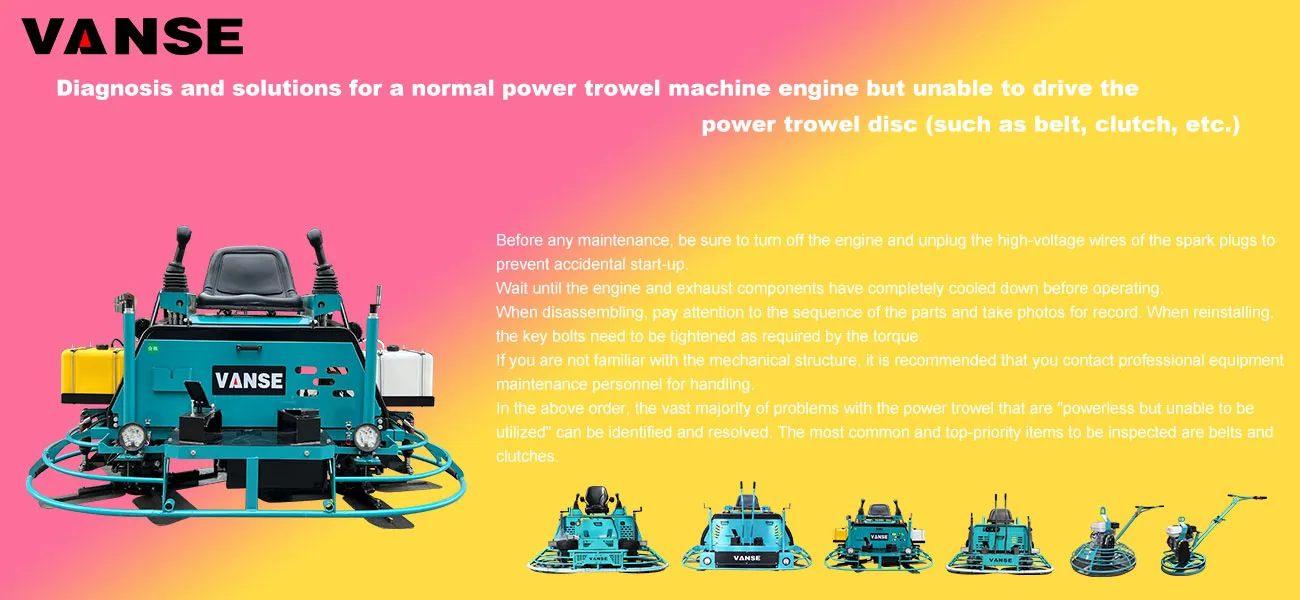
This is a common malfunction of the power trowel machine (also known as the gloss collector or polishing machine). The engine is normal (it can start and the speed sounds normal), but the brake is weak, does not rotate or rotates slowly. The problem must lie in the power transmission system. The following are systematic diagnostic steps and solutions, arranged in order from simple to complex and from outside to inside.
Core diagnostic flowchart
Engine normal → The disc does not move/lacks power → Check the power transmission path
External/Simple inspection → Drive belt system → Clutch system → Gearbox/main shaft
Ⅰ. Quick Self-examination and elimination of External Factors
Before disassembling the machine, rule out the following possibilities first
Excessive load on the power trowel plate: The concrete has passed its optimal finishing time (final setting), and its strength is too high, causing the power trowel plate to be "stuck". Try lifting the machine or testing it on a less hard ground.
The issue with the Angle of the power trowel blade: The installation Angle of the blade is too "flat" (the Angle with the ground is too small), resulting in huge resistance. Adjust the blade to an appropriate Angle (usually 5 to 15 degrees to the ground).
Foreign object jamming: Check whether the area beneath the power trowel plate and around the main shaft are jammed by hard objects such as cement blocks or steel bar heads.
Ⅱ. Key Diagnosis and Resolution: Three Major Systems
System One: Drive Belt (the most common cause)
The polishing machine usually uses a belt to transfer the engine power to the clutch or gearbox.
Symptoms
The engine makes a loud noise when idling, and when wiping the disc, it rotates intermittently or doesn't move at all.
When the machine is working, a burnt smell can be detected (due to the belt slipping and rubbing).
The speed of the power trowel disc is significantly lower than that of the engine, and it is weak.
Diagnostic steps
Shutdown inspection: Turn off the engine and check if the belt is broken, fallen off or severely worn (with cracks on the side and a shiny back).
Tightness check: Press the middle of the belt forcefully with your fingers. The normal deflection should be around 10-15mm. If it is too loose, it will slip; if it is too tight, it will accelerate wear and cause damage to the bearing.
For moderate inspection: Check whether the engine pulley and the driven pulley are on the same plane. Misalignment can cause abnormal wear and detachment of the belt.
Solution
Replace the belt: Be sure to use the original factory or the specified model belt.
Adjust the tightness: Loosen the fixing bolts of the engine base, move the engine position to adjust the tension of the belt, and then retighten the bolts.
Calibration and alignment: Inspect and adjust the installation base of the engine or driven wheel.
System Two: Centrifugal Clutch (Core Fault Point)
Centrifugal clutches are commonly used in power trowels. When the engine reaches a certain speed, the clutch block is thrown out under the action of centrifugal force and combines with the clutch cover to transmit power.
Symptoms
When the engine is running at low speed, the disc does not rotate. At high speed, it may engage but weakly, or it may not engage at all.
When the engine speed changes, there is a "clattering" sound or a metallic friction sound inside, but the power cannot be transmitted out.
Diagnostic steps
Visual inspection (disassembly required) : Remove the clutch protection cover or the wiping plate.
Check the clutch friction block
Wear: Whether the friction plate has worn to its limit (exposed metal or extremely thin thickness).
Oil stains: Whether contaminated by lubricating oil or grease (causing slippage).
Detachment: Whether the friction plate has fallen off from the horseshoe.
Check the clutch spring
Whether the spring is broken, fallen off or fatigued and deformed. Insufficient spring force can cause the clutch block to fail to be flung out or retracted at the correct speed.
Check the inner wall of the clutch cover (drum)
Whether the inner wall is smooth or has deep grooves. Oil stains and grooves can both cause slipping.
Solution
Cleaning: Thoroughly clean all oil stains with carburetor cleaner.
Replacement: Replace the worn clutch friction blocks and broken/deformed springs in a complete set. It is recommended that the friction blocks be replaced in pairs.
Repair/Replacement: If there are deep grooves on the inner wall of the clutch drum, the assembly needs to be repaired or replaced with a lathe.
System Three: Gearbox and Spindle
If both the belt and the clutch are functioning properly, the problem may extend to the final stage.
Symptoms
The engine and clutch work normally, but the main shaft doesn't rotate at all.
When the machine is running, there is an abnormal noise (creaking, clicking) from the gearbox.
The main shaft can be shaken by hand and there is a distinct gap.
Diagnostic steps
Check the gear oil: Whether the gearbox is short of oil or has metal debris (the oil is grayish-white). Lack of oil can cause gears and bearings to burn out.
Check the gears: Open the gearbox to inspect whether the planetary gears or spur gears have broken teeth or severe wear.
Check the bearings: Inspect whether the upper and lower bearings of the main shaft are cracked or stuck. Rotate the main shaft by hand to feel if there is any jamming or abnormal noise.
Check the splines/keyways: Whether the splines of the main shaft connected to the trotter or the keyways of the clutch output are worn flat, which may prevent power transmission.
Solution
Change gear oil: Add gear oil of the specified type and volume.
Replace damaged parts: Replace damaged gears, bearings or splined shafts. This usually requires professional maintenance personnel to carry out.
Summary and troubleshooting sequence table
| Serial number | Inspection site | Possible reasons | Solution | Priority |
| 1 | External and Load | The ground is too hard, the blade Angle is poor, and foreign objects are stuck | Adjust the Angle and clear the foreign objects | High |
| 2 | Drive belt | Fracture, loosening, wear, misalignment | Replace, adjust the tension and correct the alignment | High |
| 3 | Centrifugal clutch | Friction block wear/oil stains, spring breakage | Clean and replace the friction blocks and springs | High |
| 4 | Gearbox | Lack of oil, gear damage, bearing damage | Refuel and replace gears/bearings | In the |
| 5 | Main shaft/spline | The splines are ground flat and the main shaft is bent | Replace the main shaft | Low |
Safety Operation Tips
Before any maintenance, be sure to turn off the engine and unplug the high-voltage wires of the spark plugs to prevent accidental start-up.
Wait until the engine and exhaust components have completely cooled down before operating.
When disassembling, pay attention to the sequence of the parts and take photos for record. When reinstalling, the key bolts need to be tightened as required by the torque.
If you are not familiar with the mechanical structure, it is recommended that you contact professional equipment maintenance personnel for handling.
In the above order, the vast majority of problems with the power trowel that are "powerless but unable to be utilized" can be identified and resolved. The most common and top-priority items to be inspected are belts and clutches.
Note: The parameters provided in this document are for reference only and are not mandatory. Due to differences in technical characteristics between different brands and models of laser levelers, please consult the manufacturer for a suitable solution before actual operation. This reference document assumes no responsibility for any issues arising from failure to follow the manufacturer's instructions.
Thanks to All the Friends Who Support and Trust Shandong Vanse Machinery Technology Co., Ltd.
If you want to know more about Shandong Vanse Machinery Technology Co., Ltd. or have any questions, please feel free to contact us:
Our Factory
Shandong Vanse Machinery Technology Co., Ltd.








Share this article

About the Author: Shandong Vanse Machinery Technology Co., Ltd.
Shandong Vanse Machinery Technology Co., Ltd. is a high-tech manufacturer specializing in concrete construction machinery, including laser screeds and related equipment. The company integrates R&D, production, and global sales, with products exported to over 60 countries and widely used in infrastructure projects worldwide.
Previous Post
Next Post
Related Articles
You Might Also Like
In the actual case analysis of the concrete laser leveling machine construction, how did the supplier deal with the acceptance problem?
In actual concrete laser leveling installation cases, suppliers typically take the following measures to address acceptance issues: Proactive Response and Communication: Upon receiving feedback from the acceptance party regarding issues with the concrete laser leveling, the supplier should respond immediately and conduct an internal investigation as soon as possible to understand the cause of the problem. At the same time, the supplier should maintain close communication with the acceptance party, remaining calm and objective, avoiding emotional outbursts, to ensure both parties can discuss the issue rationally, jointly analyze the cause, and negotiate a solution. Develop and Implement Corrective Action Plans: Based on the nature of the issue, the supplier should develop a detailed corrective action plan, including corrective measures, a timeline, and responsible individuals. The corrective action plan should be feasible and ensure completion within the specified timeframe. For example, if the laser leveling fails to meet flatness standards, the supplier may need to adjust the laser system parameters or calibrate the mechanical structure of the equipment. Upon completion, the supplier should promptly provide feedback to the acceptance party on the corrective actions and provide relevant documentation, such as test reports and commissioning records, for re-inspection. Provide Technical Support and Services: During the acceptance process, the supplier should arrange for professional technicians to be on-site to assist the acceptance party in testing and acceptance work. If the equipment requires performance testing, the supplier's technical staff should assist the acceptance party in developing a test plan and provide necessary technical guidance and support. During the installation and commissioning phases, the supplier's technical staff should also provide technical briefings to the construction personnel, explaining the equipment's operation and maintenance procedures to ensure proper operation. Strictly Control Product Quality: The supplier should strictly control quality during the equipment production process, sampling and testing raw materials and conducting quality inspections to ensure compliance with relevant standards and requirements. Furthermore, the supplier should conduct quality monitoring on the finished concrete laser levelings, including testing and evaluating various performance indicators such as flatness, slope control accuracy, and equipment stability, to ensure that product quality meets acceptance standards. Improve Contract Management and Risk Management: During the contract signing phase, the supplier should clarify with the acceptance party key details such as acceptance standards, acceptance methods, objection deadlines, and warranty period. Any issues discovered during the acceptance process should be handled in accordance with the contractual agreement, such as responsibility for rectification costs and compensation for losses. If the parties disagree on the nature of the issue or the solution, they may consider engaging a third-party for appraisal or evaluation, or seeking legal resolution. Click the below to jump immediately!!! Shandong Vanse Machinery Technology Co.,Ltd ARMOUR JOINT view more CONCRETE LASER LEVELING MACHINE view more POWER TROWEL view more SLIPFORM MACHINE view more STEEL FIBER view more TOPPING SPREADER view moreHow can we address common safety hazards during concrete construction?
During concrete construction, common safety hazards (such as formwork support instability, mechanical failure, electric shock, and falls from height) must be addressed according to the principle of "stopping the danger first, then investigating, then rectifying, and finally verifying" to prevent them from escalating into accidents. The following describes six common hazards, including specific identification methods, emergency response measures, and long-term rectification plans, to ensure closed-loop risk management: During construction, pay close attention to the following abnormal signs to determine whether the support is unstable: Structural deformation: noticeable sagging or bulging of the formwork, or tilting or bending of the support posts; Fastener/joint abnormalities: unusual "creaking" sounds from fasteners, or loosening or disconnection of the crossbar and posts; Ground settlement: uneven subsidence at the base of the support posts (especially on soft soil) and shifting of the pads. Stop the danger immediately: Immediately stop concrete pouring operations and notify all workers (especially those under and around the formwork) via intercom/loudspeaker to evacuate to a safe area. No one is allowed to remain or approach the unstable area. Isolation and Warning: Use warning tape and signs to enclose the unstable area. Deploy dedicated personnel to prevent entry and prevent secondary collapse and injury. Temporary reinforcement (for professionals only): If the degree of instability is minor (such as partial tilting of a pole), a certified scaffolder, while ensuring their own safety, should use spare steel pipes and fasteners to temporarily support the unstable area (e.g., by adding diagonal supports or increasing the number of poles). Non-professionals are prohibited from performing this operation. Cause Identification: Determine the root cause of instability by reviewing the plan and conducting on-site inspections (e.g., excessive pole spacing, substandard fasteners, uncompacted foundation, or irregular pouring sequence). Targeted Corrective Actions: If the foundation is a problem: Replace the soft foundation with gravel/lime soil and re-install wooden (or steel) pads ≥ 20cm thick to ensure uniform load distribution at the base of the poles. If the support setup is a problem: Remove the substandard support section and re-erect according to the specific plan (with vertical deviation of the poles ≤ 1/200, and crossbar pitch and sweeping bar placement meeting requirements). After erection, conduct a joint inspection by the technical and safety departments. If the pouring sequence is a problem: Re-define the pouring process (e.g., layered pouring, symmetrical pouring), re-examine the team before pouring, and have a safety officer supervise the entire process. Fault Type Identification signals Potential Risks Pump truck/tower crane brake failure Hook slipping during lifting, pump truck boom unable to secure Machine overturning, impact from objects Vibrator leakage Operators experiencing numbness when touching, leakage protector frequently tripping Electric shock Mixer jam Motor making unusual noises, mixer drum stalling, feed inlet blocked Motor burnout, personal injury from misoperation Brake Failure (Pump Truck/Tower Crane): Immediately stop operations. If a heavy object is hanging from the hook, temporarily secure the object with a spare wire rope (e.g., tie it to a solid structure). Do not forcefully lift or lower the object. Evacuate all personnel within the operating radius and contact professional maintenance personnel. Operators are strictly prohibited from disassembling the brake system on their own. If the vibrator is leaking electricity: Immediately unplug the power cord (or turn off the main switch at the distribution box). Never operate the switch with wet hands. Check the cable for damage (such as scratches from rebar or soaking in water). If damaged, replace the entire cable. Do not wrap it with insulating tape for temporary use. If the mixer is stuck: Disconnect the power and lock the mixer (hang a "Do Not Close" warning sign) to prevent accidental restart. Use a dedicated tool (such as a long pole) to clear any obstructions in the feed inlet. Do not insert your hands or body into the mixer drum. After clearing, test-run the mixer for 3 minutes to confirm that there are no abnormalities before resuming operation. Equipment Maintenance: Establish a "one machine, one file" system and regularly (e.g., monthly) inspect the mechanical brake system, cables, and motor insulation, maintaining records. Personnel Training: Conduct emergency drills for mechanical failures (e.g., handling electrical leakage and clearing stuck materials) for operators to ensure everyone understands the "power off first, then handle" procedure. Spare Parts Reserve: Maintain a stockpile of commonly used spare parts (e.g., vibrator cables, fasteners, and wire ropes) on-site to avoid prolonged downtime due to parts shortages after a failure. Inadequate edge protection: 1.2m high guardrails are not installed around the foundation pit or floor edges, or the guardrails lack toeboards or safety nets. Work platform violations: Scaffolding planks are not fully laid (probe boards are present), or the platform's load capacity is insufficient (excessive concrete is piled). Inadequate personal protective equipment: Operators are not wearing safety belts, or safety belts are hung too low (the attachment point is below the work surface). If protective measures are missing: Immediately cease work at height. Use steel pipes and a fine-mesh safety net to construct temporary guardrails. Secure the footboards with sheet metal or wooden boards (height ≥ 18 cm). Work may resume only after inspection and approval. If the platform is not in compliance with regulations: Immediately clear any excess material from the platform, remove the probe boards (the length of the scaffolding boards extending beyond the crossbars should be ≤ 15 cm), and verify the platform's load-bearing capacity (e.g., by reinforcing with steel pipe fasteners). If personal protective equipment is inadequate: Immediately stop the violator and require them to properly fasten their safety belt (with two hooks attached to different secure points). Prohibit them from working until the situation is corrected. Daily Inspections: Safety officers inspect edge protection and work platforms before each day's workday, focusing on loose scaffolding and damaged safety nets. Mandatory Protection: Permanent protection (such as pre-embedded iron and welded railings) is implemented for fixed edges (such as floor edges) to avoid repeated installation. Penalty Mechanism: Personnel who repeatedly violate the rules by not wearing safety belts will be suspended for training (at least four hours) and may only return to work after passing the training. Illegal temporary power use: Cables laid directly on the ground (caused by tankers), soaked in concrete curing water, or distribution boxes not rainproofed or without leakage protectors; Incomplete equipment grounding: Vibrators and pump trucks not re-grounded (ground resistance > 10Ω), or grounding electrodes removed; Improper operation: Touching switches with wet hands, using power tools in the rain. If an electric shock accident occurs: Immediately disconnect the power supply (unplug the power cord first; if you cannot reach the power cord, use a dry wooden stick or bamboo pole to pry the power cord apart). Do not drag the victim by hand. Check the victim's consciousness: If unconscious and not breathing, immediately perform CPR (chest compressions and artificial respiration). Simultaneously call 120. Cover yourself with warm clothing while waiting for emergency assistance. If any electrical violations are discovered: Immediately stop using the relevant equipment and install the power cables overhead (secured with insulators, height ≥ 2.5m) or bury them underground in PVC pipes (depth ≥ 0.7m). Inspect the distribution box: Ensure that each circuit is equipped with a residual current device (RCD) (rated operating current ≤ 30mA, operating time ≤ 0.1s). Perform a test trip (press the "test button" to confirm that it trips). Electricity Regulations: Develop a "Special Plan for Temporary Electricity Use in Concrete Work Areas" to clearly define cable laying, grounding, and zeroing requirements. Certified electricians will be responsible for wiring and maintenance. Lightning and Rain Protection: Install a rain shelter on the distribution box. Cover power tools with plastic sheeting during rainy weather to prevent water from entering the motors. First Aid Training: All employees will receive training in first aid for electric shock (including cardiopulmonary resuscitation). First aid kits (including defibrillators for large projects) will be provided on-site. Unprotected Cross-Work: When pouring concrete on the upper level, someone is working on the lower level without a hard barrier (such as scaffolding or safety nets); Irregular Material Stacking: Rebar and steel pipes are stacked against edges (which can easily fall), or the concrete hopper is not secured (which can tip over if impacted); Improper Tool Use: Operators throw tools such as vibrators and shovels, or tools are not stored in tool bags. If cross-working without protective equipment: Immediately stop work on the upper and lower levels. Lay safety nets above the lower working surface (one every two layers), or install a hard barrier layer (such as full-coverage scaffolding). Once protective equipment is in place, resume work in separate layers. If materials/tools are misplaced: Immediately clear any materials stacked near the edge, secure the hopper to the scaffolding with wire rope, confiscate any tools thrown by the operator, and issue a verbal warning. Work Coordination: Rationally arrange the construction sequence and minimize vertical overlap. If overlap is necessary, assign a "safety supervisor" to monitor the work progress on the upper level in real time. Material Management: Designate a fixed mater ial storage area (away from edges) and display warning signs. Small tools must be placed in tool bags and are strictly prohibited from being thrown. Protective Facilities: In areas prone to falling objects (such as under the pouring platform), permanently install a safety shelter (made of steel pipes, topped with scaffolding and tarpaulin). All safety hazard handling must strictly adhere to the "Four No-Tolerance" principle to ensure complete elimination of risks: No Tolerance for Causes Unidentified: It is strictly prohibited to only rectify superficial issues (e.g., reinforcing a tilted support without investigating the cause of foundation settlement); No Tolerance for Responsible Personnel Untreated: Personnel who violate safety regulations or fail to fulfill their safety responsibilities (e.g., safety officers failing to conduct inspections or team leaders failing to provide briefings) will be penalized according to project regulations (e.g., fines, suspension of work for training); No Tolerance for Failed Corrective Measures: Rectifications must be jointly inspected and signed off by the technical and safety departments before work can resume. Verbal corrections are prohibited; No Tolerance for Relevant Personnel Untrained: Training should be organized for similar personnel in response to hazard cases to prevent recurrence (e.g., re-instruction for all scaffolding workers after formwork instability). In summary, the core of handling hidden dangers in concrete engineering projects is "rapid response, root cause control, and full staff coordination". It is necessary to curb the expansion of risks through emergency disposal, and to establish safety barriers through long-term measures, shifting from "passive treatment" to "active prevention". Note: The parameters provided in this document are for reference only and are not mandatory. Due to differences in technical characteristics between different brands and models of laser levelers, please consult the manufacturer for a suitable solution before actual operation. This reference document assumes no responsibility for any issues arising from failure to follow the manufacturer's instructions.What’s the process for setting the technical specifications and performance requirements for a concrete laser leveling machine?
To determine the technical specifications and performance requirements of the concrete laser leveling machine, it is necessary to combine:Construction scenario requirements, concrete properties, and engineering quality standards. The three core dimensions are gradually deduced through the logic of "clarifying application boundaries → breaking down technical parameters → verifying performance compatibility," ultimately forming a feasible selection or customization standard. The following are the specific breaking steps and key considerations: The starting point for technical specifications is "what scenario the problem is being solved." Different application scenarios have vastly different core requirements for devices, so the following four key boundaries must be clearly defined: Application boundary dimension Key decision points Example of impact on technical specifications Construction area and site form – Small area (such as indoor garages and workshops, ≤1000㎡) vs. large area (such as factories and airport runways, ≥5000㎡) Large areas require high endurance and wide operating width; small areas/special-shaped sites require flexible equipment (narrow body and small turning radius) Is the site regular (rectangular/irregular) and are there any obstacles (pillars, pipelines)? Concrete type and thickness – Ordinary commercial concrete (C20-C40) vs. special concrete (permeable, fiber, large aggregate concrete) Special concrete requires strong power for mixing/paving; thick pouring requires high vibration frequency (to prevent hollowing) and large counterweight (for compaction) – Casting thickness (thin type ≤ 100mm, regular type 100-300mm, thick type ≥ 300mm) Engineering quality standards – Flatness requirements (e.g. industrial flooring ≤2mm/2m, ordinary residential flooring ≤5mm/2m, refer to GB 50209) High-precision requirements require upgrading the laser system (such as dual laser heads, closed-loop control) and adding ultrasonic detection modules – Slope accuracy (e.g. drainage slope 0.5%, slope accuracy ±0.1%) Construction environment conditions – Indoor (floor height, ventilation) vs outdoor (wind speed, temperature) A wind-resistant laser receiver is required for outdoor use (stable when wind speed is ≥5m/s); a foldable operating arm is required for indoor low-lying spaces (floor height ≤2.5m) – Ground foundation (whether there is a risk of settlement, flatness of the base layer) Further refine the device according to the application boundaryMechanical performance, laser system, power system, control systemThe technical parameters of the four modules must correspond to clear "standards" or "test methods": Technical Parameters Definitions and Key Indicators Selection/customization basis Working width Concrete width covered by a single leveling operation (commonly 2.5m, 3.5m, 4.5m) For large areas, choose a wide width (e.g. 4.5m width, 40% efficiency improvement); for small spaces, choose a narrow width of ≤2.5m (flexible obstacle avoidance) Leveling thickness range The equipment can effectively handle the concrete pouring thickness (conventional 100-300mm, customized up to 50-500mm) For thin floors (such as indoor cushions), choose 50-150mm; for thick structures (such as equipment foundations), choose 200-500mm Vibration frequency and amplitude The vibration frequency (commonly 50-100Hz) and amplitude (0.3-0.8mm) of the vibrator determine the density of the concrete. Ordinary concrete should be 60-80Hz; large aggregate/fiber concrete should be ≥80Hz (to prevent aggregate accumulation) Travel speed and turning method Operating speed (0-6m/min), idling speed (0-12m/min), whether the steering is "crab steering" (all-wheel steering) Large areas require high operating speed (5-6m/min); special-shaped sites must use crab steering (minimum turning radius ≤1.5m) Body size and weight Length × width × height (e.g. 3500 × 2500 × 2800 mm), machine weight (3-8 tonnes) Indoor operations require controlled height (≤2.5m) and weight (≤5t to avoid damaging the base layer); weight restrictions can be relaxed for outdoor operations. The laser system is the "eye" of the leveling machine. Its accuracy directly determines the quality of the project. The following parameters need to be paid special attention to: The core indicator is "laser plane error", which is generally required to be ≤±0.1mm/m, and ≤±0.05mm/m for high-precision scenarios (such as industrial floors); it must support "single plane" and "dual slope" (such as drainage slope) modes, with a slope adjustment range of 0-5%. Receiving distance (indoors ≥50m, outdoor ≥30m, anti-interference), response speed ≤0.1s; for outdoor operation, select "anti-strong light receiver" (can work stably under direct sunlight to avoid signal loss). Give priority to the "closed-loop automatic control system" (real-time detection of flatness deviation, automatic adjustment of vibrating arm height, deviation compensation speed ≤ 0.5s), and avoid the open-loop system (frequent manual correction is required and the accuracy is low). For high-precision scenarios, it is recommended to add "ultrasonic thickness detection" (real-time monitoring of concrete thickness, error ≤ 2mm) and "real-time flatness display" (the onboard screen synchronously displays 2m ruler data). Select the appropriate power type based on the power supply/fuel supply conditions at the construction site. The core parameters are as follows: Power type Key Parameters (Example) Applicable Scenarios Electric (lithium battery) Battery capacity (e.g. 60V/100Ah, 4-6 hours of battery life), charging time (2-3 hours for fast charging) Indoor operations (no exhaust, noise ≤ 70dB), small-area construction (battery life sufficient for a single day's workload) Diesel engine Power (e.g., 25-40kW), fuel consumption (4-6L/h), emission standards (National III/National IV) Outdoor large-area construction (no charging restrictions), high-load scenarios (such as thick concrete vibration) Hybrid Hybrid-electric switching endurance (8-10 hours), fuel consumption in energy-saving mode (≤3L/h) Cross-scenario construction (electric power indoors, diesel power outdoors), long-term projects (reducing downtime and recharging time) Support "onboard control console + wireless remote control" dual mode (the effective distance of the remote control is ≥10m, which is convenient for observing corner construction); the control interface must be displayed in Chinese and the buttons must be simple (to avoid complex operations and reduce training costs). It must include "laser loss protection" (when the laser signal is interrupted, the equipment automatically shuts down to avoid out-of-tolerance), "overload protection" (frequency is reduced when the vibration load is too large to prevent motor burning), and "emergency stop button" (dual emergency stop onboard + remote control). For large-scale construction, it is recommended to choose "GPS positioning + work track recording" (to facilitate tracing the construction area and avoid omissions); LED work lights (illuminance ≥ 500lux) are required for night construction. After the technical specifications are determined, "performance testing" is required to verify whether they meet actual construction requirements. The core verification items include: Flatness test: According to GB 50209 standard, use a 2m ruler to randomly select 10 points on the concrete surface after construction and measure the maximum deviation value (must be ≤ the preset standard, such as industrial floor ≤ 2mm); Slope accuracy test: When constructing on a site with a preset slope (e.g. 0.5%), use a slope meter to measure the actual slope deviation (needs to be ≤±0.1%). Actual operating efficiency: Under standard working conditions (such as 300mm thick C30 concrete), record the leveling area per hour (must be ≥ the theoretical calculated value, such as 4.5m width × 5m/min speed = 1350㎡/h); Battery life and energy efficiency: Electric equipment is tested for continuous operation time at full charge (needs ≥4h, sufficient for half-day construction); diesel equipment is tested for full fuel endurance (needs ≥8h, sufficient for full-day construction). Site adaptability: Test turning and obstacle avoidance capabilities in a field with obstacles (such as pillars spaced 3 meters apart) (no collisions are required, and the edges and corners must be flat and without blind spots); Concrete adaptability: Use target concrete (such as fiber concrete) to test the vibration effect (there must be no aggregate accumulation and no honeycombed surface). Mandatory standards: It must comply with the industry standard "Concrete Laser Screed Machine" (JG/T 415-2013), focusing on mandatory requirements such as "flatness error", "noise limit", and "safety protection"; Case Benchmarking: Refer to the equipment selection of similar projects (for example, "4.5m width + dual laser heads" equipment is commonly used for airport runways, and "2.5m width + electric power" equipment is commonly used for indoor garages); Manufacturer's Commitment: Manufacturers are required to provide a "parameter measurement report" (issued by a third-party testing agency) and clearly state in the contract the "rectification responsibility when the accuracy does not meet the standards" (such as free rework and compensation for losses). Derived from "demand" to "parameters"Instead of blindly pursuing "high parameters", we focus on "construction scenarios and quality standards" and select parameters that have a direct impact on the actual results (such as laser accuracy and vibration frequency); Combining "hard parameters" with "soft performance": In addition to mechanical/laser parameters, attention should also be paid to ease of operation, safety protection, and after-sales service (such as spare parts supply and repair response time); Verify "parameters" through "actual measurement": Avoid just looking at the manufacturer's promotional page. You must conduct on-site testing or refer to third-party reports to ensure that the parameters are real and feasible. Through the above steps, the technical specifications and performance requirements of the concrete laser leveling machine that "precisely match needs, taking into account efficiency and quality" can be formed, avoiding project quality problems or cost waste caused by selection deviations. Click the below to jump immediately!!!