Technical Knowledge
How much money does a laser leveling truly save compared to traditional methods?
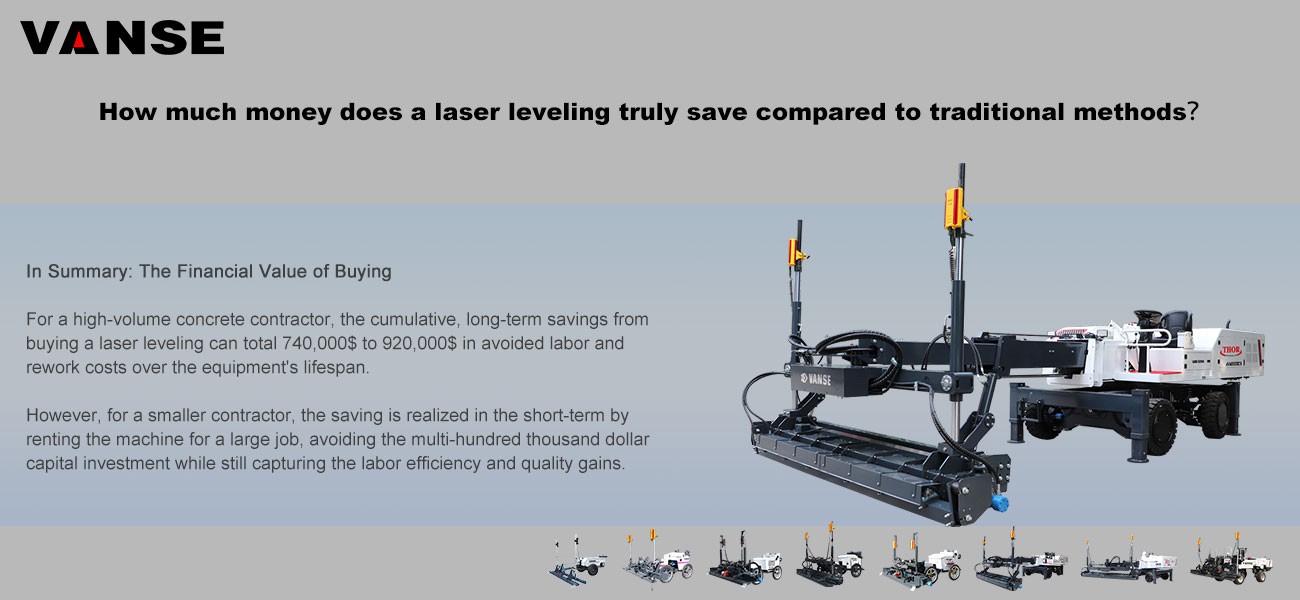
The financial savings from using a laser leveling are substantial, but they are realized primarily through reduced labor, increased speed, and minimized rework, rather than just equipment cost.
Here is a summary of the true cost savings and efficiency gains compared to traditional levelinging methods:
1. Labor Cost Reduction (The Biggest Saving)
A laser leveling dramatically reduces the size and skill level required of a crew, leading to significant savings on payroll and associated costs.
Labor Reduction: Up to 60% fewer workers needed for the levelinging and leveling process.
Example: A large commercial pour might require 20+ people using traditional methods, but only 3–4 people with a ride-on laser leveling.
Skill Dependency: The machine automates the critical leveling function, reducing reliance on expensive, highly specialized skilled laborers (who would otherwise be needed to set string lines and pour guides).
Operational Flexibility: Laser leveling allow for staggered start times, helping contractors avoid overtime and reducing worker fatigue, leading to a healthier, more productive, and less error-prone crew.
2. Time and Productivity Savings
The speed of placement is where high-volume contractors generate major savings and gain a competitive edge.
Increased Speed: Laser leveling can work 4 to 5 times faster than manual levelinging.
Output: A typical ride-on unit can place and level 6,000–10,000 square feet (550–930 m^2) per hour, or potentially 2,500–3,500 m^2 in a single day.
Shorter Construction Period: Contractors report completing slab installations 30%–40% faster, which reduces overall project timelines, minimizes formwork rental costs, and allows follow-up trades (e.g., floor finishing, racking installation) to start sooner.
3. Reduced Rework and Long-Term Operational Savings
By delivering high FF/FL numbers, the machine eliminates costly grinding and maintenance down the line.
Minimized Rework: The laser's high precision 1mm accuracy) virtually eliminates the need for expensive post-pour corrections like bump grinding or filling low spots. This dramatically reduces the risk of the slab failing ACI standards.
Material Uniformity: The consistent vibration and leveling action leads to a denser, more uniform slab, improving the floor's strength and compactness by an estimated 25%.
Equipment Maintenance: In high-tolerance environments (like VNA warehouses), a flatter floor reduces wear and tear on material handling equipment (like forklifts) by reducing bouncing and vibrations. One study suggested eliminating joint mismatches could save over $12 per square foot annually in material handling vehicle maintenance over the long term.
In Summary: The Financial Value of Buying
For a high-volume concrete contractor, the cumulative, long-term savings from buying a laser leveling can total 740,000$ to 920,000$ in avoided labor and rework costs over the equipment's lifespan.
However, for a smaller contractor, the saving is realized in the short-term by renting the machine for a large job, avoiding the multi-hundred thousand dollar capital investment while still capturing the labor efficiency and quality gains.
Note: The parameters provided in this document are for reference only and are not mandatory. Due to differences in technical characteristics between different brands and models of laser levelers, please consult the manufacturer for a suitable solution before actual operation. This reference document assumes no responsibility for any issues arising from failure to follow the manufacturer's instructions.
Thanks to All the Friends Who Support and Trust Shandong Vanse Machinery Technology Co., Ltd.
If you want to know more about Shandong Vanse Machinery Technology Co., Ltd. or have any questions, please feel free to contact us:
Our Factory
Shandong Vanse Machinery Technology Co., Ltd.








Share this article

About the Author: Shandong Vanse Machinery Technology Co., Ltd.
Shandong Vanse Machinery Technology Co., Ltd. is a high-tech manufacturer specializing in concrete construction machinery, including laser screeds and related equipment. The company integrates R&D, production, and global sales, with products exported to over 60 countries and widely used in infrastructure projects worldwide.
Previous Post
Next Post
Related Articles
You Might Also Like
How Is The Frequency Of Maintenance Of Concrete Laser Leveling Machine Determined?
How is the frequency of maintenance of concrete laser leveling machine determined? As an important equipment in modern building construction, the frequency of maintenance of concrete laser leveling machine is of great significance to ensure the normal operation of the equipment, extend its service life and ensure the quality of construction. Determining a reasonable maintenance frequency is a complex process that requires consideration of the combined effects of multiple factors. This article will delve into how to determine the maintenance frequency of concrete laser levelings, and cover frequency of use and working environment, equipment performance evaluation, manufacturer recommendations and maintenance manuals, regular inspections and preventive maintenance, fault and exception handling, maintenance records and tracking and professional technical support and services. 1. Frequency of use and working environment The frequency of use and working environment of the concrete laser leveling are the basic factors that determine the frequency of maintenance. Generally speaking, equipment that is heavily used is more prone to wear and failure and therefore requires more frequent maintenance. At the same time, the complexity of the working environment will also affect the frequency of maintenance. If the equipment often operates in harsh environments, such as dusty, watery, high or low temperatures, the frequency of maintenance will also need to increase accordingly. When determining the frequency of maintenance, a preliminary assessment can be made based on the actual use of the equipment and the working environment. For example, if the equipment needs to work for a long time every day and the working environment is harsh, then it is recommended to perform comprehensive maintenance once a week or every two weeks. 2. Equipment performance evaluation Equipment performance evaluation is an important basis for determining maintenance frequency. By evaluating the performance of the equipment, you can understand the operating status and wear of the equipment and determine when maintenance is needed. Performance evaluation includes but is not limited to the flatness, flatness deviation, compactness, operational flexibility and stability of the equipment. During the evaluation process, if it is found that the performance of the equipment has declined or an abnormality occurs, maintenance should be carried out in a timely manner. At the same time, based on the results of equipment performance evaluation, the frequency of maintenance can be adjusted to ensure that the equipment is always maintained in optimal condition. 3. Manufacturer's recommendations and maintenance manual Manufacturer's recommendations and maintenance manuals are important references for determining the frequency of maintenance on concrete laser levelings. Manufacturers usually provide a detailed set of maintenance recommendations based on equipment design, manufacturing and testing experience. These recommendations usually include specific requirements and cycles for equipment cleaning, lubrication, tightening, inspection, and replacement of wear parts. The maintenance manual is a detailed guide for equipment maintenance, which contains maintenance requirements and specific operating steps for each component of the equipment. . By reading and maintaining the manual, we can have a more comprehensive understanding of the structure, performance and maintenance methods of the equipment, thereby more accurately determining the frequency of maintenance. Therefore, when determining the maintenance frequency of the concrete laser leveling, we should carefully read the recommendations and maintenance manuals provided by the manufacturer, and comprehensively consider the actual situation of the equipment. 4.Regular inspection and preventive maintenance Regular inspection and preventive maintenance are important measures to ensure the stable operation of the concrete laser leveling. Through regular inspections, potential problems and hidden dangers of the equipment can be discovered in time to prevent the occurrence or expansion of faults. Preventive maintenance is to delay the wear and aging process of equipment through a series of maintenance measures before equipment failure occurs. Regular inspections usually include visual inspection, electrical system inspection, hydraulic system inspection and transmission component inspection. During the inspection process, attention should be paid to the wear and tear of the equipment, the lubrication condition, the tightening of fasteners, and the contact of electrical components. Preventive maintenance includes regularly changing lubricants, cleaning filters, adjusting transmission component clearances, and tightening loose components. These measures can effectively extend the service life of the equipment and improve the stability of the equipment. The frequency of regular inspections and preventive maintenance should be determined based on the actual use of the equipment and the working environment. For equipment with high frequency of use or harsh working environment, the frequency of inspection and maintenance should be appropriately increased. 5. Fault and exception handling Fault and exception handling are important links in the maintenance process. When equipment fails or an abnormal situation occurs, it should be dealt with in time to prevent the failure from expanding or affecting the construction progress. When dealing with a fault, you should first determine the cause and location of the fault. Through observation, testing and analysis, the root cause of the fault is found, and then appropriate measures are taken to repair or replace it. At the same time, faults should be summarized and recorded to avoid the recurrence of similar problems during subsequent maintenance. In addition to handling faults, attention should also be paid to abnormal conditions of the equipment. For example, abnormal sounds, vibrations or temperature increases during the operation of the equipment may be symptoms of potential problems with the equipment. When these abnormalities are discovered, timely inspection and repair should be carried out to ensure the normal operation of the equipment. Therefore, when determining the maintenance frequency of concrete laser levelings, the need for fault and abnormal handling should also be taken into consideration. If your equipment frequently malfunctions or behaves abnormally, it may require more frequent maintenance. 6. Maintenance records and tracking Maintenance records and tracking are important means to ensure that maintenance work is carried out in an orderly manner. By recording the maintenance status of the equipment, the maintenance history and status of the equipment can be understood in a timely manner, providing reference for subsequent maintenance work. Maintenance records should include information such as the time, content, and methods of each maintenance, as well as problems found and treatment results. At the same time, records should be organized and analyzed regularly to evaluate the maintenance effect of the equipment and determine the next maintenance plan. Through the tracking and analysis of maintenance records, the actual operation status and maintenance needs of the equipment can be more accurately understood, thereby providing a more reliable basis for determining the frequency of maintenance. 7. Professional technical support and services Professional technical support and services are important guarantees to ensure the smooth progress of concrete laser leveling maintenance work. Manufacturers or professional maintenance teams usually have rich technical experience and professional knowledge and can provide timely and accurate technical support and services. During the maintenance process, if you encounter problems that are difficult to solve or need professional technical support, you can seek help from the manufacturer or a professional maintenance team. They can provide targeted solutions and technical guidance based on the actual situation and specific needs of the equipment. At the same time, professional technical support and services can also provide equipment upgrades and improvement suggestions to help users make better use of the equipment and improve its performance and efficiency. Through cooperation with the professional technical team, we can have a more comprehensive understanding of the characteristics and maintenance of the equipment. Maintenance requirements to more accurately determine the frequency of maintenance. To sum up, determining the frequency of concrete laser leveling maintenance is a process that takes multiple factors into consideration. Through comprehensive consideration of frequency of use and working environment, equipment performance evaluation, manufacturer recommendations and maintenance manuals, regular inspections and preventive maintenance, fault and exception handling, maintenance records and tracking, and professional technical support and services, we can provide equipment with Develop a scientific and reasonable maintenance plan. In actual operations, we need to flexibly adjust the frequency and content of maintenance based on the specific conditions and actual needs of the equipment. At the same time, we will strengthen the training and technical improvement of maintenance personnel to ensure that they are proficient in equipment maintenance skills and provide a strong guarantee for the stable operation of the equipment. In addition, with the continuous advancement of science and technology and the upgrading of equipment, we also need to pay attention to new maintenance technologies and methods and apply them to actual work in a timely manner to improve the effectiveness and efficiency of maintenance. During the maintenance process, we should also pay attention to the following points: First, we must strengthen the daily cleaning and maintenance of the equipment, regularly clean up dust and debris on the surface of the equipment, and keep the equipment clean and hygienic. This can not only extend the service life of the equipment, but also improve the construction efficiency of the equipment. Secondly, pay attention to the lubrication of the equipment, regularly replace the lubricating oil and clean the filter to ensure that the lubrication system of the equipment is smooth. Good lubrication conditions can reduce equipment wear and failure and improve equipment stability and reliability. In addition, attention should be paid to the inspection and maintenance of the equipment's electrical system and hydraulic system. Regularly check the contact of electrical components and the connection of the lines to ensure the normal operation of the electrical system: Regularly check the cleanliness of the wave pressure oil and the stability of the oil level to ensure the stable operation of the hydraulic system. Finally, it is necessary to establish a sound maintenance record and file management system, and conduct detailed records and analysis of each maintenance situation to provide reference and basis for subsequent maintenance work. At the same time, through the management of maintenance records and files, potential problems and hidden dangers of the equipment can be discovered in time, providing a basis for preventive maintenance. In short, determining the frequency of concrete laser leveling maintenance is a comprehensive and complex process that requires comprehensive consideration of multiple factors. Through the implementation of scientific and reasonable maintenance plans and measures, we can ensure the stable operation of the equipment and extend its service life, and provide efficient and high-quality services for concrete construction. However, it is worth noting that although we have discussed multiple factors to determine the frequency of maintenance, each specific concrete laser leveling may vary depending on its model, specifications, usage conditions and other factors. different. Therefore, in actual operation, we also need to flexibly adjust the frequency and method of maintenance according to specific conditions. At the same time, with the advancement of science and technology and the upgrading of equipment, new maintenance concepts and technologies will continue to emerge. We should actively pay attention to the latest developments and technological developments in the industry, and promptly apply new maintenance concepts and technologies to actual work to improve the maintenance level and efficiency of equipment. In addition, it is also very important to strengthen communication and cooperation with other peers and professional and technical personnel. By sharing experiences, exchanging ideas and jointly discussing ways to solve problems, we can continuously improve our professional skills and levels and provide better support and services for the maintenance of concrete laser leveling machines. Finally, we need to emphasize the continuity and stability of maintenance work. Maintenance work should not be just an occasional temporary task, but should become a long-term, stable job. Only consistent maintenance can ensure the stable operation of the equipment and extend its service life. To sum up, determining the frequency of concrete laser leveling maintenance is a complex and important process. We need to comprehensively consider multiple factors, formulate a scientific and reasonable maintenance plan, and strengthen the continuity and stability of maintenance work. Only in this way can we ensure the stable operation and efficient construction of the equipment and contribute to the development of the concrete industry. The above content is only a relatively comprehensive overview of the maintenance frequency of concrete laser leveling machines. In actual operation, we still need to conduct more in-depth research and discussion based on specific circumstances. I hope this article can provide some reference and inspiration for readers, and inspire more thinking and research on the maintenance of concrete laser leveling machines.VANSE Ride-On Laser Concrete leveling For Sale
The laser leveling machine is a kind of equipment that takes the laser emitted by the transmitter as the reference plane, and controls the leveling head in real time through the laser receiver on the laser leveling machine, so as to achieve high-precision and rapid leveling of concrete. It is indeed a time-saving and labor-saving way to use a concrete laser leveling machine to pave the ground. It is not only fast and effective, but also can save labor to the greatest extent. After the equipment is started, it will level itself according to the height of the ground or after manual leveling. For compaction, both methods can be applied. Main construction process: Civil engineering formwork support (bottom formwork) → steel bar tie-up → concrete pouring and laser leveling device elevation control → laser leveling machine for concrete leveling → professional technicians use scraper bars to level accurately → single-disc troweling machine to lift slurry and smooth → Professionals use scraper bars to accurately level → professional operation of double-disc driving trowel → surface finish → finished product protection 1. Civil engineering formwork (bottom formwork): Civil engineering formwork support (bottom formwork) is strictly controlled in elevation as in normal drawing design and construction specification acceptance standards, and the scaffolding is firmly supported. It should be noted that the "clear water concrete" building (ground) Surface and concrete pouring shall be constructed at the same time. In order to facilitate mechanical construction, there shall be no formwork or supporting elements higher than the building (ground) level, except for the reserved and pre-embedded levels. 2. Reinforcement tie-up: Because the surface layer is a building (ground) surface formed at one time by using the protective layer of reinforced concrete, the reinforcement must ensure that the concrete protective layer is sufficient, and no reinforcement, stirrups or weldments are allowed to be placed The concrete pouring surface layer is exposed, causing the machine to hit the steel bar, which not only destroys the machine but also destroys the surface layer of the building (ground). 3. Laser leveling instrument controls concrete pouring: set the elevation on the column reinforcement before concrete pouring, and lead the accurate elevation to the laser leveling instrument control system, and the concrete pouring personnel will control the elevation to be 5 times higher than the design elevation when scraping – Within the range of 10mm, lay a solid foundation for the leveling of the next laser leveling machine. 4. VANSE laser leveling machine leveling: In the case of accurate elevation setting by professional technicians, mechanical operators will accurately level the concrete surface under the control of the laser sweeper, and VANSE leveling machine will automatically level the surface The machine is calibrated and controlled to ensure the accuracy of the entire plane. 5. Leveling by professionals: This process is to re-measure the puddles with a laser sweeper when the bleeding of the concrete pouring surface is completed, fill the puddles with concrete, and use a scraper bar to rotate the opposite layer 360° to achieve a comprehensive level. Control the flatness and smooth the edge details of the column root formwork, and use the laser sweeper to repeatedly detect until the requirements are met. 6. Single-disk troweling machine for smoothing and lifting slurry: while the concrete is poured in an orderly manner according to the specifications, the concrete poured earlier will reach the initial setting earlier by using the time difference of the concrete construction. 2-3mm footprint), it is convenient to use single-disc troweling machine and troweling disc to perform cross-breaking troweling to ensure the smooth control of the mechanical operation process. facebook linkedin pinterest twitter whatsapp youtube instagramHow does concrete laser leveling machines ensure construction accuracy?
The concrete laser leveling machine significantly improves the construction accuracy through its high-precision laser control system and automated operation. During the construction process, the laser leveling machine uses the laser emitted by the laser transmitter as the reference surface, and controls the height of the leveling head in real time through the laser receiver to ensure that the ground flatness reaches the optimal state. This system can monitor and adjust the leveling head in real time to achieve high-precision ground elevation and flatness control. In addition, the construction characteristics of the laser leveling machine include high flatness quality, greatly improved work efficiency, and good integrity of the ground concrete. By choosing the laser leveling machine for construction, fixed investment can be saved, labor costs can be reduced, and operating costs can be reduced. The wide application of concrete laser leveling machines has improved the green and environmental protection performance of the floor, and the supply of laser paving machine equipment market has also driven the development of floor equipment. The construction process of the laser leveling machine includes construction preparation, concrete paving + laser leveling, initial grinding and breaking of concrete laser leveling machines, and throwing wear-resistant aggregates. Before construction, the laser transmitter is fixed, and the elevation of the finished surface is accurately measured using a leveling ruler. During the construction process, the laser leveler uses laser technology to automatically level and complete the leveling work under computer control. Since the laser transmitter is fixed, it ensures that there is no cumulative error in the construction of a large area of ground, and ensures that the elevation of the ground after pouring is not affected. In summary, the concrete laser leveler significantly improves the construction efficiency and quality through its automation and high precision. It is suitable for large-area floor construction projects, especially in projects with tight schedule requirements, large paving areas, and high quality requirements.